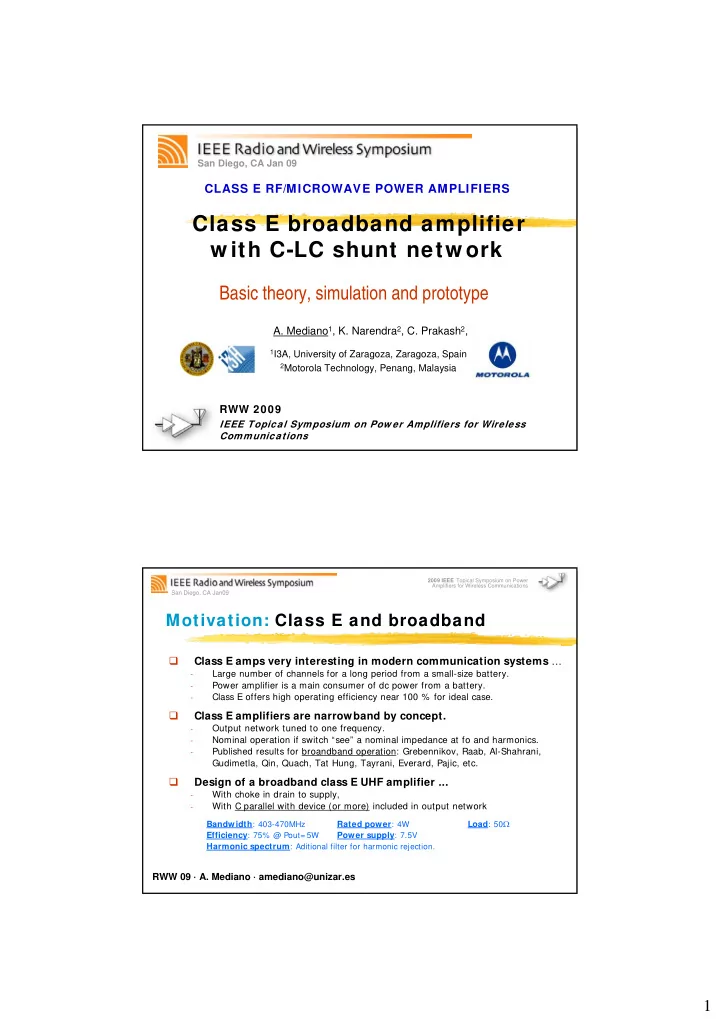
Class E broadband amplifier w ith C-LC shunt netw ork Basic theory, - - PDF document

class e broadband amplifier w ith c lc shunt netw ork
SMART_READER_LITE
LIVE PREVIEW

Class E broadband amplifier w ith C-LC shunt netw ork Basic theory, - - PDF document

San Diego, CA Jan 09 CLASS E RF/MICROWAVE POWER AMPLIFIERS Class E broadband amplifier w ith C-LC shunt netw ork Basic theory, simulation and prototype A. Mediano 1 , K. Narendra 2 , C. Prakash 2 , 1 I3A, University of Zaragoza, Zaragoza, Spain


slide-1
SLIDE 1

1

CLASS E RF/MICROWAVE POWER AMPLIFIERS

Class E broadband amplifier w ith C-LC shunt netw ork

Basic theory, simulation and prototype

1I3A, University of Zaragoza, Zaragoza, Spain 2Motorola Technology, Penang, Malaysia

RWW 2009

IEEE Topical Symposium on Pow er Amplifiers for Wireless Communications

  • A. Mediano1, K. Narendra2, C. Prakash2,

San Diego, CA Jan 09

2009 IEEE Topical Symposium on Power Amplifiers for Wireless Communications San Diego, CA Jan09

RWW 09 · A. Mediano · amediano@unizar.es

Motivation: Class E and broadband

  • Class E amps very interesting in modern communication systems …
  • Large number of channels for a long period from a small-size battery.
  • Power amplifier is a main consumer of dc power from a battery.
  • Class E offers high operating efficiency near 100 % for ideal case.
  • Class E amplifiers are narrowband by concept.
  • Output network tuned to one frequency.
  • Nominal operation if switch “see” a nominal impedance at fo and harmonics.
  • Published results for broandband operation: Grebennikov, Raab, Al-Shahrani,

Gudimetla, Qin, Quach, Tat Hung, Tayrani, Everard, Pajic, etc.

  • Design of a broadband class E UHF amplifier ...
  • With choke in drain to supply,
  • With C parallel with device (or more) included in output network

Bandwidth: 403-470MHz Rated power: 4W Load: 50Ω Efficiency: 75% @ Pout= 5W Power supply: 7.5V Harmonic spectrum: Aditional filter for harmonic rejection.

slide-2
SLIDE 2

2

2009 IEEE Topical Symposium on Power Amplifiers for Wireless Communications San Diego, CA Jan09

RWW 09 · A. Mediano · amediano@unizar.es

Class E: basics of the idea

Try a new output network designed to show almost ZLOAD for the complete broadband, 400-470MHz.

ZT

VDC Lchk Load network I DC vd ic iR iSW ∠ψ

ZLOAD XLOAD X= 0 @ fo X= ∝ @ nfo; n= 2,3,...

vR

RLOAD RLOAD + jXLOAD @ fo = INFINITE @ nfo; n= 2,3,...

∠ϕ Co

Nominal switching

Device Cout + Cext

2009 IEEE Topical Symposium on Power Amplifiers for Wireless Communications San Diego, CA Jan09

RWW 09 · A. Mediano · amediano@unizar.es

Broadband: output netw ork

Analysis was done with similar method as Raab’76.

Virtual load Choke!

To avoid DC short and/or to add new goals in design

To absorb too much Cout for Class E

resonant to center of band

ZB ZA

slide-3
SLIDE 3

3

2009 IEEE Topical Symposium on Power Amplifiers for Wireless Communications San Diego, CA Jan09

RWW 09 · A. Mediano · amediano@unizar.es

LBx ωx ψx , Cx , Cdx , Nratiox , ( ) 8.0 10-4 ωx2 Cx2 Nratiox 1. − ( ) 175. tan ψx ( ) 2 1 +

( )

1 2 Cx tan ψx ( ) + 175. tan ψx ( ) 2 1

+

( )

1 2 Cx Nratiox tan ψx ( ) +

+ ...

  • 98. Cdx Nratiox
  • 98. Cdx Nratiox tan ψx

( ) 2 + + ...

⎡ ⎢ ⎢ ⎢ ⎢ ⎢ ⎢ ⎣ ⎤ ⎥ ⎥ ⎥ ⎥ ⎥ ⎥ ⎦

:=

Broadband: equations for the design (1)

Analysis was done with similar method as Raab’76.

Considering: i) the ZLOAD to show to device at fo; ii) the angle of ZLOAD to show to device (49º ); iii) the slope of that angle = 0 for broadband design; iv) the resonant frequency of LB-CB must be fo and v) the CA value must be a low impedance versus LA impedance.

CBx ωx ψx , Cx , Cdx , Nratiox , ( )

  • 1250. Cx2

Nratiox 1. − 175. tan ψx ( ) 2 1 +

( )

1 2 Cx tan ψx ( ) + 175. tan ψx ( ) 2 1

+

( )

1 2 Cx Nratiox tan ψx ( ) +

+ ...

  • 98. Cdx Nratiox
  • 98. Cdx Nratiox tan ψx

( ) 2 + + ... :=

2009 IEEE Topical Symposium on Power Amplifiers for Wireless Communications San Diego, CA Jan09

RWW 09 · A. Mediano · amediano@unizar.es

Broadband: equations for the design (2)

Analysis was done with similar method as Raab’76.

LAx ωx ψx , Cx , Cdx , Nratiox , ( ) 7 Nratiox tan ψx ( ) 2 1 +

( )

1 2

ωx2

  • 25. tan ψx

( ) Nratiox Cx

  • 25. tan ψx

( ) Cx − + 7 Cdx Nratiox tan ψx ( ) 2 1 +

( )

1 2

  • 7. Cdx

tan ψx ( ) 2 1 +

( )

1 2

− + ...

⎡ ⎢ ⎢ ⎣ ⎤ ⎥ ⎥ ⎦

:= Rx ωx ψx

, Cx , Cdx , Nratiox , ( ) .28 tan ψx ( ) 2 1 +

( )

1 2

Cx ωx :=

CAx ωx ψx , Cx , Cdx , Nratiox , ( ) 2 10-2 Nratiox 2 10-2 −

( )

  • 49. Cdx tan ψx

( ) 2

  • 49. Cdx

+ + 175. tan ψx ( ) 2 1 +

( )

1 2 Cx tan ψx ( )

+ ... tan ψx ( ) 2 1. + :=

slide-4
SLIDE 4

4

2009 IEEE Topical Symposium on Power Amplifiers for Wireless Communications San Diego, CA Jan09

RWW 09 · A. Mediano · amediano@unizar.es

The design: using the equations …

Transistor RD07MVS1(Mitsubishi): Nominal Ron= 0.18R Cout= 60pF

Cx 15.5 pF ⋅ := fx 436.5 MHz ⋅ := ψx 49 deg ⋅ := 17.5 pF CB 7.6 nH LB 1.7 nH LA 781 pF CA 45 pF Cd

ωx 2 π ⋅ fx ⋅ := Cdx 45 pF ⋅ := Nratiox 10 :=

Cx 15.5 pF ⋅ := fx 436.5 MHz ⋅ := ψx 49 deg ⋅ := ωx 2 π ⋅ fx ⋅ := Cdx 45 pF ⋅ := Nratiox 10 := LBx ωx ψx , Cx , Cdx , Nratiox , ( ) 7.613 nH = CBx ωx ψx , Cx , Cdx , Nratiox , ( ) 17.462 pF = LAx ωx ψx , Cx , Cdx , Nratiox , ( ) 1.702 nH = Rx ωx ψx , Cx , Cdx , Nratiox , ( ) 10.04 Ω = CAx ωx ψx , Cx , Cdx , Nratiox , ( ) 781.007pF = ZLOAD fx Cx , ( ) 4.321 4.971j + Ω = ZLOAD fx Cx , ( ) 6.587 Ω =

From classical narrowband class E theory: Co = 16.8pF @ 403MHz, 15.5pF @ fo ; 14.4pF @ 470MHz Using equations:

2009 IEEE Topical Symposium on Power Amplifiers for Wireless Communications San Diego, CA Jan09

RWW 09 · A. Mediano · amediano@unizar.es

The design: output netw ork simulation

300 600 900 Frequency (MHz) 10 20 30 40 50

  • 100
  • 50

50 100

436.5 MHz 6.5726 436.52 MHz 49.108 Deg 453.44 MHz 6.6488 402.42 MHz 6.689 470.02 MHz 51.208 Deg 403.86 MHz 52.888 Deg |ZIN[1]| (L) Schematic 2 Ang(ZIN[1]) (R, Deg) Schematic 2

slide-5
SLIDE 5

5

2009 IEEE Topical Symposium on Power Amplifiers for Wireless Communications San Diego, CA Jan09

RWW 09 · A. Mediano · amediano@unizar.es

The design: block diagram

.

OUTPUT MATCH M2

Ro

LOAD NETWORK LN

Parallel capacitance of device (if bigger that optimum value for desired Pout, the excess will be included in LOAD NET). ZLOAD = RLOAD + jXLOAD = ZLOAD∠ψ

Ro

DRV INPUT MATCH M1

L1

CHOKE

Vdd

7.5V

M1

RL

50Ω

50Ω 50Ω

RF SOURCE BI AS

1) to show to device the nominal ZLOAD 2) to compensate the excess in Cdevice The matching network is a broadband

  • ne with low pass

topology to match the 50

  • hms load to the Ro

calculated value in previous stage. FUNCTI ON: To generate drive signal for the input

  • f our amplifier

FUNCTI ON: To match 50ohm to input impedance of device FUNCTI ON: To help M1 in the switching action FUNCTI ONS: FUNCTI ON: 2009 IEEE Topical Symposium on Power Amplifiers for Wireless Communications San Diego, CA Jan09

RWW 09 · A. Mediano · amediano@unizar.es

The design: matching driver

About the input matching network M1 ...

  • ZIN = 1Ω -j3Ω @ 430MHz [123pF]
  • Broadband
  • Lowpass response.
  • Maximum saturated gain in PA

DRV INPUT MATCH M1

M1

50Ω 50Ω 50Ω (1-j3) Ω Topology ...

L1 C1 L2 C2 L3 50ohms (1-j3) Ω

slide-6
SLIDE 6

6

2009 IEEE Topical Symposium on Power Amplifiers for Wireless Communications San Diego, CA Jan09

RWW 09 · A. Mediano · amediano@unizar.es

The design: output matching

Simple (low parts count) and ladder L topology for broadband.

Theoretical design ...

L1 C1 L2 C2 L3 50ohms Ro =6-10 Ω C3

2009 IEEE Topical Symposium on Power Amplifiers for Wireless Communications San Diego, CA Jan09

RWW 09 · A. Mediano · amediano@unizar.es

The design: simulation (time domain)

slide-7
SLIDE 7

7

2009 IEEE Topical Symposium on Power Amplifiers for Wireless Communications San Diego, CA Jan09

RWW 09 · A. Mediano · amediano@unizar.es

Prototype: the driver

Measurement with E7402A Agilent Spectrum Analyzer with tracking generator set to 0dBm, VDD= 7.1V (IDD= 490mA), VGG= 3V. A 30dB (5W) attenuator is used in the setup and corrections are included on screen. Arturo Mediano

Bias

2009 IEEE Topical Symposium on Power Amplifiers for Wireless Communications San Diego, CA Jan09

RWW 09 · A. Mediano · amediano@unizar.es

Prototype: the class E PCB

INPUT MATCHING OUTPUT MATCHING XTOR CHOKE OUTPUT NETWORK

slide-8
SLIDE 8

8

2009 IEEE Topical Symposium on Power Amplifiers for Wireless Communications San Diego, CA Jan09

RWW 09 · A. Mediano · amediano@unizar.es

Prototype: characterization setup

0-5W driver RFI N RFOUT CLASS E AMPLI FI ER To 50hm load through a 30dB att From RF generator BI RD Rfout sensor BI RD Rfin sensor

Arturo Mediano

2009 IEEE Topical Symposium on Power Amplifiers for Wireless Communications San Diego, CA Jan09

RWW 09 · A. Mediano · amediano@unizar.es

Prototype: measurements

75,4% 79,6% 81,8% 63,6% 47,9% 49,2% 4,44 3,70 3,46 4,05 3,39 1,66

0% 10% 20% 30% 40% 50% 60% 70% 80% 90% 350 370 400 430 470 500 Frequency (MHZ) Efficiency (%) 0,0 0,5 1,0 1,5 2,0 2,5 3,0 3,5 4,0 4,5 5,0 Output power (W)

Eff_drain (%) PAE (%) Pout (W)

slide-9
SLIDE 9

9

2009 IEEE Topical Symposium on Power Amplifiers for Wireless Communications San Diego, CA Jan09

RWW 09 · A. Mediano · amediano@unizar.es

Conclusions

Analytical expresions for a class E design with a C-LC output network for broadband, with choke in drain and excess in device

  • utput capacitance compensation-absortion were shown.

An UHF amplifier was designed, simulated and optimized with real

world components and prototype parasitics with good results.

A big transistor with excess in Cout was used for the design. A prototype has been built to work in broadband. Main problems were found in the model of transistor as a switch and the

  • utput inductance of device.

This exploration has lead to the conclusion that the C-LC series

  • utput branch in the Class E amplifier is an attractive solution for

radios where operation over a large number of channels for a long period and from a small size battery is typical.

2009 IEEE Topical Symposium on Power Amplifiers for Wireless Communications San Diego, CA Jan09

RWW 09 · A. Mediano · amediano@unizar.es

  • Dr. Arturo MEDIANO

a.mediano@ieee.org www.cartoontronics.com

Thanks for your attention...