
SLIDE 1
June 8, 2017
CLARINGTONS TRANSPORTATION HUBS June 8, 2017 The Courtice - - PowerPoint PPT Presentation
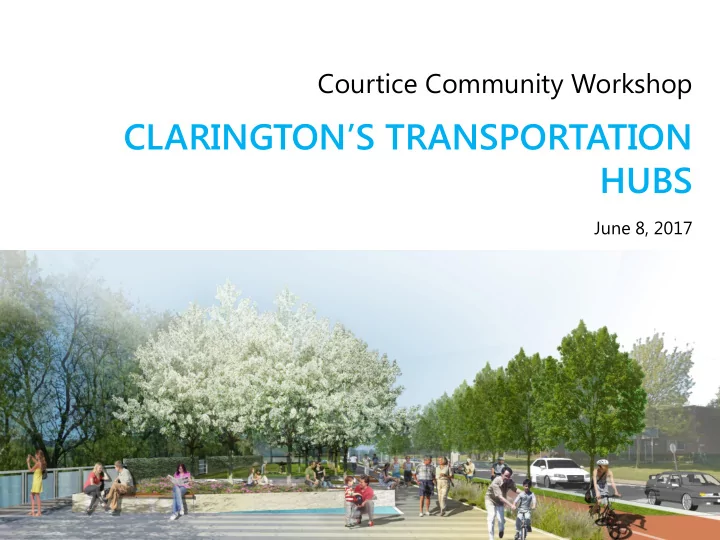
Courtice Community Workshop CLARINGTONS TRANSPORTATION HUBS June 8, 2017 The Courtice transportation hub will become an employment hub that attracts people with a diverse range of skills to live and work in Clarington. The hub will support a
June 8, 2017
The Courtice transportation hub will become an employment hub that attracts people with a diverse range of skills to live and work in
industrial to office employment. Quality of life for the people who live and work around Courtice station will be enhanced by shops and restaurants, vibrant public spaces, and active streetscapes that remain vibrant even after the work day ends.
STRENGTHS WEAKNESSES
1. Vehicular Connections to the GTA 2. Natural Features and Topography 3. Public Space 4. Established Employment Base 5. Vacant Land Area 6. Future Infrastructure 7. Highway 418 & Transitway Corridor 8. Ontario Power Generation 9. Barriers to the Waterfront
Development
Advantage
Multi-Modal Connections Natural Features Development Potential
OPPORTUNITIES
Courtice Rd Baseline Rd 401 Darlington Provincial Park GO Station Waterfront Open Space
COURTICE MOUNT PLEASANT MOBILITY HUB JAMES STREET NORTH MOBILITY HUB TAKOMA METRO STATION (WASHINGTON, DC)
CHARACTERISTICS Location:
– The station is clearly visible from the village’s central square – Clock tower articulates the presence of the GO Station, creating a distinct landmark
Built form:
– Built form is arranged in a radial pattern – Medium density buildings are located nearest the GO station and along major streets – Lower density buildings in the secondary zone
Open Space:
– The Mobility Hub connects to a green “spine” that provides access to a city park, woodlots, and renaturalized areas
Active Transportation:
– The close proximity of residential areas to the GO station provides easy pedestrian access to transit
CHARACTERISTICS Location:
– West Harbour GO Station located north west of the James Street North and Murray Street West intersection – Station plaza fronting onto James Street North – Access to the waterfront
Built form:
– Predominantly low-density built form – Low-rise residential uses – Two to four storey commercial, industrial, and employment buildings Open Space: – Significant park space at the northern portion of the mobility hub
Transportation:
– Two public buses – Pedestrian pathways and bicycle access on James Street and along and east of the Escarpment Rail Trail – Traditional street grid network for vehicular access
CHARACTERISTICS Location:
– Located on the Washington DC Metrorail, bordering Takoma DC and Takoma Park, MD – Vehicular access to Maryland and Washington DC along Piney Branch Road
Built form:
– Mixture of low to mid-rise built form – Surrounded by commercial and medium to high density residential in the primary zone – Low density residential in the secondary zone
Open Space:
– The station is located across the street from a small park and five blocks north of the Takoma Recreation Center
Transportation:
– The station area is serviced by multiple metropolitan area busses – Wide sidewalks are provided for pedestrian traffic