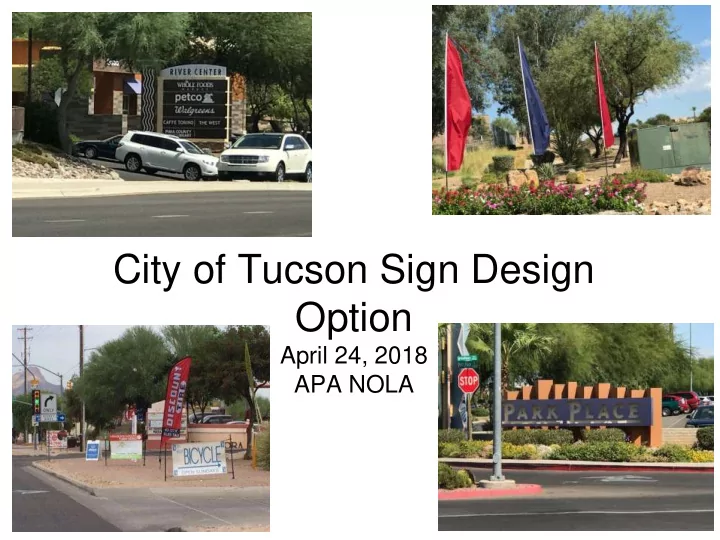
City of Tucson Sign Design Option April 24, 2018 APA NOLA Reed v. - - PowerPoint PPT Presentation
City of Tucson Sign Design Option April 24, 2018 APA NOLA Reed v. Town of Gilbert Analysis Gilbert s message-oriented sign The Town of Gilbert classified standards reflected below are the sign below as a temporary now unconstitutional. All
Reed v. Town of Gilbert Analysis
Gilbert’s message-oriented sign standards reflected below are now unconstitutional. All signs must be content-neutral. The Town of Gilbert classified the sign below as a temporary directional sign.
National Legal Analyst's Reed Reminders
- “Every sign carries some form of First
Amendment protection
- Government regulation of signs loses the normal
presumption of constitutionality and is subject to heightened scrutiny
- Sign litigation is common, expensive, and risky
- Most sign ordinances contain at least a few
provisions of questionable constitutionality, particularly following Reed.”
Typical Sign Legal Issues
- Content neutrality – The Reed issue use
time, place or manner sign types
- Arbitrary and Capricious challenges - For
vagueness
- Prior restraint challenges - For reducing
First Amendment rights by an overly long process to obtain a permit
Freedom of Speech and the Visual Environment
Freedom of speech is an existential right - election cycles exist – a
community’s visual environment defines its special character
The Sign Apocalypse is a state where through intent or oversight the sign standards allow an
- verwhelming amount of signage potentially causing proliferation and disorder to the degree
it cancels out the reason for having a sign code in the first place.
THE SIGN APOCALYPSE
Old Sign Code’s General Standards Results
Helter skelter look of signs – illegible on arterials, disorganized colored panels,
- versized structures, Good design needed a Board of Adjustment variance
Mayor and Council Direction August 9, 2016
- Initiate a Sign Code revision process
- Comply with the 2015 U.S. Supreme Court decision
- n Reed v. Town of Gilbert,
- Simplify the Sign Code by integrating it into the
Unified Development Code, and
- Make practical changes that modernize the Code,
improve the quality of design and flexibility of the
- verall code, and ground it in technical standards.
- Have the Citizens Sign Code Committee and the
Planning Commission hold joint study sessions and public hearings on the proposed changes to the Sign Code.
- Have staff return to the Mayor and Council with a
recommendation in 2017 or when Planning Commission/CSCC are ready.
A Strategy to Comply with Reed
- List technical standards in adopting ordinance
- Revise Purpose Statement – support freedom of speech,
reflect traffic safety, visual environment, and property rights
- Ensure there is a severability and substitution clause
- Review sign types for content neutrality and identify
signs by time, place or manner
- Create sign area allotment for portable signs and let
- wner allocate the messages
- Consider a future comprehensive sign policy in the
General Plan (Plan Tucson)
Changes Due to Reed
- Purpose Statement
- Substitution Clause for Non-commercial
Speech
- Design Option – Master
Permanent/Portable Sign Programs
- Four-Portable Sign General Standards
- Renaming and Deleting Sign Types to be
Content-Neutral
- Use Findings for Design Option with
technical standard references
Purpose Statement (Abbreviated)
- Accommodate freedom of speech
- Ensure signs contribute to a pleasing
visual environment
- Protect property values and minimize
adverse effects
- Facilitate traffic flow and public safety
- Respect Tucson’s amenities of scenic
views and dark night skies
- Recognize legitimate signing needs of
businesses
- Support retention of local business and
further economic development
Sign Design Option
- Master Sign Program
–Permanent Signs
- Master Sign Program-
Portable Signs
- Singular Sign Design
Sign Design Review Committee
- Composition – Architect, sign business rep, local business rep, (architect/landscape
architect/planner), general neighborhood association rep, ad hoc neighborhood association rep, Outdoor Lighting Committee rep, commercial real estate broker, (one) at-large member appointed by City Manager. Total 9
- Authority – Advises Planning Commission on text amendments and reviews Sign
Design Options
- Appointment and Term – City Manager
- Term – Four-year term, two terms, may return after one-year hiatus
- Vacancies - Filled in same manner as initial appointments
- Meetings – Quorum –five members Director may request Design Professional to
make recommendation if quorum not obtained. Pre-app meetings allowed, one continuance by committee,
- Removal - On request by City Manager
- Administrative Procedures – Executive Secretary is Zoning Administrator, and
committee shall elect chairperson. Notification per PDSD policy.
Design Process
- Completeness review - Pre-application
- Includes Design Standards and Findings review
- Advisory design review - Sign Design Review
Committee (SDRC)recommendation
- Decision by Director
- Appeal to Board of Adjustment and Mayor and Council
Master Sign Program Design Standards
- Sign’s component parts
- Integration with architecture
- Dark sky compatible illumination
- Siting of sign
- Building height profile of surroundings
- Legibility
- Uniformity in sign copy presentation
- Scenic view impact
- Proportionality
- Way finding/Identification
Findings
- Meets Purpose [A-F]
- Uses best practice of dark sky illumination [C]
- Integrates architecture with associated buildings
[B,D]
- Proportional size of signs with buildings [A,B]
- Improves legibility [A,B,F]
- Improves vehicle reaction time [F]
- Creates an organized way finding, identification,
messages [A,B]
- Protects scenic vistas [B]
- Reduces clutter along the affected streets while
enhancing street aesthetics [B,E]
Comparisons - The Home Depot
100sf 1,866 sf 622 sf
Dark Skies Illumination
Dark Skies Illumination Guidelines addresses concerns by astronomical community. Use the metric - NIT (cd/m2) is the key metric for an amount of emanating light equal to one candela per square meter. Kelvin and lumen are other metrics but less important for dark skies
Scenic America On- Premise Sign Handbook
Design Adapted from National Standards for Uniformity and Legibility on Arterial Streets
Park Mall - Tucson
Pima County
Portable Signs
- All zones may have portable signs
- Have a total sign area allotment per property
- Sign sizes are the same as State Statutes’ sizes for
political signs (16sf residential and 32sf commercial)
- No more than four signs per property (Arlington County
Republican Committee v. Arlington County VA)
- Real estate industry may use Master Portable Sign
Program to address special needs
- Political signs – Defer to State Statutes standards
Portable Master Sign Program
- Has Design Standards and Findings
- Applicant demonstrates a special signing need
- Applicant can be an organization (e.g. Southern
Arizona Home Builders Assn, Tucson Association of Realtors)
- Planning Department is working on conceptual
templates with the organizations
- Reviewed by SDRC decision by Director
Lessons Learned
- Don’t regulate if you don’t have to
- Address all the legal issues not just content-neutrality
- Two choices on regulating temporary signs - sign apocalypse or
a flexible option review.
- Real estate and political signs create a special sign need.
- Define temporary signs by materials (portable) versus
temporariness; it reduces need to create and monitor multiple temporary sign types.
- Four portable signs became the sweet spot between First
Amendment and community character.
- Real estate deals with tenants often override legibility concerns
- A design option with verifiable findings helps meet legal and
community character concerns at the same time.