
SLIDE 1
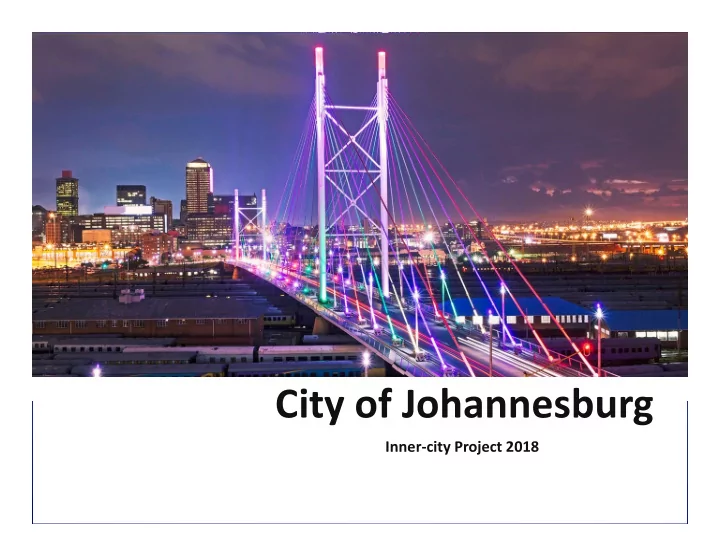
City of Johannesburg
Inner-city Project 2018 “Corridors of Freedom - Re-stitching our city to create a new future”
City of Johannesburg Inner-city Project 2018 Agenda Understanding - - PowerPoint PPT Presentation
Corridors of Freedom - Re-stitching our city to create a new future City of Johannesburg Inner-city Project 2018 Agenda Understanding our City 1 Funding Strategy 2 Financial Implications 3 Project Description 4 Potential Roles for
Inner-city Project 2018 “Corridors of Freedom - Re-stitching our city to create a new future”
2
1 2 3
Understanding our City Project Description Funding Strategy Financial Implications
4
Potential Roles for DFIs
5
Key Questions
6
(SDF 2030, approved September 2016) sets out the City’s development trajectory and area prioritisation.
Johannesburg’s spatial and social landscape: ▪ Spatial inequalities and the job-housing mismatch, ▪ Increasing pressure on the natural environment ▪ Urban sprawl and fragmentation, ▪ Exclusion and disconnection ▪ Inefficient residential densities and land use patterns
Four Stream Cash Demand(40% of Total Capex Investment) Current MTEF (Year 1- 3)
Roads & Stormwater R 5,794,121,998 Water & Sanitation R 4,590,381,848 Electricity R 15,603,336,839 Solid Waste R 563,000,000 40% Demand Per MTERF R 26,550,840,685 100% Capex Needed R 66,377,101,712 Currently Approved MTERF Budget R 26,730,371,000 Shortfall R 39,826,261,027
Water, Electricity and Waste
R26,7
5% Economic Growth Inner City Regeneration & Economic Projects PPP & Off Balance Sheet Funding Common Attainment of Joburg 2040 Vision and IDP On Balance Sheet Funding
7
year to R9,9 billion in the year under review.
4,000,000 6,000,000 8,000,000 10,000,000 12,000,000 2013 2014 2015 2016 2017 2018 (Adjust ed) 2019 (Foreca st) 2020 (Foreca st) Loan Funding 1,311,200 1,458,631 3,276,000 3,940,000 2,626,777 2,998,386 2,349,726 2,742,874 CRR & Surplus Cash 368,408 3,147,604 4,530,718 2,213,072 3,665,553 1,290,986 3,339,902 2,393,837 Grants and Contributions 2,868,251 3,094,028 3,021,231 3,170,485 3,613,240 3,084,698 3,761,103 3,821,815 Total 4,547,859 7,700,263 10,827,94 9,323,557 9,905,570 7,374,070 9,450,731 8,958,526
8
Liability Profile
Bonds DFI loans Banks Bonds 7 749 000 000.00 DFI loans 9 705 043 559.30 Banks 1 418 034 774.84 Total 18 872 078 334.14
borrowing 12.46%
2017/18 (Sinking Fund) Nedbank R1 billion COJ 04 R1,733 billion
20,000 30,000 40,000 50,000 60,000 70,000 80,000 90,000 2011 2012 2013 2014 2015 2016 2017 BILLION 2011 2012 2013 2014 2015 2016 2017 Total Assets 47,440 56,357 61,132 66,924 78,367 80,377 85,412
Total Assets
increase in cash and cash equivalents over the past years.
Programme / project description
10
for the City of Johannesburg (CoJ) in rolling out the Growth and Development Strategy 2040 in the inner city.
which is an outcomes-based approach that requires all departments involved in a particular issue to work together to resolve issues or roll out programmes.
management and partnership approach to guide municipal activity in transforming the inner city.
Through the Growth and Investment Stream… What we are resolving:
priority- focus of 5% economic growth)
precinct level
Development and SMME Support
precincts in Medium Term)
Inner City Eastern Gateway Park Station Precinct Westgate Inner City Capex Total 2017/2018 Total 2018 /2019 Total 2019/2020 Inner City - DP 115,000,000 160,000,000 160,000,000 Inner City - JDA 1,000,000 11,500,000 54,000,000 TOTAL 116,000,000 171,500,000 214,000,000
= R 501,500,000 MTEF
greater residential densities, parks, community facilities
Affordable Housing strategy for Inner City Renewal
Station funded from the Inner City Fund
Street Precinct)
Planning and Intelligence in place Ripe for Re-development and investment High Impact – Favorable Yields Market is ready Why?
PRIORITY 1: Strengthening the Core
(2014 – 2022);
development in the Inner City
market
PRIORITY 1: Strengthening the Core
accommodating an economically and demographically diverse resident profile in a well-integrated, liveable, high-density urban environment within easy reach of nearby job centres and social amenities.
completion stage.
PRIORITY 1: Strengthening the Core
facilitating ease of access by improving key pedestrian linkages
is at 55%
Precinct
completion of the Kazerne Inter-modal facility
Inner-city Transformation - Release of Bad Buildings in the Inner city
Is A Strategy To:
Inner-city Transformation - Proposed Implementing Structure
CITY MANAGER COO OR ED INNER CITY Performance management and evaluation: Cluster convener: Supported by ED CRUM, Inner City Office, Secretariat Role played by Group Governance Sustainable Growth and investment Sustainable urban management: Service delivery Sustainable Human Settlements Capital investment, strategic vision LEAD= Development Planning JDA Service delivery, Billing, Director Service delivery, Billing, Bylaw enforcement, Criminality, Municipal Courts LEAD = REGION F: Regional Director Bad buildings temp accommodation, social housing: Housing LEAD = JDA + JOSCHO WEEKLY: on FRIDAY MONTHLY EVERY 2 WEEKS INTER GOVERNMENT MENTAL RELATIONS National: Home Affairs, SAPS, Transportation, Customs and Estate Duty, SARS,Public works, National Treasury, NPA, HDA,SSA Province: Office
Liquor Board, Gamblling Board,Gautrans- taxi license, COGTA,Social Devt, Health, Dept of Education, SHRA SOEs:Telkom,Esk
Key Delivery Programmes Content and Champion Frequency of Meetings
Role of DFIs
19
Preparation
funding institution to fund social programmes
DFI’s?
Financing and Incentivising TOD in Dunkeld
TAX INCREMENTAL FINANCING
Item Cost City Power Substation Upgrade (Provisional from City Power)
R 150,000,000.00
88 kV Cables Upgrade (Provisional from City Power)
R 100,000,000.00
Roads
R 23,742,189.73
Sewer
R 297,570.24
Stormwater
R 6,148,537.62
Water
R 190,707.17
Total
R 280,379,004.20
financial debt ratio adopted by the City.
the Dunkeld neighbourhood is not budgeted to receive the infrastructure required to unlock density (based on other more pressing priorities).
experiencing an increase in demand.
desired spatial objectives; and
increasing density in high-demand area and thereby increasing property rates collected.
How can the city harness the market momentum in the area to finance the enabling infrastructure required for a low priority investment area? How can the city stimulate the creation of a mixed use neighbourhood; while having minimal (or no) impact on it’s balance sheet?
infrastructure investment
sales tax revenue paid (future gains), as a result of improvements in the TIF district, to help finance the project related costs (today) that will create the future gains.
being collected become the “baseline”
revenues, projected to be generated by the project, above the baseline, are deemed the “increment”.
the increment to service debt, issued on behalf of the project.
– Indicates development take-up, informs project phasing.
– Overall bulk infrastructure requirements and associated costs for the precinct.
– Treatment of the tool within the financial and legislative structure of the City.
– Ensure that proposed development yields do not compromise financial model but support and enhance the revenue generation to service the loan.
funding of “enabling” infrastructure
– Developer agreements; and – City to cede its right to usage of the incremental increase, and channel to SPV for repayment of debt obligation.
Development Planning.
likely to be partly on-balance sheet).
pilot other areas in the City).
29