Cit ity Wid ide PPG Foru rum 22 nd nd 22 May 2019 Welcome and - - PowerPoint PPT Presentation

cit ity wid ide ppg foru rum
SMART_READER_LITE
LIVE PREVIEW

Cit ity Wid ide PPG Foru rum 22 nd nd 22 May 2019 Welcome and - - PowerPoint PPT Presentation

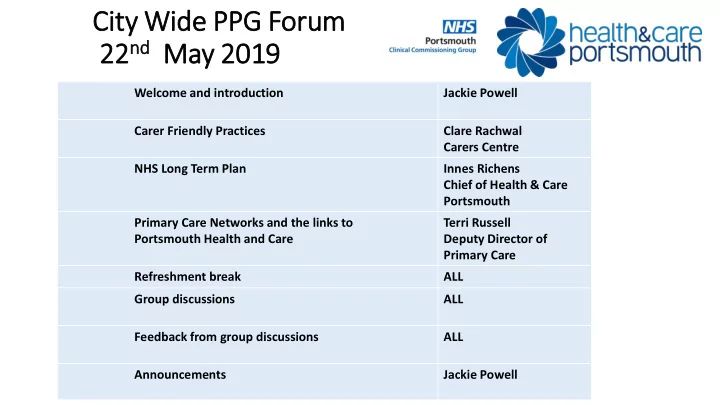
Cit ity Wid ide PPG Foru rum 22 nd nd 22 May 2019 Welcome and introduction Jackie Powell Carer Friendly Practices Clare Rachwal Carers Centre NHS Long Term Plan Innes Richens Chief of Health & Care Portsmouth Primary Care Networks


slide-1
SLIDE 1

Cit ity Wid ide PPG Foru rum 22 22nd

nd

May 2019

Welcome and introduction Jackie Powell Carer Friendly Practices Clare Rachwal Carers Centre NHS Long Term Plan Innes Richens Chief of Health & Care Portsmouth Primary Care Networks and the links to Portsmouth Health and Care Terri Russell Deputy Director of Primary Care Refreshment break ALL Group discussions ALL Feedback from group discussions ALL Announcements Jackie Powell

slide-2
SLIDE 2

Helping general practice become more carer-friendly: a framework of quality markers

  • Clare Rachwal – Team Manager, Carers Service
  • Adult Social Care
  • Clare.Rachwal@portsmouth.gov.uk
slide-3
SLIDE 3
  • Carers save health and social care an estimated £132 billion a year
  • GPs are often the first point of contact for carers
  • More than 90% of carers go unidentified by GPs
  • As a result carers can miss out on vital support including help for them to

maintain their own health and wellbeing

  • 72% of carers suffer mental ill health as a result of caring
  • 61% of carers suffer physical ill health as a result of caring
  • Carers attribute their health risk to a lack of support, with 64% citing a lack
  • f practical support
slide-4
SLIDE 4

“NHS England…will work with the Care Quality Commission on the development of quality standards for carer-friendly GP practices, and is developing a framework of questions (quality markers) that can be used by doctors' surgeries to demonstrate how effective they are in recognising and supporting carers” (p.10) "2.33. We will continue to identify and support carers, particularly those from vulnerable communities. Carers are twice as likely to suffer from poor health compared to the general population, primarily due to a lack of information and support, finance concerns, stress and social isolation. Quality marks for carer-friendly GP practices, developed with the Care Quality Commission (CQC), will help carers identify GP services that can accommodate their needs. "2.33. We will continue to identify and support carers, particularly those from vulnerable communities. Carers are twice as likely to suffer from poor health compared to the general population, primarily due to a lack of information and support, finance concerns, stress and social isolation. Quality marks for carer-friendly GP practices, developed with the Care Quality Commission (CQC), will help carers identify GP services that can accommodate their needs.

  • Social Care Green

Paper due…

  • NICE Adult Carers

Guidelines due 2020

slide-5
SLIDE 5

Quality Markers

  • Six questions that can be used by doctor’s surgeries

to demonstrate how effective they are in recognising and supporting carers

  • The questions ask the general practice to show how

they go about supporting carers for each of the six themes identified

  • Each question is supported by a number of practical

ideas that general practices can put into place to help them develop the support they give to carers

  • The general practice completes an annual

declaration as evidence of how it is supporting carers

  • This evidence can be used for CQC inspections
slide-6
SLIDE 6

Support available

  • The Carers Centre in an Adult Social Care Service providing

practical and emotional support to carers through a number

  • f services and initiatives
  • The young carers team within Children's Services support

children and young carers aged 5 up to 24

  • Referrals are accepted via phone, post, e-mail and online.

We can work with you set up direct referral processes

  • Carers can visit without appointment and request to see the

duty worker

For more information visit - https://www.portsmouth.gov.uk/ext/health-and- care/carers/portsmouth-carers-centre

slide-7
SLIDE 7

The NHS Long Term Plan

A Very Quick Overview

slide-8
SLIDE 8

NHS Long Term Plan

  • Smoking
  • Diet
  • High blood pressure
  • Obesity
  • Alcohol/drug use

Quality & Outcomes

  • Access standards for emergency mental health

from 2020

  • Maternity and neonatal
  • Children’s mental health
  • CQC emphasis on system-wide quality
  • Rapid Diagnostic Centres for cancer from 2019

Digital Care

  • Access to digital first primary care by 2022
  • Online consultations for secondary care within

5yrs

  • All trusts to digitise by 2024
  • ICSs to have Chief Clinical Information Officer

by 2021 New Service Models

  • Primary Care Networks
  • Social prescribing/ personal health budgets
  • Same day emergency care & discharge in all

hospitals

  • Clinical assessment service as single point of

access

  • Investment in CT and MRI diagnostics
  • Air pollution
  • Lack of exercise

Prevention

slide-9
SLIDE 9

Workforce

  • Regulation for NHS managers
  • NHS leadership code
  • More doctors encouraged to

train as generalists

  • Flexible rostering to be

mandatory

  • New entry routes:
  • apprenticeships, nursing associates,
  • nline qualification, ‘earn & learn’
  • £2.3m to support volunteers

Finance

  • 3.4% growth over 5yrs
  • Expectation of increased funding

going to primary, community and mental health

  • Worst performing trusts subject

to accelerated turnaround process

  • Finance Recovery Fund for

trusts with identifiable risks & plans

  • NHS expected to save £700m

from admin over 5yrs

  • £290m commissioners
  • £400m providers

Structure

  • Integrated Care Systems (ICS)
  • Integrated Care Providers (ICP)
  • Primary Care Networks (PCN)
  • Joint committees for NHS

England and NHS Improvement

Enabling the NHS Long Term Plan

slide-10
SLIDE 10

The LTP and Health & Care Portsmouth

  • Strong alignment, particularly in our focus on primary and

community (health) care:

  • Primary Care Alliance, clusters and Primary Care Networks
  • Co-located community health & social care teams
  • Integrated health & care delivery for: children, mental health,

intermediate care, learning disabilities, substance misuse

  • Single digital care record for primary, community and adult

social care

  • Long term conditions hub pilot
  • Connecting 111 and SCAS to single care record
  • NHS and Local Authority integrated commissioning
slide-11
SLIDE 11

Integrated Care Systems

  • ICSs to cover whole of England by April 2021
  • will ‘grow out of’ the current STPs
  • ICS brings commissioners and providers together to make shared decisions
  • n resource use, service design and population health
  • ‘Streamlined’ set of commissioning arrangements: ‘typically an ICS will involve

a single CCG for its area’

  • CCGs: ‘leaner, more strategic organisations that support providers to partner

with local government/community organisations for population health, service design and Plan implementation’

slide-12
SLIDE 12

Features of Integrated Care Systems

  • Partnership Board
  • Non Executive Chair
  • Arrangements to involve NEDs and Governing Bodies
  • Clinician & management capacity from partners
  • Primary care representation via Clinical Director of ‘each Primary Care Network’
  • CQC involvement
  • All providers to contribute to ICS performance goals (duty to collaborate)
  • Clinical leadership via alignment of clinical networks
slide-13
SLIDE 13

Working with Local Government

  • Integration with local government is throughout the LTP
  • ‘continue to support local approaches to blending health & social

care budgets where councils and CCGs agree this makes sense’

  • Four models highlighted
  • Pooling of budgets
  • Individual service user pooled budgets
  • NHS oversees defined Local Authority budgets
  • Local Authority Chief Executive Officer or Director of Adult Social Services is CCG

Accountable Officer

  • ‘ICSs and Health & Wellbeing Boards will also work closely

together’

slide-14
SLIDE 14

Social Care

  • LTP assumes the government commitment to ensure adult

social care funding is at a level that does not impose additional pressure on the NHS

  • Social care green paper ‘forthcoming’
slide-15
SLIDE 15

Integrated Care Providers

  • Community NHS services to be configured on the same basis as new

primary care network footprints

  • Multi-disciplinary teams to operate in same footprints
  • GPs, pharmacists, district nurses, community geriatricians, dementia workers, allied health professionals
  • Social care and voluntary sector should join these arrangements
  • New Integrated Care Provider contract available from spring 2019
  • which will allow for primary medical services integration with other services.
  • An ICP contract will be held by 'public statutory providers'
slide-16
SLIDE 16

Primary Care Networks (PCNs)

  • PCNs are ‘based on neighbouring GP practices that work together typically

covering 30-50,000 people’

  • GP contract changes will allow GP practices in a local area to enter into a

‘network contract’ which is an extension to their current contract

  • Funds will be designated to ‘flow’ through these new network contracts
  • CCG enhanced services contracts to be part of network contract
slide-17
SLIDE 17

What do Primary Care Networks do?

  • Ensure stronger links with local care homes
  • Assess local population by risk of unwarranted health outcomes and work

with local community services to address these

  • Work as part of an integrated care team to help people maintain their

independence

  • Have falls prevention schemes
  • Support carers, incentivised by the introduction of quality markers for best

practice in carer identification and support

  • Work alongside or as part of the Urgent Treatment Centre model that will be

rolled out by 2020

  • Contribute to continuing improvements in getting people home from hospital

without unnecessary delay (reducing Delayed Transfers of Care)

  • Have Link Workers to support delivery of social prescribing and connect

people to local groups and support services

  • Deliver a ‘digital first’ approach to increase access for patients to primary care

services, contracting with pre-selected range of digital suppliers to implement solutions

  • Be part of new Integrated Care Provider contractual arrangements, enabling

primary care networks to integrate primary care services with other services

  • Be a member of the ICS Partnership Board through a named accountable

Clinical Director for each primary care network

  • Work with local government and voluntary sector partners on the broader prevention

and health inequalities agenda

  • Improve early diagnosis of cancer for patients in their own neighbourhoods
  • Case find and treat people with high-risk health conditions
  • Better support people with heart failure and heart valve disease as part of local

community integrated care arrangements

  • Support the diagnosis of respiratory conditions
  • Include pharmacists who will undertake medications reviews for respiratory

conditions and educate patients on correct use of inhalers

  • Be part of an integrated primary and community mental health care offer for adults

and older adults with severe mental illnesses

  • Expand the number of physiotherapists working in primary care networks to

increase access for people with musculo-skeletal conditions

  • (Possibly) be part of offering guaranteed placements for a new online nursing

degree

  • Utilise their funding to expand the number of clinical pharmacists
  • Attract and fund additional staff to form part of the wider community integrated multi-

disciplinary team
slide-18
SLIDE 18

Possible Legislative Change*

  • CCGs and NHS providers to have reciprocal duties to deliver better health, better care and

improve sustainability

  • Lift restrictions on CCG/NHS England collaboration to allow NHSE to incorporate Public

Health Section 7A functions

  • Support ICSs to allow CCGs and NHS Trusts to make decisions jointly (eg NHS Foundation

Trusts able to create joint committees)

  • Support creation of NHS Integrated Care Provider trusts
  • Remove Competition and Markets Authority duties to intervene in NHS provider mergers
  • Increase NHS pricing regime flexibility, move away from tariff based approaches
  • Remove impediments for NHS England and NHS Improvement to work together and

streamline their functions

* When government gets time …

slide-19
SLIDE 19

Why Primary Care Networks?

  • Improving health and care outcomes – encouraging proper

communities of care and ensuring practices are at the heart of neighbourhood teams

  • Investment – Economies of scale and streamlining existing

structures and functions

  • Workforce – working at scale enables changes to skill mix and roles

that may not make sense or be viable for smaller practices

  • Workforce – working at scale enables changes to skill mix and roles

that may not make sense or be viable for smaller practices

slide-20
SLIDE 20

What will they do?

Employ new staff from the following groups to deliver 7 service specifications:

Paramedics, Physios, Social prescribing Link workers, Physicians Associates and Pharmacists

Medication reviews (2020/21) Enhanced Care in Care homes (2020/21) Clinical Pharmacists undertaking structured medication reviews - focus on priority groups e.g. frail elderly MDTs delivering proactive and reactive care to patients in care homes Early Cancer diagnosis (2020/21) Anticipatory Care (2020/21) GPs to use evidence based guidance to identify people at risk of cancer, recognise symptoms and make appropriate referrals Proactive and intense care for patients at high risk of unwarranted health

  • utcomes delivered by fully integrated primary and community care teams

CVD prevention and diagnosis (2021/22) Personalised Care (2020/21) Better prevention, diagnosis and management of patients with CVD, to include CVD prevention audit, testing alternative approaches to case finding etc Delivery of the Comprehensive Model of Personalised Care: shared decision- making, social prescribing, supported self management, personal health budgets etc Health Inequalities (2021/22) A specification designed to support implementation of good practice in relation to specific inequalities TBC

slide-21
SLIDE 21

What will they do?

  • Extended Access (evening and weekends)
  • QOF Quality Improvement Indicators (End of Life care and

Prescribing Safety)

  • Population Health Analytics
  • Savings plan / budget
  • Workforce planning
  • Health and Care Collaboration
  • Patient Engagement
slide-22
SLIDE 22

Portsmouth PCNs

North Portsmouth – Drayton & North

Harbour (28k)

Island City – Lake Rd, John Pounds,

Hanway & Derby Rd (47k)

Portsmouth South Coast –

Craneswater & Trafalgar (34k)

Brunel Health Network – Kirklands,

East Shore, Sunnyside, Devonshire, Southsea MC, Guildhall Walk & University practice (80k)

Portsdown Group Practice (44k)

slide-23
SLIDE 23

What happens next?

  • 2019/20 is a preparatory year
  • New staff groups e.g. Social prescribing link workers (and care

navigators in practices)

  • Change in extended access
  • Opportunities for PPG and wider community engagement
slide-24
SLIDE 24

In Groups think about….

  • What are the concerns regarding Primary Care Networks?
  • How could we mitigate any risks and/or what should we be

mindful of?

  • What are the opportunities around PCNs?
  • How can PPGs support? What would be your priorities?