
SLIDE 1
HALF YEAR RESULTS 2019
29 August 2019
Chesnara
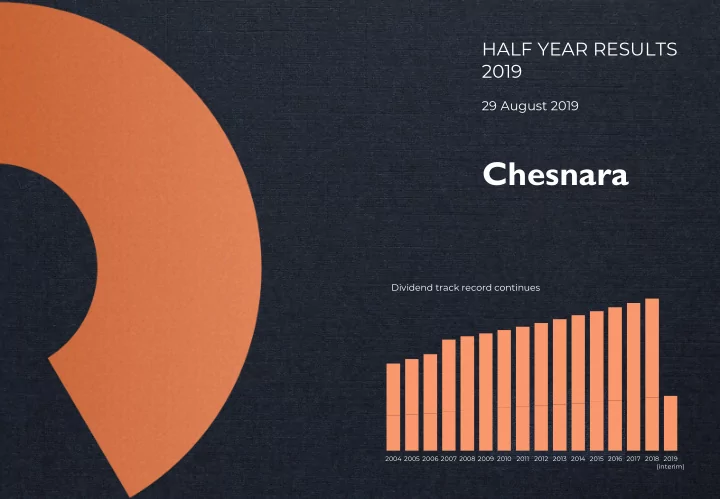
2004 2005 2006 2007 2008 2009 2010 2011 2012 2013 2014 2015 2016 2017 2018 2019 (interim)
Dividend track record continues
Chesnara Dividend track record continues 2004 2005 2006 2007 2008 - - PowerPoint PPT Presentation
HALF YEAR RESULTS 2019 29 August 2019 Chesnara Dividend track record continues 2004 2005 2006 2007 2008 2009 2010 2011 2012 2013 2014 2015 2016 2017 2018 2019 (interim) AGENDA OVERVIEW - John Deane, Chief Executive Strategic delivery
HALF YEAR RESULTS 2019
29 August 2019
2004 2005 2006 2007 2008 2009 2010 2011 2012 2013 2014 2015 2016 2017 2018 2019 (interim)
Dividend track record continues
OVERVIEW - John Deane, Chief Executive
– Strategic delivery – 2019 half year financial highlights – 2019 half year operational & strategic highlights
BUSINESS REVIEW - John Deane, Chief Executive
– UK – Sweden – Netherlands – Acquire life & pensions businesses
FINANCIAL REVIEW - David Rimmington, Group Finance Director
– Measuring our performance – IFRS pre-tax profit & IFRS total comprehensive income – Symmetric adjustment – Cash generation – Solvency II – Sensitivities – Value movement in 2019 – Value growth
CONCLUSION & OUTLOOK - John Deane, Chief Executive
– Future priorities
QUESTIONS APPENDICES
– Historical data - headline results – Historical data - dividend history
CHESNARA | 2019 HALF YEAR RESULTS PRESENTATION 1
AGENDA
2 CHESNARA | 2019 HALF YEAR RESULTS PRESENTATION
OVERVIEW
During the first half of 2019 we delivered good growth in Economic Value. The closing Economic Value of £645.1m is 3% higher than at the end of 2018, after payment of the 2018 final dividend of £20.2m, despite the negative impact of a weakening Swedish krona. Falls in interest rates, a recovering equity market and the impact, in Sweden and the UK, of the symmetric adjustment (see slide 17 for further details) , required under Solvency II rules, created generally adverse conditions for cash generation. However, our strong cash balance at group along with the half year performance supports the increase of our interim dividend.
3
MAXIMISE VALUE FROM EXISTING BUSINESS ACQUIRE LIFE AND PENSION BUSINESSES ENHANCE VALUE THROUGH NEW BUSINESS
Economic value earnings of £47.1m represent over 300% coverage of the historical annualised dividend. We have continued to see activity in our target markets. New business profits of £3.8m.
CHESNARA CULTURE AND VALUES
– We are well capitalised at both group and subsidiary level under SII, with group solvency of 155% – We continue to focus on delivering good customer outcomes – Continuing to apply the Chesnara governance and risk culture practices – Ongoing constructive relationships with UK, Swedish, Dutch and Luxembourg regulators Shareholder return: 3% interim dividend growth Interim dividend increased by 3% to 7.43p per share (2018: 7.21p interim and 13.46p final).
CHESNARA | 2019 HALF YEAR RESULTS PRESENTATION
OVERVIEW – STRATEGIC DELIVERY 01 02 03
4 CHESNARA | 2019 HALF YEAR RESULTS PRESENTATION
IFRS SOLVENCY
IFRS PRE-TAX PROFIT
£66.6M
GROUP SOLVENCY
155%
SIX MONTHS ENDED 30 JUNE 2018 £26.5M
Movement in the period largely arises within the Scildon business which has large IFRS profits due to asset movements which are not offset by reserves movements.
31 DECEMBER 2018 158%
We are well capitalised at both group and subsidiary level under Solvency II.
IFRS TOTAL COMPREHENSIVE INCOME
£51.0M
SIX MONTHS ENDED 30 JUNE 2018 £14.9M
The 2019 result includes a foreign exchange loss of £3.5m (2018: loss of £6.9m).
ECONOMIC VALUE CASH GENERATION
ECONOMIC VALUE
£645.1M
GROUP CASH GENERATION
£13.4M
31 DECEMBER 2018 £626.1M
Movement in the period is stated after dividend distributions of £20.2m and includes a foreign exchange loss of £7.9m.
SIX MONTHS ENDED 30 JUNE 2018 £48.6M
The 2019 result includes a cash strain of £13.1m from the “symmetric adjustment”
profits fund.
ECONOMIC VALUE EARNINGS
£47.1M
DIVISIONAL CASH GENERATION
£2.4M
SIX MONTHS ENDED 30 JUNE 2018 £13.6M SIX MONTHS ENDED 30 JUNE 2018 £53.1M
The impact of equity growth and interest rate reductions on Own Funds and SCR resulted in cash utilization in our European divisions while the UK business continued to deliver solid cash generation. In Sweden and the UK we saw a material negative symmetric adjustment impact broadly offsetting a corresponding gain in 2018.
OVERVIEW – 2019 HALF YEAR FINANCIAL HIGHLIGHTS
5 CHESNARA | 2019 HALF YEAR RESULTS PRESENTATION
DIVIDEND NEW BUSINESS PROFIT
INTERIM DIVIDEND INCREASE
2018 3%
Interim dividend increased by 3% to 7.43p per share (2018: 7.21p interim and 13.46p final).
3%
NEW BUSINESS PROFIT
SIX MONTHS ENDED 30 JUNE 2018 £5.3M
£3.8M
ECONOMIC BACKDROP
17 17 IFRS 17
EQUITY MARKET GROWTH, FALLING INTEREST RATES, WEAKENING SWEDISH KRONA
Rising equity markets and narrowing bond spreads since the turn of the year have supported significant investment returns and economic earnings. However, the economic conditions, including further downward pressure on interest rates, have been less beneficial for cash generation. A weakening
losses.
GROUP-WIDE IFRS 17 PROGRAMME IS PROGRESSING TO PLAN
Following completion of the impact assessment and implementation plan in 2018, considerable progress has been made on the application
OVERVIEW – 2019 HALF YEAR OPERATIONAL & STRATEGIC HIGHLIGHTS
6 CHESNARA | 2019 HALF YEAR RESULTS PRESENTATION
BUSINESS REVIEW
7
The UK has continued to progress its objectives in line with plans. The customer strategy implementation plan is nearly complete and the division remains focused on good governance of the
capital management initiatives and supporting the group in relation to any UK-based acquisitions.
MAXIMISE VALUE FROM EXISTING BUSINESS
INITIATIVES & PROGRESS IN 2019 FUTURE PRIORITIES KPIs CAPITAL AND VALUE MANAGEMENT
dividend strategy.
model used to deliver the investment management of
to deliver the investment management of
the cost base efficiently.
balance between value growth and surplus capital availability.
Underlying value growth
CUSTOMER OUTCOMES
completion.
successfully.
to have enhanced processes and procedures in place that continue to deliver fair customer outcomes.
we continue to treat our customers fairly.
implementation programme and embed into business as usual routines.
with their policies where we have lost contact.
Policyholder performance
GOVERNANCE
implementation.
critical business services has continued.
programme.
programme.
Solvency surplus and ratio CHESNARA | 2019 HALF YEAR RESULTS PRESENTATION
BUSINESS REVIEW ● UK
232.2 239.6 255.5 214.7 180.9 30.5 60.5 92.5 151.5 2015 2016 2017 2018 Jun-19 £m Reported Value Cumulative Dividends 29.1 47.0 130% 17.9 145% Dec-18 Surplus generation 30 Jun 19 surplus 3.8% 6.4% 3.9% 6.3% 2.4% 8.4% 3.5% 4.5%
12 months ended 30 Jun 2019 12 months ended 30 Jun 2018
CA Pension Managed CWA Balanced Managed Pension S&P Managed Pension Benchmark - ABI Mixed Inv 40%-85% shares
BUSINESS REVIEW ● UK
8
REGULATORY UPDATE: FURTHER INSIGHTS AND CHESNARA CONTEXT
ISSUE POSITION 29 MARCH 2019 POSITION 29 AUGUST 2019
BREXIT Other than the fact that BREXIT could impact the investment markets to which our results are sensitive, we consider that our operating model is relatively unaffected by BREXIT. We do not trade across borders nor do we share resource between our European businesses. Each division operates to autonomous local regulatory frameworks and we believe we have the flexibility to change our regulatory structure if BREXIT results in an inefficient regulatory structure of the organisation. The position remains unchanged and we maintain our
CUSTOMER COMMUNICATIONS We are on target with our project to developing our documentation and communications to meet the new forward looking standards set out in the final guidance issued by the FCA in November 2016. The programme remains on track. New requirements which differ from those required under the legacy review from the Retirements Outcomes Review are on target to be delivered by the regulatory deadline of 1 November 2019. Our customer tracing process has continued in order to ensure that we have the most up-to-date contact information for our customers and reunite them with their
delivered and on target to complete by the end of the year. Further phased enhancements to the CA website are complete.
CHESNARA | 2018 HALF YEAR RESULTS PRESENTATION
9
Movestic has continued to focus on delivering its strategic initiatives, including its front and back office IT streamlining plans. These are anticipated to bring cost efficiencies and improvements in broker and policyholder experience. From a financial perspective, Movestic has delivered growth in the period despite the headwinds arising from a very competitive market and the impact of updating processes to ensure compliance with changes in regulations.
MAXIMISE VALUE FROM EXISTING BUSINESS
INITIATIVES & PROGRESS IN 2019 FUTURE PRIORITIES KPIs CAPITAL AND VALUE MANAGEMENT
supported by positive net client cash flows.
and product enhancements required to ensure their proposition focuses on changing customer and broker needs and to generate the efficiencies required to address the challenge of reducing fees and ongoing regulatory change.
automating processes, with a view to improving both efficiency and control.
individualised customer proposition and experience.
dividend to Chesnara.
product proposition plans to reflect the fast changing market environment and consumer servicing preferences.
Growth in assets under management Economic Value
CUSTOMER OUTCOMES
2018: 3.5%).
full compliance with new regulations.
new funds, Avancera.
been delivered.
and tools to support the brokers’ value-enhancing customer proposition.
Broker assessment rating (0-5)
GOVERNANCE
software implemented.
distribution directive.
Solvency surplus and ratio CHESNARA | 2019 HALF YEAR RESULTS PRESENTATION
BUSINESS REVIEW ● SWEDEN
2.1 2.4 2.7 2.7 0.1 0.3 3.1
2015 2016 2017 2018 Net client cashflow Investment growth Jun-19
£bn 177.9 213.3 232.6 220.1 231.4 2.7 5.4 8.1
2015 2016 2017 2018 Jun-19
Cumulative Dividends Reported Value 3.7 3.8 3.7 3.8
2015 2016 2017 2018
85.2 83.6 174% (1.6 ) 161%
31 Dec 18 surplus Surplus generation 30 Jun 19 surplus
10
Movestic has had a positive 2019, with continued focus on writing new business within our target range creating value within the group.
ENHANCE VALUE THROUGH NEW BUSINESS
INITIATIVES & PROGRESS IN 2019 FUTURE PRIORITIES KPIs PROFITABLE NEW BUSINESS
and 10%.
the prior year, largely as a result of lower transfers in, coupled with pressure on investment fee rebates.
within our target range.
improve broker and customer experience.
Occupational pension market share % New business profit CHESNARA | 2019 HALF YEAR RESULTS PRESENTATION
BUSINESS REVIEW ● SWEDEN
8.3 7.6 6.6 2016 2017 2018 6.1 11.2 10.8 8.5 2.3 2015 2016 2017 2018 6 months to 30 Jun 2019 £m
11
2019 has seen dividends payments from both Scildon and Waard and key actions are being taken to strengthen the position of the Scildon new business operation whilst maintaining its market share. A small portfolio of policies has been acquired and will be transferred into Waard during the second half
movements with a significant IFRS profit and EcV earnings reported but reductions in Scildon solvency and cash generation.
MAXIMISE VALUE FROM EXISTING BUSINESS
INITIATIVES & PROGRESS IN 2019 FUTURE PRIORITIES KPIs CAPITAL AND VALUE MANAGEMENT
transferred into Waard upon completion.
cost base and supporting product alignment and strategic flexibility.
solvency ratios of 649% and 194%. Scildon remains well capitalised but has gone below its current internal management solvency target of 200%. Actions are being considered to increase this.
the two Dutch businesses.
continued dividends from both divisions.
which will strengthen future cash generation and value growth.
efficiency.
January 2021.
from a defined benefit to a defined contribution scheme.
Underlying value growth (Scildon)
CUSTOMER OUTCOMES
shows high scores.
processes, customer experiences and the underlying infrastructure.
development of our processes in conjunction with their requirements.
Client satisfaction rating (Scildon)
GOVERNANCE
through appointments to the Supervisory Boards and changes in the Scildon management structure.
environment and the governance and risk management framework.
plans.
Solvency surplus and ratio CHESNARA | 2019 HALF YEAR RESULTS PRESENTATION
BUSINESS REVIEW ● NETHERLANDS
7.5 7.4 7.6 7.7 2015 2016 2017 2018 243.4 226.0 223.0 170.6 172.2 37.6 37.6 59.9 65.1 2015 2016 2017 2018 Jun-19 £m Reported Value Cumulative Dividends 40.6 42.3 624% 1.7 649%
31 Dec 18 surplus Surplus generation 30 Jun 19 surplus
81.5 81.2 203% (0.3) 194%
31 Dec 18 surplus Surplus generation 30 Jun 19 surplus
Scildon Waard
12
Development of the Scildon new business offering is a focus of the improvement plan, the aim is to deliver meaningful value growth from a realistic market share.
ENHANCE VALUE THROUGH NEW BUSINESS
INITIATIVES & PROGRESS IN 2019 FUTURE PRIORITIES KPIs PROFITABLE NEW BUSINESS
compared to £0.6m in 2018.
2.4% compared to the 2018 year end.
the 5-10% target range but we have further work to do to strengthen the proposition and reduce costs.
costs and product mix, are ongoing in order to generate a more commercially meaningful level of new business profits.
Term assurance market share % New business profit CHESNARA | 2019 HALF YEAR RESULTS PRESENTATION
BUSINESS REVIEW ● NETHERLANDS
6.6 5.9 7.3 7.6 2015 2016 2017 2018 0.1 2.0 1.9 1.7 1.5 2015 2016 2017 2018 6 months to 30 Jun 2019 £m
13
Well considered and appropriately priced acquisitions maintain the effectiveness of the operating model, create a source of value enhancement and sustain the cash generation potential of the group.
HOW WE DELIVER OUR ACQUISITION STRATEGY
– Identify potential deals through an effective network of advisers and industry associates, utilising both group and divisional management expertise as appropriate. – We primarily focus on acquisitions in the UK and Netherlands, although consider other territories should the opportunity arise. – We assess deals applying well established criteria which consider the impact
scenarios. – We work cooperatively with regulators. – The financial benefits are viewed in the context of the impact the deal will have
– Transaction risk is minimised through stringent risk-based due diligence procedures and the senior management team’s acquisition experience and positive track record. – We fund deals with a combination of debt, equity or cash depending on the size and cash flows of each opportunity.
HOW WE ASSESS DEALS
Cash generation – Collectively our future acquisitions must be suitably cash generative to continue to fund the Chesnara dividend strategy. Value enhancement – Acquisitions are required to have a positive impact on the Economic Value per share under best estimate and certain more adverse scenarios. Customer outcomes – Acquisitions must ensure we protect, or ideally enhance, customer interests. Risk appetite – Acquisitions should normally align with the group’s documented risk appetite. If a deal is deemed to sit outside our risk appetite the financial returns must be suitably compelling
ACQUISITION OUTLOOK
– We have witnessed an increase in activity in the territories in which Chesnara currently operates and those that Chesnara doesn't exist. This increase has coincided with, what we perceive to be, a rise in seller’s valuations and prices paid for potential targets. – In the UK, we have seen a continued gradual increase in closed book market activity. – Regarding the Netherlands, we have also seen a gradual increase in market activity which we are well positioned to take advantage of. – We continue to assess opportunities within Western Europe that are outside of Chesnara’s current territories. – The environment in which European life insurance companies operate continues to increase in complexity. We believe this will potentially drive further consolidation. – Our financial foundations are strong and we have an established and stringent acquisition assessment model which is regularly reassessed.
BUSINESS REVIEW ● ACQUIRE LIFE & PENSION BUSINESSES
CHESNARA | 2019 HALF YEAR RESULTS PRESENTATION
!
14 CHESNARA | 2019 HALF YEAR RESULTS PRESENTATION
FINANCIAL REVIEW
15 CHESNARA | 2019 HALF YEAR RESULTS PRESENTATION
FINANCIAL REVIEW – MEASURING OUR PERFORMANCE Throughout the Half Year Report, we use measures to assess and report how well we have performed. The range of measures is broad and includes many measures that are not based on IFRS. The financial analysis of a life and pensions business also needs to recognise the importance of Solvency II figures, the basis of regulatory solvency. In addition the measures aim to assess performance from the perspective of all stakeholders. SOLVENCY ECONOMIC VALUE CASH GENERATION
Solvency is a fundamental financial measure which is of paramount importance to investors and policyholders. It represents the relationship between the value of the business as measured on a Solvency II basis and the capital the business is required to hold - the Solvency Capital Requirement (SCR). Solvency can be reported as an absolute surplus value or as a ratio. Solvency gives policyholders comfort regarding the security of their provider. This is also the case for investors together with giving them a sense of the level of potential surplus available to invest in the business or distribute as dividends (subject to other considerations and approvals). Economic Value (EcV) is deemed to be a more meaningful measure of the long term value of the group and it generally approximates to Embedded Value reporting, which was used before the introduction of SII. In essence, the IFRS balance sheet is not generally deemed to represent a fair commercial value of our business as it does not fully recognise the impact of future profit expectations of long term policies. EcV is derived from Solvency II Own Funds and recognises the impact of future profit expectations from existing business. Cash generation is a measure of how much distributable surplus has been generated in the period, which supports the ability of the group to pay its dividends. It is driven by the change in solvency surplus, taking into account board-approved capital management policies. .
FINANCIAL STATEMENTS ADDITIONAL METRICS
IFRS profits I Capital requirements R
Solvency capital requirement SCR plus management buffer
IFRS net assets Solvency II valuation (own funds) P R Solvency I B Percentage Absolute STAKEHOLDER FOCUS: Policyholders P Investors I Regulators R I Economic Value I Cash generation Business partners B B Balance sheet Earnings Group Divisional Key performance indicators
Headlines – Group IFRS pre-tax profit of £66.6m (HY 2018: £26.5m). – Operating profit of £23.4m (HY 2018: £27.3m) demonstrates the strength and stability of the underlying business. – Economic profit of £43.2m (HY 2018: loss of £0.8m). – TCI of £51.0m allowing for the forex loss of £3.5m (HY 2018: profit of £14.9m). Stable core (CA & Waard) – Stable underlying core earnings from Waard in line with expectations of the run-off book profile. – CA has reported strong results for the 2019 half year period, which are marginally behind the same period in 2018. Variable element (Scildon) – Scildon has delivered a strong result predominantly due to favourable market movements in the company’s bond portfolio. This arises from the fact that Scildon measures the majority of its insurance contract liabilities using historical rates of interest, as is customary in the Netherlands. This can lead to increased volatility in IFRS profits by virtue of the assets that back the liabilities being reported on a fair value basis. Growth business (Movestic) – Movestic continues to contribute positively to the overall group IFRS result and has out performed against the same period in
and reduced operating costs were the main drivers.
16 CHESNARA | 2019 HALF YEAR RESULTS PRESENTATION
Strong results in Scildon and the UK drive substantial profits for the period as a result of improved investment market
£23.4m have also been delivered in the period.
Group IFRS pre-tax profit (£m) Group IFRS pre-tax profit – split by division - £m
FINANCIAL REVIEW – IFRS PRE-TAX PROFIT & TOTAL COMPREHENSIVE INCOME
Analysis of IFRS TCI (£m)
Group costs and consolidation adjustments – This includes holding company expenses, foreign exchange movements on our euro denominated loan and consolidation adjustments.
51.6 26.5 66.6 30 Jun 17 30 Jun 18 30 Jun 19 27.3 23.4 (0.8) 43.2 (4.7) (12.3) (6.9) (3.5) 0.0 0.2 30 June 2019 30 June 2018 Operating Economic Tax Forex Other comp income 23.1 27.6 25.8 7.1 4.6 6.5 2.3 2.0 3.5 7.0 (2.8) 36.4 (8.6) (4.9) (5.6) 20.7 0.0 0.0
5 10 15 20 25 30 35 40 30 Jun 17 30 Jun 18 30 Jun 19 CA Movestic Waard Scildon Group & Consol adj Business combination
The group cash generation result of £13.4m includes a cash strain of £13.1m as a result of the symmetric adjustment impact.
17 CHESNARA | 2019 HALF YEAR RESULTS PRESENTATION
FINANCIAL REVIEW – SYMMETRIC ADJUSTMENT
What is the symmetric adjustment? The Solvency II capital requirement calculation includes an adjusting factor that reduces or increases the level of the equity capital required depending on historical market conditions. Following periods of market growth, the factor tends to increase the level of capital required and conversely, in falling markets the capital requirement becomes less onerous. The adjustment is applied to the equity stress base percentage each reporting period. The rationale for the adjustment is to reduce the impact in a downwards market and reflect that if equities have already suffered a material fall, then a further 1-in-200 year fall would be less than in the typical position. How might the SA impact results in the future The symmetric adjustment can create a swing in the SCR value each period up to an adjustment of +/- 10%. If you are one of the extremities of that range, then subsequent movement is more likely in one direction. For example if the adjustment is at +9%, the maximum swing in the adjustment is +1% or -19%. Who sets the symmetric adjustment? The adjustment is set by the European Insurance and Occupational Pensions Authority (EIOPA). The adjustment is provided each month and is calculated on a rolling three year basis. The adjustment tends towards zero in a period of normal equity market movements but as it is calculated using a rolling average, a period of minimal movement can still see a shift in the adjustment. This information is publicly available on the EIOPA website (https://eiopa.europa.eu/regulation- supervision/insurance/solvency-ii-technical-information/symmetric-adjustment-of-the-equity-capital-charge)
01/12/16,
01/03/17, 1.36% 01/06/17, 0.90% 01/09/17, 2.40% 01/12/17, 1.90% 01/03/18,
01/06/18,
01/09/18, 0.14% 01/12/18,
01/03/19,
01/06/19,
Symmetric adjustment SCR impact
+10%
+c£20m
(c£20m)
Symmetric adjustment per quarter 6 monthly movement
– The cash value includes the net non-recurring benefit of a £0.8m (2018 HY: £20.9m) capital extraction from the UK restricted with profit funds. Excluding this, underlying group cash generation for HY 2018 was £21.8m compared to £5.5m for HY 2019. – UK remains the primary source of divisional cash. – Waard continues to supply stable but modest cash. – Scildon has reported a loss of £7.4m as a result of an increased capital requirement. This is primarily due to economic factors, in particular spread risk capital, driven by rising bond values. This also includes an adverse impact of £8.3m due to increases in lapse risk capital. – Movestic reported cash utilisation of £8.0m with growth in
assets under management, and hence growth in future fee income, driven by rising equity markets. This growth was partially offset by a strengthening of assumptions relating to transfers and fund rebates. However, the asset growth has demanded a high level of capital to be held within the business. Alongside this, SEK depreciation against sterling resulted in an exchange loss
– Chesnara plc has £95.7m of cash and other highly liquid balances at 30 June 2019. Post dividend, Chesnara PLC will have c£84.6m of cash balances which is more than sufficient to fund the remaining 2019 debt repayments of £7.7m and to support potential acquisition activity.
Cash generation has been slightly muted compared to the same period in 2018. The main contributing factor is the capital requirement impact of the growth in equity markets*.
18 CHESNARA | 2019 HALF YEAR RESULTS PRESENTATION
FINANCIAL REVIEW – CASH GENERATION
Cash generation HY 2019*: Solvency II equity risk capital requirement rules include a concept called the symmetric adjustment, which requires proportionately more equity risk capital to be held in rising markets, which subsequently unwinds over time. It is estimated that the symmetric adjustment movement in the period has supressed cash generation by some £13.1m, and mainly impacted the UK and Swedish divisions.
16.2 (8.0) 1.7 (7.4) 11.1 15.6 Jun 2019 Cash generation Dividends*
Cash generation (£m)
Dividend payments Other group activities Netherlands - Scildon Netherlands - Waard Sweden UK
Total = 13.6
* Estimate of 50% of the full year dividend based on 2018 levels.
20 30 40 50 60 Cash generation (pre exceptional items) Exceptional item Total cash generation for the period 30 Jun 19 30 Jun 18
£m
0.0 10.0 20.0 30.0 40.0 50.0 60.0
Cash generation - historical profile (£m)
Dividends* Exceptional items Cash generation (underlying) 31 Dec 2018 30 Jun 2019 30 Jun 2018
GROUP SOLVENCY SURPLUS GENERATION GROUP SOLVENCY POSITION INSIGHT DIVISIONAL SOLVENCY
The below highlights key points in the year to date. Surplus: The solvency position of the group has reduced slightly from 158% to 155%. The group now has £170m
2018. Dividends: The closing solvency position is stated after deducting the £11.1m proposed interim dividend (31 December 2018: £20.2m). Own funds: Own funds have increased by £35.6m, before the impact of the interim dividend (£11.1m). This growth is driven by positive investment returns so far this year for Movestic and CA, particularly following significant gains in equity markets. In addition, £7.9m capital was transferred from the with-profits funds within the UK division. A decrease in spreads has also increased the value of Scildon’s bond holdings. SCR: The SCR has risen by £30.2m so far this year. The key movements underlying this are increases in equity risk capital due to the impact of positive equity returns, and unwinding of the symmetric adjustment, in the group’s unit linked funds.
19 CHESNARA | 2019 HALF YEAR RESULTS PRESENTATION
We are well capitalised at both a group and subsidiary level. We have applied the volatility adjustment in Scildon for the first time in this period, but have not used any other elements of the long term guarantee package. FINANCIAL REVIEW – SOLVENCY II
Jun 2019 Dec 2018 Business Post-Div Post-Div CA 145% 130% Movestic 161% 174% Waard 649% 624% Scildon 194% 203%
Own Funds (post Div) SCR Buffer Surplus 203.0 208.3 17.9 1.6 1.7 0.3 2.3 3.5 11.1 Group surplus 31 Dec 2018 CA Movestic Waard Scildon Chesnara / consol adj Exchange rates Dividends Group surplus 30 Jun 2019 £m Divisional movement - £17.7m 588 553 380 350 38 35 170 168 30 Jun 2019 31 Dec 2018 £m 158% 155%
Impacts ts
£0m to £15m £15m to £30m £30m to £50m £50m to £90m £90m to £140m KEY + ve
20 CHESNARA | 2019 HALF YEAR RESULTS PRESENTATION
The table provides some insight into the immediate and longer term impact of certain sensitivities that the group is exposed to, covering solvency, cash generation and economic value FINANCIAL REVIEW – SENSITIVITIES
Solv lvency s surp rplu lus Cash g h gene neration ECV Sensit itiv ivit ity s scenario io Immediate impact 5 year impact Immediate impact 20% Sterling appreciation 25% equity fall 25% equity rise 10% equity fall 10% equity rise 1% interest rate rise 50bps credit spread rise 25bps swap rate fall 10 % mass lapse 10% expense rise + 1% inflation rise 10% mortality increase
EcV tends to take the “full force” of adverse conditions whereas cash generation is often protected in the short term and to a certain extent in the longer term due to compensating impacts on our required capital. A material Sterling appreciation reduces the value of surplus in our overseas divisions, and hence has an immediate impact on group cash generation. It also reduces the value of projected Own Funds growth in our
investments in CA. The short term solvency is relatively insensitive to equity movements because the SCR tends to move to hedge the movement in own funds. The EcV impacts are more intuitive given the link between fund values and cash flows. An interest rate rise is generally positive across the group. CA, Movestic and Scildon all contribute significantly towards the total group cash generation project. There is only a small immediate impact on surplus as the reduction in own funds is negated by a reduction in SCR. However with fewer policies EcV is impacted as there is less potential for future profits. The expense sensitivity hits the solvency position immediately as the increase in future expenses and inflation is capitalised into the balance sheet. The sensitivity has an adverse impact on surplus and cash generation, particularly for Scildon due to their term products. BASIS OF PREPARATION ON REPORTING:
Although it is not a precise exercise, the general aim is that the sensitivities modelled are deemed to be broadly similar (with the exception that the 10% equity movements are naturally more likely to arise) in terms of likelihood. Whilst the sensitivities provide a useful guide, in practice, how our results react to changing conditions is complex and the exact level of impact can vary due to the interactions of events and the starting position.
6 5 3 1 2 7
5 4 3 1 2 6
4
7
21
The EcV earnings in the period of £47.1m comprises the following elements: EcV has increased from £626.1m at Dec 2018 to £645.1m at June 2019. The growth in EcV during the period includes the impact of the 2018 year end dividend payment of £20.2m and foreign exchange losses arising
Because Economic Value is derived from Solvency II, we expect EcV profits to align relatively closely to movements to Solvency II “Own Funds”.
What is Economic Value? – Own funds are deemed to underestimate the commercial value of Chesnara due to: – Contract boundaries – Excessive risk margin – Ring-fenced funds restrictions – We have therefore adjusted our SII valuations for these items to create “Economic Value” – Economic Value does not include any value for the companies capability to write new business or complete acquisitions in the future.
CHESNARA | 2019 HALF YEAR RESULTS PRESENTATION
The group’s EcV earnings of £47.1m in the period are largely driven by operating profits. Economic earnings have contributed more than in the prior period as a consequence of an upturn in market conditions since the start of the year, primarily equity market returns and the narrowing of bond spreads. FINANCIAL REVIEW – VALUE MOVEMENT IN 2019
626.1 645.1 47.1 ( 20.2 ) (7.9) 2018 Group EcV EcV earnings Dividends Forex Jun 2019 Group EcV
£m
Jun 2019 £m Jun 2018 £m Operating (loss)/earnings (17.8) 9.6 Material other operating items (9.5)
85.3 6.6 Other non operating variances (0.1) (0.3) Risk margin movement (3.0) (0.5) Tax (7.8) (1.8) EcV earnings 47.1 13.6
22
Value growth is achieved through a combination of efficient management of the existing policies, acquisitions and writing profitable new business. The growth includes c£148m of new equity since 2004 but is net of £318m of cumulative dividend payments.
FINANCIAL REVIEW – VALUE GROWTH
COMPANY HISTORY WHAT WE HAVE DONE
OUTCOME
2004
6
SUCCESSFUL ACQUISITIONS, INCLUDING LGN.
3
TERRITORIES Our deals demonstrate flexib ibilit ility and creati tivity ty where appropriate:
transformative deals
UK
solutions
to de-risk where required We are not willin lling t to compromis ise
lity, valu lue or ris
have:
value
requirements of generating medium term cash and enhancing long term value
diligence
terms of customer outcomes
income stock Chesnara is born. EEV of £126m.
2005
First acquisition. CWA adds £30m of EEV.
2009
Chesnara moves into Europe acquiring Movestic in Sweden. Group EEV now £263m.
2010
S&P acquired. Group AuM over £4bn.
2013
Direct Line’s life assurance acquired end
2015
Expansion into the Netherlands. Waard Group acquired.
2016
Building on our entry to the Dutch market, we announce the acquisition of LGN.
2017
Completion of Legal & General Nederland acquisition, renamed Scildon, at a 32% discount to its EcV of £202.5m.
CHESNARA | 2019 HALF YEAR RESULTS PRESENTATION
126 176 189 187 183 263 355 295 311 376 417 455 603 723 626 645 2004 2005 2006 2007 2008 2009 2010 2011 2012 2013 2014 2015 2016 2017 2018 HY 2019
Value Growth £m
23
CONCLUSION & OUTLOOK
CHESNARA | 2019 HALF YEAR RESULTS PRESENTATION
24 CHESNARA | 2019 HALF YEAR RESULTS PRESENTATION
CONCLUSION & OUTLOOK – FUTURE PRIORITIES MAXIMISE VALUE FROM EXISTING BUSINESS ACQUIRE LIFE AND PENSION BUSINESSES ENHANCE VALUE THROUGH NEW BUSINESS
capital management opportunities.
benefit our customers and shareholders.
changes resulting from the final guidance from the Legacy Review.
and the efficiency enhancements for Scildon.
Swedish business.
where appropriate.
target territories.
disciplines.
targets.
undertake portfolio as well as company transfers by reassurance
transfers of data from sellers systems is well understood in the market.
improvements to the business processes and products in the Netherlands.
marketing to reflect consumer and broker changing habits.
provide enhanced value to customers and brokers, in particular on transfer business in Sweden. CHESNARA CULTURE AND VALUES
01 02 03
Delivery on core strategic objectives drives shareholder value.
25
CHESNARA | 2019 HALF YEAR RESULTS PRESENTATION
26 CHESNARA | 2019 HALF YEAR RESULTS PRESENTATION
APPENDICES: HISTORICAL DATA - HEADLINE RESULTS
27 CHESNARA | 2019 HALF YEAR RESULTS PRESENTATION
Jun-19 Dec-18 Dec-17 Dec-16 Dec-15 Dec-14 Dec-13 Dec-12 IFRS profit £m (pre-tax and exceptionals) 66.6 27.0 89.6 40.7 42.8 28.8 57.8 24.5 EcV / EEV profit / (loss) £m (after tax and
exceptionals) 1
47.1 (60.9) 139.5 72.5 57.5 44.2 82.7 31.2 EcV / EEV Shareholder equity £m 1 645.1 626.1 723.1 602.6 453.4 417.2 376.4 311.1 Solvency II ratio (UK) 145% 130% 130% 128% 135% n/a n/a n/a Solvency II ratio (Sweden) 161% 174% 153% 140% 154% n/a n/a n/a Solvency II ratio (Netherlands - Waard) 649% 624% 483% 712% 597% n/a n/a n/a Solvency II ratio (Netherlands - Scildon) 194% 203% 231% n/a n/a n/a n/a n/a Solvency II ratio (Group) 2 155% 158% 146% 158% 146% n/a n/a n/a
1 From the 1st January 2016 we have moved from reporting on an embedded value basis to an economic value basis. 2 December 2016 Group solvency includes the impact of the capital raise and associated costs for the acquisition of LGN, removing this the ratio is 144%.
APPENDICES: HISTORICAL DATA - DIVIDEND HISTORY
28 CHESNARA | 2019 HALF YEAR RESULTS PRESENTATION
4.75 4.90 5.05 5.25 5.50 5.65 5.80 5.95 6.10 6.25 6.42 6.61 6.80 7.00 7.21 7.43 7.10 7.55 8.05 9.85 10.05 10.30 10.60 10.90 11.25 11.63 11.98 12.33 12.69 13.07 13.46
11.85 12.45 13.10 15.10 15.55 15.95 16.40 16.85 17.35 17.88 18.40 18.94 19.49 20.07 20.67 2004 2005 2006 2007 2008 2009 2010 2011 2012 2013 2014 2015 2016 2017 2018 2019 (interim)
Dividend History (pence per share)
Interim dividend (paid October) Final dividend (paid May of the following year)
Disclaimer
This presentation has been issued by Chesnara plc (“Chesnara” or the “Company”) and is being made
falling within Article 19 of the Financial Services and Markets Act 2000 (Financial Promotion) Order 2005 (the “FPO”); or (b) high net worth entities, and other persons to whom it may otherwise lawfully be communicated, falling within Article 49 of the FPO (all such persons together being referred to as “relevant persons”); or (c) any other person to whom this promotion may lawfully be directed. Any person who is not a relevant person should not act or rely on this presentation or any of its contents. This presentation is supplied for information only and may not be reproduced or redistributed. This presentation is not and should not be construed as an offer to sell or the solicitation of an offer to purchase or subscribe for any investment nor shall it form the basis of or be relied upon in connection with, or act as any inducement to enter into, any contract or commitment whatsoever. This presentation may contain forward-looking statements with respect to certain of the plans and current expectations relating to future financial condition, business performance and results of
relate to future events and circumstances that are beyond the control of Chesnara including, amongst
conditions, market-related risks such as fluctuations in interest rates, inflation, deflation, the impact of competition, changes in customer preferences, delays in implementing proposals, the timing, impact and other uncertainties of future acquisitions or other combinations within relevant industries, the policies and actions of regulatory authorities, the impact of tax or other legislation and other regulations in the jurisdictions in which Chesnara and its subsidiaries operate. As a result, Chesnara’s actual future condition, business performance and results may differ materially from the plans, goals and expectations expressed or implied in these forward-looking statements. Chesnara undertakes no obligation to update the forward-looking statements contained in this presentation or any other forward-looking statements the Company may make.
29 CHESNARA | 2019 HALF YEAR RESULTS PRESENTATION