Chemistry Lab Safety This material is made freely available at - - PDF document

chemistry lab safety
SMART_READER_LITE
LIVE PREVIEW

Chemistry Lab Safety This material is made freely available at - - PDF document

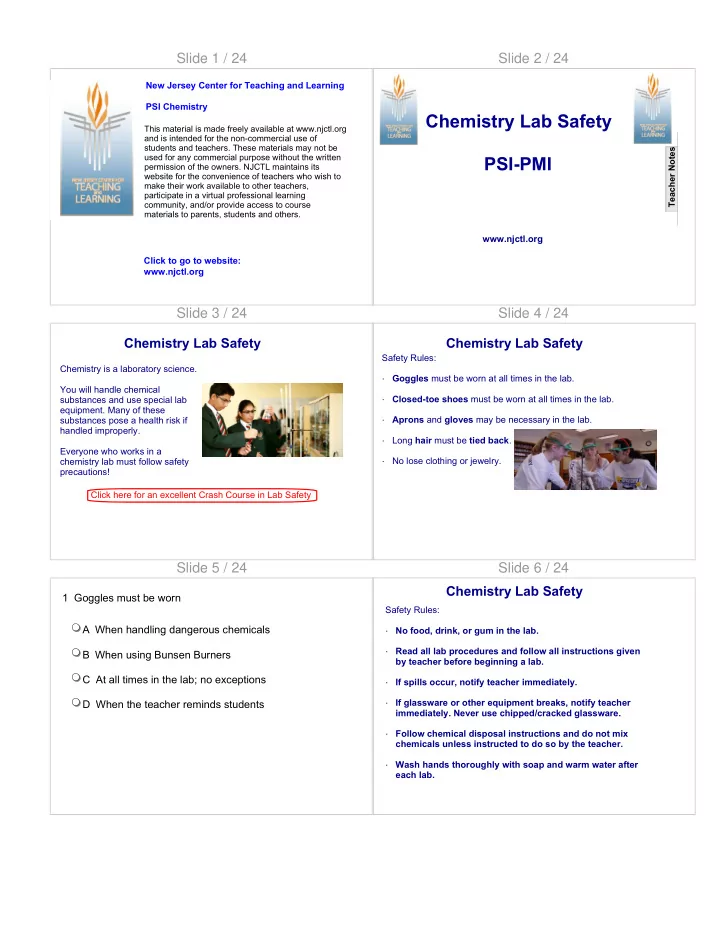
Slide 1 / 24 Slide 2 / 24 New Jersey Center for Teaching and Learning PSI Chemistry Chemistry Lab Safety This material is made freely available at www.njctl.org and is intended for the non-commercial use of students and teachers. These


slide-1
SLIDE 1

Slide 1 / 24

This material is made freely available at www.njctl.org and is intended for the non-commercial use of students and teachers. These materials may not be used for any commercial purpose without the written permission of the owners. NJCTL maintains its website for the convenience of teachers who wish to make their work available to other teachers, participate in a virtual professional learning community, and/or provide access to course materials to parents, students and others.

Click to go to website: www.njctl.org New Jersey Center for Teaching and Learning PSI Chemistry

Slide 2 / 24

Chemistry Lab Safety PSI-PMI

www.njctl.org Teacher Notes

Slide 3 / 24

Chemistry Lab Safety

Chemistry is a laboratory science. You will handle chemical substances and use special lab

  • equipment. Many of these

substances pose a health risk if handled improperly. Everyone who works in a chemistry lab must follow safety precautions! Click here for an excellent Crash Course in Lab Safety

Slide 4 / 24

Chemistry Lab Safety

Safety Rules: · Goggles must be worn at all times in the lab. · Closed-toe shoes must be worn at all times in the lab. · Aprons and gloves may be necessary in the lab. · Long hair must be tied back. · No lose clothing or jewelry.

Slide 5 / 24

1 Goggles must be worn A When handling dangerous chemicals B When using Bunsen Burners C At all times in the lab; no exceptions D When the teacher reminds students

Slide 6 / 24

Chemistry Lab Safety

Safety Rules: · No food, drink, or gum in the lab. · Read all lab procedures and follow all instructions given by teacher before beginning a lab. · If spills occur, notify teacher immediately. · If glassware or other equipment breaks, notify teacher

  • immediately. Never use chipped/cracked glassware.

· Follow chemical disposal instructions and do not mix chemicals unless instructed to do so by the teacher. · Wash hands thoroughly with soap and warm water after each lab.

slide-2
SLIDE 2

Slide 7 / 24

2 A student is measuring liquid in a graduated cylinder as instructed and cuts himself. The injury was most likely caused by A not following procedure B using cracked glassware C random chance D a dangerous chemical corroding the glass

Slide 8 / 24

3 Cleaning up a chemical spill yourself, rather than notifying the teacher, can result in A extra credit B possible chemical burns C contamination of clothing D both b and c

Slide 9 / 24

4 What is the last you thing you should do at the end of a lab? A Clean up all materials B Turn in lab questions C Wash your hands thoroughly with warm soap and water

Slide 10 / 24

Chemistry Lab Safety

Safety Procedures: · Read and understand directions and procedures before beginning the lab. · Review the chemical safety guidelines before handling

  • chemicals. You can find chemical information on MSDS sheets,

the chemical bottles, and in the lab procedure. · Keep lab area neat and organized. Clean up and wash all materials at the end of each lab. · Avoid contamination: > Unused chemicals should not be returned to a reagent bottle. > Never put a pipet, spatula, dropper, etc. directly into a reagent bottle.

Slide 11 / 24

Chemistry Lab Safety

Safety Procedures: · When heating a liquid, turn the container away from yourself and others. Use tongs to handle hot glassware. · When heating a flammable liquid, use a hot plate instead of an

  • pen flame.

· When diluting acids, always pour acids slowly into the water and stir to get rid of any generated heat. CAUTION: Water should never be poured into concentrated acid · To properly smell an odor from a chemical, waft it: Use your hand to wave vapors towards your nose. Do not inhale deeply. Do not put your nose near the chemicals.

Slide 12 / 24

5 A student uses a spatula to remove a chemical from a reagent bottle, then uses the same spatula to return a small amount of spilled chemical back into the reagent bottle. Is this correct protocol? A No, chemicals should never be returned to reagent bottles once removed because they could be contaminated. B Yes, the spatula only touched one type of chemical, so there is little risk of contamination.

slide-3
SLIDE 3

Slide 13 / 24

6 When diluting acids, always add A a little bit of water directly to the acid B a small amount of acid to a larger quantity of water C a base to neutralize the acid D ice to cool the reaction

Slide 14 / 24

Chemistry Lab Safety

Safety Equipment: Eyewash Station Location in Lab ____________ Fire Extinguishers Locations in Lab _______________ Emergency Shower Location in Lab ___________ Fire Blanket Location in Lab _________ First Aid Kit Location in Lab _______________

Slide 15 / 24

Chemistry Lab Safety

The eyewash station is used if chemicals contaminate the eye. Procedure: Engage water Hold eyelid open Flush for at least 15 minutes Rotate eyeball around while flushing

Slide 16 / 24

Chemistry Lab Safety

The safety shower is used if skin is exposed to hazardous chemicals. Procedure: Stand under shower and engage water Flush for at least 15 minutes Remove contaminated clothing if necessary

Slide 17 / 24

Chemistry Lab Safety

The fire extinguisher may be used if a fire breaks out in the lab. Notify the teacher immediately if a fire breaks out in the lab! Note, fire extinguishers will not put out all types of chemical fires. If a person catches on fire, do not use an extinguisher, use a fire blanket. Procedure: Hold extinguisher upright and pull the ring (safety) pin Stand back from the fire and aim at the base of the fire nearest you. Squeeze handles together and sweep the extinguisher stream side to side

Slide 18 / 24

Chemistry Lab Safety

The fire blanket is used to smother fires. If you catch on fire, STOP, DROP, and ROLL . Someone else should grab the fire blanket to put out the flames. Procedure: Remove the blanket from holder Wrap around victim or place over fire

slide-4
SLIDE 4

Slide 19 / 24

7 If your lab partner forgets to tie back her hair, and it catches on fire during lab, you should immediately A Notify the teacher and grab the fire blanket B Grab the fire extinguisher C Walk her to the safety shower D Throw water on her

Slide 20 / 24

8 If you accidentally touch hot glassware A Run to the safety shower B Pour a chemical on your skin to dull the pain C Continue working D Immediately rinse your hand under cold water and notify the teacher

Slide 21 / 24

9 If a large amount of chemical spills on your clothing A Run to the safety shower B Pour a chemical on your clothes to neutralize the spilled chemical C Continue working D Dab at the chemical with a wet paper towel

Slide 22 / 24

10 If a chemical splashes into your eye A Run to the safety shower B Rub your eyes gently and notify teacher C Immediately run to the eye wash station and begin flushing your eye for 15 minutes D Dab at the chemical with a wet paper towel

Slide 23 / 24

Chemistry Lab Safety

Follow all safety rules and procedures for a healthy and productive lab experience.

Slide 24 / 24