Presentation Outline I. Project Overview II. Industry & the - - PowerPoint PPT Presentation

presentation outline
SMART_READER_LITE
LIVE PREVIEW

Presentation Outline I. Project Overview II. Industry & the - - PowerPoint PPT Presentation

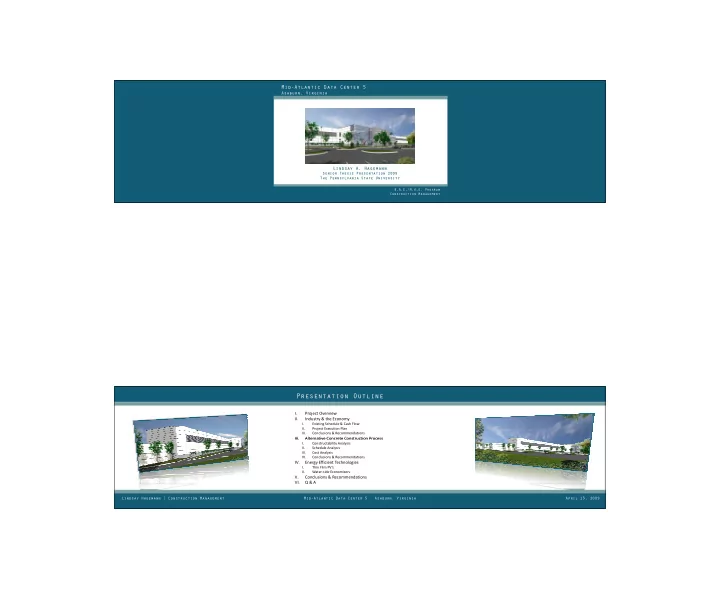
Mid-Atlantic Data Center 5 Ashburn, Virginia Linds Lindsay A Linds Lindsay A. . Hagema Hagema Hagemann Hagemann Senior Senior Thesis Presentat Thesis Presentation ion 2009 2009 The Pennsylvani The Pennsylvania a State University


slide-1
SLIDE 1

Mid-Atlantic Data Center 5

Ashburn, Virginia Linds Lindsay A Hagema Hagemann Linds Lindsay A. . Hagema Hagemann

Senior Senior Thesis Presentat Thesis Presentation ion 2009 2009 The Pennsylvani The Pennsylvania a State University State University

B.A.E./M.A.E. Program Construction Management

Presentation Outline

I. Project Overview II. Industry & the Economy

I. Existing Schedule & Cash Flow II. Project Execution Plan III. Conclusions & Recommendations

III Alternative Concrete Construction Process III. Alternative Concrete Construction Process

I. Constructability Analysis II. Schedule Analysis III. Cost Analysis IV C l i & R d ti IV. Conclusions & Recommendations

IV. Energy Efficient Technologies

I. Thin Film PV’s II. Water‐side Economizers

V. Conclusions & Recommendations VI. Q & A

Mid-Atlantic Data Center 5 Ashburn, Virginia Lindsay Hagemann | Construction Management April 13, 2009

slide-2
SLIDE 2

Project Overview Project Overview

Function: Data Center Si 360 000 SF T t l

Project Team

Owner

I. Project Overview II. Industry & the Economy

I Existing Schedule & Cash Flow Size: 360,000 SF Total 180,000 SF Raised Floor 23,000 SF Office Space Construction Manager I. Existing Schedule & Cash Flow II. Project Execution Plan III. Conclusions & Recommendations

III. Alternative Concrete Construction Process

Height: 2 Stories Redundancy: N+2 Construction: 2 Phases Construction Manager I. Constructability Analysis II. Schedule Analysis III. Cost Analysis IV. Conclusions & Recommendations Construction: 2 Phases Schedule: February 2008 – March 2009 Delivery Method: CM @ Risk w/ Cost + Fee Architect MEP Engineer Structural Engineer

IV. Energy Efficient Technologies

I. Thin Film PV’s II. Water‐side Economizers

V Conclusions & Recommendations V. Conclusions & Recommendations VI. Q & A

Mid-Atlantic Data Center 5 Ashburn, Virginia Lindsay Hagemann | Construction Management April 13, 2009

Project Overview Project Overview

Electrical System Mechanical System I. Project Overview II. Industry & the Economy

I Existing Schedule & Cash Flow *Equipment per phase (3) 14,400‐23,000 cfm AHU’s in Chiller Plant *Total System 34.5 kV Total Utility Power 59 6 MW Total Electrical Load I. Existing Schedule & Cash Flow II. Project Execution Plan III. Conclusions & Recommendations

III. Alternative Concrete Construction Process

(8) 1080 ton Chillers (8) 3240 gpm Cooling Towers (240) 18 000 cfm CRAH’s Units 59.6 MW Total Electrical Load *Equipment per phase (8) 600 V Pad Mounted Transformers w/ Integral VFI I. Constructability Analysis II. Schedule Analysis III. Cost Analysis IV. Conclusions & Recommendations (240) 18,000 cfm CRAH s Units (2) 50,000 gal Underground Diesel Storage Tanks (8) 600 V Pad‐Mounted Transformers w/ Integral VFI (16) 2500 kW Engine‐Generators (16) UPS Systems

IV. Energy Efficient Technologies

I. Thin Film PV’s II. Water‐side Economizers

V Conclusions & Recommendations V. Conclusions & Recommendations VI. Q & A

Mid-Atlantic Data Center 5 Ashburn, Virginia Lindsay Hagemann | Construction Management April 13, 2009

slide-3
SLIDE 3

Industry & the Economy Industry & the Economy

Goals

1 Evaluate:

Background

  • Owner views as one project, Project Seven, including 3 data centers
  • Northwest Data Center (NWDC) in Santa Clara CA

I. Project Overview II. Industry & the Economy

I Existing Schedule & Cash Flow

1. Evaluate:

  • Current economy and Project Seven status

h d l &

  • Northwest Data Center (NWDC) in Santa Clara, CA
  • Northeast Data Center (NEDC) in Piscataway, NJ
  • Mid‐Atlantic Data Center 5 (MADC5) in Ashburn, VA

I. Existing Schedule & Cash Flow II. Project Execution Plan III. Conclusions & Recommendations

III. Alternative Concrete Construction Process

Problem

1. Project Seven has been completely suspended.

  • NWDC

A t 2008

  • Project schedule & cost projections

2. Develop a project execution plan to successfully complete Project d

I. Constructability Analysis II. Schedule Analysis III. Cost Analysis IV. Conclusions & Recommendations

  • NWDC

August 2008

  • NEDC

October 2008

  • MADC5

November 2008 2 D P t F b i t i l l t l l d d t t d i t d

Seven in a down economy.

IV. Energy Efficient Technologies

I. Thin Film PV’s II. Water‐side Economizers

V Conclusions & Recommendations

2. DuPont Fabros maintains several completely leased data centers producing steady revenue.

V. Conclusions & Recommendations VI. Q & A

Mid-Atlantic Data Center 5 Ashburn, Virginia Lindsay Hagemann | Construction Management April 13, 2009

Industry & the Economy Industry & the Economy

Economy

September 2007: Economy slowly declines to a temporary halt.

Construction Industry

  • Trouble securing loans and allocating funds

I. Project Overview II. Industry & the Economy

I Existing Schedule & Cash Flow

January 2008: Begins another continual decrease. November 2008: Government finally declares a recession.

  • Operate on rolling‐over short‐term loans
  • Projects are suspended, shut down, postponed

I. Existing Schedule & Cash Flow II. Project Execution Plan III. Conclusions & Recommendations

III. Alternative Concrete Construction Process

Market Segment 2008 2009 Commercial/Industrial Hotels 5.1% ‐3.1% Office Buildings 1.7% ‐3.7% Industrial Facilities ‐3.8% 0.4% R t il 5 7% 3 6%

Causes:

  • 1. “Credit Crunch”

I. Constructability Analysis II. Schedule Analysis III. Cost Analysis IV. Conclusions & Recommendations

Retail ‐5.7% ‐3.6% Institutional Healthcare Facilities 5.6% 3.6% Education 5.5% ‐0.1% Public Safety 3.5% 0.4% Amusement/Recreation 1.4% ‐2.6%

  • 2. Federal Reserve response to a

tightening of available capital

IV. Energy Efficient Technologies

I. Thin Film PV’s II. Water‐side Economizers

V Conclusions & Recommendations

Religious ‐1.0% 4.0% Source: (DiLouie, 2008)

V. Conclusions & Recommendations VI. Q & A

Mid-Atlantic Data Center 5 Ashburn, Virginia Lindsay Hagemann | Construction Management April 13, 2009

slide-4
SLIDE 4

Industry & the Economy Industry & the Economy

Entering New Markets

Region Information

Simultaneous Projects

d l

I. Project Overview II. Industry & the Economy

I Existing Schedule & Cash Flow

Region Information Northern Virginia “If software center Seattle is the new economy's brain and chipmaking Silicon Valley is its heart, then Washington is its central nervous system. Spread along, around and mostly under the Dulles Toll Road, are the vital Ideal:

  • Growing company in a growing economy
  • Suitable locations

I. Existing Schedule & Cash Flow II. Project Execution Plan III. Conclusions & Recommendations

III. Alternative Concrete Construction Process

electronic pathways that carry more than half of all traffic on the Internet. The region is home to more telecom and satellite companies than any other place on earth. It's not a coincidence that Virginia license plates recently got a new slogan: THE INTERNET CAPITAL OF THE WORLD.”

  • Economic stability

Plan: Approximately $520 million within 20 months

I. Constructability Analysis II. Schedule Analysis III. Cost Analysis IV. Conclusions & Recommendations

Piscataway, NJ “Metro New York was prominent in the tech‐service category, with many of its workers in telecommunications, Internet services, R&D and testing labs, and computer training services.” Santa Clara, CA “Silicon Valley continues to maintain its status as one of the top research and

  • Mid‐Atlantic Data Center 5 (top)

360,000 SF

  • Northeast Data Center (middle)

366,000 SF

  • Northwest Data Center (bottom)

362,000 SF

IV. Energy Efficient Technologies

I. Thin Film PV’s II. Water‐side Economizers

V Conclusions & Recommendations

Sa ta C a a, C (Silicon Valley) S co a ey co ues o a a s s a us as o e o e op esea c a d development centers in the world. Thousands of high technology companies are headquartered in Silicon Valley.”

V. Conclusions & Recommendations VI. Q & A

Lindsay Hagemann | Construction Management Mid-Atlantic Data Center 5 Ashburn, Virginia April 13, 2009

Existing Schedule/Cash Flow Existing Schedule/Cash Flow

Original Plan I. Project Overview II. Industry & the Economy

I Existing Schedule & Cash Flow

Actual Plan

Project Seven Duration: 20 months Start: February 2008 Finish: September 2009 I. Existing Schedule & Cash Flow II. Project Execution Plan III. Conclusions & Recommendations

III. Alternative Concrete Construction Process

Project Start Suspended Finish

  • Orig. Duration

(months) Suspension (months) Total Duration (months) MADC5 Feb 2008 Aug 2008 July 09 15 3 18

Project Start Finish

  • Orig. Duration

(months) Overlap (months)

I. Constructability Analysis II. Schedule Analysis III. Cost Analysis IV. Conclusions & Recommendations

g y NEDC May 2008 Oct 2008 Mar 10 13 10 23 NWDC July 2008 Nov 2008 Apr 10 15 20 35 TOTAL Feb 2008 ‐ Apr 10 ‐ ‐ 40

(months) (months) MADC5 Feb 2008 Apr 2009 15 ‐ NEDC May 2008 May 2009 13 11 NWDC July 2008 Sept 2009 15 10

IV. Energy Efficient Technologies

I. Thin Film PV’s II. Water‐side Economizers

V Conclusions & Recommendations

After temporary suspensions and restarts, the project duration is 40 months. Start: February 2008 Finish: April 2010

Total Feb 2008 Sept 2009 20 ‐

V. Conclusions & Recommendations VI. Q & A

Finish: April 2010 Mid-Atlantic Data Center 5 Ashburn, Virginia Lindsay Hagemann | Construction Management April 13, 2009

slide-5
SLIDE 5

Existing Schedule/Cash Flow Existing Schedule/Cash Flow

First Suspension (NWDC): ‐$50.4 million

I. Project Overview II. Industry & the Economy

I Existing Schedule & Cash Flow

Original Plan Actual Plan

Second Suspension (NWDC): ‐$87.9 million Third Suspension (MADC5): ‐$92.5 million ‐$92.5 million deemed the “suspension value” – stay above to complete Project Seven

I. Existing Schedule & Cash Flow II. Project Execution Plan III. Conclusions & Recommendations

III. Alternative Concrete Construction Process

$(125 000 000) $(75,000,000) $(25,000,000) $25,000,000

December January February March April May June July August September October November December January February March April May June July August September October November December January February March April

$150,000,000 $200,000,000 $250,000,000

I. Constructability Analysis II. Schedule Analysis III. Cost Analysis IV. Conclusions & Recommendations

$(275,000,000) $(225,000,000) $(175,000,000) $(125,000,000) $(50 000 000) $‐ $50,000,000 $100,000,000

IV. Energy Efficient Technologies

I. Thin Film PV’s II. Water‐side Economizers

V Conclusions & Recommendations

$(325,000,000) ( ) Month 2007‐2010 DFT Cash Flow Suspension Point $(100,000,000) $(50,000,000) Month 2007‐2011 DFT Cash Flow Suspension Point

V. Conclusions & Recommendations VI. Q & A

Total Construction Cost = $520 million. May 2009 = ultimate low net income of ‐$298.9 million.

Mid-Atlantic Data Center 5 Ashburn, Virginia Lindsay Hagemann | Construction Management April 13, 2009

Project Execution Plan Project Execution Plan

1 Schedule:

Option 1 | Prolong Projects I. Project Overview II. Industry & the Economy

I Existing Schedule & Cash Flow

  • 1. Schedule:
  • Decrease in the amount of work performed each month
  • Lengthen the OPS significantly

Evaluate

I. Existing Schedule & Cash Flow II. Project Execution Plan III. Conclusions & Recommendations

III. Alternative Concrete Construction Process

  • 2. Cash Flow:

C i i i l l b GC’ d O&P

Evaluate

  • Owner’s construction expenditures
  • Construction schedule
  • Existing revenue

I. Constructability Analysis II. Schedule Analysis III. Cost Analysis IV. Conclusions & Recommendations

  • Cost increase in equipment rental, labor, GC’s, and O&P
  • Delay in receiving revenue from each project due to leased spaces.
  • Limits the amount of overlap between each project

g

Successful completion of Project Seven could occur :

  • 1. Prolong each project schedule.

2 M i t i d ti d j t ith fi i h t t t l ti hi

IV. Energy Efficient Technologies

I. Thin Film PV’s II. Water‐side Economizers

V Conclusions & Recommendations

  • OPS further delayed to remain above the suspension point
  • 2. Maintain durations and sequence projects with a finish‐to‐start relationship.
  • 3. Maintain durations with less of an overlap than the original plan.

V. Conclusions & Recommendations VI. Q & A

Mid-Atlantic Data Center 5 Ashburn, Virginia Lindsay Hagemann | Construction Management April 13, 2009

slide-6
SLIDE 6

Project Execution Plan Project Execution Plan

Option 2 | Maintain Durations w/ Sequential Projects

1 Schedule:

$200 000 000 $250,000,000 $300,000,000

I. Project Overview II. Industry & the Economy

I Existing Schedule & Cash Flow

  • 1. Schedule:
  • Projects constructed with finish‐start relationship
  • Lengthen the OPS significantly

$50,000,000 $100,000,000 $150,000,000 $200,000,000

I. Existing Schedule & Cash Flow II. Project Execution Plan III. Conclusions & Recommendations

III. Alternative Concrete Construction Process

Project Start Finish

  • Orig. Duration

(months) MADC5 F b 2008 A 2009 15

$(100,000,000) $(50,000,000) $‐ Month

I. Constructability Analysis II. Schedule Analysis III. Cost Analysis IV. Conclusions & Recommendations

  • 2. Cash Flow:

h fl l l MADC5 Feb 2008 Apr 2009 15 NEDC May 2009 May 2010 13 NWDC June 2009 Aug 2011 15 Total Feb 2008 Aug 2011 43

Month 2007‐2012 DFT Cash Flow Suspension Point

IV. Energy Efficient Technologies

I. Thin Film PV’s II. Water‐side Economizers

V Conclusions & Recommendations

  • Same cash flow as actual plan
  • Remains above suspension point
  • Delays potential revenue

Total Feb 2008 Aug 2011 43

V. Conclusions & Recommendations VI. Q & A

Mid-Atlantic Data Center 5 Ashburn, Virginia Lindsay Hagemann | Construction Management April 13, 2009

Project Execution Plan Project Execution Plan

Option 3 | Maintain Durations w/ Less Overlap

1 Schedule:

$100,000,000 $150,000,000

I. Project Overview II. Industry & the Economy

I Existing Schedule & Cash Flow

  • 1. Schedule:
  • Less extreme project overlaps – finish‐start
  • Original =

NEDC 11 month NWDC 10 month

  • New =

NEDC 5 month NWDC 2 month

$‐ $50,000,000

I. Existing Schedule & Cash Flow II. Project Execution Plan III. Conclusions & Recommendations

III. Alternative Concrete Construction Process

  • Shorter OPS by 6 months

P j t St t Fi i h O i D ti O l

$(100,000,000) $(50,000,000) Month 2007 2011

I. Constructability Analysis II. Schedule Analysis III. Cost Analysis IV. Conclusions & Recommendations

  • 2. Cash Flow:
  • No added costs or suspension

Project Start Finish

  • Orig. Duration

(months) Overlap (months) MADC5 Feb 2008 Apr 2009 15 ‐ NEDC Nov 2008 Nov 2009 13 5

2007‐2011 DFT Cash Flow Suspension Point

IV. Energy Efficient Technologies

I. Thin Film PV’s II. Water‐side Economizers

V Conclusions & Recommendations

p

  • Nears suspension at completion of NEDC and start‐up NWDC
  • Receive revenue earlier causing drastic increase in cash flow at the end
  • Able to start another project

NWDC Sept 2009 Nov 2010 15 2 Total Feb 2008 Nov 2010 34 ‐

V. Conclusions & Recommendations VI. Q & A

Mid-Atlantic Data Center 5 Ashburn, Virginia Lindsay Hagemann | Construction Management April 13, 2009

slide-7
SLIDE 7

Conclusions Recommendations

I. Project Overview II. Industry & the Economy

I Existing Schedule & Cash Flow

Option Start Finish

  • Orig. Duration

(months) Income at Nov 2010 Add’l Revenue A t l P j t D ti F b 2008 M 2011 40 $452 599 560 $0

Given the economic times, the possibility of successfully constructing all three projects is nonexistent. I. Existing Schedule & Cash Flow II. Project Execution Plan III. Conclusions & Recommendations

III. Alternative Concrete Construction Process

Actual Project Duration Feb 2008 May 2011 40 $452,599,560 $0

  • 1. Prolong Projects

Feb 2008 ? ? ‐ ‐

  • 2. Maintain Duration with

Sequential Projects Feb 2008 Aug 2011 43 $457,185,960 $4,586,400

  • 3. Maintain Durations with

Less Overlap Feb 2008 Nov 2010 34 $485,850,960 $33,251,400

$250,000,000 $350,000,000 Comparison of All Cash‐Flow Options

I. Constructability Analysis II. Schedule Analysis III. Cost Analysis IV. Conclusions & Recommendations

Less Overlap

$(50,000,000) $50,000,000 $150,000,000

*Maintain the schedule durations with less of an overlap*

  • 6 months shorter than actual schedule

IV. Energy Efficient Technologies

I. Thin Film PV’s II. Water‐side Economizers

V Conclusions & Recommendations

$(350,000,000) $(250,000,000) $(150,000,000)

Months 2007‐2012

  • 6 months shorter than actual schedule
  • Produces $33,251,400 of additional revenue

V. Conclusions & Recommendations VI. Q & A

Original Schedule Actual Schedule Option 2 Schedule Option 3 Schedule Suspension Point

  • Future development

Mid-Atlantic Data Center 5 Ashburn, Virginia Lindsay Hagemann | Construction Management April 13, 2009

  • Alt. Concrete Constr. Process
  • Alt. Concrete Constr. Process

I. Project Overview II. Industry & the Economy

I Existing Schedule & Cash Flow

Background

Concrete Utilization: Foundation Trenches Mech Rms & Computer Rms

Existing Concrete Process

Contractor On‐Site I. Existing Schedule & Cash Flow II. Project Execution Plan III. Conclusions & Recommendations

III. Alternative Concrete Construction Process

Foundation Trenches – Mech. Rms. & Computer Rms. Equipment Pits Raised Slab in Engine‐Generator Rms. Slab‐on‐Grade (SOG) Topping Slabs Computer Room Concrete Design

  • May 28, 2008‐Oct. 28, 2008

110 Days

  • Contract Value

$7.2 Million I. Constructability Analysis II. Schedule Analysis III. Cost Analysis IV. Conclusions & Recommendations Computer Room Concrete Design

  • 6” SOG
  • Trenches along walls adjacent to CRAH’s
  • Dimensions:

3’‐0” deep x (3’‐0” ‐ 7’‐0”) wide

IV. Energy Efficient Technologies

I. Thin Film PV’s II. Water‐side Economizers

V Conclusions & Recommendations

Mechanical Trenches:

  • Chilled Water Pipes sized 8”‐30” dia.
  • Connect CRAH’s and chillers
  • Leak containment

Goals V. Conclusions & Recommendations VI. Q & A

Leak containment

  • Create more space below raised floor
  • Metal channels to support pipes

1. Reduce concrete contractor time on‐site & contract value by removing trenches & replacing with a continuous slab 2. Reduce OPS & produce significant savings for the owner Mid-Atlantic Data Center 5 Ashburn, Virginia Lindsay Hagemann | Construction Management April 13, 2009

slide-8
SLIDE 8

Constructability Analysis Constructability Analysis

I. Project Overview II. Industry & the Economy

I Existing Schedule & Cash Flow

Underground Conduit Access Floor

Metal channels to bridge the piping Requirements Trenches No Trenches

I. Existing Schedule & Cash Flow II. Project Execution Plan III. Conclusions & Recommendations

III. Alternative Concrete Construction Process

Maximum Tile: 24”x24” Piping Diameter: 8”‐30” (+ insulation) piping

  • Less bridging required

Quicker/easier to install on a continuous surface Coordination

  • UG Electrical
  • UG Plumbing
  • Storm Lines
  • Sanitary Lines
  • None – SOG on top of

underground systems Excavation

  • Underground systems + Trench depth
  • Underground systems

I. Constructability Analysis II. Schedule Analysis III. Cost Analysis IV. Conclusions & Recommendations

Chilled Water Piping Precast UPS Pits

Less worries about falling and maneuvering Excavation Underground systems + Trench depth *Lines crossing trenches must be lower Underground systems

IV. Energy Efficient Technologies

I. Thin Film PV’s II. Water‐side Economizers

V Conclusions & Recommendations

Quicker & easier to install Install Options: No bridging required for new design

  • Rest on slab mounted tube steel

V. Conclusions & Recommendations VI. Q & A

Install Options: Pre‐coordination – Rough‐ins Post‐coordination – Core‐drill Leak containment only 6” as opposed to 3’‐4’ with trenches

  • Require flat/level slabs to prevent ponding

Mid-Atlantic Data Center 5 Ashburn, Virginia Lindsay Hagemann | Construction Management April 13, 2009

Schedule Analysis Schedule Analysis

I. Project Overview II. Industry & the Economy

I Existing Schedule & Cash Flow

Sequence Original Duration New Duration Computer Room 5/28/08 – 8/15/08 7/2/08 – 8/6/08

Alter sequences for a majority of the rooms I. Existing Schedule & Cash Flow II. Project Execution Plan III. Conclusions & Recommendations

III. Alternative Concrete Construction Process

p / / / / (50 days) / / / / (26 days) UPS Room 6/12/08 – 8/15/08 (47 days) 6/23/08 – 8/1/08 (30 days) M h i l R 2 8/1/08 8/22/08 8/1/08 8/14/08

Precast dictates the OPS

  • Original Schedule:

Sporadic concrete pours

  • New Schedule:

Continuous concrete pours I. Constructability Analysis II. Schedule Analysis III. Cost Analysis IV. Conclusions & Recommendations

Mechanical Room 2 8/1/08 – 8/22/08 (16 days) 8/1/08 – 8/14/08 (10 days)

  • Admin. Office Area

8/4/08 – 9/16/08 (32 days) 8/13/08 – 9/19/08 (28 days)

Allow larger duration between precast erection and concrete pour sequences

  • Eliminates the chance of pours catching up to precast

IV. Energy Efficient Technologies

I. Thin Film PV’s II. Water‐side Economizers

V Conclusions & Recommendations

Phase II SOG 9/11/08 – 2/10/09 (109 days) 9/18/08 – 12/2/08 (54 days) Topping Slab 6/4/08 – 10/14/08 (95 days) 8/14/08 – 10/14/08 (44 days)

Eliminates the chance of pours catching up to precast

  • Allows for smoother, continuous pour sequences
  • Crews constantly working and no wasted time between pours

Delay subcontractor start date to June 18 2008 vs May 28 2008

V. Conclusions & Recommendations VI. Q & A

(95 days) (44 days) Transformer Yard 10/17/08 – 10/28/08 (8 days) 8/28/08 – 9/8/08 (8 days)

Delay subcontractor start date to June 18, 2008 vs. May 28, 2008 Mid-Atlantic Data Center 5 Ashburn, Virginia Lindsay Hagemann | Construction Management April 13, 2009

slide-9
SLIDE 9

Schedule Analysis Schedule Analysis

I. Project Overview II. Industry & the Economy

I Existing Schedule & Cash Flow Concrete Contractor Savings 65 days

Other Affected Activities Results

Sealing Concrete

I. Existing Schedule & Cash Flow II. Project Execution Plan III. Conclusions & Recommendations

III. Alternative Concrete Construction Process

g y OPS Savings 15 days Discrepancy due to activates not on critical path & other trade sequences

Sealing Concrete SOGs sealed earlier Access Floor Install Time 5 days to 4 days

I. Constructability Analysis II. Schedule Analysis III. Cost Analysis IV. Conclusions & Recommendations trade sequences

  • Precast Concrete
  • Electrical Equipment
  • Power

5 days to 4 days CWP & Insulation Install Time Piping : 15 days to 10 days Insulation: 5 days to 3 days

IV. Energy Efficient Technologies

I. Thin Film PV’s II. Water‐side Economizers

V Conclusions & Recommendations

Precast and concrete dictate the ability to install the equipment

Insulation: 5 days to 3 days Medium Voltage 1 (MV) MV equipment installed earlier Level 3 commissioning

V. Conclusions & Recommendations VI. Q & A

All equipment must be in place before starting commissioning

  • Only go as fast as the last UPS room

Level 3 commissioning Set CRAH Stands/Units – earlier delivery

Mid-Atlantic Data Center 5 Ashburn, Virginia April 13, 2009 Lindsay Hagemann | Construction Management
Cost Analysis Cost Analysis

I. Project Overview II. Industry & the Economy

I Existing Schedule & Cash Flow

l

General Conditions Savings General Conditions Savings Construction Cost Construction Cost Comparison Comparison I. Existing Schedule & Cash Flow II. Project Execution Plan III. Conclusions & Recommendations

III. Alternative Concrete Construction Process

Company Total Cost Duration (wk) Unit Cost ($/wk) Savings (wk) Savings ($) Holder Construction

Construction Manager

$ 7,025,338 58 $ 121,000 3.0 $ 363,000 Dynalectric (Dyna) $ 1,756,335 58 $ 30,000 3.0 $ 90,000

Material Labor Equipment Total Original Process $ 5,488,661 $ 1,142,884 $ 325,848 $ 7,227,393 Alternative Process $ 5,140,523 $ 1,096,322 $ 316,720 $ 6,599,565 % Savings 6% 4% 3% 9%

I. Constructability Analysis II. Schedule Analysis III. Cost Analysis IV. Conclusions & Recommendations

Electrical Contractor

John J. Kirlin (JJK)

Mechanical Contractor

$ 1,756,335 58 $ 30,000 3.0 $ 90,000 TOTAL $ 543,000 HCC % Savings 3%

g

Savings = $627,828

  • Precast UPS equipment
  • Removing trenches

IV. Energy Efficient Technologies

I. Thin Film PV’s II. Water‐side Economizers

V Conclusions & Recommendations

HCC % Savings 3% Dyna % Savings 5% JJK % Savings 5%

*Dyna and JJK total GC value is approximately 25% of HCC's value (per HCC estimate)

  • Removing trenches

Other cost savings:

  • Overhead and profit,

V. Conclusions & Recommendations VI. Q & A

  • Personnel
  • Reduction in contractual fees.

Mid-Atlantic Data Center 5 Ashburn, Virginia Lindsay Hagemann | Construction Management April 13, 2009

slide-10
SLIDE 10

Conclusions/Recommendations

I. Project Overview II. Industry & the Economy

I Existing Schedule & Cash Flow Utilize Utilize a continuous a continuous slab design slab design in lieu of trenches. in lieu of trenches. I. Existing Schedule & Cash Flow II. Project Execution Plan III. Conclusions & Recommendations

III. Alternative Concrete Construction Process

Constructability

  • Less coordination efforts due to a simpler design and less material.

Schedule I. Constructability Analysis II. Schedule Analysis III. Cost Analysis IV. Conclusions & Recommendations Schedule

  • Concrete subcontractor onsite duration reduced 65 days
  • Reduced OPS by 15 days

IV. Energy Efficient Technologies

I. Thin Film PV’s II. Water‐side Economizers

V Conclusions & Recommendations

Cost This system saves the owner $1,170,828 in construction costs.

  • Concrete Contract Savings = $627,828
  • Project General Conditions Savings = $543,000

V. Conclusions & Recommendations VI. Q & A

Project General Conditions Savings $543,000 Mid-Atlantic Data Center 5 Ashburn, Virginia April 13, 2009 Lindsay Hagemann | Construction Management

Energy Efficient Technologies Energy Efficient Technologies

I. Project Overview II. Industry & the Economy

I Existing Schedule & Cash Flow

Background

Goals

1. Evaluate state‐of‐the‐art electrical & mechanical technologies: I. Existing Schedule & Cash Flow II. Project Execution Plan III. Conclusions & Recommendations

III. Alternative Concrete Construction Process

MADC5 will be certified LEED Gold Data centers still consume a great deal of energy and struggle with efficiency g

  • Thin‐Film Photovoltaic Systems for building lighting load
  • Water‐Side Economizers

I. Constructability Analysis II. Schedule Analysis III. Cost Analysis IV. Conclusions & Recommendations Data centers still consume a great deal of energy and struggle with efficiency issues. Escalating energy costs – harsher carbon emission policies 2. Implement systems that produce the following results:

  • Create a more energy efficient building

IV. Energy Efficient Technologies

I. Thin Film PV’s II. Water‐side Economizers

V Conclusions & Recommendations

Developers seeking to reduce energy costs and build “Green”

  • Reduce energy costs
  • Relatively quick payback period (less than 10 years)

V. Conclusions & Recommendations VI. Q & A

Mid-Atlantic Data Center 5 Ashburn, Virginia April 13, 2009 Lindsay Hagemann | Construction Management

slide-11
SLIDE 11

Thin-Film PV’s Thin-Film PV’s

I. Project Overview II. Industry & the Economy

I Existing Schedule & Cash Flow

Research Product Selection

CIGS (Copper‐Indium‐Gallium‐Selenium) I. Existing Schedule & Cash Flow II. Project Execution Plan III. Conclusions & Recommendations

III. Alternative Concrete Construction Process

( pp )

  • Semi‐conductor light absorbing material
  • Microstructure allows for cells to be a few micrometers thin

Most efficient solar technology available in the market Greater rooftop coverage I. Constructability Analysis II. Schedule Analysis III. Cost Analysis IV. Conclusions & Recommendations Most efficient solar technology available in the market

  • 19.5 % efficiency

More electricity per rooftop

Solyndra IV. Energy Efficient Technologies

I. Thin Film PV’s II. Water‐side Economizers

V Conclusions & Recommendations

Wind performance CIGS technology inside cylindrical PV panels Panel Dimensions: 6’ x 3.5’

V. Conclusions & Recommendations VI. Q & A

p

  • Negligible wind loads
  • Sustain 130 mph

(40) 1‐in. diameter cylinders per panel Mid-Atlantic Data Center 5 Ashburn, Virginia April 13, 2009 Lindsay Hagemann | Construction Management

Thin-Film PV’s Thin-Film PV’s

I. Project Overview II. Industry & the Economy

I Existing Schedule & Cash Flow

Design Analysis Design Analysis

1. Determine the maximum amount of panels that could fit onto the roof, 4. Determine the amount of inverters

DC Wires – Combiner Boxes to Inverters From Combiner To Inverter # of Arrays Cable Size Conduit Size AF01 1 10 300 2"

I. Existing Schedule & Cash Flow II. Project Execution Plan III. Conclusions & Recommendations

III. Alternative Concrete Construction Process

which includes a main roof and a second level mezzanine roof.

  • Main Roof = 236,000 SF
  • Panel Size = 6 ft x 3.5 ft = 21 SF
  • 11,000 panels

required for the system.

  • Typical:260kW inverter
  • For a factor of safety: 3

inverters

AF01 1 10 300 2" AF02 1 10 4/0 1‐1/2" AF03 1 10 3/0 1‐1/2" AF04 1 10 2/0 1‐1/4" AF05 1 10 1 1" AF06 1 10 2/0 1 1/4"

I. Constructability Analysis II. Schedule Analysis III. Cost Analysis IV. Conclusions & Recommendations

2. Determine the amount of panels in each array.

  • Connected in Series = 5 panels
  • Connected in Parallel = 3 strings

5. Determine the wire and conduit sizes of the conductors connecting the combiner boxes to the inverters.

AF06 1 10 2/0 1‐1/4" AF07 1 10 4/0 1‐1/2" BF01 2 10 300 2" BF02 2 10 250 2" BF03 2 10 4/0 1‐1/2" BF04 2 10 2/0 1 1/4"

IV. Energy Efficient Technologies

I. Thin Film PV’s II. Water‐side Economizers

V Conclusions & Recommendations

3. Determine the amount of panels required to power 508 kW building lighting load.

  • Requires 19 Arrays @ 27.3 kW/array

BF04 2 10 2/0 1‐1/4" BF05 2 10 1/0 1‐1/4" BF06 2 10 3/0 1‐1/2" BF07 2 10 4/0 1‐1/2" CF01 3 10 350 2" CF02 3 10 300 2"

V. Conclusions & Recommendations VI. Q & A

  • Array = 150 panels
  • 2850 Panels = 518.7 kW

CF02 3 10 300 2 CF03 3 10 4/0 1‐1/2" CF04 3 10 3/0 1‐1/2" CF05 3 10 2/0 1‐1/4"

Mid-Atlantic Data Center 5 Ashburn, Virginia April 13, 2009 Lindsay Hagemann | Construction Management

slide-12
SLIDE 12

Thin-Film PV’s Thin-Film PV’s

I. Project Overview II. Industry & the Economy

I Existing Schedule & Cash Flow

Constructability Analysis Schedule Analysis

Labor Rate for 5‐man Crew: 15 panels/hour Panel Weight: 70 lbs (3.3 lbs/ ft2 distributed load)

I. Existing Schedule & Cash Flow II. Project Execution Plan III. Conclusions & Recommendations

III. Alternative Concrete Construction Process

Number of Panels: 2,850 Installation Duration: 190 hrs = 24 Days Affected Activities: Mounting: Self‐ballasted No roof penetrations or anchoring 9” above roof membrane

I. Constructability Analysis II. Schedule Analysis III. Cost Analysis IV. Conclusions & Recommendations

Roof Completion

  • Sept. 12, 2008

Level 3 Commissioning start‐up

  • Dec. 1, 2008

Available Time Period: 2.5 months Wiring: Prewired for connection to each other #12 AWG between panels and combiner boxes

IV. Energy Efficient Technologies

I. Thin Film PV’s II. Water‐side Economizers

V Conclusions & Recommendations

Safety: Voltage is present when sunlight is present

V. Conclusions & Recommendations VI. Q & A

Mid-Atlantic Data Center 5 Ashburn, Virginia April 13, 2009 Lindsay Hagemann | Construction Management

Thin-Film PV’s Thin-Film PV’s

I. Project Overview II. Industry & the Economy

I Existing Schedule & Cash Flow

PV Avg. Power Output (kWh/yr) Electricity Cost ($/kWh) Total Savings Savings (lbs of CO2/yr) 687,796 0.068 $46,770 962,914

Cost Analysis

Description Cost System $3,316,700

I. Existing Schedule & Cash Flow II. Project Execution Plan III. Conclusions & Recommendations

III. Alternative Concrete Construction Process

Recommendation Funding Opportunities Business Energy Investment Tax Credit

  • 30% tax credit on solar energy systems

Panels (2,850) Wiring from Panels to Combiner Boxes Combiner Boxes Inverter Labor Monitoring System $22 900

I. Constructability Analysis II. Schedule Analysis III. Cost Analysis IV. Conclusions & Recommendations

Given the incentives, carbon taxes, escalated prices, and protecting the environment, it is recommended that the system is implemented.

gy y Local Option Property Tax Exemption for Solar

  • VA ‐ solar energy equipment can be exempt

from property taxes

Monitoring System $22,900 20‐yr Warranty for Inverter/System $62,000 Permitting $5,000 Electrical Installation (Conduit & Labor for Combiner Box to Grid) $320,400 TOTAL INSTALLATION COST $3,727,000

IV. Energy Efficient Technologies

I. Thin Film PV’s II. Water‐side Economizers

V Conclusions & Recommendations

from property taxes

TOTAL INSTALLATION COST $3,727,000 Installation Cost $/W $7.19 Incentives Business Energy Investment Tax (30%) $1,118,100 Local Option Property Tax Exemption for Solar $0.00

Description Electricity Cost ($/kWh) Total Savings Payback + Carbon Tax ($0.1082) Payback Current Cost 0.068 $46,770 55.8 yrs. $121,190 21.5 yrs. Escalated Energy Costs 0 10 $68 780 37 9 $143 200 18 2

V. Conclusions & Recommendations VI. Q & A

Post Incentive Installation Cost $2,608,900 Installation Cost $/W $5.03

Escalation Costs 0.10 $68,780 37.9 yrs. $143,200 18.2 yrs. 0.20 $137,560 19.0 yrs. $211,980 12.3 yrs. 0.30 $206,340 12.6 yrs. $280,760 9.3 yrs.

Mid-Atlantic Data Center 5 Ashburn, Virginia April 13, 2009 Lindsay Hagemann | Construction Management

slide-13
SLIDE 13

Water-Side Economizers Water-Side Economizers

I. Project Overview II. Industry & the Economy

I Existing Schedule & Cash Flow

Wet Bulb Temp. Cooling Load (tons) Cooling Efficiency (kWh/ton) Electricity Cost ($/kWh) Load Hours (h) Savings per Chiller Total Savings Savings (lbs of CO2/Plant) 24°F 840 0.5 0.068 803 $22,934 $183,472 4,704

Purpose

Allows cooling towers to produce chilled water when weather I. Existing Schedule & Cash Flow II. Project Execution Plan III. Conclusions & Recommendations

III. Alternative Concrete Construction Process

conditions permit. Bypass chillers if wet‐bulb temperature is below 24°F

How

I. Constructability Analysis II. Schedule Analysis III. Cost Analysis IV. Conclusions & Recommendations Pre‐cools the chilled water prior to flowing into the evaporator Heat transfer from the CHWR to the CW loop from the cooling tower. Lowers the temperature of the water entering the evaporator

Description Electricity Cost ($/kWh) Total Savings Payback + Carbon Tax ($0.1082) Payback Current Cost 0.068 $183,472 2.05 yrs. $475,400 9.5 mos. Escalated Energy Costs

IV. Energy Efficient Technologies

I. Thin Film PV’s II. Water‐side Economizers

V Conclusions & Recommendations

Lowers the temperature of the water entering the evaporator, reducing the chiller load and energy consumption. Ideal in temperate climates, i.e. Washington, D.C.

Escalated Energy Costs Escalation Costs 0.10 $269,808 1.39 yrs. $561,744 8.0 mos. 0.20 $539,616 8.4 mos. $831,552 5.4 mos. 0.30 $809,424 5.6 mos. $1,101,360 4.1 mos.

V. Conclusions & Recommendations VI. Q & A

Recommendation

Implement (8) water‐side economizers for Phase I construction.

No schedule impact Mid-Atlantic Data Center 5 Ashburn, Virginia April 13, 2009 Lindsay Hagemann | Construction Management

Conclusions Recommendations

I. Project Overview II. Industry & the Economy

I Existing Schedule & Cash Flow

Project Execution Plan

  • Maintain schedule durations with less overlap = No Suspension
  • Shorter construction schedule (6 months) & $ 33,251,400 additional revenue

I. Existing Schedule & Cash Flow II. Project Execution Plan III. Conclusions & Recommendations

III. Alternative Concrete Construction Process

Analysis Cost Savings Schedule Savings Additional Savings New Execution Plan* ‐ 6 mo. $33,251,400 Additional Revenue in 6 months Contin o s Slab Design* $1 170 828 0 5 mo 65 da s for the concrete s bcontractor

S o te co st uct o sc edu e (6

  • t s) & $ 33, 5 , 00 add t o a e e ue
  • Future development

Alternative Concrete Construction Process

  • Continuous slab system

I. Constructability Analysis II. Schedule Analysis III. Cost Analysis IV. Conclusions & Recommendations

Continuous Slab Design* $1,170,828 0.5 mo. 65 days for the concrete subcontractor Thin‐Film PV’s ($2,608,900) No effect $183,472 in electricity cost & 962,914 lb of CO2 saved annually Water side Economizers* ($376,000) No effect $46,770 in electricity cost & 4 704 lb of CO saved annually

  • Continuous slab system
  • Concrete contractor off‐site 65 days earlier & accelerates OPS 15 days
  • $1,170,828 Owner savings

IV. Energy Efficient Technologies

I. Thin Film PV’s II. Water‐side Economizers

V Conclusions & Recommendations

& 4,704 lb of CO2 saved annually * Savings ‐ 3 systems Total Savings $794,828 (‐1,814,072) 6.5 mos. 6.5 mos.

Thin-Film Photovoltaic System

  • Reduce electrical system grid dependency & energy consumption
  • 55.8 year payback

V. Conclusions & Recommendations VI. Q & A Water-Side Economizers

  • Reduce mechanical system energy consumption
  • 2 year payback

Mid-Atlantic Data Center 5 Ashburn, Virginia April 13, 2009 Lindsay Hagemann | Construction Management

slide-14
SLIDE 14

Questions? Acknowledgements

I. Project Overview II. Industry & the Economy

I Existing Schedule & Cash Flow

The Pennsylvania State University Donnally Vujcic Associates

  • Dr. Riley
  • Prof. Robert Holland

Hasmukh Patel

I. Existing Schedule & Cash Flow II. Project Execution Plan III. Conclusions & Recommendations

III. Alternative Concrete Construction Process

y

  • Dr. Messner
  • Prof. Kevin Parfitt

Ron Runnion Holder Construction Company CCG Integrated Facilities, Inc. Blake Edwards Mark Bacus John Hamburger

I. Constructability Analysis II. Schedule Analysis III. Cost Analysis IV. Conclusions & Recommendations

Paul Jorgensen Greg Smith Tommy Breard Aaron Martens Angel Holthus Mike Mckenna Jonathan Galvin Mark Maska Bryan Bramlett Tyler Antil Carlisle SynTec

IV. Energy Efficient Technologies

I. Thin Film PV’s II. Water‐side Economizers

V Conclusions & Recommendations

y y y Josh Thompson Jason Bell Chris Cope Jason Fleege TJ Thrasher Mike Meier DuPont Fabros Technology The Morin Company, LLC

V. Conclusions & Recommendations VI. Q & A

Scott Davis Joe Ambrogio Steve Wanishin Faran Kaplan

Mid-Atlantic Data Center 5 Ashburn, Virginia April 13, 2009 Lindsay Hagemann | Construction Management