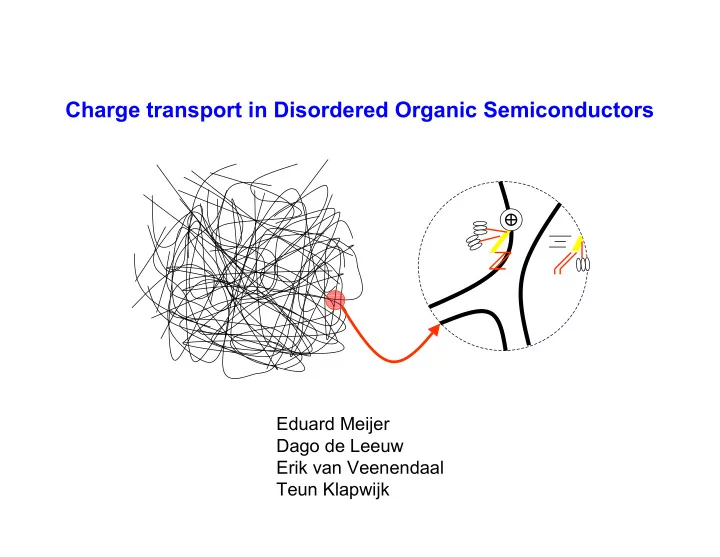
Charge transport in Disordered Organic Semiconductors Eduard Meijer - - PowerPoint PPT Presentation

charge transport in disordered organic semiconductors
SMART_READER_LITE
LIVE PREVIEW

Charge transport in Disordered Organic Semiconductors Eduard Meijer - - PowerPoint PPT Presentation

Charge transport in Disordered Organic Semiconductors Eduard Meijer Dago de Leeuw Erik van Veenendaal Teun Klapwijk Outline Introduction: Ordered vs. Disordered semiconductors The field-effect transistor Parameter Definition:


slide-1
SLIDE 1

Charge transport in Disordered Organic Semiconductors

Eduard Meijer Dago de Leeuw Erik van Veenendaal Teun Klapwijk

slide-2
SLIDE 2

Outline

  • Introduction:

Ordered vs. Disordered semiconductors The field-effect transistor

  • Parameter Definition:

Threshold voltage and Mobility

  • Modelling the temperature dependence
  • Temperature dependence of the field-effect mobility
  • Field dependence of the conductivity
  • Conclusions
slide-3
SLIDE 3

Conduction band Valence band Eg Electron energy Hole energy Simplified band diagram of a semiconductor Ordered system: conduction takes place in the extended states (CB&VB)

Introduction Ordered Semiconductor

slide-4
SLIDE 4

Introduction Disordered Semiconductor

  • Non equivalent sites
  • Variation in energy levels
slide-5
SLIDE 5
  • Localized states have a Gaussian distribution
  • Charge carriers hop between localized states

HOMO LUMO E DOS EF EF E DOS EF E DOS The tail of the Gaussian is approximated by an Exponential Introduction Disordered Semiconductor

  • H. Bässler, Phys. Stat. Sol. B, 175, 15 (1993).

M.C.J.M. Vissenberg and M. Matters, Phys. Rev. B. 57, 12964 (1998)

slide-6
SLIDE 6

Introduction Field-Effect Transistor

D S

Vds Vg

+

  • rganic semiconductor

+ +

  • What moves?
  • How (fast) does it move?

Basic questions:

slide-7
SLIDE 7

S n S C6H13 n

Poly(2,5-thienylene vinylene) (PTV) Poly(3-hexyl thiophene) (P3HT) Pentacene

Introduction Field-Effect Transistor

slide-8
SLIDE 8
  • 20
  • 15
  • 10
  • 5

2 4 6 8 Vg=-10 V Vg=-15 V Vg=-20 V x10-5 Ids [A] Vds [V]

  • P-type semiconductors
  • Charge carrier density

is varied with applied Vg.

  • Mobility ~ 10-3-10-1 cm2/Vs

Vds=-2 V Vds=-30 V pentacene

  • 35 -30 -25 -20 -15 -10 -5

5 10-11 10-10 10-9 10-8 10-7 10-6 10-5 10-4 10-3 Ids [A] Vg [V]

Introduction Field-Effect Transistor

slide-9
SLIDE 9

2 important characterization parameters:

  • Charge carrier mobility (steepness of the Ids-Vg-curve)
  • Threshold voltage (position of the curve)

Standard MOSFET modeling is often used for the parameter extraction: linear: saturation:

( )

2 ,

2

th g i FE sat d

V V C L W I − = µ

( )

th g i d FE lin d

V V C V L W I − = µ

,

Introduction Field-Effect Transistor

slide-10
SLIDE 10

But standard MOSFET analysis is not allowed, since:

  • These are accumulation devices (no inversion observed)
  • No extended state transport
  • Non-constant density of states

Threshold voltage can not be defined Mobility depends on the charge density Parameter definition

{

slide-11
SLIDE 11

Instead of the threshold voltage for accumulation FETs the flatband voltage is important#

#Appl. Phys. Lett. 80, 3838 (2002)

*Tanase et al. submitted.

2 4 6 8 10 10

16

10

17

10

18

10

19

10

20

Gate Semiconductor Source Drain x

Au Au

n

++Si

SiO2

ρ [cm

  • 3]

x [nm]

Vg=-10 V Vg=-19 V

Parameter definition Assumption that all induced carriers move with

  • ne mobility is still found to be reasonable*:

µFE= L WCiVds ∂Ids ∂Vg

slide-12
SLIDE 12

Modelling the temperature dependence We use a hopping model in an exponential density of states* (based on polyled modelling)

*M.C.J.M. Vissenberg and M. Matters, Phys. Rev. B. 57, 12964 (1998)

EF E DOS         = exp ) ( T k E T k N E g

B B t

slide-13
SLIDE 13

( )

( )

1 2 3 4

2 2 sin 2 2

              −                                     − =

T T s FB g i B s T T c s B s d ds

V V C T k B T T T T T k T T T Lq WV I ε ε α π ε σ ε

Conductivity prefactor Overlap parameter between localized sites Width of exponential distribution Flat-band voltage Modelling the temperature dependence 4 modelling parameters

slide-14
SLIDE 14

S

n

Modelling the temperature dependence PTV

slide-15
SLIDE 15

Modelling the temperature dependence Pentacene

slide-16
SLIDE 16

S C6H13

n

Modelling the temperature dependence P3HT

slide-17
SLIDE 17

But what do these parameters mean? → Look at the temperature dependence in a different way Modelling the temperature dependence T0 [K] σ0[106S/m] α-1 [Å] VFB [V] PTV 382 5.6 1.5 1 Pentacene 385 3.5 3.1 1 P3HT 425 1.6 1.6 2.5

slide-18
SLIDE 18

Typically observed:

  • Thermally activated behaviour
  • Ea depends on the amount of induced charge (Vg)

2 4 6 8 10 12 14 10

  • 8

10

  • 7

10

  • 6

10

  • 5

10

  • 4

10

  • 3

10

  • 2

10

  • 1

10 10

1

10

2

µFE [cm

2/Vs]

Vg=-25 V Vg=-20 V Vg=-15 V Vg=-10 V Vg=-5 V

1000/T [K

  • 1]

T0*=EMN/kB

µ0

Ea

Temperature dependence of the field-effect mobility

  • Appl. Phys. Lett. 76, 3433 (2000)
slide-19
SLIDE 19

ln(µ0) ~ Ea → Meyer-Neldel Rule*.

*W. Meyer and H. Neldel, Z. Tech. Phys. 18, 588 (1937).

0.0 0.1 0.2 0.3 0.1 1 10 100 prefactor µ0 [cm2/Vs] Ea [eV]

n S

kBT0*=38 meV for pentacene kBT0*=42 meV for PTV

Common intersection point at T0*:

              − − = * 1 1 exp

00

T k T k E

B B a FE

µ µ

Temperature dependence of the field-effect mobility

slide-20
SLIDE 20

Temperature dependence Discussion . T , T , T : for linearity improved No

4 1 3 1 2 1 − − −

kBT0* ~ 40 meV for pentacene, PTV, P3HT C60 and sexithiophene*. → common origin?

What are µ0 and T0* ?

+ ?

slide-21
SLIDE 21

Jump rate from site to site

i , Ei j , Ej

+

The energy for a hop is supplied by phonons.

        δ −         δ υ =         δ − υ = υ T k H exp k S exp T k G exp

B B B

S T H G with δ − δ = δ

Jump rate:

  • A. Yelon and B. Movaghar, Phys. Rev. Lett. 65, 618 (1990).
  • D. Emin Phys. Rev. B 61, 14543 (2000).

Entropy change results in Meyer-Neldel rule

Temperature dependence Discussion

slide-22
SLIDE 22

Etc. Single phonon → attempt frequency ↑ Multi phonon → entropy ↑ ln(µ0) ~ Ea

  • A. Yelon and B. Movaghar, Phys. Rev. Lett. 65, 618 (1990).

Temperature dependence Discussion

slide-23
SLIDE 23

Temperature dependence Discussion +

Ea

+

Ea

+

Single or multi-phonon?

hω0 < Ea hω0 > Ea

  • A. Miller and E. Abrahams, Phys. Rev. 120, 745 (1960).
  • D. Emin Phys. Rev. Lett. 32, 303 (1974).
slide-24
SLIDE 24

Field dependence of the in-plane conductivity

E Glass Au

slide-25
SLIDE 25

Field dependence in PTV

1 2 3 4 5 6 7 10

  • 13

10

  • 12

10

  • 11

10

  • 10

10

  • 9

10

  • 8

10

  • 7

209 K 187 K 170 K 156 K 145 K 135 K 125 K 115 K

σ [S/cm] E

1/2 [(V/µm) 1/2]

S n

  • Synth. Metals. 121, 1351 (2001).
slide-26
SLIDE 26

2 4 6 8 10 10

  • 13

10

  • 12

10

  • 11

10

  • 10

10

  • 9

10

  • 8

10

  • 7

10

  • 6

10

  • 5

10

  • 4

10

  • 3

49MV/m 34MV/m 25MV/m 15MV/m

σ [S/cm] 1000/T [K

  • 1]

Field dependence in PTV

T0*

              − + ∆ − = F T k T k B T k

B B B

* 1 1 exp µ µ

slide-27
SLIDE 27

Field dependence of the mobility

              − + ∆ − = F T k T k B T k

B B B

* 1 1 exp µ µ

For PTV: T0*520 K For P3HT: T0*550 K

              − − = * 1 1 ) ( exp

00

T k T k V E

B B g a FE

µ µ

For PTV: T0*490 K For P3HT: T0*510 K Related?#

#A. Peled, L. Schein, Phys. Scripta 44, 304 (1991).

slide-28
SLIDE 28
  • Hopping in an exponential DOS gives a reasonable

description of the charge transport

  • Meyer-Neldel rule is related to the Field dependence
  • T0* found in MNR and the field-dependent mobility

indicates a multiphonon process (entropy)

  • Entropy considerations are important to describe the

charge transport (polaron) Conclusions