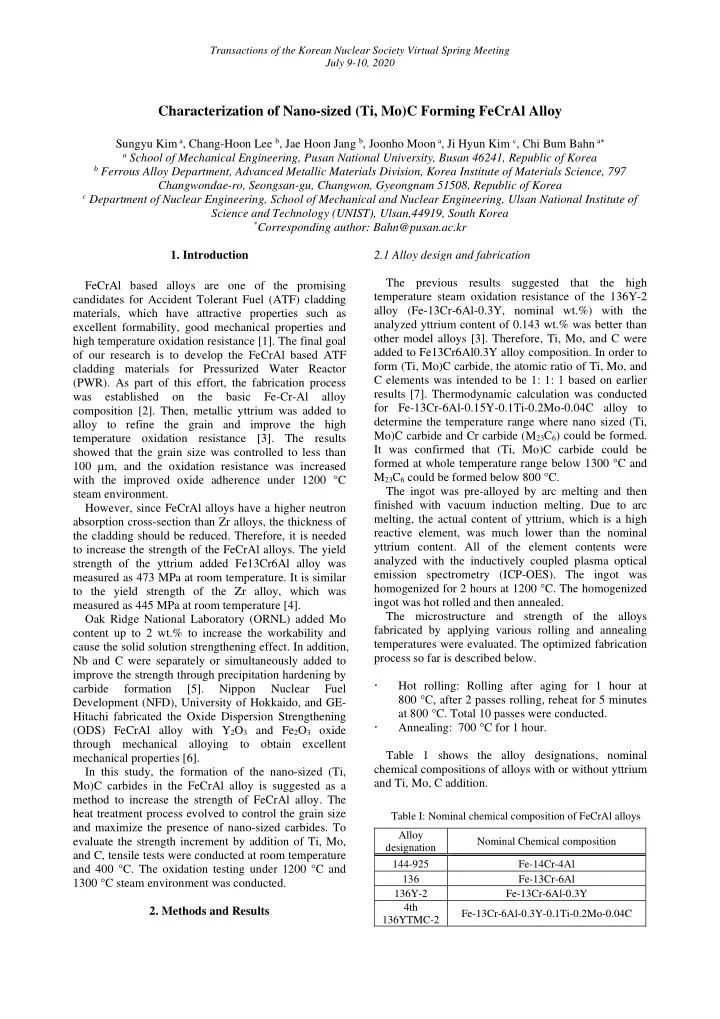
Characterization of Nano-sized (Ti, Mo)C Forming FeCrAl Alloy Sungyu - - PDF document

characterization of nano sized ti mo c forming fecral
SMART_READER_LITE
LIVE PREVIEW

Characterization of Nano-sized (Ti, Mo)C Forming FeCrAl Alloy Sungyu - - PDF document

Transactions of the Korean Nuclear Society Virtual Spring Meeting July 9-10, 2020 Characterization of Nano-sized (Ti, Mo)C Forming FeCrAl Alloy Sungyu Kim a , Chang-Hoon Lee b , Jae Hoon Jang b , Joonho Moon a , Ji Hyun Kim c , Chi Bum Bahn a


slide-1
SLIDE 1

Characterization of Nano-sized (Ti, Mo)C Forming FeCrAl Alloy

Sungyu Kim a, Chang-Hoon Lee b, Jae Hoon Jang b, Joonho Moon a, Ji Hyun Kim c, Chi Bum Bahn a∗

a School of Mechanical Engineering, Pusan National University, Busan 46241, Republic of Korea b Ferrous Alloy Department, Advanced Metallic Materials Division, Korea Institute of Materials Science, 797

Changwondae-ro, Seongsan-gu, Changwon, Gyeongnam 51508, Republic of Korea

c Department of Nuclear Engineering, School of Mechanical and Nuclear Engineering, Ulsan National Institute of

Science and Technology (UNIST), Ulsan,44919, South Korea

*Corresponding author: Bahn@pusan.ac.kr

  • 1. Introduction

FeCrAl based alloys are one of the promising candidates for Accident Tolerant Fuel (ATF) cladding materials, which have attractive properties such as excellent formability, good mechanical properties and high temperature oxidation resistance [1]. The final goal

  • f our research is to develop the FeCrAl based ATF

cladding materials for Pressurized Water Reactor (PWR). As part of this effort, the fabrication process was established

  • n

the basic Fe-Cr-Al alloy composition [2]. Then, metallic yttrium was added to alloy to refine the grain and improve the high temperature oxidation resistance [3]. The results showed that the grain size was controlled to less than 100 µm, and the oxidation resistance was increased with the improved oxide adherence under 1200 °C steam environment. However, since FeCrAl alloys have a higher neutron absorption cross-section than Zr alloys, the thickness of the cladding should be reduced. Therefore, it is needed to increase the strength of the FeCrAl alloys. The yield strength of the yttrium added Fe13Cr6Al alloy was measured as 473 MPa at room temperature. It is similar to the yield strength of the Zr alloy, which was measured as 445 MPa at room temperature [4]. Oak Ridge National Laboratory (ORNL) added Mo content up to 2 wt.% to increase the workability and cause the solid solution strengthening effect. In addition, Nb and C were separately or simultaneously added to improve the strength through precipitation hardening by carbide formation [5]. Nippon Nuclear Fuel Development (NFD), University of Hokkaido, and GE- Hitachi fabricated the Oxide Dispersion Strengthening (ODS) FeCrAl alloy with Y2O3 and Fe2O3 oxide through mechanical alloying to obtain excellent mechanical properties [6]. In this study, the formation of the nano-sized (Ti, Mo)C carbides in the FeCrAl alloy is suggested as a method to increase the strength of FeCrAl alloy. The heat treatment process evolved to control the grain size and maximize the presence of nano-sized carbides. To evaluate the strength increment by addition of Ti, Mo, and C, tensile tests were conducted at room temperature and 400 °C. The oxidation testing under 1200 °C and 1300 °C steam environment was conducted.

  • 2. Methods and Results

2.1 Alloy design and fabrication The previous results suggested that the high temperature steam oxidation resistance of the 136Y-2 alloy (Fe-13Cr-6Al-0.3Y, nominal wt.%) with the analyzed yttrium content of 0.143 wt.% was better than

  • ther model alloys [3]. Therefore, Ti, Mo, and C were

added to Fe13Cr6Al0.3Y alloy composition. In order to form (Ti, Mo)C carbide, the atomic ratio of Ti, Mo, and C elements was intended to be 1: 1: 1 based on earlier results [7]. Thermodynamic calculation was conducted for Fe-13Cr-6Al-0.15Y-0.1Ti-0.2Mo-0.04C alloy to determine the temperature range where nano sized (Ti, Mo)C carbide and Cr carbide (M23C6) could be formed. It was confirmed that (Ti, Mo)C carbide could be formed at whole temperature range below 1300 °C and M23C6 could be formed below 800 °C. The ingot was pre-alloyed by arc melting and then finished with vacuum induction melting. Due to arc melting, the actual content of yttrium, which is a high reactive element, was much lower than the nominal yttrium content. All of the element contents were analyzed with the inductively coupled plasma optical emission spectrometry (ICP-OES). The ingot was homogenized for 2 hours at 1200 °C. The homogenized ingot was hot rolled and then annealed. The microstructure and strength of the alloys fabricated by applying various rolling and annealing temperatures were evaluated. The optimized fabrication process so far is described below.  Hot rolling: Rolling after aging for 1 hour at 800 °C, after 2 passes rolling, reheat for 5 minutes at 800 °C. Total 10 passes were conducted.  Annealing: 700 °C for 1 hour. Table 1 shows the alloy designations, nominal chemical compositions of alloys with or without yttrium and Ti, Mo, C addition.

Table I: Nominal chemical composition of FeCrAl alloys Alloy designation Nominal Chemical composition 144-925 Fe-14Cr-4Al 136 Fe-13Cr-6Al 136Y-2 Fe-13Cr-6Al-0.3Y 4th 136YTMC-2 Fe-13Cr-6Al-0.3Y-0.1Ti-0.2Mo-0.04C Transactions of the Korean Nuclear Society Virtual Spring Meeting July 9-10, 2020

slide-2
SLIDE 2

2.2 Microstructure In the case of 144-925 and 136 alloys, which have Fe-Cr-Al composition without any minor element addition, elongated grains were observed at the center

  • f cross section. However, in the case of 136Y-2 with

yttrium addition, fine grains of average 41 µm were

  • bserved without any elongated grains. Figure 1 shows

the microstructure of the 4th 136YTMC-2 alloy with Ti, Mo, C addition. The average grain size of the 4th 136YTMC-2 alloy was 51 µm. Yttrium rich particles were uniformly distributed same as the 136Y-2 alloy. The (Ti, Mo)C carbide formed by the addition of Ti, Mo, C was uniformly distributed with the nano size as shown in Figure 2. However, some carbides are enriched at the interface between the yttrium rich particle and the matrix, and relatively large (Ti, Mo)C carbides are also locally observed within the matrix. (Ti, Mo)C carbide, if it is large, does not contribute to the strength improvement of alloy. As more (Ti, Mo)C carbides, that are larger than a few tens of nano meter, are formed, the number of nano-sized carbides

  • decreases. Therefore, it is desirable to suppress the

formation of larger-than-nano-sized (Ti, Mo)C carbides as much as possible by further study.

  • Fig. 1. Microstructure of Ti,Mo,C added 4th 136YTMC-2

alloy

  • Fig. 2. TEM/EDS analysis results of nano-sized (Ti, Mo)C

carbides present in 4th 136YTMC-2 alloy

2.3 Mechanical property The tensile tests were conducted to evaluate the mechanical properties of the fabricated alloys. Tensile testing was performed at room temperature with a sub- size specimen according to ASTM A370-17. For 4th 136YTMC-2 alloy, tensile testing was also conducted at 400 ℃. The yield strength, tensile strength, and elongation of the 4th 136YTMC-2 alloy were compared with Zr-Nb- Sn alloy, 144-925 alloy, and 136Y-2 alloy as shown in Figure 3. It can be seen that the yield strength and tensile strength of 4th 136YTMC-2 alloy are significantly higher than 136Y-2 alloy. This is

  • bviously due to nano-sized (Ti, Mo) C carbide formed

in the alloy. The elongation slightly decreased to 24 % in 4th 136YTMC-2 alloy, but it seems that the ‘24%’ total elongation would be sufficient for industrial scale tube fabrication. Compared to the Zr-Nb-Sn alloy, the elongation was similar, but the yield strength and tensile strength are improved by more than 20%. It is believed that improved strength will make a significant contribution to structural integrity, although the neutron economy with reduced thickness needs to be evaluated further. It is believed that the structural integrity can be maintained even if the thickness of the FeCrAl tube is reduced due to neutron economy. The tensile testing at 400 °C was conducted on the 4th 136YTMC-2 alloy. The average yield strength, tensile strength and elongation was about 412 MPa, 503 MPa and 15 %, respectively. The stress-strain curves of the 4th 136YTMC-2 alloy at room temperature and 400 ° C are shown in Figure 4. It can be seen that all tensile properties were deteriorated at 400 °C, but there was no significant difference in fracture surface analysis at both room temperature and 400 °C. The typical ductile fracture feature consisting of voids and dimples was observed. The deterioration of tensile properties at specific temperatures has been reported by ORNL [5]. The elongation change by temperature in ‘C35M' alloy (Fe-13Cr-4.5Al-0.15Y-2Mo-0.2Si) and 'C35MN' alloy (Fe-13Cr-4.5 Al-0.15Y-2Mo-0.2Si-1Nb), showed that as the temperature increased, the elongation decreased, but at specific temperature of 400 °C or 600 °C the elongation began to rapidly

  • increased. It is known that this phenomenon is caused

by Dynamic Strain Aging (DSA) generated by solute atoms of the alloy.

Transactions of the Korean Nuclear Society Virtual Spring Meeting July 9-10, 2020

slide-3
SLIDE 3
  • Fig. 3. Yield strength, tensile strength and elongation at room

temperature for Zr-Nb-Sn alloy and FeCrAl alloys fabricated in this study.

  • Fig. 4. Stress-strain curve at room temperature and 400 °C of

4th 136YTMC-2 alloy and fracture surface SEM analysis at each temperature.

2.4 High temperature steam oxidation resistance The steam oxidation test was conducted using a resistance-heated horizontal alumina tube furnace. After heating the furnace to the temperature of 1200 °C, steam and Ar gas were supplied at a rate of 500 cc/h, respectively, to prevent condensate generation in the alumina tube furnace. When the furnace was heated and stabilized, a polished sample of the size 10 × 30 × 2 mm was inserted into the furnace. The samples were isothermally oxidized for 10 minutes, 3 hours, 8 hours and 24 hours under a 1200 ℃ steam/Ar environment. After oxidation, the samples were cooled in laboratory air. The 144-925 and 136 alloy without yttrium addition showed poor oxidation resistance as most of the oxide layer spalled out during the cooling even after 10 minutes exposure time, and nodular oxide was formed

  • n the oxidized surface.

On the other hand, in the only yttrium added 136Y-2 alloy, uniform aluminum oxide was formed at all exposure times and the oxide spallation did not occur. In the same manner, since 4th 136YTMC-2 alloy also contains yttrium, the oxide spallation did not occur. However, the oxide layer became thicker than 136Y-2 (see Figure 5). The Ti addition appears to play a role in the oxidation process, which is supported by the formation of TiO2 and Ti-Y oxide on the aluminum

  • xide layer as shown in Figure 6. It seems that Mo or C

does not affect the oxidation mechanism, but the Ti addition causes the negative effect on oxidation

  • mechanism. Unlike at 1200 ℃, TiO2 and Ti-Y oxide

were not observed at 1300 ℃. It is believed that above 1300 ℃, Ti rich oxide is thought to be vaporized during the oxidation. The oxidation behavior of Ti rich oxide will be further studied. To evaluate the high temperature oxidation resistance

  • f the 4th 136YTMC-2 alloy, the parabolic rate

constant (kp) was calculated and compared with the Zr- Nb-Sn alloy and 136Y-2 alloy. The kp values of Zr-Nb- Sn alloy, 136Y-2 alloy and 4th 136YTMC-2 alloy were calculated as 1.17E-03, 9.15E-07 and 1.58E-06 g/cm2s-

1/2, respectively. It can be seen that the high temperature

  • xidation resistance of the 4th 136YTMC-2 alloy is

about 300 times superior to that of the Zr-Nb-Sn alloy. Figure 7 shows a comparison with other materials such as APMT, SiC and stainless steel [8].

  • Fig. 5. Change of uniform oxide thickness of 136Y-2 alloy

and 4th 136YTMC-2 alloy according to exposure time under 1200 °C steam/Ar environment.

  • Fig. 6. Ti-Y oxide and TiO2 formed on the aluminum oxide of

4th 136YTMC-2 alloy exposed for 3 hours under 1200 °C steam/Ar environment. Transactions of the Korean Nuclear Society Virtual Spring Meeting July 9-10, 2020

slide-4
SLIDE 4
  • Fig. 7. Comparison of kp values of 4th 136YTMC-2 and

136Y-2 alloys with previous studies [8].

  • 3. Conclusions and Future Work

In this study, Ti, Mo, and C were added to the FeCrAl alloy to form nano-sized (Ti, Mo)C carbides to increase the strength with the precipitation hardening. It was observed that grain having an average size of 51 µm were formed. Due to the precipitation hardening with nano-sized (Ti, Mo)C carbides, the strength of the 4th 136YTMC-2 alloy was significantly higher than that of the 136Y-2 alloy with only yttrium added. Compared to the Zr-Nb-Sn alloy, the elongation was similar, but the yield strength and tensile strength were improved by over 20%. Moreover, the strength of the 4th 136YTMC-2 alloy is much higher than the C36M alloy (Fe-13Cr-4.5Al-0.15Y-2Mo-0.2Si) which is fabricated by ORNL. High temperature steam oxidation test was conducted at 1200 and 1300 °C, and it was confirmed that the 4th 136YTMC-2 alloy had about 300 times superior in high temperature steam oxidation resistance compared to the Zr-Nb-Sn alloy by the kp value comparison. Further study will be conducted on how Ti affects the oxidation mechanism and why Ti rich oxide is not observed at 1300 °C. Although the 4th 136YTMC-2 alloy was evaluated as a FeCrAl alloy with excellent mechanical properties, it is thought that the mechanical properties could be further improved by optimizing the manufacturing

  • process. The nano-sized (Ti, Mo)C carbide needs to be

more finely distributed in the matrix. Therefore, it is necessary to increase the number of dislocations, which are nucleation sites, by additional cold rolling. In addition, it will be very important to find an appropriate annealing temperature at which nano-sized (Ti, Mo)C carbides are well formed. ACKNOWLEDGMENT Foundation of Korea(NRF) grant funded by the Korean government(MSIP:Ministry of Science, ICT and Future Planning) (No. 2017M2A8A4056239), “Human Resources Program in Energy Technology” of the Korea Institute of Energy Technology Evaluation and Planning (KETEP), granted financial resource from the Ministry of Trade, Industry & Energy, Republic of

  • Korea. (No. 20184010201660).

REFERENCES

[1] K.A. Terrani, S.J. Zinkle and L.L. SneadAdvanced

  • xidation-resistant iron-based alloys for LWR fuel cladding,

Journal of Nuclear Materials, Vol.448(1-3), p. 420, 2014. [2] Sungyu Kim, Joonho Moon and Chi Bum Bahn, Development of Basic Technology for FeCrAl-based LWR Cladding, Proceedings of the Transactions of the Korean Nuclear Society Spring Meeting, May.17-18, 2018, Jeju, South Korea [3] Sungyu Kim, Joonho Moon and Chi Bum Bahn, Microscopic Characterization of various yttrium doped FeCrAl Alloys under High Temperature Steam Oxidation, Proceedings of the Transactions of the Korean Nuclear Society Spring Meeting, May.23-24, 2019, Jeju, South Korea [4] Lee, Hoon, et al. "Effects of hydride precipitation on the mechanical property of cold worked zirconium alloys in fully recrystallized condition." Nuclear Engineering and Technology 52.2 (2020): 352-359. [5] Yamamoto, Yukinori, et al. "Development and property evaluation of nuclear grade wrought FeCrAl fuel cladding for light water reactors." Journal of Nuclear Materials 467 (2015): 703-716. [6] Sakamoto, K., et al. "Overview of japanese development

  • f accident tolerant FeCrAl-ODS fuel claddings for BWRs."

WRFPM Conference, Jeju Island. 2017. [7] Funakawa, Yoshimasa, et al. "Development of high strength hot-rolled sheet steel consisting of ferrite and nanometer-sized carbides." ISIJ international 44.11 (2004): 1945-1951. [8] Terrani, Kurt A., Steven J. Zinkle, and Lance Lewis Snead. "Advanced oxidation-resistant iron-based alloys for LWR fuel cladding." Journal of Nuclear Materials 448.1-3 (2014): 420- 435. Transactions of the Korean Nuclear Society Virtual Spring Meeting July 9-10, 2020