Character formulas and matrices Ron Adin and Yuval Roichman - - PowerPoint PPT Presentation

character formulas and matrices
SMART_READER_LITE
LIVE PREVIEW

Character formulas and matrices Ron Adin and Yuval Roichman - - PowerPoint PPT Presentation

Character formulas and matrices Ron Adin and Yuval Roichman Department of Mathematics Bar-Ilan University 1 1 1 1 1 1 1 1 1 1 1 1 1 1 0 1 1. Character formulas 2. Matrices


slide-1
SLIDE 1

Character formulas and matrices

Ron Adin and Yuval Roichman

Department of Mathematics Bar-Ilan University

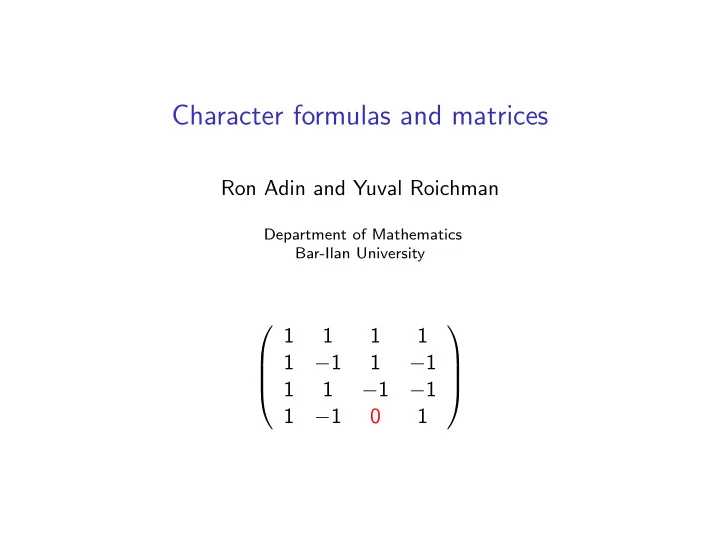
    1 1 1 1 1 −1 1 −1 1 1 −1 −1 1 −1 1    

slide-2
SLIDE 2
  • 1. Character formulas
  • 2. Matrices
  • 3. Back to characters

Abstract

We present a family of square matrices which are asymmetric variants of Walsh-Hadamard matrices. They originate in the study

  • f character formulas, and provide a handy tool for translation of

statements about permutation statistics to results in representation theory, and vice versa. They turn out to have many fascinating properties.

slide-3
SLIDE 3
  • 1. Character formulas
  • 2. Matrices
  • 3. Back to characters

Outline

  • 1. Character formulas
  • 2. Matrices
  • 3. Back to characters
slide-4
SLIDE 4
  • 1. Character formulas
  • 2. Matrices
  • 3. Back to characters

Character formulas

slide-5
SLIDE 5
  • 1. Character formulas
  • 2. Matrices
  • 3. Back to characters

µ-unimodal permutations

  • A sequence (a1, . . . , an) of distinct positive integers is

unimodal if there exists 1 ≤ m ≤ n such that a1 > a2 > . . . > am < am+1 < . . . < an.

slide-6
SLIDE 6
  • 1. Character formulas
  • 2. Matrices
  • 3. Back to characters

µ-unimodal permutations

  • A sequence (a1, . . . , an) of distinct positive integers is

unimodal if there exists 1 ≤ m ≤ n such that a1 > a2 > . . . > am < am+1 < . . . < an.

  • Let µ = (µ1, . . . , µt) be a composition of n. A sequence of n

positive integers is µ-unimodal if the first µ1 integers form a unimodal sequence, the next µ2 integers form a unimodal sequence, and so on.

slide-7
SLIDE 7
  • 1. Character formulas
  • 2. Matrices
  • 3. Back to characters

µ-unimodal permutations

  • A sequence (a1, . . . , an) of distinct positive integers is

unimodal if there exists 1 ≤ m ≤ n such that a1 > a2 > . . . > am < am+1 < . . . < an.

  • Let µ = (µ1, . . . , µt) be a composition of n. A sequence of n

positive integers is µ-unimodal if the first µ1 integers form a unimodal sequence, the next µ2 integers form a unimodal sequence, and so on.

  • A permutation π ∈ Sn is µ-unimodal if the sequence

(π(1), . . . , π(n)) is µ-unimodal.

slide-8
SLIDE 8
  • 1. Character formulas
  • 2. Matrices
  • 3. Back to characters

µ-unimodal permutations, descent set

  • Let Uµ be the set of all µ-unimodal permutations in Sn.
slide-9
SLIDE 9
  • 1. Character formulas
  • 2. Matrices
  • 3. Back to characters

µ-unimodal permutations, descent set

  • Let Uµ be the set of all µ-unimodal permutations in Sn.
  • Example: n = 10, µ = (3, 3, 4).

π = (4, 2, 10, 9, 7, 6, 5, 3, 1, 8) ∈ Uµ | µ1 | µ2 | µ3 |

slide-10
SLIDE 10
  • 1. Character formulas
  • 2. Matrices
  • 3. Back to characters

µ-unimodal permutations, descent set

  • Let Uµ be the set of all µ-unimodal permutations in Sn.
  • Example: n = 10, µ = (3, 3, 4).

π = (4, 2, 10, 9, 7, 6, 5, 3, 1, 8) ∈ Uµ | µ1 | µ2 | µ3 |

  • The descent set of a permutation π ∈ Sn is

Des(π) := {i : π(i) > π(i + 1)}.

slide-11
SLIDE 11
  • 1. Character formulas
  • 2. Matrices
  • 3. Back to characters

µ-unimodal permutations, descent set

  • Let Uµ be the set of all µ-unimodal permutations in Sn.
  • Example: n = 10, µ = (3, 3, 4).

π = (4, 2, 10, 9, 7, 6, 5, 3, 1, 8) ∈ Uµ | µ1 | µ2 | µ3 |

  • The descent set of a permutation π ∈ Sn is

Des(π) := {i : π(i) > π(i + 1)}.

  • Example: Des(π) = {1, 3, 4, 5, 6, 7, 8}
slide-12
SLIDE 12
  • 1. Character formulas
  • 2. Matrices
  • 3. Back to characters

µ-unimodal permutations, descent set

  • Let Uµ be the set of all µ-unimodal permutations in Sn.
  • Example: n = 10, µ = (3, 3, 4).

π = (4, 2, 10, 9, 7, 6, 5, 3, 1, 8) ∈ Uµ | µ1 | µ2 | µ3 |

  • The descent set of a permutation π ∈ Sn is

Des(π) := {i : π(i) > π(i + 1)}.

  • Example: Des(π) = {1, 3, 4, 5, 6, 7, 8}
  • Denote I(µ) := {1, . . . , n} \ {µ1, µ1 + µ2, µ1 + µ2 + µ3, . . .}
slide-13
SLIDE 13
  • 1. Character formulas
  • 2. Matrices
  • 3. Back to characters

µ-unimodal permutations, descent set

  • Let Uµ be the set of all µ-unimodal permutations in Sn.
  • Example: n = 10, µ = (3, 3, 4).

π = (4, 2, 10, 9, 7, 6, 5, 3, 1, 8) ∈ Uµ | µ1 | µ2 | µ3 |

  • The descent set of a permutation π ∈ Sn is

Des(π) := {i : π(i) > π(i + 1)}.

  • Example: Des(π) = {1, 3, 4, 5, 6, 7, 8}
  • Denote I(µ) := {1, . . . , n} \ {µ1, µ1 + µ2, µ1 + µ2 + µ3, . . .}
  • Example: I(µ) = {1, . . . , 10} \ {3, 6, 10} = {1, 2, 4, 5, 7, 8, 9}

Des(π) ∩ I(µ) = {1, 4, 5, 7, 8}

slide-14
SLIDE 14
  • 1. Character formulas
  • 2. Matrices
  • 3. Back to characters

Formula 1: irreducible characters

Let λ and µ be partitions of n, let χλ be the character of the irreducible Sn-representation corresponding to λ, and let χλ

µ be its

value on a conjugacy class of cycle type µ.

Theorem (Roichman ’97)

χλ

µ =

  • π∈C∩Uµ

(−1)| Des(π)∩I(µ)|, where C is any Knuth class of shape λ.

slide-15
SLIDE 15
  • 1. Character formulas
  • 2. Matrices
  • 3. Back to characters

Formula 2: coinvariant algebra, homogeneous component

Let χ(k) be the Sn-character corresponding to the symmetric group action on the k-th homogeneous component of its coinvariant algebra, and let χ(k)

µ

be its value on a conjugacy class of cycle type µ.

Theorem (A-Postnikov-Roichman, ’00)

χ(k)

µ

=

  • π∈L(k)∩Uµ

(−1)| Des(π)∩I(µ)|, where L(k) is the set of all permutations of length k in Sn.

slide-16
SLIDE 16
  • 1. Character formulas
  • 2. Matrices
  • 3. Back to characters

Formula 3: Gelfand model

A complex representation of a group or an algebra A is called a Gelfand model for A if it is equivalent to the multiplicity free direct sum of all irreducible A-representations. Let χG be the corresponding character, and let χG

µ be its value on a conjugacy

class of cycle type µ.

Theorem (A-Postnikov-Roichman, ’08)

The character of the Gelfand model of Sn at a conjugacy class of cycle type µ is equal to χG

µ =

  • π∈Invn∩Uµ

(−1)| Des(π)∩I(µ)|, where Invn := {σ ∈ Sn : σ2 = id} is the set of all involutions in Sn.

slide-17
SLIDE 17
  • 1. Character formulas
  • 2. Matrices
  • 3. Back to characters

Inverse formulas?

Question Are these formulas invertible? In other words: to what extent do the character values χ∗

µ (∀µ)

determine the distribution of descent sets?

slide-18
SLIDE 18
  • 1. Character formulas
  • 2. Matrices
  • 3. Back to characters

Matrices

slide-19
SLIDE 19
  • 1. Character formulas
  • 2. Matrices
  • 3. Back to characters

Subsets as indices

Definition

Let Pn be the power set (set of all subsets) of {1, . . . , n}, with the anti-lexicographic linear order: for I, J ∈ Pn, I = J, let m be the largest element in the symmetric difference I△J := (I ∪ J) \ (I ∩ J), and define: I < J ⇐ ⇒ m ∈ J.

Example

The linear order on P3 is ∅ < {1} < {2} < {1, 2} < {3} < {1, 3} < {2, 3} < {1, 2, 3}. Pn will index the rows and columns of our matrices.

slide-20
SLIDE 20
  • 1. Character formulas
  • 2. Matrices
  • 3. Back to characters

Walsh-Hadamard matrices

The Walsh-Hadamard matrix Hn of order 2n has entries hI,J := (−1)|I∩J| (∀I, J ∈ Pn).

slide-21
SLIDE 21
  • 1. Character formulas
  • 2. Matrices
  • 3. Back to characters

Walsh-Hadamard matrices

The Walsh-Hadamard matrix Hn of order 2n has entries hI,J := (−1)|I∩J| (∀I, J ∈ Pn).

Example

H1 = 1 1 1 −1

slide-22
SLIDE 22
  • 1. Character formulas
  • 2. Matrices
  • 3. Back to characters

Walsh-Hadamard matrices

The Walsh-Hadamard matrix Hn of order 2n has entries hI,J := (−1)|I∩J| (∀I, J ∈ Pn).

Example

H1 = 1 1 1 −1

  • H2 =

    1 1 1 1 1 −1 1 −1 1 1 −1 −1 1 −1 1 1     = H⊗2

1

slide-23
SLIDE 23
  • 1. Character formulas
  • 2. Matrices
  • 3. Back to characters

Walsh-Hadamard matrices

The Walsh-Hadamard matrix Hn of order 2n has entries hI,J := (−1)|I∩J| (∀I, J ∈ Pn).

Example

H1 = 1 1 1 −1

  • H2 =

    1 1 1 1 1 −1 1 −1 1 1 −1 −1 1 −1 1 1     = H⊗2

1

Ht

n = Hn

HnHt

n = 2nI2n

slide-24
SLIDE 24
  • 1. Character formulas
  • 2. Matrices
  • 3. Back to characters

Prefixes and runs

Definition

The prefix of length p of an interval {m + 1, . . . , m + ℓ} is the interval {m + 1, . . . , m + p} (0 ≤ p ≤ ℓ).

slide-25
SLIDE 25
  • 1. Character formulas
  • 2. Matrices
  • 3. Back to characters

Prefixes and runs

Definition

The prefix of length p of an interval {m + 1, . . . , m + ℓ} is the interval {m + 1, . . . , m + p} (0 ≤ p ≤ ℓ).

Definition

For I ∈ Pn let I1, . . . , It be the sequence of runs (maximal consecutive intervals) in I.

slide-26
SLIDE 26
  • 1. Character formulas
  • 2. Matrices
  • 3. Back to characters

Prefixes and runs

Definition

The prefix of length p of an interval {m + 1, . . . , m + ℓ} is the interval {m + 1, . . . , m + p} (0 ≤ p ≤ ℓ).

Definition

For I ∈ Pn let I1, . . . , It be the sequence of runs (maximal consecutive intervals) in I.

Example

For I = {1, 2, 4, 5, 6, 8, 10} ∈ P10: I1 = {1, 2}, I2 = {4, 5, 6}, I3 = {8}, I4 = {10}.

slide-27
SLIDE 27
  • 1. Character formulas
  • 2. Matrices
  • 3. Back to characters

The matrices A and B

slide-28
SLIDE 28
  • 1. Character formulas
  • 2. Matrices
  • 3. Back to characters

The matrices A and B

Definition

For I ∈ Pn let I1, . . . , It be the runs in I. Define, for any J ∈ Pn: aI,J :=

  • (−1)|I∩J|,

if Ik ∩ J is a prefix of Ik for each k; 0,

  • therwise.

An := (aI,J)I,J∈Pn, with Pn ordered as above.

slide-29
SLIDE 29
  • 1. Character formulas
  • 2. Matrices
  • 3. Back to characters

The matrices A and B

Definition

For I ∈ Pn let I1, . . . , It be the runs in I. Define, for any J ∈ Pn: aI,J :=

  • (−1)|I∩J|,

if Ik ∩ J is a prefix of Ik for each k; 0,

  • therwise.

An := (aI,J)I,J∈Pn, with Pn ordered as above. An auxiliary matrix: bI,J :=      (−1)|I∩J|, if Ik ∩ J is a prefix of Ik for each k, and n ∈ I \ J; 0,

  • therwise.

Bn := (bI,J)I,J∈Pn.

slide-30
SLIDE 30
  • 1. Character formulas
  • 2. Matrices
  • 3. Back to characters

A and B (examples)

A1 = (1) B1 = (1)

slide-31
SLIDE 31
  • 1. Character formulas
  • 2. Matrices
  • 3. Back to characters

A and B (examples)

A1 = (1) B1 = (1) A1 = 1 1 1 −1

  • B1 =

1 1 −1

slide-32
SLIDE 32
  • 1. Character formulas
  • 2. Matrices
  • 3. Back to characters

A and B (examples)

A1 = (1) B1 = (1) A1 = 1 1 1 −1

  • B1 =

1 1 −1

  • A2 =

    1 1 1 1 1 −1 1 −1 1 1 −1 −1 1 −1 1     B2 =     1 1 1 1 1 −1 1 −1 −1 −1 1     ∅ {1} {2} {1, 2}

slide-33
SLIDE 33
  • 1. Character formulas
  • 2. Matrices
  • 3. Back to characters

A and B (examples)

A1 = (1) B1 = (1) A1 = 1 1 1 −1

  • B1 =

1 1 −1

  • A2 =

    1 1 1 1 1 −1 1 −1 1 1 −1 −1 1 −1 1     B2 =     1 1 1 1 1 −1 1 −1 −1 −1 1     ∅ {1} {2} {1, 2} ↑ I = {1, 2}, J = {2}, I ∩ J = {2} is not a prefix of I

slide-34
SLIDE 34
  • 1. Character formulas
  • 2. Matrices
  • 3. Back to characters

A and B (examples)

A1 = (1) B1 = (1) A1 = 1 1 1 −1

  • B1 =

1 1 −1

  • A2 =

    1 1 1 1 1 −1 1 −1 1 1 −1 −1 1 −1 1     B2 =     1 1 1 1 1 −1 1 −1 −1 −1 1     ∅ {1} {2} {1, 2} ↑ I = {1, 2}, J = {2}, I ∩ J = {2} is not a prefix of I At

n = An

AnAt

n = 2nI2n

(n ≥ 2)

slide-35
SLIDE 35
  • 1. Character formulas
  • 2. Matrices
  • 3. Back to characters

Recursion

Lemma

An = An−1 An−1 An−1 −Bn−1

  • (n ≥ 1)

with A0 = (1), and Bn = An−1 An−1 −Bn−1

  • (n ≥ 1)

with B0 = (1).

slide-36
SLIDE 36
  • 1. Character formulas
  • 2. Matrices
  • 3. Back to characters

Recursion

Lemma

An = An−1 An−1 An−1 −Bn−1

  • (n ≥ 1)

with A0 = (1), and Bn = An−1 An−1 −Bn−1

  • (n ≥ 1)

with B0 = (1). For comparison: Hn = Hn−1 Hn−1 Hn−1 −Hn−1

  • (n ≥ 1)

with H0 = (1).

slide-37
SLIDE 37
  • 1. Character formulas
  • 2. Matrices
  • 3. Back to characters

Determinant

Theorem

An and Bn are invertible for all n ≥ 0.

slide-38
SLIDE 38
  • 1. Character formulas
  • 2. Matrices
  • 3. Back to characters

Determinant

Theorem

An and Bn are invertible for all n ≥ 0. In fact, det(An) = (n + 1) ·

n

  • k=1

k2n−1−k(n+4−k) (n ≥ 2) while det(A0) = 1 and det(A1) = −2,

slide-39
SLIDE 39
  • 1. Character formulas
  • 2. Matrices
  • 3. Back to characters

Determinant

Theorem

An and Bn are invertible for all n ≥ 0. In fact, det(An) = (n + 1) ·

n

  • k=1

k2n−1−k(n+4−k) (n ≥ 2) while det(A0) = 1 and det(A1) = −2, and det(Bn) =

n

  • k=1

k2n−1−k(n+2−k) (n ≥ 2) while det(B0) = 1 and det(B1) = −1.

slide-40
SLIDE 40
  • 1. Character formulas
  • 2. Matrices
  • 3. Back to characters

Determinant

Theorem

An and Bn are invertible for all n ≥ 0. In fact, det(An) = (n + 1) ·

n

  • k=1

k2n−1−k(n+4−k) (n ≥ 2) while det(A0) = 1 and det(A1) = −2, and det(Bn) =

n

  • k=1

k2n−1−k(n+2−k) (n ≥ 2) while det(B0) = 1 and det(B1) = −1. For comparison, det(Hn) = 22n−1n (n ≥ 2) with det(H0) = 1 and det(H1) = −2.

slide-41
SLIDE 41
  • 1. Character formulas
  • 2. Matrices
  • 3. Back to characters

  • bius inversion

Let Zn be the zeta matrix of the poset Pn with respect to set inclusion: zI,J :=

  • 1,

if I ⊆ J; 0,

  • therwise.

Then Zn = Zn−1 Zn−1 Zn−1

  • (n ≥ 1)

with Z0 = (1). Its inverse is the M¨

  • bius matrix Mn = Z −1

n , with

entries mI,J defined by mI,J :=

  • (−1)|J\I|,

if I ⊆ J; 0,

  • therwise.

It satisfies Mn = Mn−1 −Mn−1 Mn−1

  • (n ≥ 1)

with M0 = (1).

slide-42
SLIDE 42
  • 1. Character formulas
  • 2. Matrices
  • 3. Back to characters

AM and BM

Denote now AMn := AnMn, BMn := BnMn and HMn := HnMn. It follows that AMn = AMn−1 AMn−1 −(AMn−1 + BMn−1)

  • (n ≥ 1)

with AM0 = (1) and BMn = AMn−1 −BMn−1

  • (n ≥ 1)

with BM0 = (1), as well as HMn = HMn−1 HMn−1 −2HMn−1

  • (n ≥ 1)

with HM0 = (1).

slide-43
SLIDE 43
  • 1. Character formulas
  • 2. Matrices
  • 3. Back to characters

Determinant computation (1)

By the BM recursion, det(BMn) = det(AMn−1) det(−BMn−1) (n ≥ 1). Now Mn is an upper triangular matrix with 1-s on its diagonal, so that det(Mn) = 1. We conclude that det(Bn) = δn−1 det(An−1) det(Bn−1) (n ≥ 1), where δn = (−1)2n =

  • −1,

if n = 0; 1,

  • therwise.
slide-44
SLIDE 44
  • 1. Character formulas
  • 2. Matrices
  • 3. Back to characters

Determinant computation (2)

Similarly, for any scalar t and n ≥ 1, AMn + tBMn = (t + 1)AMn−1 AMn−1 −AMn−1 − (t + 1)BMn−1

  • and a similar argument yields

det(An + tBn) = δn−1 det((t + 1)An−1) det(An−1 + (t + 1)Bn−1) It follows that det(An) = n

  • k=1

δn−k det(kAn−k)

  • · det(A0 + nB0) =

= −(n + 1) ·

n

  • k=1

k2n−k ·

n

  • k=1

det(An−k) (n ≥ 1). Since A0 = (1) it follows that det(An) = 0 for any nonnegative integer n.

slide-45
SLIDE 45
  • 1. Character formulas
  • 2. Matrices
  • 3. Back to characters

Determinant computation (3)

The solution to this recursion, with initial value det(A1) = −2, is det(An) = (n + 1) ·

n

  • k=1

k2n−1−k(n+4−k) (n ≥ 2). The BM recursion, with initial value det(B1) = −1, now yields det(Bn) =

n

  • k=1

k2n−1−k(n+2−k) (n ≥ 2). For comparison, det(Hn) = 22n−1 det(Hn−1)2 (n ≥ 2) with initial value det(H1) = −2, so that det(Hn) = 22n−1n (n ≥ 2).

slide-46
SLIDE 46
  • 1. Character formulas
  • 2. Matrices
  • 3. Back to characters

HM entries

HM3 =             1 1 −2 1 −2 1 −2 −2 4 1 −2 1 −2 −2 4 1 −2 −2 4 1 −2 −2 4 −2 4 4 −8            

slide-47
SLIDE 47
  • 1. Character formulas
  • 2. Matrices
  • 3. Back to characters

HM entries

HM3 =             1 1 −2 1 −2 1 −2 −2 4 1 −2 1 −2 −2 4 1 −2 −2 4 1 −2 −2 4 −2 4 4 −8            

Lemma

  • Zero pattern: (HMn)I,J = 0 ⇐

⇒ J ⊆ I

slide-48
SLIDE 48
  • 1. Character formulas
  • 2. Matrices
  • 3. Back to characters

HM entries

HM3 =             1 1 −2 1 −2 1 −2 −2 4 1 −2 1 −2 −2 4 1 −2 −2 4 1 −2 −2 4 −2 4 4 −8            

Lemma

  • Zero pattern: (HMn)I,J = 0 ⇐

⇒ J ⊆ I

  • Signs: (HMn)I,J = 0 =

⇒ sign((HMn)I,J) = (−1)|J|

slide-49
SLIDE 49
  • 1. Character formulas
  • 2. Matrices
  • 3. Back to characters

HM entries

HM3 =             1 1 −2 1 −2 1 −2 −2 4 1 −2 1 −2 −2 4 1 −2 −2 4 1 −2 −2 4 −2 4 4 −8            

Lemma

  • Zero pattern: (HMn)I,J = 0 ⇐

⇒ J ⊆ I

  • Signs: (HMn)I,J = 0 =

⇒ sign((HMn)I,J) = (−1)|J|

  • Absolute values: (HMn)I,J = 0 =

⇒ |(HMn)I,J| = 2|J|

slide-50
SLIDE 50
  • 1. Character formulas
  • 2. Matrices
  • 3. Back to characters

AM entries (1)

AM3 =             1 1 −2 1 −2 1 −2 −1 3 1 −2 1 −2 −2 4 1 −2 −1 3 1 −2 −1 3 −1 2 1 −4            

slide-51
SLIDE 51
  • 1. Character formulas
  • 2. Matrices
  • 3. Back to characters

AM entries (1)

AM3 =             1 1 −2 1 −2 1 −2 −1 3 1 −2 1 −2 −2 4 1 −2 −1 3 1 −2 −1 3 −1 2 1 −4            

Theorem

  • Zero pattern: (AMn)I,J = 0 ⇐

⇒ J ⊆ I

slide-52
SLIDE 52
  • 1. Character formulas
  • 2. Matrices
  • 3. Back to characters

AM entries (1)

AM3 =             1 1 −2 1 −2 1 −2 −1 3 1 −2 1 −2 −2 4 1 −2 −1 3 1 −2 −1 3 −1 2 1 −4            

Theorem

  • Zero pattern: (AMn)I,J = 0 ⇐

⇒ J ⊆ I

  • Signs: (AMn)I,J = 0 =

⇒ sign((AMn)I,J) = (−1)|J|

slide-53
SLIDE 53
  • 1. Character formulas
  • 2. Matrices
  • 3. Back to characters

AM entries (1)

AM3 =             1 1 −2 1 −2 1 −2 −1 3 1 −2 1 −2 −2 4 1 −2 −1 3 1 −2 −1 3 −1 2 1 −4            

Theorem

  • Zero pattern: (AMn)I,J = 0 ⇐

⇒ J ⊆ I

  • Signs: (AMn)I,J = 0 =

⇒ sign((AMn)I,J) = (−1)|J|

  • Absolute values: ???
slide-54
SLIDE 54
  • 1. Character formulas
  • 2. Matrices
  • 3. Back to characters

Dispersion

HMn AMn

slide-55
SLIDE 55
  • 1. Character formulas
  • 2. Matrices
  • 3. Back to characters

AM entries (2)

Theorem

  • Zero pattern: (AMn)I,J = 0 ⇐

⇒ J ⊆ I

  • Signs: (AMn)I,J = 0 =

⇒ sign((AMn)I,J) = (−1)|J|

  • Absolute values:

(AMn)I,J = 0 = ⇒ |(AMn)I,J| =

t

  • k=1

(|Jk| + 1)δk(I) where J1, . . . , Jt are the runs in J and, for Jk = {mk + 1, . . . , mk + ℓk} (1 ≤ k ≤ t): δk(I) :=

  • 0,

if mk ∈ I; 1,

  • therwise.
slide-56
SLIDE 56
  • 1. Character formulas
  • 2. Matrices
  • 3. Back to characters

Diagonal and last row

Corollary

  • All entries in the diagonal and last row of AMn are non-zero.
  • Diagonal:

|(AMn)J,J| =

t

  • k=1

(|Jk| + 1)

  • Last row:

|(AMn)[n],J| =

  • |J1| + 1,

if 1 ∈ J; 1,

  • therwise.
  • Each nonzero entry (AMn)I,J divides the corresponding

diagonal entry (AMn)J,J and is divisible by the corresponding last row entry (AMn)[n],J.

slide-57
SLIDE 57
  • 1. Character formulas
  • 2. Matrices
  • 3. Back to characters

Diagonal and last row (example)

AM3 =              1 1 −2 1 −2 1 −2 −1 3 1 −2 1 −2 −2 4 1 −2 −1 3 1 −2 −1 3 −1 2 1 −4              I = {1, 2} I = {1, 2, 3} ↑ J = {1, 2}

slide-58
SLIDE 58
  • 1. Character formulas
  • 2. Matrices
  • 3. Back to characters

Diagonal and last row (example)

AM3 =              1 1 −2 1 −2 1 −2 −1 3 1 −2 1 −2 −2 4 1 −2 −1 3 1 −2 −1 3 −1 2 1 −4              I = {2, 3} I = {1, 2, 3} ↑ J = {2, 3}

slide-59
SLIDE 59
  • 1. Character formulas
  • 2. Matrices
  • 3. Back to characters

Row sums

Lemma

  • The sum of all entries in row I of AMn (or HMn) is (−1)|I|.
  • The sum of absolute values of all entries in row I of AMn is

t

  • k=1

(2|Ik|+1 − 1). In HMn the sum is 3|I|.

slide-60
SLIDE 60
  • 1. Character formulas
  • 2. Matrices
  • 3. Back to characters

Column sums and square diagonal entries

Theorem

  • The sum of absolute values of all the entries in column J of

AMn is equal to the (J, J) diagonal entry of A2

n, which in turn

is equal to 2n−t∗−|J∗|

t∗

  • k=1

(|J∗

k| + 2),

where J∗ := J \ {1} and J∗

1, . . . , J∗ t∗ are its runs.

  • For comparison, the sum of absolute values of all the entries

in column J of HMn is equal to the (J, J) diagonal entry of H2

n, namely to the constant 2n.

slide-61
SLIDE 61
  • 1. Character formulas
  • 2. Matrices
  • 3. Back to characters

Column sums and square diagonal entries

Example

AM3 =             1 1 −2 1 −2 1 −2 −1 3 1 −2 1 −2 −2 4 1 −2 −1 3 1 −2 −1 3 −1 2 1 −4             column sums: 8 8 6 6 6 6 4 4

slide-62
SLIDE 62
  • 1. Character formulas
  • 2. Matrices
  • 3. Back to characters

Column sums and square diagonal entries

Example

A2

3 =

             8 2 2 8 −2 2 6 −2 2 2 6 1 −1 6 2 6 −2 2 2 4 2 2 1 1 4             

slide-63
SLIDE 63
  • 1. Character formulas
  • 2. Matrices
  • 3. Back to characters

Inverse of AM

Theorem

  • (AM−1

n )I,J = 0 ⇐

⇒ J ⊆ I

  • For J ⊆ I,

(AM−1

n )I,J = (−1)|J| i∈I

dI,J(i) eI,J(i), where, for i ∈ Ik (k-th run of I): dI,J(i) :=

  • max(Ik) − i + 1,

if i ∈ J; 1,

  • therwise

and eI,J(i) := max(Ik) − i + 2.

slide-64
SLIDE 64
  • 1. Character formulas
  • 2. Matrices
  • 3. Back to characters

Inverse of AM

Equivalently, for J ⊆ I, (AM−1

n )I,J = (−1)|J| t

  • k=1

1 (|Ik| + 1)!

  • i∈Ik∩J

(max(Ik) − i + 1). Note that the denominator t

k=1(|Ik| + 1)! is the cardinality of the

parabolic subgroup I of Sn+1 generated by the simple reflections {si : i ∈ I}.

slide-65
SLIDE 65
  • 1. Character formulas
  • 2. Matrices
  • 3. Back to characters

Inverse of AM

Corollary

  • Each nonzero entry of AM−1

n

is the inverse of an integer.

  • In each row of AM−1

n , the sum of absolute values of all the

entries is 1.

  • In each row I of AM−1

n , the first entry

(AM−1

n )I,∅ = t

  • k=1

1 (|Ik| + 1)! divides all the other nonzero entries and the diagonal entry (AM−1

n )I,I = (−1)|I| t

  • k=1

1 |Ik| + 1 is divisible by all the other nonzero entries.

slide-66
SLIDE 66
  • 1. Character formulas
  • 2. Matrices
  • 3. Back to characters

Inverse of AM

Example

AM−1

3

=             1 1/2 −1/2 1/2 −1/2 1/6 −1/3 −1/6 1/3 1/2 −1/2 1/4 −1/4 −1/4 1/4 1/6 −1/3 −1/6 1/3 1/24 −1/8 −1/12 1/4 −1/24 1/8 1/12 −1/4            

slide-67
SLIDE 67
  • 1. Character formulas
  • 2. Matrices
  • 3. Back to characters

Eigenvalues

A2 =     1 1 1 1 1 −1 1 −1 1 1 −1 −1 1 −1 1    

slide-68
SLIDE 68
  • 1. Character formulas
  • 2. Matrices
  • 3. Back to characters

Eigenvalues

A2 =     1 1 1 1 1 −1 1 −1 1 1 −1 −1 1 −1 1     At

2 = A2

A2At

2 = 4I4

slide-69
SLIDE 69
  • 1. Character formulas
  • 2. Matrices
  • 3. Back to characters

Eigenvalues

A2 =     1 1 1 1 1 −1 1 −1 1 1 −1 −1 1 −1 1     At

2 = A2

A2At

2 = 4I4

Question: What can be said about its eigenvalues?

slide-70
SLIDE 70
  • 1. Character formulas
  • 2. Matrices
  • 3. Back to characters

Eigenvalues

A2 =     1 1 1 1 1 −1 1 −1 1 1 −1 −1 1 −1 1     At

2 = A2

A2At

2 = 4I4

Question: What can be said about its eigenvalues? Answer: char. poly.(A2) = (x2 − 4)(x2 − 3)

slide-71
SLIDE 71
  • 1. Character formulas
  • 2. Matrices
  • 3. Back to characters

Eigenvalues

A2 =     1 1 1 1 1 −1 1 −1 1 1 −1 −1 1 −1 1     At

2 = A2

A2At

2 = 4I4

Question: What can be said about its eigenvalues? Answer: char. poly.(A2) = (x2 − 4)(x2 − 3) A2

2 =

    4 1 4 −1 3 1 1 3    

slide-72
SLIDE 72
  • 1. Character formulas
  • 2. Matrices
  • 3. Back to characters

Eigenvalues

A2

3 =

            8 2 2 8 −2 2 6 −2 2 2 6 1 −1 6 2 6 −2 2 2 4 2 2 1 1 4            

slide-73
SLIDE 73
  • 1. Character formulas
  • 2. Matrices
  • 3. Back to characters

Eigenvalues

A2

3 =

            8 2 2 8 −2 2 6 −2 2 2 6 1 −1 6 2 6 −2 2 2 4 2 2 1 1 4            

  • char. poly.(A2

3) = (x − 8)2(x − 6)4(x − 4)2

slide-74
SLIDE 74
  • 1. Character formulas
  • 2. Matrices
  • 3. Back to characters

Eigenvalues

A2

3 =

            8 2 2 8 −2 2 6 −2 2 2 6 1 −1 6 2 6 −2 2 2 4 2 2 1 1 4            

  • char. poly.(A2

3) = (x − 8)2(x − 6)4(x − 4)2

Alas... A2

3 is not diagonalizable !

slide-75
SLIDE 75
  • 1. Character formulas
  • 2. Matrices
  • 3. Back to characters

Eigenvalues (conjecture)

Conjecture The eigenvalues of A2

n (counted by algebraic multiplicity) are in

1 : 1 correspondence with the diagonal entries of A2

n.

slide-76
SLIDE 76
  • 1. Character formulas
  • 2. Matrices
  • 3. Back to characters

Eigenvalues (conjecture)

Conjecture The eigenvalues of A2

n (counted by algebraic multiplicity) are in

1 : 1 correspondence with the diagonal entries of A2

n.

The latter are explicitly known:

Theorem

The (J, J) diagonal entry of A2

n is equal to the sum of absolute

values of all the entries in column J of AMn, which in turn is equal to 2n−t∗−|J∗|

t∗

  • k=1

(|J∗

k| + 2) =

  • k

(µk + 1), where µ is the composition of n corresponding to J∗ := J \ {1}.

slide-77
SLIDE 77
  • 1. Character formulas
  • 2. Matrices
  • 3. Back to characters

Back to characters

slide-78
SLIDE 78
  • 1. Character formulas
  • 2. Matrices
  • 3. Back to characters

Fine sets

Definition

Let B be a set of combinatorial objects, and let Des : B → Pn−1 be a map which associates a “descent set” Des(b) ⊆ [n − 1] to each element b ∈ B. Denote by Bµ the set of elements in B whose descent set Des(b) is µ-unimodal. Let ρ be a complex Sn-representation. Then B is called a fine set for ρ if, for each composition µ of n, the character value of ρ on a conjugacy class

  • f cycle type µ satisfies

χρ

µ =

  • b∈Bµ

(−1)| Des(b)\S(µ)|.

slide-79
SLIDE 79
  • 1. Character formulas
  • 2. Matrices
  • 3. Back to characters

Character values and descent sets

Theorem (Fine Set Theorem)

If B is a fine set for an Sn-representation ρ, then the character values of ρ uniquely determine the overall distribution of descent sets over B.

slide-80
SLIDE 80
  • 1. Character formulas
  • 2. Matrices
  • 3. Back to characters

Character values and descent sets

Theorem (Fine Set Theorem)

If B is a fine set for an Sn-representation ρ, then the character values of ρ uniquely determine the overall distribution of descent sets over B. Idea of proof For a subset J = {j1, . . . , jk} ⊆ [n − 1] let sJ := sj1sj2 · · · sjk ∈ Sn. Let χρ be the vector with entries χρ(sJ), for J ∈ Pn−1, and let vB be the vector with entries vB

J := |{b ∈ B : Des(b) = J}|

(∀J ∈ Pn−1). Then, by definition, B is a fine set for ρ if and only if χρ = An−1vB. The result follows since An−1 is an invertible matrix.

slide-81
SLIDE 81
  • 1. Character formulas
  • 2. Matrices
  • 3. Back to characters

Explicit inversion formula

Theorem

Let B be a fine set for an Sn-representation ρ. For every D ⊆ [n − 1], the number of elements in B with descent set D satisfies |{b ∈ B : Des(b) = D}| =

  • J

χρ(cJ)

  • I:D∪J⊆I

(−1)|I\D|(AM−1

n−1)I,J

where (AM−1

n−1)I,J = (−1)|J|

|I|

t

  • k=1
  • i∈Ik∩J

(max(Ik) − i + 1), I1, . . . , It are the runs in I and cJ :=

j∈J sj is a Coxeter element

in the parabolic subgroup J.

slide-82
SLIDE 82
  • 1. Character formulas
  • 2. Matrices
  • 3. Back to characters

Equivalence of classical theorems

For 0 ≤ k ≤ n

2

  • let Rk be the k-th homogeneous component of

the coinvariant algebra of the symmetric group Sn. For a partition λ, let mk,λ be the number of standard Young tableaux of shape λ with major index k.

Theorem (Lusztig-Stanley)

Rk ∼ =

  • λ⊢n

mk,λSλ, where the sum runs over all partitions of n and Sλ denotes the irreducible Sn-module indexed by λ.

slide-83
SLIDE 83
  • 1. Character formulas
  • 2. Matrices
  • 3. Back to characters

Equivalence of classical theorems

The major index of a permutation π is maj(π) :=

  • i∈Des(π)

i, and its length ℓ(π) is the number of inversions in π. For a subset I ⊆ [n − 1] denote xI :=

i∈I

xi.

Theorem (Foata-Sch¨ utzenberger; Garsia-Gessel)

  • π∈Sn

xDes(π)qℓ(π) =

  • π∈Sn

xDes(π)qmaj(π−1). The Fine Set Theorem implies

Corollary

The Foata-Sch¨ utzenberger Theorem is equivalent to the Lusztig-Stanley Theorem.

slide-84
SLIDE 84
  • 1. Character formulas
  • 2. Matrices
  • 3. Back to characters

Summary

slide-85
SLIDE 85
  • 1. Character formulas
  • 2. Matrices
  • 3. Back to characters

Summary

  • Asymmetric variants of Walsh-Hadamard matrices
slide-86
SLIDE 86
  • 1. Character formulas
  • 2. Matrices
  • 3. Back to characters

Summary

  • Asymmetric variants of Walsh-Hadamard matrices
  • Have fascinating properties, with strong combinatorial flavor
slide-87
SLIDE 87
  • 1. Character formulas
  • 2. Matrices
  • 3. Back to characters

Summary

  • Asymmetric variants of Walsh-Hadamard matrices
  • Have fascinating properties, with strong combinatorial flavor
  • Serve as a bridge between characters and combinatorial

permutation statistics

slide-88
SLIDE 88
  • 1. Character formulas
  • 2. Matrices
  • 3. Back to characters

Summary

  • Asymmetric variants of Walsh-Hadamard matrices
  • Have fascinating properties, with strong combinatorial flavor
  • Serve as a bridge between characters and combinatorial

permutation statistics

  • Eigenvalues are still conjectural
slide-89
SLIDE 89
  • 1. Character formulas
  • 2. Matrices
  • 3. Back to characters

Summary

  • Asymmetric variants of Walsh-Hadamard matrices
  • Have fascinating properties, with strong combinatorial flavor
  • Serve as a bridge between characters and combinatorial

permutation statistics

  • Eigenvalues are still conjectural

A2 =     1 1 1 1 1 −1 1 −1 1 1 −1 −1 1 −1 1    

slide-90
SLIDE 90
  • 1. Character formulas
  • 2. Matrices
  • 3. Back to characters

Summary

  • Asymmetric variants of Walsh-Hadamard matrices
  • Have fascinating properties, with strong combinatorial flavor
  • Serve as a bridge between characters and combinatorial

permutation statistics

  • Eigenvalues are still conjectural

A2 =     1 1 1 1 1 −1 1 −1 1 1 −1 −1 1 −1 1    

THANK YOU !