Ulam networks, fractal Weyl law and Anderson localization Dima - - PowerPoint PPT Presentation

ulam networks fractal weyl law and anderson localization
SMART_READER_LITE
LIVE PREVIEW

Ulam networks, fractal Weyl law and Anderson localization Dima - - PowerPoint PPT Presentation

Ulam networks, fractal Weyl law and Anderson localization Dima Shepelyansky (CNRS, Toulouse) www.quantware.ups-tlse.fr/dima with L.Ermann (CNEA TANDAR), K.Frahm (LPT), V.Kandiah (LPT), H.Escaith (WTO Geneve), O.V.Zhirov (BINP Novosibirsk) *


slide-1
SLIDE 1

Ulam networks, fractal Weyl law and Anderson localization

Dima Shepelyansky (CNRS, Toulouse) www.quantware.ups-tlse.fr/dima

with L.Ermann (CNEA TANDAR), K.Frahm (LPT), V.Kandiah (LPT), H.Escaith (WTO Geneve), O.V.Zhirov (BINP Novosibirsk)

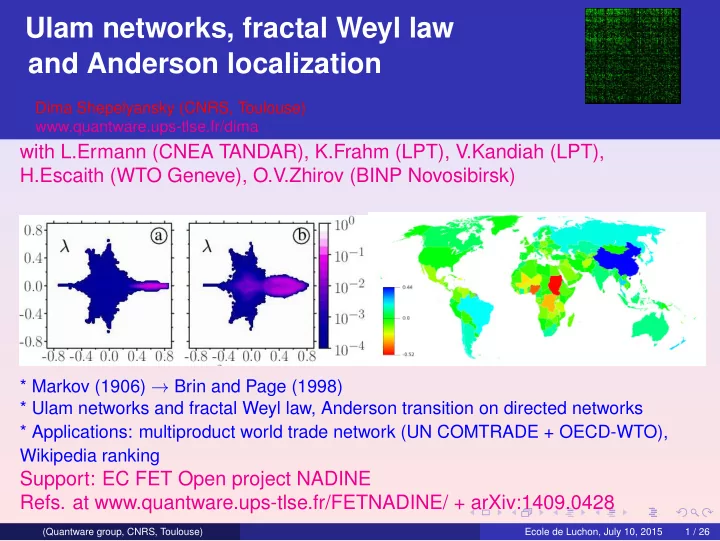
* Markov (1906) → Brin and Page (1998) * Ulam networks and fractal Weyl law, Anderson transition on directed networks * Applications: multiproduct world trade network (UN COMTRADE + OECD-WTO), Wikipedia ranking

Support: EC FET Open project NADINE

  • Refs. at www.quantware.ups-tlse.fr/FETNADINE/ + arXiv:1409.0428

(Quantware group, CNRS, Toulouse) Ecole de Luchon, July 10, 2015 1 / 26

slide-2
SLIDE 2

Google matrix construction rules

Markov chains (1906) and Directed networks

1 2 3 4 5

(a) (b)

For a directed network with N nodes the adjacency matrix A is defined as Aij = 1 if there is a link from node j to node i and Aij = 0 otherwise. The weighted adjacency matrix is Sij = Aij/

  • k

Akj In addition the elements of columns with only zeros elements are replaced by 1/N.

(Quantware group, CNRS, Toulouse) Ecole de Luchon, July 10, 2015 2 / 26

slide-3
SLIDE 3

Google matrix construction rules

Google Matrix and Computation of PageRank

P = SP ⇒ P= stationary vector of S; can be computed by iteration of S. To remove convergence problems: Replace columns of 0 (dangling nodes) by 1

N :

To remove degeneracies of λ = 1, replace S by Google matrix

G = αS + (1 − α) E

N ;

GP = λP

=> Perron-Frobenius operator

α models a random surfer with a random jump after approximately 6 clicks (usually α = 0.85); PageRank vector => P at λ = 1 (

j Pj = 1).

CheiRank vector P∗: G∗ = αS∗ + (1 − α) E

N , G∗P∗ = P∗

(S∗ with inverted link directions) Fogaras (2003) ... Chepelianskii arXiv:1003.5455 (2010) ...

(Quantware group, CNRS, Toulouse) Ecole de Luchon, July 10, 2015 3 / 26

slide-4
SLIDE 4

Real directed networks

Real networks are characterized by: small world property: average distance between 2 nodes ∼ log N scale-free property: distribution of the number of ingoing or outgoing links ρ(k) ∼ k−ν PageRank vector for large WWW: P(K) ∼ 1/K β, where K is the ordered rank index number of nodes Nn with PageRank P scales as Nn ∼ 1/Pν with numerical values ν = 1 + 1/β ≈ 2.1 and β ≈ 0.9. PageRank P(K) on average is proportional to the number of ingoing links CheiRank P∗(K ∗) ∼ 1/K ∗β on average is proportional to the number of

  • utgoing links (ν ≈ 2.7; β = 1/(ν − 1) ≈ 0.6)

WWW at present: ∼ 1011 web pages Donato et al. EPJB 38, 239 (2004)

(Quantware group, CNRS, Toulouse) Ecole de Luchon, July 10, 2015 4 / 26

slide-5
SLIDE 5

Fractal Weyl law

invented for open quantum systems, quantum chaotic scattering: the number of Gamow eigenstates Nγ, that have escape rates γ in a finite bandwidth 0 ≤ γ ≤ γb, scales as

Nγ ∝ −ν ∝ Nν, ν = d/2

where d is a fractal dimension of a strange invariant set formed by obits non-escaping in the future and in the past (N is matrix size) References: J.Sjostrand, Duke Math. J. 60, 1 (1990) M.Zworski, Not. Am. Math. Soc. 46, 319 (1999) W.T.Lu, S.Sridhar and M.Zworski, Phys. Rev. Lett. 91, 154101 (2003) S.Nonnenmacher and M.Zworski, Commun. Math. Phys. 269, 311 (2007) Resonances in quantum chaotic scattering: three disks, quantum maps with absorption Perron-Frobenius operators, Ulam method for dynamical maps, Ulam networks, dynamical maps, strange attractors Linux kernel network d = 1.3, N ≤ 285509;

  • Phys. Rev. up to 2009 d ≈ 1, N = 460422

(Quantware group, CNRS, Toulouse) Ecole de Luchon, July 10, 2015 5 / 26

slide-6
SLIDE 6

Ulam networks

Ulam conjecture (method) for discrete approximant of Perron-Frobenius operator of dynamical systems

S.M.Ulam, A Collection of mathematical problems, Interscience, 8, 73 N.Y. (1960) A rigorous prove for hyperbolic maps: T.-Y.Li J.Approx. Theory 17, 177 (1976) Related works:

  • Z. Kovacs and T. Tel, Phys. Rev. A 40,

4641 (1989) M.Blank, G.Keller, and C.Liverani, Nonlinearity 15, 1905 (2002) D.Terhesiu and G.Froyland, Nonlinearity 21, 1953 (2008) Links to Markov chains: ∞∞∞∞∞∞∞∞∞∞ Contre-example: Hamiltonian systems with invariant curves, e.g. the Chirikov standard map: noise, induced by coarse-graining, destroys the KAM curves and gives homogeneous ergodic eigenvector at λ = 1

(Quantware group, CNRS, Toulouse) Ecole de Luchon, July 10, 2015 6 / 26

slide-7
SLIDE 7

Ulam method for the Chirikov standard map

¯ y = y + K sin x, ¯ x = x + ¯ y (mod2π); K = 0.971635... Left: spectrum Gψ = λψ, M × M/2 cells; M = 280, Nd = 16609, exact and Arnoldi method for matrix diagonalization; generalized Ulam method of one trajectory. Right: modulus of eigenstate of λ2 = 0.99878..., M = 1600, Nd = 494964. Here K = KG

(Quantware group, CNRS, Toulouse) Ecole de Luchon, July 10, 2015 7 / 26

slide-8
SLIDE 8

Ulam method for dissipative systems

Strange repellers and strange attractors

(Quantware group, CNRS, Toulouse) Ecole de Luchon, July 10, 2015 8 / 26

slide-9
SLIDE 9

Fractal Weyl law for Ulam networks

Fractal Weyl law for three different models with dimension d0 of invariant set. The fractal Weyl exponent ν is shown as a function of fractal dimension d0 of the strange repeller in model 1 and strange attractor in model 2 and Henon map; dashed line shows the theory dependence ν = d0/2. Inset shows relation between the fractal dimension d of trajectories nonescaping in future and the fractal inv-set dimension d0 for model 1; dashed line is d = d0/2 + 1.

(Quantware group, CNRS, Toulouse) Ecole de Luchon, July 10, 2015 9 / 26

slide-10
SLIDE 10

Linux Kernel Network

Procedure call network for Linux Links distribution (left); PageRank and inverse PageRank (CheiRank) distribution (right) for Linux versions up to 2.6.32 with N = 285509 (ρ ∼ 1/jβ, β = 1/(ν − 1)).

(Chepelianskii arxiv:1003.5455)

(Quantware group, CNRS, Toulouse) Ecole de Luchon, July 10, 2015 10 / 26

slide-11
SLIDE 11

Fractal Weyl law for Linux Network

Sjöstrand Duke Math J. 60, 1 (1990), Zworski et al. PRL 91, 154101 (2003) → quantum chaotic scattering; Ermann, DS EPJB 75, 299 (2010)→ Perron-Frobenius operators Spectrum of Google matrix (left); integrated density of states for relaxation rate γ = −2 ln |λ| (right) for Linux versions, α = 0.85.

(Quantware group, CNRS, Toulouse) Ecole de Luchon, July 10, 2015 11 / 26

slide-12
SLIDE 12

Fractal Weyl law for Linux Network

Number of states Nλ ∼ Nν, ν = d/2 (N ∼ 1/d/2) Number of states Nλ with |λ| > 0.1; 0.25 vs. N, lines show Nλ ∼ Nν with ν ≈ 0.65 (left); average mass < Mc > (number of nodes) as a functon of network distance l, line shows the power law for fractal dimension < Mc >∼ ld with d ≈ 1.3 (right).

(Quantware group, CNRS, Toulouse) Ecole de Luchon, July 10, 2015 12 / 26

slide-13
SLIDE 13

Fractal Weyl law for Physical Review network

103 104 105 106 1920 1940 1960 1980 2000 Nt t t0 = 1791 τ = 11.4 Nt 2(t-t0)/τ 100 101 102 103 103 104 105 106 Nλ Nt a = 0.32 b = 0.51 λc = 0.50 Nλ = a (Nt)b nA = 4000 nA = 2000 100 101 102 103 103 104 105 106 Nλ Nt a = 0.24 b = 0.47 λc = 0.65 Nλ = a (Nt)b nA = 4000 nA = 2000 0.5 0.6 0.7 0.8 0.2 0.4 0.6 0.8 1 b λc

(b) (a) (c) (d)

Panel (a) (or (c)): shows the number Nλ of eigenvalues with λc ≤ λ ≤ 1 for λc = 0.50 (or λc = 0.65) versus the network size Nt (up to time t). The green line shows the fractal Weyl law Nλ = a (Nt )b with parameters a = 0.32 ± 0.08 (a = 0.24 ± 0.11) and b = 0.51 ± 0.02 (b = 0.47 ± 0.04)

  • btained from a fit in the range 3 × 10⁴ ≤ Nt < 5 × 10⁵. Panel (b): exponent b with error bars obtained from the fit Nλ = a (Nt )b in the range

3 × 10⁴ ≤ Nt < 5 × 10⁵ versus cut value λc . Panel (d): effective network size Nt versus cut time t (in years). The green line shows the exponential fit 2(t−t0)/τ with t0 = 1791 ± 3 and τ = 11.4 ± 0.2. Thus N = 463348, Nℓ = 4684496, d ≈ 1, b = ν ≈ 0.5. (Quantware group, CNRS, Toulouse) Ecole de Luchon, July 10, 2015 13 / 26

slide-14
SLIDE 14

Anderson transition on directed networks

Anderson (1958) metal-insulator transition for electron transport in disordered solids H = ǫnψn + V(ψna+1 + ψn−1) = Eψn ; −W/2 < ǫn < W/2 In dimensions d = 1, 2 all eigenstates are exponentially localized, insulating phase. At d = 3 for W > 16.5V all eigenstates are exponentially localized, for W < 16.5V there are metalic delocalized states, mobility edge, metalic phase Random Matrix Theory - RMT (Wigner (1955)) for Hermitian and unitary matrices (quantum chaos, many-body quantum systems, quantum computers) Google matrix, Markov chains, Perron-Frobenium operators: => complex spectrum of eigenvalues; new field of research Can we have the Anderson transition for Google matrix? All the world would go blind if PageRank is delocalized What are good RMT models of Google matrix? Subspaces and core S =

  • Sss

Ssc Scc

  • (Quantware group, CNRS, Toulouse)

Ecole de Luchon, July 10, 2015 14 / 26

slide-15
SLIDE 15

Wikipedia spectrum and eigenstates

  • 1
  • 0.5

0.5 1 0.5

  • 0.82
  • 0.8
  • 0.78
  • 0.76
  • 0.74
  • 0.72

0.8 0.82 0.84 0.86 0.88 0.9 0.92 0.94 0.96 0.98 Australia

Switzerland

England Bangladesh New Zeland Poland Kuwait Iceland Austria Brazil China Australia Australia Canada England muscle-artery biology DNA RNA protein skin muscle-artery muscle-artery mathematics math (function, geometry,surface, logic-circuit) rail war

Gaafu Alif Atoll Quantum Leap

Texas-Dallas-Houston

Language music Bible poetry football song poetry aircraft

Spectrum S of EN Wikipedia, Aug 2009, N = 3282257. Eigenvalues-communities are labeled by most repeated words following word counting of first 1000 nodes.

(Ermann, Frahm, DS 2013)

(Quantware group, CNRS, Toulouse) Ecole de Luchon, July 10, 2015 15 / 26

slide-16
SLIDE 16

Spectrum of random orthostochastic matrices

Spectrum N = 3 (left), 4 (right) [K.Zyczkowski et al. J.Phys. A 36, 3425 (2003)]

(Quantware group, CNRS, Toulouse) Ecole de Luchon, July 10, 2015 16 / 26

slide-17
SLIDE 17

Localization features

Multiproduct world trade network N = Np × Nc = 61 × 227 = 13847 (year 2008): small IPR values ξ. Small gaps in S of directed networks.

(Quantware group, CNRS, Toulouse) Ecole de Luchon, July 10, 2015 17 / 26

slide-18
SLIDE 18

Random Matrix Models of directed networks

random matrix elements of G with sum equat unity in each column (N = 400)

  • 1
  • 0.5

0.5 1

  • 1
  • 0.5

0.5 1

λ

  • 1
  • 0.5

0.5 1

  • 1
  • 0.5

0.5 1

λ

  • 0.02

0.02

  • 0.02

0.02

λ

  • 1
  • 0.5

0.5 1

  • 1
  • 0.5

0.5 1

λ (a) (b) (c) (d)

(a) N positive random elements with unit sum in each column; (c) triangular matrix with random elements; (b),(d) Q = 20 nonzero elements in each column

  • blue circle is theory with radius ∼ 1/

√ N, 1/ √ Q

(Quantware group, CNRS, Toulouse) Ecole de Luchon, July 10, 2015 18 / 26

slide-19
SLIDE 19

Anderson type models for directed networks

We use the usual Anderson model with diagonal disorder terms Wi and transitions V to nearby sites on a lattice in dimension d: Wiψi + Vψi+1 + Vψi−1 = λψi , (1) where indexes in bold are vectors in d-dimensional space. On this we construct the matrices S and G for d = 2, 3. The matrix S is constructed as follows: each transition matrix element, corresponding to V terms, in the Anderson model in dimension d is replaced by a random number εi uniformly distributed in the interval [0, εmax/2d], the diagonal element Wi is replaced by unity minus the sum of all εi over 2d nearby sites (1 − 2d

i=1 εi). The

asymmetric matrix S constructed in this way belongs to the Google matrix class. By replacing matrix elements in the model AD2 by blocks B of size 4 × 4 we

  • btain the model AD2Z. In a similar way we obtain the model AD2ZS with

block shortcuts. In this case we restrict our studies only for dimension d = 2.

(Quantware group, CNRS, Toulouse) Ecole de Luchon, July 10, 2015 19 / 26

slide-20
SLIDE 20

Anderson transition on directed networks

Panels show distribution of IPR values ξ (number of nodes contributing to an eigenstate) on the plane λ or eigenvalues of G matrix for two nodels of directed networks with disorder; color shows the ratio ξ/N, α = 0.85.

(Quantware group, CNRS, Toulouse) Ecole de Luchon, July 10, 2015 20 / 26

slide-21
SLIDE 21

Anderson transition on directed networks

Panel (c): dependence of ξ on N for AD2Z with triangles for states with λ located in the delocalized domain Reλ ∈ (0.3, 0.85) (red triangles, fit gives ν = 0.67) and in the localized domain Reλ < −0.5 (blue triangles, ν = 0.15); for AD2ZS at δ = 0.25 with circles for states with λ located in the delocalized domain Reλ ∈ (0.2, 0.85) (red circles, ν = 0.53) and in the quasi-localized domain Reλ < −0.5 (blue circles, ν = 0.25); fits are shown by lines, green line shows ξ = N. Panel (d): dependence of PageRank probability P on PageRank index K for models AD2Z (gray symbols) and AD2ZS at δ = 0.25 (black symbols); the fits for the range K ∈ (100, 6000) are shown by dashed lines with β = 0.16 (AD2Z) and β = 0.51 (AD2ZS) for the parameters of panels (a,b). (Quantware group, CNRS, Toulouse) Ecole de Luchon, July 10, 2015 21 / 26

slide-22
SLIDE 22

CheiRank-PageRank balance (2008)

Bc = (Pc

∗ − Pc)/(Pc ∗ + Pc) (top - CheiRank-PageRank; bottom

  • Export-Import volume; multiproduct world trade

Nc = 227, Np = 61, N = 13847 ==> Ermann lecture)

(Quantware group, CNRS, Toulouse) Ecole de Luchon, July 10, 2015 22 / 26

slide-23
SLIDE 23

Top historical figures of 24 Wikipedia editions

2DRanking of Wikipedia articles; top 100 historical figures; comparison with historical studies of M.Hart (37 and 43 percent overlap) 35 centures and all countries by birth place; 17 millions wiki-articles

A.Zhirov, O.Zhirov, DLS EPJB (2010); Y.-H.Eom, K.M.Frahm, A.Benczur, DLS EPJB (2013); Y.-H.Eom, DLS PLoS ONE (2013), Y.-H.Eom,P .Aragon, D.Laniado, A.Kaltenbrunner, S.Vigna, DLS arXiv2014 - PLoS ONE (2015)

(Quantware group, CNRS, Toulouse) Ecole de Luchon, July 10, 2015 23 / 26

slide-24
SLIDE 24

Top historical figures of 24 Wikipedia editions

Top global PageRank historical figures: Carl Linnaeus, Jesus, Aristotle ... Media highlights: The Guardian, The Independent, The Washington Post, France24, EC CORDIS, Uppsala Universitet: “Carl Linnaeus ranked most influential person of all time” ... (about 20 countries) Competitors: MIT Pantheon project http://pantheon.media.mit.edu (2014); Stony-Brook NY http://www.whoisbigger.com/ (2014)

(Quantware group, CNRS, Toulouse) Ecole de Luchon, July 10, 2015 24 / 26

slide-25
SLIDE 25

Time evolution of 35 centuries

(A)

BC 15th BC 10th BC 5th BC 1th AD 5th AD 10th AD 15th AD 20th

Century

EN NL DE FR ES IT PT EL DA SV PL HU RU HE TR AR FA HI MS TH VI ZH KO JA WR

Culture

5 10 15 20 25 30 35 40 45 50 (B)

BC 15th BC 10th BC 5th BC 1th AD 5th AD 10th AD 15th AD 20th

Century

EN NL DE FR ES IT PT EL DA SV PL HU RU HE TR AR FA HI MS TH VI ZH KO JA WR

Culture

20 40 60 80 100 120 140

(C)

BC 15th BC 10th BC 5th BC 1th AD 5th AD 10th AD 15th AD 20th

Century

EN NL DE FR ES IT PT EL DA SV PL HU RU HE TR AR FA HI MS TH VI ZH KO JA WR

Culture

0.2 0.4 0.6 0.8 1 (D)

BC 15th BC 10th BC 5th BC 1th AD 5th AD 10th AD 15th AD 20th

Century

EN NL DE FR ES IT PT EL DA SV PL HU RU HE TR AR FA HI MS TH VI ZH KO JA WR

Culture

0.2 0.4 0.6 0.8 1

Birth date distribution of historical figures from the global PageRank list (A,C, 1045 persons) and 2DRank list (B,D, 1616 persons). Each historical figure is attributed to her/his own language according to her/his birth place as described in the paper (if the birth place is not among our 24 languages then a person is attributed to the remaining world (WR)). Color in panels (A,B) shows the total number of persons for a given century, while in panels (C,D) color shows a percent for a given century (normalized to unity in each column). (Quantware group, CNRS, Toulouse) Ecole de Luchon, July 10, 2015 25 / 26

slide-26
SLIDE 26

Further applications of Markov chains and Google matrix ?

Google matrix power

(Quantware group, CNRS, Toulouse) Ecole de Luchon, July 10, 2015 26 / 26