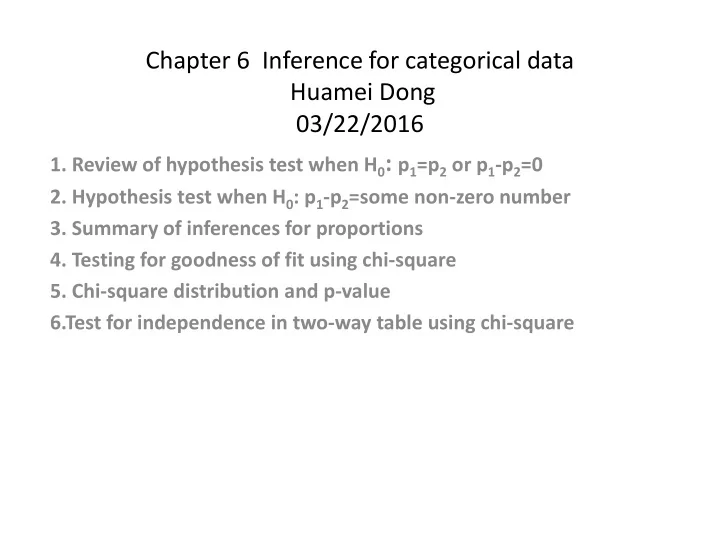
SLIDE 1 Chapter 6 Inference for categorical data Huamei Dong 03/22/2016
- 1. Review of hypothesis test when H0: p1=p2 or p1-p2=0
- 2. Hypothesis test when H0: p1-p2=some non-zero number
- 3. Summary of inferences for proportions
- 4. Testing for goodness of fit using chi-square
- 5. Chi-square distribution and p-value
6.Test for independence in two-way table using chi-square
SLIDE 2
- 1. Review of hypothesis test for H0: p1-p2=0 or p1=p2
We have learned the hypothesis test for H0: p1-p2=0 or p1=p2. In the test, we use to calculate the standard error In this test, we assume H0 is true and try to find p-value. If H0 is true, the two population proportions are equal and we should use one sample proportion, the pooled proportion estimate, to calculate standard error.
SLIDE 3
- 2. Hypothesis test for H0: p1-p2=c (some constant not equal to 0)
When we test for H0: p1-p2=some non-zero number, we still use and to estimate the standard error Example 1 There were 50 patients in the experiment who did not receive the blood thinner and 40 patients who did. Does this provide convincing evidence for the claim that blood thinners improve survival rate more than 8% using significant level 0f 0.05?
Survived Died Total control 11 39 50 treatment 14 26 40 total 25 65 90
SLIDE 4
Answer: (1) H0: pt-pc=0.08, HA: pt-pc>0.08 (2) Check the success-failure condition: Using (3) Point estimate for pt-pc is (4) Standard error is (5) Now we calculate Z score and find the p-value.
SLIDE 5 (6) Since p-value is 0.3 which is big than 0.05, we don’t reject H0. That is we don’t have convincing evidence for improvement of 8% survival rate.
- 3. Summary of inferences for proportions
The right tail area is 0.3 The Z score is 0.5236
SLIDE 6
: Point estimate for p1, : Point estimate for p2 95% confidence interval for p1 Hypothesis test for H0: p1=0.5 Using to calculate z score and p-value Point estimate for p1-p2 95% confidence interval for p1-p2 : Here Z*=1.96 Hypothesis test for H0: p1-p2=0.2 using and to get p-value Hypothesis test for H0: p1-p2=0 or p1=p2 using Here is pooled proportion estimate.
SLIDE 7
- 4. Testing for goodness of fit using chi-square
Given a sample of cases that can be classified into several groups, how can we test if the sample is representative of the general population? Example 2 We consider data from a random sample of 275 jurors in a small county as in the following table. We would like to determine if these jurors are racially representative of the population. How should we do the test? The idea is that if the jury is representative of the population, then the proportion in the sample should roughly reflect the population of registered voters. Let’s check the following table. If the more the differences between the observed data and expected data are, the stronger evidence we have for not fit.
SLIDE 8
SLIDE 9
- 5. Chi-square distribution and p-value
Three chi-square distributions with different degrees of freedom Chi-square distribution with 2 degree
- f freedom, area above 4.3 shaded
Chi-square distribution with 3 degree
- f freedom, area above 6.25 shaded
SLIDE 10
Example 2 We consider data from a random sample of 275 jurors in a small county as in the following table. We would like to test at 5% significant level if these jurors are racially representative of the population. Answer: (1) H0: The jury is representative of the population. HA: The jury is not representative of the population. (2) Calculate X2 :
(3)Using R or table to find the p-value, which is the right tail area for Chi-square. Using R: “ pchisq(5.89, 3)” we get 0.8828, so the right tail is 0.1172>0.05. We don’t reject H0.
SLIDE 11
6.Test for independence in two-way table using chi-square
Test of two-way table is very similar to the test of one-way table. We still use chi-square test. There are two modifications here. (1) Calculation of the expected count: (2)
SLIDE 12
Example 3 The following table are the results of a Pew Research Poll. We would like to test if there are actually differences in the approval rating of Barack Obama, Democrats in Congress, and Republicans in Congress. Answer: (1) H0: There is no difference in approval rating between three groups. HA: There is some difference in approval rating between three groups.
(2)
Obama Democrats Republican Total Approval 842 (E=2119x1458/4223 =731.6) 736 (E=2119x1382/4223 =693.45) 541 (E=2119x1383/4223 =693.96) 2119 Disapprove 616 (E=2104x1458/4223 =726.4) 646 (E=2104x1382/4223 =688.55) 842 (E=2104x1383/4223 =689.04) 2104 total 1458 1382 1383 4223
SLIDE 13
For first cell, we calculate (842-731.6)2/731.6=16.7. Similarly we calculate all the cells, and add all the results together. Then we have X2=16.7+…..+34.0=106.4 Degree of freedom=(2-1)(3-1)=2. Using R: pchisq(106.4, 2)=1. So the right tail area is 0<0.05. We reject H0.
SLIDE 14 Homework on 03/22/16 (due 03/29/16) (1) Try to finish the following table and do one-way chi-square test. I have 33.3% (or 1/3) black dice, 40% (or 2/5) white dice, and 26.7 % (or 4/15) color
- dice. Try to sample 60 dice in total and finish one way test.
(2) Using the data you and all your classmates collected on 03/15/16 to do the two-way table chi-square test.
Yours Classmate 1 Classmate 2 Classmates 3 total Black White total black white color total 33.3% 40% 26.7% 1.00
SLIDE 15