4/19/2016 Chapter 6 Inference for categorical data 1.Quick Review - - PowerPoint PPT Presentation

4 19 2016
SMART_READER_LITE
LIVE PREVIEW

4/19/2016 Chapter 6 Inference for categorical data 1.Quick Review - - PowerPoint PPT Presentation

4/19/2016 Chapter 6 Inference for categorical data 1.Quick Review Huamei Dong 03/17/2016 Last class, we talked about the inference for a single proportion, that is, confidence (1)Confidence interval for one proportion interval and hypothesis


slide-1
SLIDE 1

4/19/2016 1

Chapter 6 Inference for categorical data

Huamei Dong 03/17/2016 Last class, we talked about the inference for a single proportion, that is, confidence interval and hypothesis test about one proportion. Today we will learn the inference for the difference of two proportions.

1. Quick Review 2. Sampling distribution of differences of two proportions 3. Confidence interval for p1-p2 4. Hypothesis test when H0: p1=p2

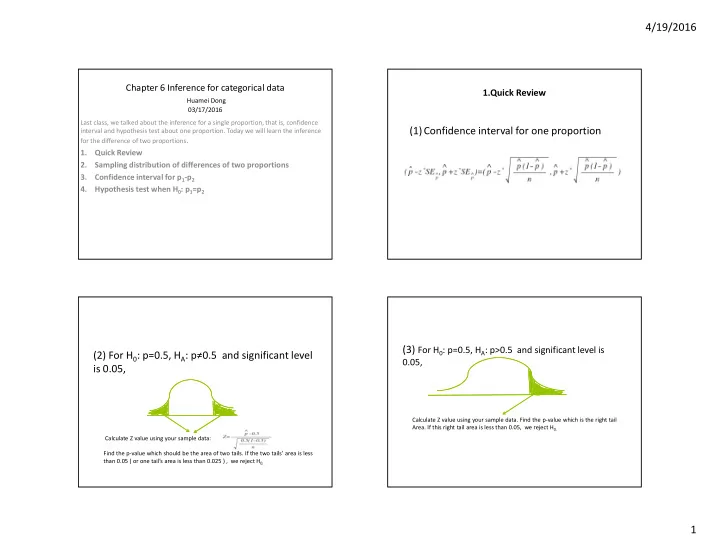
1.Quick Review

(1)Confidence interval for one proportion (2) For H0: p=0.5, HA: p≠0.5 and significant level is 0.05,

Calculate Z value using your sample data: Find the p-value which should be the area of two tails. If the two tails’ area is less than 0.05 ( or one tail’s area is less than 0.025 ) , we reject H0.

(3) For H0: p=0.5, HA: p>0.5 and significant level is

0.05,

Calculate Z value using your sample data. Find the p-value which is the right tail

  • Area. If this right tail area is less than 0.05, we reject H0.
slide-2
SLIDE 2

4/19/2016 2 (4) For H0: p=0.5, HA: p<0.5 and significant level is 0.05, we

Calculate Z value using your sample data. Find the p-value which is the left tail

  • Area. If this left tail area is less than 0.05, we reject H0.
  • 2. Sampling distribution of the difference of two proportions

Sampling distribution of :

Assume the true proportion for population 1 is , sample size from population 1 is , the true proportion for population 2 is , sample size from population 2 is . (1) If samples from population 1 are independent of each other and (2) If samples from population 2 are independent of each other and (3) Samples from population 1 and samples from population 2 are independent. Then the sampling distribution of is nearly normal with mean And standard error

  • 3. Confidence interval for p1-p2

Constructing a confidence interval for a proportion.

(1) Verify the observations are independent and verify the success- failure condition using (2) If the condition are met, the sampling distribution of is nearly normal. (3) Standard error can be approximated by

(4) Confidence interval is

  • 4. Hypothesis test when H0: p1=p2

If we do the hypothesis test when H0: p1=p2, we use to verify the success-failure condition, that is to verify We also calculate standard error using , , that is

slide-3
SLIDE 3

4/19/2016 3

Example1 There were 50 patients in the experiment who did not receive the blood

thinner and 40 patients who did.(1) What is the observed survival rate in the control group? (2) And in the treatment group?(3) Provide a point estimate of the difference in survival proportion of the two groups: (4) Find 95% confidence interval for (5) Complete hypothesis test whether the blood thinner are helpful or harmful at significant level of 0.05. Answer: (1) (2) (3) (4) To find 95% confidence interval, we need check the success-failure condition: We can just check the table to see if the successes are bigger or equal to 10, the failures are bigger or equal to 10. Or you can use Survived Died Total Control 11 39 50 Treatment 14 26 40 Total 25 65 90

Standard error is So the confidence interval is

(5) H0 : pt=pc HA : pt ≠ pc Check the success-failure condition using So the conditions is satisfied. Now we need estimate the standard error using

If we use the Z table, we find the one side tail is 0.0853. So the p-value is 0.176. So we don’t reject H0. Area is 0.0853 This area is 0.0853, too. Z=1.37

slide-4
SLIDE 4

4/19/2016 4

Homework on 03/17/16: (due 03/24/16)

  • 1. Using the data (breast_cancel.txt)

(a) To calculate a 95% confidence interval for the difference between the proportion of women under 55 for those who underwent a radical mastectomy and the proportion of women under 55 for those who underwent a partial mastectomy accompanied by radiation therapy. (b) Test whether two proportions are equal at significance level of 0.05.

  • 2. Using the data you sampled on 03/15/16 and the data your classmate sampled:

(a) To calculate a 95% confidence interval for the difference between two proportions (b) Test whether two proportions are equal at significance level of 0.05.