Changing Farm Structure and Agricultural Commercialization: - - PowerPoint PPT Presentation

changing farm structure and agricultural
SMART_READER_LITE
LIVE PREVIEW

Changing Farm Structure and Agricultural Commercialization: - - PowerPoint PPT Presentation

Changing Farm Structure and Agricultural Commercialization: Implications for Livelihood Improvements among Small-Scale Farmers in Nigeria Adebayo B Aromolaran, Milu Muyanga, Thomas Jayne, Saweda Liverpool- Tasie, Titus Awokuse, Elijah Obayelu ,


slide-1
SLIDE 1

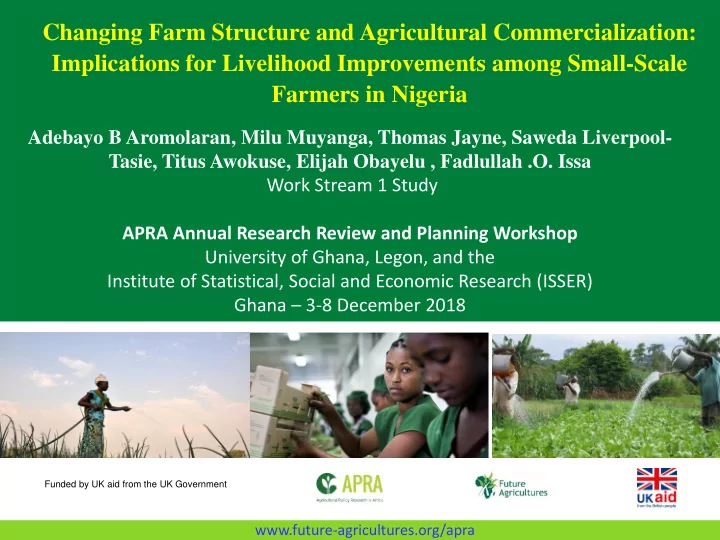
Changing Farm Structure and Agricultural Commercialization: Implications for Livelihood Improvements among Small-Scale Farmers in Nigeria

Adebayo B Aromolaran, Milu Muyanga, Thomas Jayne, Saweda Liverpool- Tasie, Titus Awokuse, Elijah Obayelu , Fadlullah .O. Issa Work Stream 1 Study APRA Annual Research Review and Planning Workshop University of Ghana, Legon, and the Institute of Statistical, Social and Economic Research (ISSER) Ghana – 3-8 December 2018

Funded by UK aid from the UK Government

www.future-agricultures.org/apra

slide-2
SLIDE 2

www.future-agricultures.org/apra

Introduction

  • In the past, national development policy strategies within

the SSA region officially regard the smallholder farming sector as the main vehicle for achieving sustainable and inclusive growth in the agricultural sector.

  • However, the recent wave of rise of medium scale farms

across SSA is providing an alternative pathway to food security, poverty reduction, and employment.

  • These changing farm structures is expected to impact to

the livelihood outcomes of the millions of smallholder farms through the growth of commercialization

slide-3
SLIDE 3

www.future-agricultures.org/apra

Research Questions

  • i. What are the characteristics of the emerging medium-scale farms?
  • ii. Are there productivity differences between small and medium-scale

farms? iii.How do these MSFs influence the behavior and welfare of the millions of small-scale farm households around them? iv.Are there differences in welfare of medium scale farm households compared with small scale farm households ?

  • v. Should Medium Scale Investor farms be promoted as a policy tool to

promote agricultural commercialization and transformation?

slide-4
SLIDE 4

Map Of Nigeria showing APRA WS1 & WS3 Study Locations

slide-5
SLIDE 5

www.future-agricultures.org/apra

Key Findings (1)

Basic Types of MSFs identified: Stepping Up: MSFs who Transitioned from SSFs (TMSFs) Stepping In : MSF who started off as Medium Scale Farms (CMSFs) Stepping-up is more common ( 40%) than Stepping-in ( 24%) in past 8 years (2010 -2018) Land Use Patterns : Non-staple food crops are more common with MSFs relative to SSFs Productivity Differences Land Productivity: SSFs greater than MSFs Labour Productivity: MSFs greater than SSFs Productivity (both land and Labour) : CMSFs greater than TMSFs

slide-6
SLIDE 6

www.future-agricultures.org/apra

Key Findings (2)

Degree of Commercialization: HCI: “Stepped Up” MSFs (72%) higher than Small Scale Farms (63%) HIMCI: Stepped Up” MSFs (15%) higher than Small Scale Farms(10%) Spill–Over Effects : Providing extension services/information in terms of use of improved seeds and better planting techniques is most common form of Interaction between MSFs and SSFs

slide-7
SLIDE 7

www.future-agricultures.org/apra

Key Findings (3)

Welfare Indicators Income Poverty Index : Small Scale farm Households (SSFH) are poorer (IPI= 35%) than Medium Scale Farm households (MSFHs); (IPI=13 -14%) WEI : Women in MSFHs are more empowered (63% For TSMFs and 59% for CMSFs ) than women in SSFHs (56%) MDD_W: SSFHs ( 59%) are better than MSFHs ( 53% and 37%) MPI : MSFHs not different from SSFHs ( 20% -22%) Food Insecurity Experiences : MSFHs not different from SSFHs

(42-44%)

slide-8
SLIDE 8

www.future-agricultures.org/apra

Key Findings (4)

Some Key challenges for growth of MSFs

  • Security of tenure is very low among MSFs

as is with SSFs

  • Land acquisition through land markets is

Limited due to underdeveloped land markets

  • Inheritance, which is the most important

source of land for expansion, is unsustainable

slide-9
SLIDE 9

www.future-agricultures.org/apra

Highlights

i. Promoting Medium Scale farms could be an important policy tool for enhancing agricultural commercialization and smallholder transformation in Nigeria

  • ii. We observe that MSFs are better off than SSFs in terms of labor

productivity, degree of Commercialization, and some livelihood

  • utcomes such as poverty reduction and women empowerment
  • iii. The rise of MSFs can potentially enhance the transformation of SSFs

through observed spill-over effects

  • iv. To promote the growth of MSFs, policy will need to effectively address

the issue of land tenure security and increased access to land markets by prospective investors.

slide-10
SLIDE 10

NEXT STEPS : PLAN FOR 2019

1. Finalize WS#1 Report and Working Paper 2. Prepare at least four research papers and journal manuscripts i. Medium-scale farming as a pathway to agricultural commercialization in Nigeria ii. Relationship between Farm Size and Productivity: Evidence from Nigeria iii. Spillovers between medium- and smallholder farms iv. Do medium Scale Farm households have better livelihood

  • utcomes than small scale farming households:

3. Conduct qualitative data collection 4. Conduct stakeholder outreach event in Nigeria

10

www.future-agricultures.org/apra

slide-11
SLIDE 11

More Detailed Results Presentation

11

www.future-agricultures.org/apra

slide-12
SLIDE 12

www.future-agricultures.org/apra

Characteristics of MSFs : Basic Types The study identifies two basic categories of Medium scale farms:

  • i. Transition from small to medium scale

farms - “Stepping up group”

  • ii. Emergence of investor farmers that start
  • ff as medium scale level farmers-

”Stepping in group ”

slide-13
SLIDE 13

www.future-agricultures.org/apra

Figure 1 : Farm-types in the Commercialization Pathway

97.40% 2.60% 47.30% 52.70%

0.00% 20.00% 40.00% 60.00% 80.00% 100.00% 120.00%

Small Scale Medium-scale

Small-scale Medium-scale

slide-14
SLIDE 14

www.future-agricultures.org/apra

Identification of Pathways to Commercialization contd.

  • Stepping up rate has been low : 6%

stepping up in 3 decades

  • Stepping up is more important mode of

entry into medium scale farming witnin the past decade. 40% stepped up and 24% stepped in within 2010-2018

slide-15
SLIDE 15

www.future-agricultures.org/apra

Land Use Pattern Differences.

  • OGUN : Staple foods( Starch & Cereals )

more popular with SSFs; Non-staple crop groups (fruits, beverage (Cocoa) , oil seeds , nuts, pulses ) more common with MSFs.

  • Kaduna: all categories more common for

MSFs compared with SSFs

slide-16
SLIDE 16

www.future-agricultures.org/apra

Cropping Pattern Differences: Ogun State

100 200 300 400 500 600 Figure 9 : No of Farmers by Crop and Scale - OGUN Small Scale Medium Scale

slide-17
SLIDE 17

www.future-agricultures.org/apra

Cropping Pattern Differences: Kaduna State .

200 400 600 800 1,000 1,200 Figure 10 : No of Farmers by Crop and Scale- KADUNA Small Scale Medium Scale

slide-18
SLIDE 18

www.future-agricultures.org/apra

Characteristics of Pathways: Productivity Indicators

  • land and labor productivity are generally

higher for MSFs who “stepped in” relative to those who “stepped up”.

  • Land productivity declines with farm size,

while labor productivity increases with farm size.

slide-19
SLIDE 19

www.future-agricultures.org/apra

Productivity Indicators

100 200 300 400 500 600 700 800 900 Crop income per ha planted ‘000N Crop income per adult person ‘000N Crop income per day spent in the farm ‘000N Net income per adult equivalent ‘000N

Chart Title

CSSF TSSF TMSF CMSF

slide-20
SLIDE 20

www.future-agricultures.org/apra

Productivity Indicators by State (Ogun) : Net

Income(Y)/adult labor use (L2) Net Income (y) /Hectare, by farm size 0.00 500,000.00 1,000,000.00 1,500,000.00 2,000,000.00 2,500,000.00 3,000,000.00 3,500,000.00 4,000,000.00 4,500,000.00 below 2ha 2-5 ha 5-10 ha 10-20 ha 20 ha and over Y1 /L2 Y1/A L2/A

slide-21
SLIDE 21

www.future-agricultures.org/apra

Productivity Indicators by State (Kaduna):

Net Income(Y)/adult labor use (L2) Net Income (y) /Hectare, by farm size

67,309.16 135,029.09 251,543.63 276,793.45 1,589,853.52

0.00 200,000.00 400,000.00 600,000.00 800,000.00 1,000,000.00 1,200,000.00 1,400,000.00 1,600,000.00 1,800,000.00 below 2ha 2-5 ha 5-10 ha 10-20 ha 20 ha and over

Y1/L2 Y1/A L2/A

slide-22
SLIDE 22

www.future-agricultures.org/apra

Characteristics of Pathways: Levels of Commercialization Medium Scale Farms who “stepped up” (TMSF) Have attained: Higher degrees of commercialization Compared with: Small Scale Farms who “hanged in” (CSSF) In both: Input and output markets

slide-23
SLIDE 23

www.future-agricultures.org/apra

Characteristics of Pathways: Levels of Commercialization

Current farm scale Small-scale Medium-scale Farm scale when household started farming Farm scale when household started farming Small-scale (CSSF) Medium-scale (TSSF) Small-scale (TMSF) Medium-scale (CMSF) N 1065 34 476 534 Household commercializati

  • n index

62.78 62.71 71.92 61.07 Household Input Market Commercializati

  • n Index (

HIMCI) 10% 18% 15% 9%

slide-24
SLIDE 24

www.future-agricultures.org/apra

Spillover Effects

MSFs interacts with SSFs in the following economically beneficial ways, in order of importance : i. Provision of extension guide/services ii. Sales of farm inputs to smallholders,

  • iii. Joint purchase of farms inputs

iv. Rentals of tractor and farm machinery services

slide-25
SLIDE 25

www.future-agricultures.org/apra

Spillover Effects: Services from MSFs to SSFs

0% 10% 20% 30% 40% 50% 60% Services Formerly Small- Scale, now MS (TMSF) Services Consistently Medium-Scale (CMSF)

slide-26
SLIDE 26

www.future-agricultures.org/apra

Extension Service Provided by MSFs : Common forms

  • i. Use of improved seeds (40%)

ii.Better planting techniques (16.4%) iii.Use of tractor for land preparation (13.3%) iv.Better timing of farming activities (11.7%).

slide-27
SLIDE 27

www.future-agricultures.org/apra

Extension Service Provided by MSFs : Common forms

39.5 16.4 13.3 11.7 19.1

Percent

Use of improved seed Better planting techniques Use of tractor for land preparation Better timing of farming activities Other

slide-28
SLIDE 28

www.future-agricultures.org/apra

Welfare Indicators

  • i. Farms who remained as small scale were

poorer than those who stepped up to MSFs

  • ii. Women from households of Transitined

MSFs are more empowered relative to those from Small scale farming households

slide-29
SLIDE 29

www.future-agricultures.org/apra

Welfare Indicators

  • Preliminary Results Indicates

No Difference

  • between SSFs and MSFs in terms of both:
  • Minimum Dietary Diversity for Women

and

  • Food Insecurity Experience of Household
slide-30
SLIDE 30

www.future-agricultures.org/apra

Welfare Indicators

Current farm scale

Small-scale Medium-scale Farm scale when household started farming Farm scale when household started farming Small-scale (CSSF) Medium-scale (TSCF) Small-scale (TMSF) Medium- scale (CMSF)

N 1065 34 476 534 Income Poverty Index (Poverty Headcount) 35% 47% 13% 14% MPI 43% 55% 44% 50% MPI (adjusted) 20% 27% 21% 22% MDD_W 59% 48% 53% 37% Food Insecurity Experience Scale (FIES) 42% 48% 44% 42% Women Empowerment Index 56% 74% 63% 59%

slide-31
SLIDE 31

www.future-agricultures.org/apra

Welfare Indicators

0% 10% 20% 30% 40% 50% 60% 70% CSSF TMSF CMSF

slide-32
SLIDE 32

www.future-agricultures.org/apra

Key Challenges Characterising the rise of Medium Scale Farms

  • i. Security of tenure is very low among MSFs as

is with SSFs ii.Land acquisition through land markets is Limited due to underdeveloped land markets iii.Inheritance, which is the most important source of land for expansion, is unsustainable

slide-33
SLIDE 33

www.future-agricultures.org/apra

APRA Nigeria WS1 & 3 Data Collection Staff

slide-34
SLIDE 34

www.future-agricultures.org/apra

APRA Nigeria Stakeholders Meeting 2018 Collection Staff

slide-35
SLIDE 35

www.future-agricultures.org/apra

Visit of APRA Nigeria WS1 Leadership to The

Permanent Secretary, Kaduna State Ministry of Agriculture

slide-36
SLIDE 36

www.future-agricultures.org/apra

Visit of APRA Nigeria WS1 Leadership to The

Permanent Secretary, Ogun State Ministry of Agriculture

slide-37
SLIDE 37

www.future-agricultures.org/apra

APRA Nigeria WS1 Field Staff in a periodical data collection

review meeting with Country and Ogun State Coordinators, at Obafemi Owode LGA, Ogun State, April 2018