
SLIDE 1
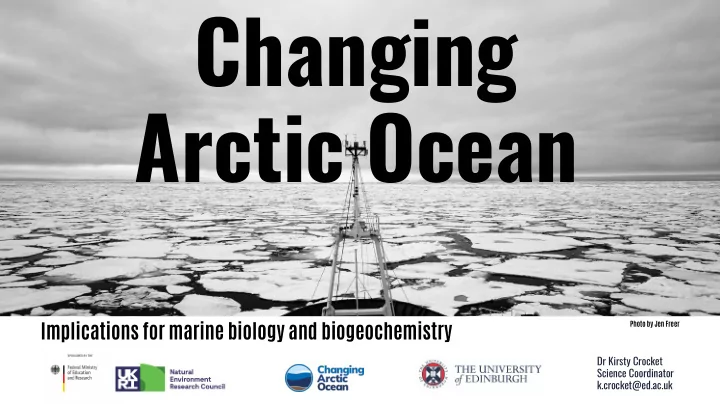
Changing Arctic Ocean
Dr Kirsty Crocket Science Coordinator k.crocket@ed.ac.uk
Photo by Jen FreerImplications for marine biology and biogeochemistry
Changing Arctic Ocean Implications for marine biology and - - PowerPoint PPT Presentation
Changing Arctic Ocean Implications for marine biology and biogeochemistry Photo by Jen Freer Dr Kirsty Crocket Science Coordinator k.crocket@ed.ac.uk GLOBAL WARMING RETREAT OF SEA ICE NEW PHYSICAL STATE Photo by Jen Freer Changing Arctic
Dr Kirsty Crocket Science Coordinator k.crocket@ed.ac.uk
Photo by Jen FreerImplications for marine biology and biogeochemistry
Photo by Jen Freer
Photo by Jen FreerChanging Arctic Ocean: Implications for marine biology and biogeochemistry
Average air temperature anomaly in JUNE 2020
relative to 1981-2010 baseline
Figure from Zack Labe ~ @ZLabe ~ https://sites.uci.edu/zlabe/ Data source: http://www.esrl.noaa.gov/psd/
Figure from Zack Labe ~ @ZLabe ~ https://sites.uci.edu/zlabe/
Arctic Basin Sea Ice
Data: National Snow & Ice Data Center, USA (Sea Ice Index v3)
Updated 3 July 2020
Figure from the 2018 Arctic Report Card
Loss of sea ice older than 4 years
comparison March 1985 to March 2018
March 1985 March 2018
Figure from Zack Labe ~ @ZLabe ~ https://sites.uci.edu/zlabe/
Arctic Sea Ice 1979-2020 Volume
Data: PIOMAS v2.1 (Zhang and Rothrock, 2003)
Thickness
Figure from Zack Labe ~ @ZLabe ~ https://sites.uci.edu/zlabe/ Data: National Snow & Ice Data Center, USA (Sea Ice Index v3)
East Siberian + Laptev + Kara Seas 1979-2020
Figure from Zack Labe ~ @ZLabe ~ https://sites.uci.edu/zlabe/
Reconstruction of Arctic sea ice extent: AD 561 to modern
Years AD
Reconstruction data: Kinnard et al., 2011
Warming
Figures from Zack Labe ~ @ZLabe ~ https://sites.uci.edu/zlabe/
Reduction in sea ice extent, volume and thickness
Figures from Zack Labe ~ @ZLabe ~ https://sites.uci.edu/zlabe/
Warming Record anomalies No recent precedent Reduction in sea ice extent, volume and thickness
Figures from Zack Labe ~ @ZLabe ~ https://sites.uci.edu/zlabe/
Extreme, unprecedented, rapid change
Reduction in sea ice extent, volume and thickness Warming Record anomalies No recent precedent
Photo by Callum Whyte
Why is it important to know about change in the Arctic Ocean?
Photo by Callum Whyte
Why is it important to know about change in the Arctic Ocean?
Implications for marine biology and biogeochemistry
Photo by Jen Freer
Understanding and quantifying the impacts of climate change
5-year programme
2017-2022
Dual national funding
UK and Germany
w w w . c h a n g i n g - a r c t i c - o c e a n . a c . u k
@ N E R C _ C A O
@ n e r c _ c a o
16 projects
32 research institutions
T o d e v e l o p a q u a n t i f i e d u n d e r s t a n d i n g o f t h e s t r u c t u r e a n d f u n c t i o n i n g o f A r c t i c O c e a n e c o s y s t e m s
A quantified understanding
T o u n d e r s t a n d t h e s e n s i t i v i t y t o m u l t i p l e s t r e s s o r s ; T o d e v e l o p p r o j e c t i o n s o f c h a n g e
Sensitivity to change and future projections
Photo by Callum Whyte
Arctic PRIZE ChAOS ARISE DIAPOD
How does Arctic change affect Calanus, a key Arctic species? How do changes in the surface ocean affect seafloor processes? Can we detect changes in Arctic ecosystems? How does seasonal sea ice control Arctic productivity?
2017 - 2021
P r o f F i n l o C o t t i e r P r o f C l a i r e M a h a f f e y D r C h r i s t i a n M a e r z P r o f D a v i d P o n d
w w w . c h a n g i n g - a r c t i c - o c e a n . a c . u k
@ N E R C _ C A O
@ n e r c _ c a o
2018-2021
w w w . c h a n g i n g - a r c t i c - o c e a n . a c . u k
@ N E R C _ C A O
@ n e r c _ c a o
PEANUTS CACOON
Coldfish Micro-ARC
APEAR LOMVIA Eco-Light Diatom- ARCTIC MiMeMo EISPAC CHASE PETRA
Key Arctic fish response Fishery yields
Influx of Atlantic and Pacific waters Under-ice light field Sea-ice algae Biological clock Climate-active gases Contaminant cycling Ecosystem competition Permafrost thaw Pelagic microbial ecosystem Ocean circulation and nutrients
@ N E R C _ C A O
@ n e r c _ c a o w w w . c h a n g i n g - a r c t i c - o c e a n . a c . u k
@ N E R C _ C A O
@ n e r c _ c a o w w w . c h a n g i n g - a r c t i c - o c e a n . a c . u k
> 2 0 0 i n v e s t i g a t o r s a t 3 2 r e s e a r c h o r g a n i s a t i o n s
@ N E R C _ C A O
@ n e r c _ c a o w w w . c h a n g i n g - a r c t i c - o c e a n . a c . u k
> 2 0 0 i n v e s t i g a t o r s a t 3 2 r e s e a r c h o r g a n i s a t i o n s C o l l a b o r a t i o n w i t h s c i e n t i s t s i n 1 5 o t h e r c o u n t r i e s
@ N E R C _ C A O
@ n e r c _ c a o w w w . c h a n g i n g - a r c t i c - o c e a n . a c . u k
> 2 0 0 i n v e s t i g a t o r s a t 3 2 r e s e a r c h o r g a n i s a t i o n s C o l l a b o r a t i o n w i t h p o l i c y m a k e r s C o l l a b o r a t i o n w i t h s c i e n t i s t s i n 1 5 o t h e r c o u n t r i e s
@ N E R C _ C A O
@ n e r c _ c a o w w w . c h a n g i n g - a r c t i c - o c e a n . a c . u k
Participation on Arctic cruises International cruise funding source
Policy orientation document (autumn 2020) Overview of the programme Project descriptions and policy- relevant outputs Science areas International collaborators https://www.changing-arctic-ocean.ac.uk/science-outputs/science-in-policy/
Prof Crispin Halsall co-lead author of Chapter 2.2, along with Dr Hayley Hung EISPAC contribution to Chapter 2.2 Physical Environment, Levels and Trends Science from sea ice chamber experiments Quantification of the uptake, accumulation and release of chemical contaminants in sea ice
EISPAC
Project leaders
Prof Crispin Halsall Lancaster University, UK c.halsall@lancaster.ac.uk Dr Kirstin Dähnke Helmholtz-Zentrum Geesthacht, Germany kirstin.daehnke@hzg.de"Persistent Organic Pollutants (POPs) and Climate Change"
Assessment Report (submitted June 2020, publication imminent)
Science input to policy
Direct input of the Assessment Report to inform the Arctic Council Contributes to setting the pan-Arctic environmental strategy for the Arctic Nations Provides evidence for the UNEP Stockholm Convention on POPs and the UNECE Convention on long range, transboundary air pollution (LRTAP)
PEANUTS
Project leaders
Dr Yueng-Djern Lenn Bangor University, UK y.lenn@bangor.ac.uk Dr Markus Janout Alfred Wegener Institute, Germany markus.janout@awi.deArctic oceanographic data
Key science outputs: The project is communicating key science outputs to Dstl Baseline estimates of vertical mixing, stratification, turbulence, heat content and circulation Development of methods for satellite data interpretation to inform on water column structure and heat content Delivery of datasets that demonstrate turbulent mixing on the Beaufort Slope (a first) and on the Laptev slope
Eco-Light
Dr Jeremy Wilkinson British Antarctic Survey, UK jpw28@bas.ac.uk Dr Giulia Castellani Alfred Wegener Institute, Germany giulia.castellani@awi.deThis technology has applications beyond the polar regions.
Robotics and artificial intelligence
Project leaders
Eco-Light have developed and deployed innovative robotic technology that provides a year-round presence in the Arctic Ocean. To better understand the Arctic marine system, year-round measurements of key parameters are essential These robots constantly monitor the marine environment and transmit physical and biological data, via satellites, to the UK in near real time.
Ocean properties: Salinity, temperature, oxygen… Atmospheric properties: Wind speed & direction, air pressure, humidity… Sea ice and snow properties: Thickness and temperature Biological properties: Zooplankton (animals) and phytoplankton (plants) concentrations Sunlight properties: Above and below sea ice Time-lapse images: Above and below sea ice
Photo: Valcic2012 Marginal Ice Zone (MIZ) 2016 Stratified Ocean Dynamics in the Arctic (SODA) 2017 Changing Arctic Ocean 2019 Arctic Mobile Observing System (AMOS)
"Ambio" special issue
Publication in February 2022
Summary articles of key scientific outputs Aimed at stakeholder audience
Final programme event
Late 2021
Programme highlights UK-based In-person & on-line participation
COP26
November 2021
Key conclusions
www.changing-arctic-ocean.ac.uk
Stay updated...
@NERC_CAO
@NERC_CAO @nerc_cao Dr Kirsty Crocket Science Coordinator University of Edinburgh k.crocket@ed.ac.uk www.changing-arctic-ocean.ac.uk
Photo: Johan FaustWith thanks to Zack Labe for permission to use his figures ~ @ZLabe ~ https://sites.uci.edu/zlabe/