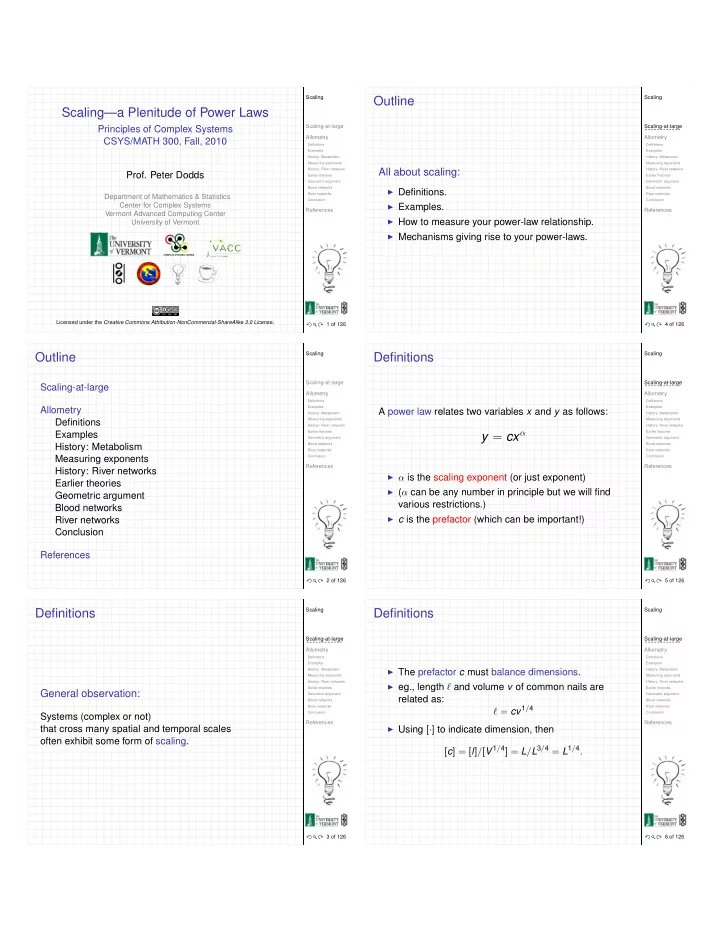
Outline Scalinga Plenitude of Power Laws Scaling-at-large - - PDF document

outline scaling a plenitude of power laws
SMART_READER_LITE
LIVE PREVIEW

Outline Scalinga Plenitude of Power Laws Scaling-at-large - - PDF document

Scaling Scaling Outline Scalinga Plenitude of Power Laws Scaling-at-large Scaling-at-large Principles of Complex Systems Allometry Allometry CSYS/MATH 300, Fall, 2010 Definitions Definitions Examples Examples History: Metabolism


slide-1
SLIDE 1

Scaling Scaling-at-large Allometry

Definitions Examples History: Metabolism Measuring exponents History: River networks Earlier theories Geometric argument Blood networks River networks Conclusion

References 1 of 126

Scaling—a Plenitude of Power Laws

Principles of Complex Systems CSYS/MATH 300, Fall, 2010

  • Prof. Peter Dodds

Department of Mathematics & Statistics Center for Complex Systems Vermont Advanced Computing Center University of Vermont

Licensed under the Creative Commons Attribution-NonCommercial-ShareAlike 3.0 License. Scaling Scaling-at-large Allometry

Definitions Examples History: Metabolism Measuring exponents History: River networks Earlier theories Geometric argument Blood networks River networks Conclusion

References 2 of 126

Outline

Scaling-at-large Allometry Definitions Examples History: Metabolism Measuring exponents History: River networks Earlier theories Geometric argument Blood networks River networks Conclusion References

Scaling Scaling-at-large Allometry

Definitions Examples History: Metabolism Measuring exponents History: River networks Earlier theories Geometric argument Blood networks River networks Conclusion

References 3 of 126

Definitions

General observation:

Systems (complex or not) that cross many spatial and temporal scales

  • ften exhibit some form of scaling.

Scaling Scaling-at-large Allometry

Definitions Examples History: Metabolism Measuring exponents History: River networks Earlier theories Geometric argument Blood networks River networks Conclusion

References 4 of 126

Outline

All about scaling:

◮ Definitions. ◮ Examples. ◮ How to measure your power-law relationship. ◮ Mechanisms giving rise to your power-laws.

Scaling Scaling-at-large Allometry

Definitions Examples History: Metabolism Measuring exponents History: River networks Earlier theories Geometric argument Blood networks River networks Conclusion

References 5 of 126

Definitions

A power law relates two variables x and y as follows:

y = cxα

◮ α is the scaling exponent (or just exponent) ◮ (α can be any number in principle but we will find

various restrictions.)

◮ c is the prefactor (which can be important!)

Scaling Scaling-at-large Allometry

Definitions Examples History: Metabolism Measuring exponents History: River networks Earlier theories Geometric argument Blood networks River networks Conclusion

References 6 of 126

Definitions

◮ The prefactor c must balance dimensions. ◮ eg., length ℓ and volume v of common nails are

related as: ℓ = cv1/4

◮ Using [·] to indicate dimension, then

[c] = [l]/[V 1/4] = L/L3/4 = L1/4.

slide-2
SLIDE 2

Scaling Scaling-at-large Allometry

Definitions Examples History: Metabolism Measuring exponents History: River networks Earlier theories Geometric argument Blood networks River networks Conclusion

References 7 of 126

Looking at data

◮ Power-law relationships are linear in log-log space:

y = cxα ⇒ logb y = α logb x + logb c with slope equal to α, the scaling exponent.

◮ Much searching for straight lines on log-log or

double-logarithmic plots.

◮ Good practice: Always, always, always use base 10. ◮ Talk only about orders of magnitude (powers of 10).

Scaling Scaling-at-large Allometry

Definitions Examples History: Metabolism Measuring exponents History: River networks Earlier theories Geometric argument Blood networks River networks Conclusion

References 8 of 126

A beautiful, heart-warming example:

α ≃ 1.23 gray matter: ‘computing elements’ white matter: ‘wiring’

from Zhang & Sejnowski, PNAS (2000) [41]

Scaling Scaling-at-large Allometry

Definitions Examples History: Metabolism Measuring exponents History: River networks Earlier theories Geometric argument Blood networks River networks Conclusion

References 9 of 126

Why is α ≃ 1.23?

Quantities (following Zhang and Sejnowski):

◮ G = Volume of gray matter (cortex/processors) ◮ W = Volume of white matter (wiring) ◮ T = Cortical thickness (wiring) ◮ S = Cortical surface area ◮ L = Average length of white matter fibers ◮ p = density of axons on white matter/cortex interface

A rough understanding:

◮ G ∼ ST (convolutions are okay) ◮ W ∼ 1 2pSL ◮ G ∼ L3 ← this is a little sketchy... ◮ Eliminate S and L to find W ∝ G 4/3/T

Scaling Scaling-at-large Allometry

Definitions Examples History: Metabolism Measuring exponents History: River networks Earlier theories Geometric argument Blood networks River networks Conclusion

References 10 of 126

Why is α ≃ 1.23?

A rough understanding:

◮ We are here: W ∝ G 4/3/T ◮ Observe weak scaling T ∝ G 0.10±0.02. ◮ (Implies S ∝ G 0.9 → convolutions fill space.) ◮ ⇒ W ∝ G 4/3/T ∝ G 1.23±0.02

Scaling Scaling-at-large Allometry

Definitions Examples History: Metabolism Measuring exponents History: River networks Earlier theories Geometric argument Blood networks River networks Conclusion

References 11 of 126

Why is α ≃ 1.23?

Trickiness:

◮ With V = G + W, some power laws must be

approximations.

◮ Measuring exponents is a hairy business...

Scaling Scaling-at-large Allometry

Definitions Examples History: Metabolism Measuring exponents History: River networks Earlier theories Geometric argument Blood networks River networks Conclusion

References 12 of 126

Good scaling:

General rules of thumb:

◮ High quality: scaling persists over

three or more orders of magnitude for each variable.

◮ Medium quality: scaling persists over

three or more orders of magnitude for only one variable and at least one for the other.

◮ Very dubious: scaling ‘persists’ over

less than an order of magnitude for both variables.

slide-3
SLIDE 3

Scaling Scaling-at-large Allometry

Definitions Examples History: Metabolism Measuring exponents History: River networks Earlier theories Geometric argument Blood networks River networks Conclusion

References 13 of 126

Unconvincing scaling:

Average walking speed as a function of city population:

Two problems:

  • 1. use of natural log, and
  • 2. minute varation in

dependent variable.

from Bettencourt et al. (2007) [4]; otherwise very interesting!

Scaling Scaling-at-large Allometry

Definitions Examples History: Metabolism Measuring exponents History: River networks Earlier theories Geometric argument Blood networks River networks Conclusion

References 14 of 126

Definitions

Power laws are the signature of scale invariance:

Scale invariant ‘objects’ look the ‘same’ when they are appropriately rescaled.

◮ Objects = geometric shapes, time series, functions,

relationships, distributions,...

◮ ‘Same’ might be ‘statistically the same’ ◮ To rescale means to change the units of

measurement for the relevant variables

Scaling Scaling-at-large Allometry

Definitions Examples History: Metabolism Measuring exponents History: River networks Earlier theories Geometric argument Blood networks River networks Conclusion

References 15 of 126

Scale invariance

Our friend y = cxα:

◮ If we rescale x as x = rx′ and y as y = r αy′, ◮ then

r αy′ = c(rx′)α

⇒ y′ = cr αx′αr −α

⇒ y′ = cx′α

Scaling Scaling-at-large Allometry

Definitions Examples History: Metabolism Measuring exponents History: River networks Earlier theories Geometric argument Blood networks River networks Conclusion

References 16 of 126

Scale invariance

Compare with y = ce−λx:

◮ If we rescale x as x = rx′, then

y = ce−λrx′

◮ Original form cannot be recovered. ◮ ⇒ scale matters for the exponential.

Scaling Scaling-at-large Allometry

Definitions Examples History: Metabolism Measuring exponents History: River networks Earlier theories Geometric argument Blood networks River networks Conclusion

References 17 of 126

Scale invariance

More on y = ce−λx:

◮ Say x0 = 1/λ is the characteristic scale. ◮ For x ≫ x0, y is small,

while for x ≪ x0, y is large.

◮ ⇒ More on this later with size distributions.

Scaling Scaling-at-large Allometry

Definitions Examples History: Metabolism Measuring exponents History: River networks Earlier theories Geometric argument Blood networks River networks Conclusion

References 19 of 126

Definitions

Allometry: (⊞)

refers to differential growth rates of the parts of a living

  • rganism’s body part or process.

◮ First proposed by Huxley and Teissier, Nature, 1936

“Terminology of relative growth” [21]

slide-4
SLIDE 4

Scaling Scaling-at-large Allometry

Definitions Examples History: Metabolism Measuring exponents History: River networks Earlier theories Geometric argument Blood networks River networks Conclusion

References 20 of 126

Definitions:

Isometry: dimensions scale linearly with each

  • ther.

Allometry: dimensions scale nonlinearly.

Scaling Scaling-at-large Allometry

Definitions Examples History: Metabolism Measuring exponents History: River networks Earlier theories Geometric argument Blood networks River networks Conclusion

References 21 of 126

Definitions

Isometry versus Allometry:

◮ Isometry = ‘same measure’ ◮ Allometry = ‘other measure’

Confusingly, we use allometric scaling to refer to both:

  • 1. nonlinear scaling (e.g., x ∝ y1/3)
  • 2. and the relative scaling of different measures

(e.g., resting heart rate as a function of body size)

Scaling Scaling-at-large Allometry

Definitions Examples History: Metabolism Measuring exponents History: River networks Earlier theories Geometric argument Blood networks River networks Conclusion

References 23 of 126

A wonderful treatise on scaling:

McMahon and Bonner, 1983 [26]

Scaling Scaling-at-large Allometry

Definitions Examples History: Metabolism Measuring exponents History: River networks Earlier theories Geometric argument Blood networks River networks Conclusion

References 24 of 126

For the following slide:

  • p. 2, McMahon and Bonner[26]

Scaling Scaling-at-large Allometry

Definitions Examples History: Metabolism Measuring exponents History: River networks Earlier theories Geometric argument Blood networks River networks Conclusion

References 25 of 126

The many scales of life:

  • p. 2, McMahon and Bonner[26]

Scaling Scaling-at-large Allometry

Definitions Examples History: Metabolism Measuring exponents History: River networks Earlier theories Geometric argument Blood networks River networks Conclusion

References 26 of 126

For the following slide:

  • p. 2, McMahon and Bonner[26]
slide-5
SLIDE 5

Scaling Scaling-at-large Allometry

Definitions Examples History: Metabolism Measuring exponents History: River networks Earlier theories Geometric argument Blood networks River networks Conclusion

References 27 of 126

The many scales of life:

  • p. 3, McMahon and Bonner[26]

Scaling Scaling-at-large Allometry

Definitions Examples History: Metabolism Measuring exponents History: River networks Earlier theories Geometric argument Blood networks River networks Conclusion

References 28 of 126

For the following slide:

  • p. 2, McMahon and Bonner[26]

Scaling Scaling-at-large Allometry

Definitions Examples History: Metabolism Measuring exponents History: River networks Earlier theories Geometric argument Blood networks River networks Conclusion

References 29 of 126

The many scales of life:

  • p. 3, McMahon and Bonner[26]

Scaling Scaling-at-large Allometry

Definitions Examples History: Metabolism Measuring exponents History: River networks Earlier theories Geometric argument Blood networks River networks Conclusion

References 30 of 126

Size range and cell differentiation:

  • p. 3, McMahon and Bonner[26]

Scaling Scaling-at-large Allometry

Definitions Examples History: Metabolism Measuring exponents History: River networks Earlier theories Geometric argument Blood networks River networks Conclusion

References 31 of 126

Non-uniform growth:

  • p. 32, McMahon and Bonner[26]

Scaling Scaling-at-large Allometry

Definitions Examples History: Metabolism Measuring exponents History: River networks Earlier theories Geometric argument Blood networks River networks Conclusion

References 32 of 126

Non-uniform growth—arm length versus height:

Good example of a break in scaling: A crossover in scaling occurs around a height of 1 metre.

  • p. 32, McMahon and Bonner[26]
slide-6
SLIDE 6

Scaling Scaling-at-large Allometry

Definitions Examples History: Metabolism Measuring exponents History: River networks Earlier theories Geometric argument Blood networks River networks Conclusion

References 33 of 126

Weightlifting: Mworldrecord ∝ M 2/3

lifter

Idea: Power ∼ cross-sectional area of isometric lifters.

  • p. 53, McMahon and Bonner[26]

Scaling Scaling-at-large Allometry

Definitions Examples History: Metabolism Measuring exponents History: River networks Earlier theories Geometric argument Blood networks River networks Conclusion

References 34 of 126

Titanothere horns: Lhorn ∼ L4

skull

  • p. 36, McMahon and Bonner[26]

Scaling Scaling-at-large Allometry

Definitions Examples History: Metabolism Measuring exponents History: River networks Earlier theories Geometric argument Blood networks River networks Conclusion

References 35 of 126

The allometry of nails:

◮ Diameter ∝ Mass3/8 ◮ Length ∝ Mass1/4 ◮ Diameter ∝ Length2/3

  • p. 58–59, McMahon and Bonner[26]

Scaling Scaling-at-large Allometry

Definitions Examples History: Metabolism Measuring exponents History: River networks Earlier theories Geometric argument Blood networks River networks Conclusion

References 36 of 126

The allometry of nails:

A buckling instability?:

◮ Physics/Engineering result: Columns buckle under a

load which depends on d4/ℓ2.

◮ To drive nails in, resistive force ∝ nail circumference

= πd.

◮ Match forces independent of nail size: d4/ℓ2 ∝ d. ◮ Leads to d ∝ ℓ2/3. ◮ Argument made by Galileo [13] in 1638 in “Discourses

  • n Two New Sciences.” (⊞) [pdf] Also, see here (⊞).

◮ Also see McMahon, “Size and Shape in Biology,”

Science, 1973. [24]

Scaling Scaling-at-large Allometry

Definitions Examples History: Metabolism Measuring exponents History: River networks Earlier theories Geometric argument Blood networks River networks Conclusion

References 37 of 126

Rowing: Speed ∝ (number of rowers)1/9

Scaling Scaling-at-large Allometry

Definitions Examples History: Metabolism Measuring exponents History: River networks Earlier theories Geometric argument Blood networks River networks Conclusion

References 38 of 126

Scaling in Cities:

◮ “Growth, innovation, scaling, and the pace of life in

cities” Bettencourt et al., PNAS, 2007. [4]

◮ Quantified levels of

◮ Infrastructure ◮ Wealth ◮ Crime levels ◮ Disease ◮ Energy consumption

as a function of city size N (population).

slide-7
SLIDE 7

Scaling Scaling-at-large Allometry

Definitions Examples History: Metabolism Measuring exponents History: River networks Earlier theories Geometric argument Blood networks River networks Conclusion

References 39 of 126

Scaling in Cities:

Table 1. Scaling exponents for urban indicators vs. city size Y

  • 95% CI

Adj-R2 Observations Country–year New patents 1.27 1.25,1.29 0.72 331 U.S. 2001 Inventors 1.25 1.22,1.27 0.76 331 U.S. 2001 Private R&D employment 1.34 1.29,1.39 0.92 266 U.S. 2002 Supercreative employment 1.15 1.11,1.18 0.89 287 U.S. 2003 R&D establishments 1.19 1.14,1.22 0.77 287 U.S. 1997 R&D employment 1.26 1.18,1.43 0.93 295 China 2002 Total wages 1.12 1.09,1.13 0.96 361 U.S. 2002 Total bank deposits 1.08 1.03,1.11 0.91 267 U.S. 1996 GDP 1.15 1.06,1.23 0.96 295 China 2002 GDP 1.26 1.09,1.46 0.64 196 EU 1999–2003 GDP 1.13 1.03,1.23 0.94 37 Germany 2003 Total electrical consumption 1.07 1.03,1.11 0.88 392 Germany 2002 New AIDS cases 1.23 1.18,1.29 0.76 93 U.S. 2002–2003 Serious crimes 1.16 [1.11, 1.18] 0.89 287 U.S. 2003 Total housing 1.00 0.99,1.01 0.99 316 U.S. 1990 Total employment 1.01 0.99,1.02 0.98 331 U.S. 2001 Household electrical consumption 1.00 0.94,1.06 0.88 377 Germany 2002 Household electrical consumption 1.05 0.89,1.22 0.91 295 China 2002 Household water consumption 1.01 0.89,1.11 0.96 295 China 2002 Gasoline stations 0.77 0.74,0.81 0.93 318 U.S. 2001 Gasoline sales 0.79 0.73,0.80 0.94 318 U.S. 2001 Length of electrical cables 0.87 0.82,0.92 0.75 380 Germany 2002 Road surface 0.83 0.74,0.92 0.87 29 Germany 2002 Data sources are shown in SI Text. CI, confidence interval; Adj-R2, adjusted R2; GDP, gross domestic product. Scaling Scaling-at-large Allometry

Definitions Examples History: Metabolism Measuring exponents History: River networks Earlier theories Geometric argument Blood networks River networks Conclusion

References 40 of 126

Scaling in Cities:

Intriguing findings:

◮ Global supply costs scale sublinearly with N (β < 1).

◮ Returns to scale for infrastructure.

◮ Total individual costs scale linearly with N (β = 1)

◮ Individuals consume similar amounts independent of

city size.

◮ Social quantities scale superlinearly with N (β > 1)

◮ Creativity (# patents), wealth, disease, crime, ...

Density doesn’t seem to matter...

◮ Surprising given that across the world, we observe

two orders of magnitude variation in area covered by agglomerations of fixed populations.

Scaling Scaling-at-large Allometry

Definitions Examples History: Metabolism Measuring exponents History: River networks Earlier theories Geometric argument Blood networks River networks Conclusion

References 41 of 126

Ecology—Species-area law: Nspecies ∝ A β

Allegedly (data is messy):

◮ On islands: β ≈ 1/4. ◮ On continuous land: β ≈ 1/8.

Scaling Scaling-at-large Allometry

Definitions Examples History: Metabolism Measuring exponents History: River networks Earlier theories Geometric argument Blood networks River networks Conclusion

References 42 of 126

A focus:

◮ How much energy do organisms need to live? ◮ And how does this scale with organismal size?

Scaling Scaling-at-large Allometry

Definitions Examples History: Metabolism Measuring exponents History: River networks Earlier theories Geometric argument Blood networks River networks Conclusion

References 44 of 126

Animal power

Fundamental biological and ecological constraint: P = c M α P = basal metabolic rate M = organismal body mass

Scaling Scaling-at-large Allometry

Definitions Examples History: Metabolism Measuring exponents History: River networks Earlier theories Geometric argument Blood networks River networks Conclusion

References 45 of 126

P = c M α

Prefactor c depends on body plan and body temperature: Birds 39–41 ◦C Eutherian Mammals 36–38 ◦C Marsupials 34–36 ◦C Monotremes 30–31 ◦C

slide-8
SLIDE 8

Scaling Scaling-at-large Allometry

Definitions Examples History: Metabolism Measuring exponents History: River networks Earlier theories Geometric argument Blood networks River networks Conclusion

References 46 of 126

What one might expect:

α = 2/3 because . . .

◮ Dimensional analysis suggests

an energy balance surface law: P ∝ S ∝ V 2/3 ∝ M 2/3

◮ Lognormal fluctuations:

Gaussian fluctuations in log P around log cMα.

◮ Stefan-Boltzmann law (⊞) for radiated energy:

dE dt = σεST 4 ∝ S

Scaling Scaling-at-large Allometry

Definitions Examples History: Metabolism Measuring exponents History: River networks Earlier theories Geometric argument Blood networks River networks Conclusion

References 47 of 126

The prevailing belief of the church of quarterology

α = 3/4 P ∝ M 3/4 Huh?

Scaling Scaling-at-large Allometry

Definitions Examples History: Metabolism Measuring exponents History: River networks Earlier theories Geometric argument Blood networks River networks Conclusion

References 48 of 126

Related putative scalings:

◮ number of capillaries ∝ M 3/4 ◮ time to reproductive maturity ∝ M 1/4 ◮ heart rate ∝ M −1/4 ◮ cross-sectional area of aorta ∝ M 3/4 ◮ population density ∝ M −3/4

Scaling Scaling-at-large Allometry

Definitions Examples History: Metabolism Measuring exponents History: River networks Earlier theories Geometric argument Blood networks River networks Conclusion

References 49 of 126

The great ‘law’ of heartbeats:

Assuming:

◮ Average lifespan ∝ Mβ ◮ Average heart rate ∝ M−β ◮ Irrelevant but perhaps β = 1/4.

Then:

◮ Average number of heart beats in a lifespan

≃ (Average lifespan) × (Average heart rate) ∝ Mβ−β ∝ M0

◮ Number of heartbeats per life time is independent of

  • rganism size!

◮ ≈ 1.5 billion....

Scaling Scaling-at-large Allometry

Definitions Examples History: Metabolism Measuring exponents History: River networks Earlier theories Geometric argument Blood networks River networks Conclusion

References 50 of 126

History

1840’s: Sarrus and Rameaux [33] first suggested α = 2/3.

Scaling Scaling-at-large Allometry

Definitions Examples History: Metabolism Measuring exponents History: River networks Earlier theories Geometric argument Blood networks River networks Conclusion

References 51 of 126

History

1883: Rubner [31] found α ≃ 2/3.

slide-9
SLIDE 9

Scaling Scaling-at-large Allometry

Definitions Examples History: Metabolism Measuring exponents History: River networks Earlier theories Geometric argument Blood networks River networks Conclusion

References 52 of 126

History

1930’s: Brody, Benedict study mammals. [7] Found α ≃ 0.73 (standard).

Scaling Scaling-at-large Allometry

Definitions Examples History: Metabolism Measuring exponents History: River networks Earlier theories Geometric argument Blood networks River networks Conclusion

References 53 of 126

History

1932: Kleiber analyzed 13 mammals. [22] Found α = 0.76 and suggested α = 3/4.

Scaling Scaling-at-large Allometry

Definitions Examples History: Metabolism Measuring exponents History: River networks Earlier theories Geometric argument Blood networks River networks Conclusion

References 54 of 126

History

1950/1960: Hemmingsen [18, 19] Extension to unicellular organisms. α = 3/4 assumed true.

Scaling Scaling-at-large Allometry

Definitions Examples History: Metabolism Measuring exponents History: River networks Earlier theories Geometric argument Blood networks River networks Conclusion

References 55 of 126

History

1964: Troon, Scotland: [5] 3rd symposium on energy metabolism. α = 3/4 made official . . . . . . 29 to zip.

Scaling Scaling-at-large Allometry

Definitions Examples History: Metabolism Measuring exponents History: River networks Earlier theories Geometric argument Blood networks River networks Conclusion

References 56 of 126

Today

◮ 3/4 is held by many to be the one true exponent.

In the Beat of a Heart: Life, Energy, and the Unity of Nature—by John Whitfield

◮ But—much controversy... ◮ See ‘Re-examination of the “3/4-law” of metabolism’

Dodds, Rothman, and Weitz [11] and ensuing madness...

Scaling Scaling-at-large Allometry

Definitions Examples History: Metabolism Measuring exponents History: River networks Earlier theories Geometric argument Blood networks River networks Conclusion

References 57 of 126

Some data on metabolic rates

1 2 3 4 5 6 7 −1.5 −1 −0.5 0.5 1 1.5 2 2.5 3 3.5

log10M log10B

B = 0.026 M 0.668

[source=/home/dodds/work/biology/allometry/heusner/figures/figheusner391.ps]

[10−Dec−2001 peter dodds]

◮ Heusner’s

data (1991) [20]

◮ 391 Mammals ◮ blue line: 2/3 ◮ red line: 3/4. ◮ (B = P)

slide-10
SLIDE 10

Scaling Scaling-at-large Allometry

Definitions Examples History: Metabolism Measuring exponents History: River networks Earlier theories Geometric argument Blood networks River networks Conclusion

References 58 of 126

Some data on metabolic rates

1 2 3 4 5 −1.5 −1 −0.5 0.5 1 1.5 2

log10M log10B

B = 0.041 M 0.664 ◮ Bennett and

Harvey’s data (1987) [3]

◮ 398 birds ◮ blue line: 2/3 ◮ red line: 3/4. ◮ (B = P)

Passerine vs. non-passerine...

Scaling Scaling-at-large Allometry

Definitions Examples History: Metabolism Measuring exponents History: River networks Earlier theories Geometric argument Blood networks River networks Conclusion

References 60 of 126

Linear regression

Important:

◮ Ordinary Least Squares (OLS) Linear regression is

  • nly appropriate for analyzing a dataset {(xi, yi)}

when we know the xi are measured without error.

◮ Here we assume that measurements of mass M

have less error than measurements of metabolic rate B.

◮ Linear regression assumes Gaussian errors.

Scaling Scaling-at-large Allometry

Definitions Examples History: Metabolism Measuring exponents History: River networks Earlier theories Geometric argument Blood networks River networks Conclusion

References 61 of 126

Measuring exponents

More on regression:

If (a) we don’t know what the errors of either variable are,

  • r (b) no variable can be considered independent,

then we need to use Standardized Major Axis Linear Regression. [32, 30] (aka Reduced Major Axis = RMA.)

Scaling Scaling-at-large Allometry

Definitions Examples History: Metabolism Measuring exponents History: River networks Earlier theories Geometric argument Blood networks River networks Conclusion

References 62 of 126

Measuring exponents

For Standardized Major Axis Linear Regression:

slopeSMA = standard deviation of y data standard deviation of x data

◮ Very simple! ◮ Scale invariant.

Scaling Scaling-at-large Allometry

Definitions Examples History: Metabolism Measuring exponents History: River networks Earlier theories Geometric argument Blood networks River networks Conclusion

References 63 of 126

Measuring exponents

Relationship to ordinary least squares regression is simple: slopeSMA = r −1 × slopeOLS y on x = r × slopeOLS x on y where r = standard correlation coefficient: r = n

i=1(xi − ¯

x)(yi − ¯ y) n

i=1(xi − ¯

x)2 n

i=1(yi − ¯

y)2

Scaling Scaling-at-large Allometry

Definitions Examples History: Metabolism Measuring exponents History: River networks Earlier theories Geometric argument Blood networks River networks Conclusion

References 64 of 126

Heusner’s data, 1991 (391 Mammals)

range of M N ˆ α ≤ 0.1 kg 167 0.678 ± 0.038 ≤ 1 kg 276 0.662 ± 0.032 ≤ 10 kg 357 0.668 ± 0.019 ≤ 25 kg 366 0.669 ± 0.018 ≤ 35 kg 371 0.675 ± 0.018 ≤ 350 kg 389 0.706 ± 0.016 ≤ 3670 kg 391 0.710 ± 0.021

slide-11
SLIDE 11

Scaling Scaling-at-large Allometry

Definitions Examples History: Metabolism Measuring exponents History: River networks Earlier theories Geometric argument Blood networks River networks Conclusion

References 65 of 126

Bennett and Harvey, 1987 (398 birds)

Mmax N ˆ α ≤ 0.032 162 0.636 ± 0.103 ≤ 0.1 236 0.602 ± 0.060 ≤ 0.32 290 0.607 ± 0.039 ≤ 1 334 0.652 ± 0.030 ≤ 3.2 371 0.655 ± 0.023 ≤ 10 391 0.664 ± 0.020 ≤ 32 396 0.665 ± 0.019 ≤ 100 398 0.664 ± 0.019

Scaling Scaling-at-large Allometry

Definitions Examples History: Metabolism Measuring exponents History: River networks Earlier theories Geometric argument Blood networks River networks Conclusion

References 66 of 126

Hypothesis testing

Test to see if α′ is consistent with our data {(Mi, Bi)}: H0 : α = α′ and H1 : α = α′.

◮ Assume each Bi (now a random variable) is normally

distributed about α′ log10 Mi + log10 c.

◮ Follows that the measured α for one realization

  • beys a t distribution with N − 2 degrees of freedom.

◮ Calculate a p-value: probability that the measured α

is as least as different to our hypothesized α′ as we

  • bserve.

◮ See, for example, DeGroot and Scherish, “Probability

and Statistics.” [8]

Scaling Scaling-at-large Allometry

Definitions Examples History: Metabolism Measuring exponents History: River networks Earlier theories Geometric argument Blood networks River networks Conclusion

References 67 of 126

Revisiting the past—mammals

Full mass range: N ˆ α p2/3 p3/4 Kleiber 13 0.738 < 10−6 0.11 Brody 35 0.718 < 10−4 < 10−2 Heusner 391 0.710 < 10−6 < 10−5 Bennett 398 0.664 0.69 < 10−15 and Harvey

Scaling Scaling-at-large Allometry

Definitions Examples History: Metabolism Measuring exponents History: River networks Earlier theories Geometric argument Blood networks River networks Conclusion

References 68 of 126

Revisiting the past—mammals

M ≤ 10 kg: N ˆ α p2/3 p3/4 Kleiber 5 0.667 0.99 0.088 Brody 26 0.709 < 10−3 < 10−3 Heusner 357 0.668 0.91 < 10−15 M ≥ 10 kg: N ˆ α p2/3 p3/4 Kleiber 8 0.754 < 10−4 0.66 Brody 9 0.760 < 10−3 0.56 Heusner 34 0.877 < 10−12 < 10−7

Scaling Scaling-at-large Allometry

Definitions Examples History: Metabolism Measuring exponents History: River networks Earlier theories Geometric argument Blood networks River networks Conclusion

References 69 of 126

Fluctuations—Things look normal...

−0.5 0.5 0.5 1 1.5 2 2.5 3 3.5 4

log10B/M 2/3 P( log10B/M 2/3 )

20 bins

[source=/home/dodds/work/biology/allometry/heusner/figures/figmetascalingfn2.ps]

[07−Nov−1999 peter dodds]

◮ P(B |M) = 1/M2/3f(B/M2/3) ◮ Use a Kolmogorov-Smirnov test.

Scaling Scaling-at-large Allometry

Definitions Examples History: Metabolism Measuring exponents History: River networks Earlier theories Geometric argument Blood networks River networks Conclusion

References 70 of 126

Analysis of residuals

  • 1. Presume an exponent of your choice: 2/3 or 3/4.
  • 2. Fit the prefactor (log10 c) and then examine the

residuals: ri = log10 Bi − (α′ log10 Mi − log10 c).

  • 3. H0: residuals are uncorrelated

H1: residuals are correlated.

  • 4. Measure the correlations in the residuals and

compute a p-value.

slide-12
SLIDE 12

Scaling Scaling-at-large Allometry

Definitions Examples History: Metabolism Measuring exponents History: River networks Earlier theories Geometric argument Blood networks River networks Conclusion

References 71 of 126

Analysis of residuals

We use the spiffing Spearman Rank-Order Correlation Cofficient (⊞)

Basic idea:

◮ Given {(xi, yi)}, rank the {xi} and {yi} separately

from smallest to largest. Call these ranks Ri and Si.

◮ Now calculate correlation coefficient for ranks, rs: ◮

rs = n

i=1(Ri − ¯

R)(Si − ¯ S) n

i=1(Ri − ¯

R)2 n

i=1(Si − ¯

S)2

◮ Perfect correlation: xi’s and yi’s both increase

monotonically.

Scaling Scaling-at-large Allometry

Definitions Examples History: Metabolism Measuring exponents History: River networks Earlier theories Geometric argument Blood networks River networks Conclusion

References 72 of 126

Analysis of residuals

We assume all rank orderings are equally likely:

◮ rs is distributed according to a Student’s

t-distribution (⊞) with N − 2 degrees of freedom.

◮ Excellent feature: Non-parametric—real distribution

  • f x’s and y’s doesn’t matter.

◮ Bonus: works for non-linear monotonic relationships

as well.

◮ See Numerical Recipes in C/Fortran (⊞) which

contains many good things. [29]

Scaling Scaling-at-large Allometry

Definitions Examples History: Metabolism Measuring exponents History: River networks Earlier theories Geometric argument Blood networks River networks Conclusion

References 73 of 126

Analysis of residuals—mammals

0.6 2/3 0.7 3/4 0.8 −4 −3 −2 −1

(a)

0.6 2/3 0.7 3/4 0.8 −4 −3 −2 −1

(b)

0.6 2/3 0.7 3/4 0.8 −4 −3 −2 −1

(c)

0.6 2/3 0.7 3/4 0.8 −4 −3 −2 −1

(d)

α’ log10 p (a) M < 3.2 kg, (b) M < 10 kg, (c) M < 32 kg, (d) all mammals.

Scaling Scaling-at-large Allometry

Definitions Examples History: Metabolism Measuring exponents History: River networks Earlier theories Geometric argument Blood networks River networks Conclusion

References 74 of 126

Analysis of residuals—birds

0.6 2/3 0.7 3/4 0.8 −4 −3 −2 −1

(a)

0.6 2/3 0.7 3/4 0.8 −4 −3 −2 −1

(b)

0.6 2/3 0.7 3/4 0.8 −4 −3 −2 −1

(c)

0.6 2/3 0.7 3/4 0.8 −4 −3 −2 −1

(d)

α’ log10 p (a) M < 0.1 kg, (b) M < 1 kg, (c) M < 10 kg, (d) all birds.

Scaling Scaling-at-large Allometry

Definitions Examples History: Metabolism Measuring exponents History: River networks Earlier theories Geometric argument Blood networks River networks Conclusion

References 75 of 126

Other approaches to measuring exponents:

For distributions with power law tails:

◮ Clauset et al.. ◮

Scaling Scaling-at-large Allometry

Definitions Examples History: Metabolism Measuring exponents History: River networks Earlier theories Geometric argument Blood networks River networks Conclusion

References 76 of 126

Recap:

◮ So: The exponent α = 2/3 works for all birds and

mammals up to 10–30 kg

◮ For mammals > 10–30 kg, maybe we have a new

scaling regime

◮ Possible connection?: Economos (1983)—limb

length break in scaling around 20 kg [12]

◮ But see later: non-isometric growth leads to lower

metabolic scaling. Oops.

slide-13
SLIDE 13

Scaling Scaling-at-large Allometry

Definitions Examples History: Metabolism Measuring exponents History: River networks Earlier theories Geometric argument Blood networks River networks Conclusion

References 77 of 126

The widening gyre:

Now we’re really confused (empirically):

◮ White and Seymour, 2005: unhappy with large

herbivore measurements [40]. Pro 2/3: Find α ≃ 0.686 ± 0.014.

◮ White ... [39] ◮ Glazier, BioScience (2006) [16]: “The 3/4-Power Law

Is Not Universal: Evolution of Isometric, Ontogenetic Metabolic Scaling in Pelagic Animals.”

◮ Glazier, Biol. Rev. (2005) [15]: “Beyond the 3/4-power

law’: variation in the intra- and interspecific scaling of metabolic rate in animals.”

◮ Savage et al., PLoS Biology (2008) [34] “Sizing up

allometric scaling theory” Pro 3/4: problems claimed to be finite-size scaling.

◮ Mori et al. [?] ◮ Add more.

Scaling Scaling-at-large Allometry

Definitions Examples History: Metabolism Measuring exponents History: River networks Earlier theories Geometric argument Blood networks River networks Conclusion

References 79 of 126

Basic basin quantities: a, l, L, L⊥:

a L ? L ? L k = L a l l L k

◮ a = drainage

basin area

◮ ℓ = length of

longest (main) stream

◮ L = L =

longitudinal length

  • f basin

Scaling Scaling-at-large Allometry

Definitions Examples History: Metabolism Measuring exponents History: River networks Earlier theories Geometric argument Blood networks River networks Conclusion

References 80 of 126

River networks

◮ 1957: J. T. Hack [17]

“Studies of Longitudinal Stream Profiles in Virginia and Maryland” ℓ ∼ a h h ∼ 0.6

◮ Anomalous scaling: we would expect h = 1/2... ◮ Subsequent studies: 0.5 h 0.6 ◮ Another quest to find universality/god... ◮ A catch: studies done on small scales.

Scaling Scaling-at-large Allometry

Definitions Examples History: Metabolism Measuring exponents History: River networks Earlier theories Geometric argument Blood networks River networks Conclusion

References 81 of 126

Large-scale networks:

(1992) Montgomery and Dietrich [27]:

  • Fig. 1. Without a scale bar it

is almost impossible to de-

termine even the approxi- mate scale of a topographic

  • map. The upper two maps

show adjacent drainage ba-

sins in the Oregon Coast

Range and illustrate the ef-

fect of depicting an area of similar topography at diffier- ent scales. The map on the

right

covers an area four

times as large as, and has twice the contour interval

  • f, the map on the left. The

lower two maps depict very

different landscapes, and de- tailed mapping was done to resolve the finest scale val-

  • leys, which determine the
  • extent, or scale, of landscape
  • dissection. The map on the

left shows a portion of a/

small badlands area at Perth

Amboy, New Jersey

(28) (scale bar represents 2 m; contour interval is 0.3 in).

The map on the right shows

a portion of the San Gabriel

Mountains of southern Cal-

ifornia (20) (scale bar repre- sents 100 m; contour inter- val is 15 in). Dashed fines on

both lower maps represent the limit of original map-

  • ping. The drainage basin outlet on each map is oriented toward the bottom of the page. All four maps

suggest a limit to landscape dissection, defined by the size of the hilislopes, separating valleys. This apparent limit, however, only corresponds to the extent ofvalley dissection definable in the field for the

case of the lower two maps.

We collected data from small drainage

basins in a variety of geologic settings that represent a range in climate and vegetation

(4, 5). We measured the drainage area (A),

basin length (L), and local slope (S) for locations in convergent topography along low-order channel networks,

at channel

heads, and along unchanneled valleys in drainage basins where we had mapped the channel networks in the field (4, 5). Drain- age area was defined as the area upslope of the measurement location, basin length was defined as the length along the main valley

axis to the drainage divide, and local slope

was measured in the field. The structural

relation ofdrainage area to basin length (10) for our composite data set is

L = 1.78 A49

(1)

E

5

c

U

Drainage area (m2)

where L and A are expressed in meters. This

relation is well approximated by the simple, isometric relation

L

(3 A)05 (2) Inclusion of reported drainage area and

mainstream length data from larger net- works (11-15) provides a composite data

set that also is reasonably fit (5) by this

  • relation. The data span a range of more

than 11 orders of magnitude in basin area,

from unchanneled hillside depressions to

the world's largest rivers (Fig. 2). This relation suggests that there is a basic geo- metric similarity between drainage basins

and the smaller basins contained within them that holds down to the finest scale to which the landscape is dissected (Fig. 3).

In the field this scale is easily recognized as

  • Fig. 2. Basin length versus drainage

area for unchanneled valleys, source areas, and low-order channels mapped in this study (0)

and mainstream length versus drainage area data report- ed for large channel networks (0). Sources of mainstream length data are given in (5).

  • Fig. 3. The coherence of the data in Fig. 2 across

11 orders of magnitude indicates a geometric

similarity between small drainage basins and the larger drainage basins that contain them. Al-

though the variance about the trend in Fig. 2

indicates a range in individual basin shapes, this general relation apparently characterizes the land- scape down to the finest scale of convergent

topography. that ofthe topographically divergent ridges that separate these fine-scale valleys.

Equation 1 differs, however, from the

relation between the mainstream length

and drainage area first reported by Hack

(11), in which basin area increases as L`.

Many subsequent workers interpreted sim-

ilar relations as indicating that drainage

network planform geometry changes with

increasing scale. Relations between main- stream length and drainage area also have

been used to infer the fractal dimension of

individual channels and channel networks

(1, 16). Mueller (15), however, reported

that the exponent in the relation of main- stream length to drainage area is not con- stant, but decreases from 0.6 to -0.5 with increasing network size, and Hack (11)

noted that the exponent in this relation

varies for individual drainage networks.

We cannot compare our data more quanti-

tatively with those reported by others be- cause the mainstream length will diverge

from the basin length in proportion to the

area upslope of the stream head. We sus- pect that the difference in the relations derived from our data and those reported previously reflects variation in the head-

ward extent ofthe stream network depicted

  • n maps of varying scale (17) as well as

downstream variations in both channel sin-

uosity (14) and drainage density (18). The general scale independence indicated in

  • Fig. 2 suggests that landscape dissection

results in an integrated network of valleys that capture geometrically similar drainage basins at scales ranging from the largest rivers to the finest scale valleys. Within this scale range there appears to be little inher- ent to the channel network and to the

corresponding shape ofthe drainage area it captures that provides reference to an ab-

solute scale.

Nonetheless, field studies in semiarid to humid regions demonstrate that there is a

finite extent to the branching channel net-

work (4, 5, 19-22). Channels do not occupy

the entire landscape; rather, they typically begin at the foot of an unchanneled valley, REPORT

827 14 FEBRUARY 1992

◮ Composite data set: includes everything from

unchanneled valleys up to world’s largest rivers.

◮ Estimated fit:

L ≃ 1.78a 0.49

◮ Mixture of basin and main stream lengths.

Scaling Scaling-at-large Allometry

Definitions Examples History: Metabolism Measuring exponents History: River networks Earlier theories Geometric argument Blood networks River networks Conclusion

References 82 of 126

World’s largest rivers only:

10

4

10

5

10

6

10

7

10

2

10

3

10

4

area a (sq mi) main stream length l (mi)

◮ Data from Leopold (1994) [23, 10] ◮ Estimate of Hack exponent: h = 0.50 ± 0.06

Scaling Scaling-at-large Allometry

Definitions Examples History: Metabolism Measuring exponents History: River networks Earlier theories Geometric argument Blood networks River networks Conclusion

References 84 of 126

Earlier theories

Building on the surface area idea...

◮ Blum (1977) [6] speculates on four-dimensional

biology: P ∝ M (d−1)/d

◮ d = 3 gives α = 2/3 ◮ d = 4 gives α = 3/4 ◮ So we need another dimension... ◮ Obviously, a bit silly. . . [35]

slide-14
SLIDE 14

Scaling Scaling-at-large Allometry

Definitions Examples History: Metabolism Measuring exponents History: River networks Earlier theories Geometric argument Blood networks River networks Conclusion

References 85 of 126

Earlier theories

Building on the surface area idea:

◮ McMahon (70’s, 80’s): Elastic Similarity [24, 26] ◮ Idea is that organismal shapes scale allometrically

with 1/4 powers (like nails and trees...)

◮ Appears to be true for ungulate legs... [25] ◮ Metabolism and shape never properly connected.

Scaling Scaling-at-large Allometry

Definitions Examples History: Metabolism Measuring exponents History: River networks Earlier theories Geometric argument Blood networks River networks Conclusion

References 86 of 126

Nutrient delivering networks:

◮ 1960’s: Rashevsky considers blood networks and

finds a 2/3 scaling.

◮ 1997: West et al. [38] use a network story to find 3/4

scaling.

Scaling Scaling-at-large Allometry

Definitions Examples History: Metabolism Measuring exponents History: River networks Earlier theories Geometric argument Blood networks River networks Conclusion

References 87 of 126

Nutrient delivering networks:

West et al.’s assumptions:

  • 1. hierarchical network
  • 2. capillaries (delivery units) invariant
  • 3. network impedance is minimized via evolution

Claims:

◮ P ∝ M 3/4 ◮ networks are fractal ◮ quarter powers everywhere

Scaling Scaling-at-large Allometry

Definitions Examples History: Metabolism Measuring exponents History: River networks Earlier theories Geometric argument Blood networks River networks Conclusion

References 88 of 126

Impedance measures:

Poiseuille flow (outer branches): Z = 8µ π

N

  • k=0

ℓk r 4

k Nk

Pulsatile flow (main branches): Z ∝

N

  • k=0

h1/2

k

r 5/2

k

Nk

Scaling Scaling-at-large Allometry

Definitions Examples History: Metabolism Measuring exponents History: River networks Earlier theories Geometric argument Blood networks River networks Conclusion

References 89 of 126

Not so fast . . .

Actually, model shows:

◮ P ∝ M 3/4 does not follow for pulsatile flow ◮ networks are not necessarily fractal.

Do find:

◮ Murray’s cube law (1927) for outer branches: [28]

r 3

0 = r 3 1 + r 3 2 ◮ Impedance is distributed evenly. ◮ Can still assume networks are fractal.

Scaling Scaling-at-large Allometry

Definitions Examples History: Metabolism Measuring exponents History: River networks Earlier theories Geometric argument Blood networks River networks Conclusion

References 90 of 126

Connecting network structure to α

  • 1. Ratios of network parameters:

Rn = nk+1 nk , Rℓ = ℓk+1 ℓk , Rr = rk+1 rk

  • 2. Number of capillaries ∝ P ∝ Mα.

⇒ α = − ln Rn ln R2

r Rℓ

(also problematic due to prefactor issues)

Soldiering on, assert:

◮ area-preservingness: Rr = R−1/2 n ◮ space-fillingness: Rℓ = R−1/3 n ◮

⇒ α = 3/4

slide-15
SLIDE 15

Scaling Scaling-at-large Allometry

Definitions Examples History: Metabolism Measuring exponents History: River networks Earlier theories Geometric argument Blood networks River networks Conclusion

References 91 of 126

Data from real networks

Network Rn R−1

r

R−1

− ln Rr

ln Rn

− ln Rℓ

ln Rn

α West et al. – – – 1/2 1/3 3/4 rat (PAT) 2.76 1.58 1.60 0.45 0.46 0.73 cat (PAT) 3.67 1.71 1.78 0.41 0.44 0.79

(Turcotte et al.[37])

dog (PAT) 3.69 1.67 1.52 0.39 0.32 0.90 pig (LCX) 3.57 1.89 2.20 0.50 0.62 0.62 pig (RCA) 3.50 1.81 2.12 0.47 0.60 0.65 pig (LAD) 3.51 1.84 2.02 0.49 0.56 0.65 human (PAT) 3.03 1.60 1.49 0.42 0.36 0.83 human (PAT) 3.36 1.56 1.49 0.37 0.33 0.94

Scaling Scaling-at-large Allometry

Definitions Examples History: Metabolism Measuring exponents History: River networks Earlier theories Geometric argument Blood networks River networks Conclusion

References 92 of 126

Simple supply networks

◮ Banavar et al.,

Nature, (1999) [1]

◮ Flow rate

argument

◮ Ignore

impedance

◮ Very general

attempt to find most efficient transportation networks

Scaling Scaling-at-large Allometry

Definitions Examples History: Metabolism Measuring exponents History: River networks Earlier theories Geometric argument Blood networks River networks Conclusion

References 93 of 126

Simple supply networks

◮ Banavar et al. find ‘most efficient’ networks with

P ∝ M d/(d+1)

◮ ... but also find

Vnetwork ∝ M (d+1)/d

◮ d = 3:

Vblood ∝ M 4/3

◮ Consider a 3 g shrew with Vblood = 0.1Vbody ◮ ⇒ 3000 kg elephant with Vblood = 10Vbody

Scaling Scaling-at-large Allometry

Definitions Examples History: Metabolism Measuring exponents History: River networks Earlier theories Geometric argument Blood networks River networks Conclusion

References 94 of 126

Simple supply networks

Such a pachyderm would be rather miserable:

Scaling Scaling-at-large Allometry

Definitions Examples History: Metabolism Measuring exponents History: River networks Earlier theories Geometric argument Blood networks River networks Conclusion

References 96 of 126

Geometric argument

◮ “Optimal Form of Branching Supply and Collection

Networks.” Dodds, Phys. Rev. Lett., 2010. [9]

◮ Consider one source supplying many sinks in a

d-dim. volume in a D-dim. ambient space.

◮ Assume sinks are invariant. ◮ Assume sink density ρ = ρ(V). ◮ Assume some cap on flow speed of material. ◮ See network as a bundle of virtual vessels:

Scaling Scaling-at-large Allometry

Definitions Examples History: Metabolism Measuring exponents History: River networks Earlier theories Geometric argument Blood networks River networks Conclusion

References 97 of 126

Geometric argument

◮ Q: how does the number of sustainable sinks Nsinks

scale with volume V for the most efficient network design?

◮ Or: what is the highest α for Nsinks ∝ V α?

slide-16
SLIDE 16

Scaling Scaling-at-large Allometry

Definitions Examples History: Metabolism Measuring exponents History: River networks Earlier theories Geometric argument Blood networks River networks Conclusion

References 98 of 126

Geometric argument

◮ Allometrically growing regions:

Ω Ω L’

2

L 1 L’

2

L

1

(V) (V’) ◮ Have d length scales which scale as

Li ∝ V γi where γ1 + γ2 + . . . + γd = 1.

◮ For isometric growth, γi = 1/d. ◮ For allometric growth, we must have at least two of

the {γi} being different

Scaling Scaling-at-large Allometry

Definitions Examples History: Metabolism Measuring exponents History: River networks Earlier theories Geometric argument Blood networks River networks Conclusion

References 99 of 126

Geometric argument

◮ Best and worst configurations (Banavar et al.)

a b

◮ Rather obviously:

min Vnet ∝ distances from source to sinks.

Scaling Scaling-at-large Allometry

Definitions Examples History: Metabolism Measuring exponents History: River networks Earlier theories Geometric argument Blood networks River networks Conclusion

References 100 of 126

Minimal network volume:

Real supply networks are close to optimal:

(a) (b) (c) (d)

Figure 1. (a) Commuter rail network in the Boston area. The arrow marks the assumed root of the network. (b) Star graph. (c) Minimum spanning tree. (d) The model of equation (3) applied to the same set of stations.

(2006) Gastner and Newman [14]: “Shape and efficiency in spatial distribution networks”

Scaling Scaling-at-large Allometry

Definitions Examples History: Metabolism Measuring exponents History: River networks Earlier theories Geometric argument Blood networks River networks Conclusion

References 101 of 126

Minimal network volume:

Approximate network volume by integral over region: min Vnet ∝

  • Ωd,D(V)

ρ || x|| d x → ρV 1+γmax

  • Ωd,D(c)

(c2

1u2 1 + . . . + c2 ku2 k)1/2d

u ∝ ρV 1+γmax

Scaling Scaling-at-large Allometry

Definitions Examples History: Metabolism Measuring exponents History: River networks Earlier theories Geometric argument Blood networks River networks Conclusion

References 102 of 126

Geometric argument

◮ General result:

min Vnet ∝ ρV 1+γmax

◮ If scaling is isometric, we have γmax = 1/d:

min Vnet/iso ∝ ρV 1+1/d = ρV (d+1)/d

◮ If scaling is allometric, we have γmax = γallo > 1/d:

and min Vnet/allo ∝ ρV 1+γallo

◮ Isometrically growing volumes require less network

volume than allometrically growing volumes: min Vnet/iso min Vnet/allo → 0 as V → ∞

Scaling Scaling-at-large Allometry

Definitions Examples History: Metabolism Measuring exponents History: River networks Earlier theories Geometric argument Blood networks River networks Conclusion

References 104 of 126

Blood networks

◮ Material costly ⇒ expect lower optimal bound of

Vnet ∝ ρV (d+1)/d to be followed closely.

◮ For cardiovascular networks, d = D = 3. ◮ Blood volume scales linearly with body volume [36],

Vnet ∝ V.

◮ Sink density must ∴ decrease as volume increases:

ρ ∝ V −1/d.

◮ Density of suppliable sinks decreases with organism

size.

slide-17
SLIDE 17

Scaling Scaling-at-large Allometry

Definitions Examples History: Metabolism Measuring exponents History: River networks Earlier theories Geometric argument Blood networks River networks Conclusion

References 105 of 126

Blood networks

◮ Then P, the rate of overall energy use in Ω, can at

most scale with volume as P ∝ ρV ∝ ρ M ∝ M (d−1)/d

◮ For d = 3 dimensional organisms, we have

P ∝ M 2/3

Scaling Scaling-at-large Allometry

Definitions Examples History: Metabolism Measuring exponents History: River networks Earlier theories Geometric argument Blood networks River networks Conclusion

References 106 of 126

Prefactor:

Stefan-Boltzmann law: (⊞)

dE dt = σST 4 where S is surface and T is temperature.

◮ Very rough estimate of prefactor based on scaling of

normal mammalian body temperature and surface area S: B ≃ 105M2/3erg/sec.

◮ Measured for M ≤ 10 kg:

B = 2.57 × 10⁵M2/3erg/sec.

Scaling Scaling-at-large Allometry

Definitions Examples History: Metabolism Measuring exponents History: River networks Earlier theories Geometric argument Blood networks River networks Conclusion

References 108 of 126

River networks

◮ View river networks as collection networks. ◮ Many sources and one sink. ◮ Assume ρ is constant over time:

Vnet ∝ ρV (d+1)/d = constant × V 3/2

◮ Network volume grows faster than basin ‘volume’

(really area).

◮ It’s all okay:

Landscapes are d=2 surfaces living in D=3 dimension.

◮ Streams can grow not just in width but in depth...

Scaling Scaling-at-large Allometry

Definitions Examples History: Metabolism Measuring exponents History: River networks Earlier theories Geometric argument Blood networks River networks Conclusion

References 109 of 126

Hack’s law

◮ Volume of water in river network can be calculated by

adding up basin areas

◮ Flows sum in such a way that

Vnet =

  • all pixels

apixel i

◮ Hack’s law again:

ℓ ∼ a h

◮ Can argue

Vnet ∝ V 1+h

basin = a1+h basin

where h is Hack’s exponent.

◮ ∴ minimal volume calculations gives

h = 1/2

Scaling Scaling-at-large Allometry

Definitions Examples History: Metabolism Measuring exponents History: River networks Earlier theories Geometric argument Blood networks River networks Conclusion

References 110 of 126

Real data:

◮ Banavar et al.’s

approach [1] is

  • kay because ρ

really is constant.

◮ The irony: shows

  • ptimal basins are

isometric

◮ Optimal Hack’s

law: ℓ ∼ ah with h = 1/2

◮ (Zzzzz)

From Banavar et al. (1999) [1]

Scaling Scaling-at-large Allometry

Definitions Examples History: Metabolism Measuring exponents History: River networks Earlier theories Geometric argument Blood networks River networks Conclusion

References 111 of 126

Even better—prefactors match up:

6 7 8 9 10 11 12 13 8 9 10 11 12 13 14 15 16 17 18 19 20

log10 area a [m2] log10 water volume V [m3] Amazon Mississippi Congo Nile

slide-18
SLIDE 18

Scaling Scaling-at-large Allometry

Definitions Examples History: Metabolism Measuring exponents History: River networks Earlier theories Geometric argument Blood networks River networks Conclusion

References 112 of 126

Yet more theoretical madness from the Quarterologists:

◮ Banavar et al., 2010, PNAS:

“A general basis for quarter-power scaling in animals.” [2]

◮ “It has been known for decades that the metabolic

rate of animals scales with body mass with an exponent that is almost always < 1, > 2/3, and often very close to 3/4.”

◮ Cough, cough, cough, hack, wheeze, cough.

Scaling Scaling-at-large Allometry

Definitions Examples History: Metabolism Measuring exponents History: River networks Earlier theories Geometric argument Blood networks River networks Conclusion

References 114 of 126

Conclusion

◮ Supply network story consistent with dimensional

analysis.

◮ Isometrically growing regions can be more efficiently

supplied than allometrically growing ones.

◮ Ambient and region dimensions matter

(D = d versus D > d).

◮ Deviations from optimal scaling suggest inefficiency

(e.g., gravity for organisms, geological boundaries).

◮ Actual details of branching networks not that

important.

◮ Exact nature of self-similarity varies.

Scaling Scaling-at-large Allometry

Definitions Examples History: Metabolism Measuring exponents History: River networks Earlier theories Geometric argument Blood networks River networks Conclusion

References 115 of 126

References I

[1]

  • J. R. Banavar, A. Maritan, and A. Rinaldo.

Size and form in efficient transportation networks. Nature, 399:130–132, 1999. pdf (⊞) [2]

  • J. R. Banavar, M. E. Moses, J. H. Brown, J. Damuth,
  • A. Rinaldo, R. M. Sibly, and A. Maritan.

A general basis for quarter-power scaling in animals.

  • Proc. Natl. Acad. Sci., 107:15816–15820, 2010.

pdf (⊞) [3] P . Bennett and P . Harvey. Active and resting metabolism in birds—allometry, phylogeny and ecology.

  • J. Zool., 213:327–363, 1987. pdf (⊞)

Scaling Scaling-at-large Allometry

Definitions Examples History: Metabolism Measuring exponents History: River networks Earlier theories Geometric argument Blood networks River networks Conclusion

References 116 of 126

References II

[4]

  • L. M. A. Bettencourt, J. Lobo, D. Helbing, Kühnhert,

and G. B. West. Growth, innovation, scaling, and the pace of life in cities.

  • Proc. Natl. Acad. Sci., 104(17):7301–7306, 2007.

pdf (⊞) [5]

  • K. L. Blaxter, editor.

Energy Metabolism; Proceedings of the 3rd symposium held at Troon, Scotland, May 1964. Academic Press, New York, 1965. [6]

  • J. J. Blum.

On the geometry of four-dimensions and the relationship between metabolism and body mass.

  • J. Theor. Biol., 64:599–601, 1977.

Scaling Scaling-at-large Allometry

Definitions Examples History: Metabolism Measuring exponents History: River networks Earlier theories Geometric argument Blood networks River networks Conclusion

References 117 of 126

References III

[7]

  • S. Brody.

Bioenergetics and Growth. Reinhold, New York, 1945. reprint, . [8]

  • M. H. DeGroot.

Probability and Statistics. Addison-Wesley, Reading, Massachusetts, 1975. [9] P . S. Dodds. Optimal form of branching supply and collection networks.

  • Phys. Rev. Lett., 104(4):048702, 2010. pdf (⊞)

[10] P . S. Dodds and D. H. Rothman. Scaling, universality, and geomorphology.

  • Annu. Rev. Earth Planet. Sci., 28:571–610, 2000.

pdf (⊞)

Scaling Scaling-at-large Allometry

Definitions Examples History: Metabolism Measuring exponents History: River networks Earlier theories Geometric argument Blood networks River networks Conclusion

References 118 of 126

References IV

[11] P . S. Dodds, D. H. Rothman, and J. S. Weitz. Re-examination of the “3/4-law” of metabolism. Journal of Theoretical Biology, 209:9–27, 2001. pdf (⊞) [12] A. E. Economos. Elastic and/or geometric similarity in mammalian design. Journal of Theoretical Biology, 103:167–172, 1983. pdf (⊞) [13] G. Galilei. Dialogues Concerning Two New Sciences. Kessinger Publishing, 2010. Translated by Henry Crew and Alfonso De Salvio.

slide-19
SLIDE 19

Scaling Scaling-at-large Allometry

Definitions Examples History: Metabolism Measuring exponents History: River networks Earlier theories Geometric argument Blood networks River networks Conclusion

References 119 of 126

References V

[14] M. T. Gastner and M. E. J. Newman. Shape and efficiency in spatial distribution networks.

  • J. Stat. Mech.: Theor. & Exp., 1:P01015, 2006.

pdf (⊞) [15] D. S. Glazier. Beyond the ‘3/4-power law’: variation in the intra- and interspecific scaling of metabolic rate in animals.

  • Biol. Rev., 80:611–662, 2005. pdf (⊞)

[16] D. S. Glazier. The 3/4-power law is not universal: Evolution of isometric, ontogenetic metabolic scaling in pelagic animals. BioScience, 56:325–332, 2006. pdf (⊞)

Scaling Scaling-at-large Allometry

Definitions Examples History: Metabolism Measuring exponents History: River networks Earlier theories Geometric argument Blood networks River networks Conclusion

References 120 of 126

References VI

[17] J. T. Hack. Studies of longitudinal stream profiles in Virginia and Maryland. United States Geological Survey Professional Paper, 294-B:45–97, 1957. [18] A. Hemmingsen. The relation of standard (basal) energy metabolism to total fresh weight of living organisms.

  • Rep. Steno Mem. Hosp., 4:1–58, 1950. pdf (⊞)

[19] A. Hemmingsen. Energy metabolism as related to body size and respiratory surfaces, and its evolution.

  • Rep. Steno Mem. Hosp., 9:1–110, 1960. pdf (⊞)

Scaling Scaling-at-large Allometry

Definitions Examples History: Metabolism Measuring exponents History: River networks Earlier theories Geometric argument Blood networks River networks Conclusion

References 121 of 126

References VII

[20] A. A. Heusner. Size and power in mammals. Journal of Experimental Biology, 160:25–54, 1991. pdf (⊞) [21] J. S. Huxley and G. Teissier. Terminology of relative growth. Nature, 137:780–781, 1936. pdf (⊞) [22] M. Kleiber. Body size and metabolism. Hilgardia, 6:315–353, 1932. pdf (⊞) [23] L. B. Leopold. A View of the River. Harvard University Press, Cambridge, MA, 1994.

Scaling Scaling-at-large Allometry

Definitions Examples History: Metabolism Measuring exponents History: River networks Earlier theories Geometric argument Blood networks River networks Conclusion

References 122 of 126

References VIII

[24] T. McMahon. Size and shape in biology. Science, 179:1201–1204, 1973. pdf (⊞) [25] T. A. McMahon. Allometry and biomechanics: Limb bones in adult ungulates. The American Naturalist, 109:547–563, 1975. pdf (⊞) [26] T. A. McMahon and J. T. Bonner. On Size and Life. Scientific American Library, New York, 1983. [27] D. R. Montgomery and W. E. Dietrich. Channel initiation and the problem of landscape scale. Science, 255:826–30, 1992. pdf (⊞)

Scaling Scaling-at-large Allometry

Definitions Examples History: Metabolism Measuring exponents History: River networks Earlier theories Geometric argument Blood networks River networks Conclusion

References 123 of 126

References IX

[28] C. D. Murray. A relationship between circumference and weight in trees and its bearing on branching angles.

  • J. Gen. Physiol., 10:725–729, 1927. pdf (⊞)

[29] W. H. Press, S. A. Teukolsky, W. T. Vetterling, and

  • B. P

. Flannery. Numerical Recipes in C. Cambridge University Press, second edition, 1992. [30] J. M. V. Rayner. Linear relations in biomechanics: the statistics of scaling functions.

  • J. Zool. Lond. (A), 206:415–439, 1985.

Scaling Scaling-at-large Allometry

Definitions Examples History: Metabolism Measuring exponents History: River networks Earlier theories Geometric argument Blood networks River networks Conclusion

References 124 of 126

References X

[31] M. Rubner. Ueber den einfluss der körpergrösse auf stoffund kraftwechsel.

  • Z. Biol., 19:535–562, 1883. pdf (⊞)

[32] P . A. Samuelson. A note on alternative regressions. Econometrica, 10:80–83, 1942. pdf (⊞) [33] Sarrus and Rameaux. Rapport sur une mémoire adressé à l’Académie de Médecine.

  • Bull. Acad. R. Méd. (Paris), 3:1094–1100, 1838–39.

[34] V. M. Savage, E. J. Deeds, and W. Fontana. Sizing up allometric scaling theory. PLoS Computational Biology, 4:e1000171, 2008. pdf (⊞)

slide-20
SLIDE 20

Scaling Scaling-at-large Allometry

Definitions Examples History: Metabolism Measuring exponents History: River networks Earlier theories Geometric argument Blood networks River networks Conclusion

References 125 of 126

References XI

[35] J. Speakman. On Blum’s four-dimensional geometric explanation for the 0.75 exponent in metabolic allometry.

  • J. Theor. Biol., 144(1):139–141, 1990. pdf (⊞)

[36] W. R. Stahl. Scaling of respiratory variables in mammals. Journal of Applied Physiology, 22:453–460, 1967. [37] D. L. Turcotte, J. D. Pelletier, and W. I. Newman. Networks with side branching in biology. Journal of Theoretical Biology, 193:577–592, 1998. pdf (⊞) [38] G. B. West, J. H. Brown, and B. J. Enquist. A general model for the origin of allometric scaling laws in biology. Science, 276:122–126, 1997. pdf (⊞)

Scaling Scaling-at-large Allometry

Definitions Examples History: Metabolism Measuring exponents History: River networks Earlier theories Geometric argument Blood networks River networks Conclusion

References 126 of 126

References XII

[39] C. R. White, P . Cassey, and T. M. Blackburn. Allometric exponents do not support a universal metabolic allometry. Ecology, 88:315–323, 2007. pdf (⊞) [40] C. R. White and R. S. Seymour. Allometric scaling of mammalian metabolism.

  • J. Exp. Biol., 208:1611–1619, 2005. pdf (⊞)

[41] K. Zhang and T. J. Sejnowski. A universal scaling law between gray matter and white matter of cerebral cortex. Proceedings of the National Academy of Sciences, 97:5621–5626, 2000. pdf (⊞)