Effectively Scaling Effectively Scaling up/universalizing exclusive - - PowerPoint PPT Presentation

effectively scaling effectively scaling up universalizing
SMART_READER_LITE
LIVE PREVIEW

Effectively Scaling Effectively Scaling up/universalizing exclusive - - PowerPoint PPT Presentation

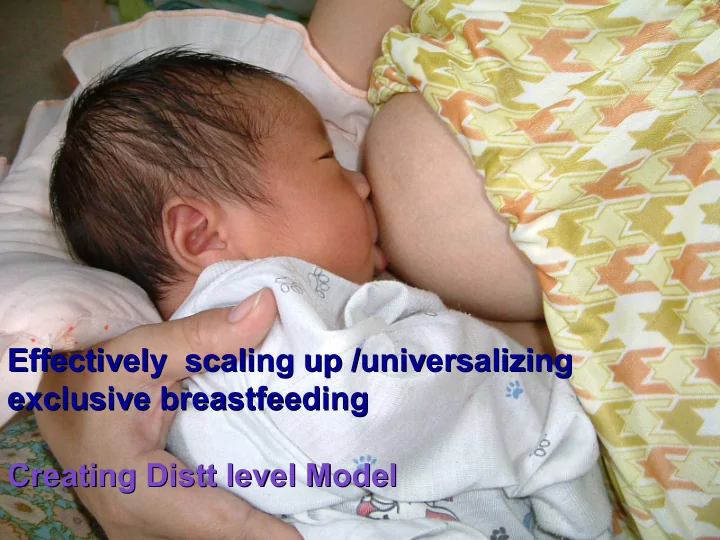
Effectively Scaling Effectively Scaling up/universalizing exclusive up/universalizing exclusive breastfeeding breastfeeding Creating Distt. Level Model Creating Distt. Level Model Effectively scaling up /universalizing Effectively scaling


slide-1
SLIDE 1

Effectively Scaling Effectively Scaling up/universalizing exclusive up/universalizing exclusive breastfeeding breastfeeding

Creating Distt. Level Model Creating Distt. Level Model

Effectively scaling up /universalizing Effectively scaling up /universalizing exclusive breastfeeding exclusive breastfeeding Creating Distt level Model Creating Distt level Model

slide-2
SLIDE 2

First year is critical!

  • Malnutrition strikes in infancy from 11 % at 0-6 months reaches its peak

by 23 months, then flat.

  • 36 million under three/ nearly 60 million U-5 are underweight and

undernourished thus underdeveloped

  • 2.4 million children die and 2/3rd in first year

Years of life Brain development

Underweight (-2sd) NFHS-2 Over 60 million

Child deaths U-5 (Lancet 2003 16 Lacs during first year and 8 lacs during next 4 years

slide-3
SLIDE 3

What happens with infants?

  • 2.4 million U-5 deaths in India(10.9 M global deaths)
  • 2/3rd during 1st year alone, according to the WHO , these

are related to inappropriate infant and young child feeding.

  • Only 40% EX BF for the first 6 months, 33% adequately CF

6-9 months.

  • Brain development is dependent on level of interaction

with the child.

Years of life Brain development

slide-4
SLIDE 4

Under-5 deaths preventable through universal coverage with individual interventions (2000) India

*Breastfeeding: Exclusive for first 6 months and continued for 6 to 12 months Source: Jones et al. LANCET 2003;362:65-71 0% 2% 4% 6% 8% 10% 12% 14% 16% 18%

Breastfeeding* Complementary feeding Clean delivery Hib vaccine Clean water, sanitation, hygiene Zinc Vitamin A Antenatal steroids Newborn temperature management Tetanus toxoid Antibiotics for PRM Measles vaccine Nivirapine and replacement feeding Insecticide-treated materials Antimalarial IPT in pregnancy

Intervention Percent

slide-5
SLIDE 5

Breastfeeding !

  • We are a breastfeeding nation
  • We are “drop outs” in EX BF
  • Only 90% EX BF can achieve benefits described in Lancet

Months Brain development 6 12 18 24

Breastfeeding status (NFHS-2) Exclusive BF 0-6 months (NFHS-2)

slide-6
SLIDE 6

Exclusive breastfeeding falls rapidly from first month onwards

(NFHS-2-1999)

Exclusive Breastfeeding

72% 61% 54.2% 43.3% 37% 25.3% 19.4% 0% 10% 20% 30% 40% 50% 60% 70% 80% 90% 100%

<1 1 2 3 4 5 6

Age in Months Percentages

slide-7
SLIDE 7

Optimal infant and young child feeding Our commitments

  • Major intervention in RCH II and ICDS
  • National Guidelines on Infant and Young

Child Feeding

  • IMS Act 1992 and 2003
  • 10th plan goals of exclusive breastfeeding

and complementary feeding

slide-8
SLIDE 8

10th Five- Year Plan

GOALS Government of India

50.0% 80.0% 75.0% 15.8% 41.2% 33.5%

NFHS-2 Tenth Plan Goal

Initiation of breastfeeding within

  • ne hour

Exclusive breastfeeding (0-6 months) Complementary feeding (6-9 months)

Note: NFHS 2 data for exclusive breastfeeding is the Simple average of 0-3 & 4-6 months period.

slide-9
SLIDE 9

Our response

  • ASHA’s job: Counseling on IYCF
  • AWW : health and Nutrition education includes

breastfeeding

  • NNP-NPAN: Ensure exclusive breastfeeding for first ….6

months through high quality training of health workers in lactation management and breastfeeding

  • RCH II : National breastfeeding ( How ??) partnership
  • IMNCI: To reach only 125 districts, breastfeeding

component needs a clear preventive approach These are not reaching universally

slide-10
SLIDE 10

Why Distt. Level models

  • Focus is on district level planning
  • Policy makers have raised questions is it

doable/feasible?

slide-11
SLIDE 11

What it takes ?

  • Log frame approach/ Goal oriented

project planning exercises demonstrate that we need to address several areas altogether. ACTIVITY: RESULTS: OBJECTIVE: GOAL

  • Recent analysis of policy and

programme of IYCF in India revealed that gaps are there in all areas of action and need to be plugged

slide-12
SLIDE 12

Why we are here today?

  • Guidance
  • Feasibility
  • How to go forward?
  • Collaboration formally
  • Core group: expanding partners
  • How to do it: to get started, development of

project and proposals, strategies, funding etc.

  • What we can offer to the project?
  • What mechanisms ?
  • What next ? 6-12 months