Changes in telecommunications Emerging technologies are affecting - - PowerPoint PPT Presentation

changes in telecommunications
SMART_READER_LITE
LIVE PREVIEW

Changes in telecommunications Emerging technologies are affecting - - PowerPoint PPT Presentation

Changes in telecommunications Emerging technologies are affecting telecom industries Computers are now capable of hearing, speaking, seeing Portable computing: mobility and wireless communication Optical technologies: no bandwidth


slide-1
SLIDE 1

Professor: C. Courcoubetis

http://www.aueb.gr/users/courcou

Basic Economics - 2

Telecom MBA Prof C. Courcoubetis

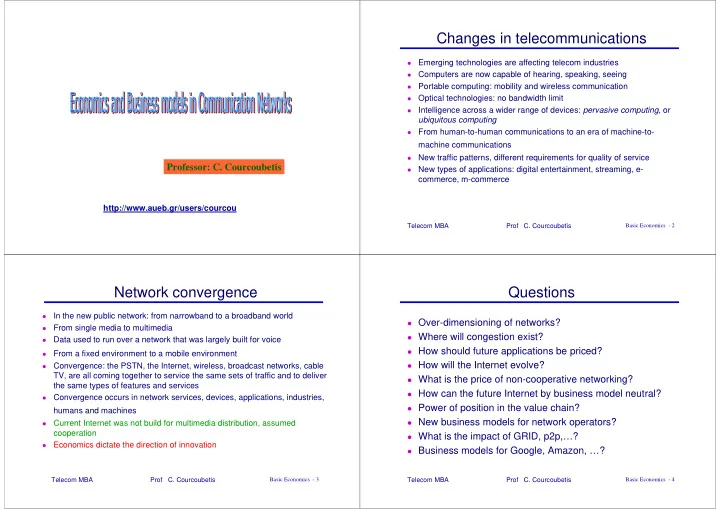
Changes in telecommunications

  • Emerging technologies are affecting telecom industries
  • Computers are now capable of hearing, speaking, seeing
  • Portable computing: mobility and wireless communication
  • Optical technologies: no bandwidth limit
  • Intelligence across a wider range of devices: pervasive computing, or

ubiquitous computing

  • From human-to-human communications to an era of machine-to-

machine communications

  • New traffic patterns, different requirements for quality of service
  • New types of applications: digital entertainment, streaming, e-

commerce, m-commerce

Basic Economics - 3

Telecom MBA Prof C. Courcoubetis

Network convergence

  • In the new public network: from narrowband to a broadband world
  • From single media to multimedia
  • Data used to run over a network that was largely built for voice
  • From a fixed environment to a mobile environment
  • Convergence: the PSTN, the Internet, wireless, broadcast networks, cable

TV, are all coming together to service the same sets of traffic and to deliver the same types of features and services

  • Convergence occurs in network services, devices, applications, industries,

humans and machines

  • Current Internet was not build for multimedia distribution, assumed

cooperation

  • Economics dictate the direction of innovation

Basic Economics - 4

Telecom MBA Prof C. Courcoubetis

Questions

Over-dimensioning of networks? Where will congestion exist? How should future applications be priced? How will the Internet evolve? What is the price of non-cooperative networking? How can the future Internet by business model neutral? Power of position in the value chain? New business models for network operators? What is the impact of GRID, p2p,…? Business models for Google, Amazon, …?

slide-2
SLIDE 2

Basic Economics - 5

Telecom MBA Prof C. Courcoubetis

Economics = incentives

The taxi tariff The “all-you can eat” restaurants: flat vs usage-based The Internet café tariff: dynamic pricing Pricing a single link

cX bT a w + + =

Basic Economics - 6

Telecom MBA Prof C. Courcoubetis

Course outline

1.

Basic economic concepts

  • Microeconomic models, competition, pricing, cost recovery, lock-

in, externalities, price differentiation

2.

Markets for communication services

  • Basic concepts of communication services
  • Internet value chain

3.

New technologies and their effects to the market

  • The effect of signaling services to business models
  • VoIP, SIP, ENUM, IMS
  • Internet regulation

4.

The inadequacy of the current Internet

  • what are the problems with the current internet
  • ideas about its evolution
  • NGN

5.

The telecommunications market today

  • discussion of competition in the communications services market

Basic Economics

Basic Economics - 8

Telecom MBA Prof C. Courcoubetis

Basic Economics - Outline

The consumer The producer The social planner Market mechanisms and

competitive equilibria

Marginal cost pricing and

cost recovery

Externalities and

congestion pricing

Market competition Lock-in Networks and positive

externalities

Game theory The information economy Pricing in communication

networks

slide-3
SLIDE 3

Basic Economics - 9

Telecom MBA Prof C. Courcoubetis

The context

Communication services are economic commodities Demand factors: amounts of services purchased by users utility of using a service, demand elasticity Supply factors: amounts of services produced technology of network elements, service control

architecture, cost of production

Market model: models interaction and competition Prices: control mechanism control demand and production, deter new entry provide income to cover costs structure and value depends on underlying model

The consumer

Basic Economics - 11

Telecom MBA Prof C. Courcoubetis

The consumer’s problem

Consumers: utility function

increasing, concave

consumer surplus (net benefit): solve optimisation problem (linear prices): at optimum

) (x u

− ) (x u

charge for x

} ) ( max{ arg : ) ( px x u p x − =

p x u x = ) ( ' :

u(x) x p x(p) $

px px x u − ) (

x

$ ) ( ' x u

) (x p Demand curve

Basic Economics - 12

Telecom MBA Prof C. Courcoubetis

The demand curve

x $

CS p ( )

) ( p x

p

px

px p CS x u + = ) ( ) (

The demand curve: = ) ( p x = ) ( p CS

quantity demanded at price p consumer surplus at price p = value of consuming x

) (x u′

} ) ( max{ arg : ) ( px x u p x − =

) ( p D

slide-4
SLIDE 4

Basic Economics - 13

Telecom MBA Prof C. Courcoubetis

Elasticity

x $

) (x u′ CS p ( ) ) ( p x p

px

j j i i ij

p p x x / / ∂ ∂ = ε

Elasticity of demand:

i i i i i

p p x x / / ∂ ∂ = ε

Cross-elasticity:

$ x inelastic elastic

  • > Complements, substitutes

The producer

Basic Economics - 15

Telecom MBA Prof C. Courcoubetis Producer: cost function profit function (producer surplus):

The producer’s problem

)] ( ) ( [ max y c y y p

Y y

Monopoly:

p y c py

Y y

given for )], ( [ max −

Perfect competition:

)] ( ) ( [ max y c y z y p

Y y

− +

Oligopoly: Regulation:

fixed p, produce y=y( p )

Y y y c y yp y ∈ − = ), ( ) ( ) ( π

Demand curve

y

) (y p

) (y c

Basic Economics - 16

Telecom MBA Prof C. Courcoubetis

The producer in a competitive market

Competitive market with price :

⎪ ⎩ ⎪ ⎨ ⎧ < ∞ = > = p p p p p p p D if if produced amount any if ) (

p

p p y c py

y

= − for ) ( max

Producer solves:

y

$

) (y c

py

p

*

y

p

p y c = *) ( '

slide-5
SLIDE 5

The social planner

Basic Economics - 18

Telecom MBA Prof C. Courcoubetis

The social planner’s problem

⇔ − ) ( ) ( max x c x u

x i i

x x c x x u ∂ ∂ = ∂ ∂ ) ( ) (

* *

= MC $ ' u

p ) ( p x ' c

) ( ) ( x c x u −

) (x c

Basic Economics - 19

Telecom MBA Prof C. Courcoubetis

Maximising efficiency

$

1

x

x

) ( 1 x u

Cost of

1

x

x

  • pt

x

  • pt

p

MC Net social gain MC MC = marginal cost of x

Set prices = marginal cost Simple case: constant marginal cost

Basic Economics - 20

Telecom MBA Prof C. Courcoubetis

Competitive equilibrium

  • Every participant in the market is small, can not affect prices
  • Equilibrium: stable point where production = demand, price p

consumers producers

i

x

j

y

j

c

i

u

i

j

p

i i i x

px x u

i

− ) ( max ) ( max

j j j y

y c py

j

) ( ) ( p y p x

j j i i

∑ ∑

=

Market clearance:

∑ ∑ ∑ ∑

≤ − ⇔ = ∂ ∂ = ∂ ∂

i j j i i j j j i i y x j j i i

y x t s y c x u p y c x u

j i

. . ) ( ) ( max

} , {

=> Social welfare optimum!

=> Reached by tatonnement “Invisible Hand” Theorem:

slide-6
SLIDE 6

Basic Economics - 21

Telecom MBA Prof C. Courcoubetis

Capacity constraints

  • Total amount of resource available =
  • Maximization problem:
  • Define a market: find the clearing price such that
  • The “Invisible Hand” Theorem: under the market clearing price we

achieve the optimum in (1)

  • Note: each user solves:
  • = shadow cost of capacity

C ) 1 ( . . ) ( max

} {

∑ ∑

i i i i i x

C x t s x u

i

(2) ) (

= C p xi } ) ( max{ arg : ) ( px x u p x

i i

− = p p

Basic Economics - 22

Telecom MBA Prof C. Courcoubetis

Dimensioning of the network

Prices at the equilibrium can play the role of “signals” for

increase or decrease of the required network capacity C

If the marginal cost of C is ,

mc ⇒ > mc p

decrease of C

⇒ < mc p

increase of C

Basic Economics - 23

Telecom MBA Prof C. Courcoubetis

Strategy issues

Why should users respond truthfully their ? it may be profitable to cheat! In a case of 2 unequal users, the large user may pretend

he is small

) ( p xi

) (

1 x

u ) (

2 x

u

ε − C p

x

$ net benefit of user 1 if truthful

2 / C

net benefit of user 1 if he pretends he is like user 2

px

Pricing

Marginal cost pricing and cost recovery

slide-7
SLIDE 7

Basic Economics - 25

Telecom MBA Prof C. Courcoubetis

Marginal cost prices

Strong points: welfare maximisation under appropriate conditions firmly based on costs easy to understand Weak points: do not cover total cost (need for subsidisation) must be defined w.r.t. time frame of output expansion?

– short run marginal cost = 0 or – use long-run marginal cost (planned permanent expansion)

difficult to predict demand and to dimension the network difficult to relate cost changes to marginal output changes

Basic Economics - 26

Telecom MBA Prof C. Courcoubetis

Marginal cost pricing (cont.)

Marginal cost = covers all sacrifices, present or future,

external or internal to the company, for which production is at the margin causally responsible

Problem1: specifying the time perspective should we use long-run MC rather than short-run MC? MC includes present and future causally attributed costs problem: total cost coverage Problem2: specifying the incremental block of output incremental cost depends on size of increment charge the shortest run MC for the smallest output

increment

Problem3: large proportions of common costs Basic Economics - 27 Telecom MBA Prof C. Courcoubetis

Recovering network cost

Pricing at marginal cost maximises efficiency but

does not necessarily recover network cost

example: assume

Then under marginal cost pricing, and the network revenue is , hence we are short of

Ways out: Ramsey prices (linear prices) add fixed fee (two-part tariffs) general non-linear tariffs

– –

x x c β α + = ) ( p = β x β α

K k p a

k k

, , 1 ), , ( K = ) (x r

Basic Economics - 28

Telecom MBA Prof C. Courcoubetis

Average cost tariffs

Cost =

bx a +

b x a AC + = /

$ AC (average cost)

pAC MC

b x

*

x N customers

(marginal cost)

=

i i p

x p D ) ( ) (

AC

x Use price = Average Cost (AC)

MC =

slide-8
SLIDE 8

Basic Economics - 29

Telecom MBA Prof C. Courcoubetis

Two-part tariffs

Cost =

bx a +

Under MC pricing, network needs to recover an additional amount Use tariff Customer benefit =

bx N a + /

) ( / )) ( ( b bx N a b x u

i i i

− − < 0 ?

N customers

a

= ) (b xi

User i demand at price b

Hence SW reduction because small users do not participate!

Pricing

Lock-In

Reference: “Information Rules” by Carl Shapiro and Hal R. Varian

Basic Economics - 31

Telecom MBA Prof C. Courcoubetis

Recognizing lock-In

Durable investments in complementary assets

  • Hardware
  • Software

Supplier wants to lock-in customer Customer wants to avoid lock-in Basic principle: Look ahead and reason back

  • Examples:

Bell Atlantic and AT&T

– 5ESS digital switch used proprietary operating system – Large switching costs to change switches

Computer Associates User behavior in the Web Basic Economics - 32

Telecom MBA Prof C. Courcoubetis

Small switching costs matter

Small switching cost per customer but large customer

bases

Phone number portability Email addresses

– Hotmail (advertising, portability) – ACM, CalTech

Look at lock-in costs on a per customer basis

slide-9
SLIDE 9

Basic Economics - 33

Telecom MBA Prof C. Courcoubetis

Profits & switching costs in general:

Profits from a customer = total switching costs + quality/cost

advantages

Customer C switches from A to "same position" w/ B: Total

switching costs = customer costs + B's costs

In commodity market like telephony, profit per customer = total

switching costs per customer

Example: ILECs vs CLECs: ILEC profits = customer + CLEC

switching costs

Can answer these questions: How much to invest to get locked-in base Evaluate a target acquisition (e.g., Hotmail) Product and design decisions that affect switching costs Basic Economics - 34

Telecom MBA Prof C. Courcoubetis

p

s

q

s r r c q s r c q c q d r c p c p d s r p p r q q + + = ⇔ = − + − ⇒ = − − + − − + + = + 1 , ,

new entrant, offers discount d to switching customer

d +

customer indifferent to switch new entrant balances costs

A model of switching cost

switching cost s

Pricing

Monopoly - Oligopoly

Basic Economics - 36

Telecom MBA Prof C. Courcoubetis

Monopoly: linear+uniform prices

  • Goal: maximize profits
  • Advantage: economies of scale (small MC)
  • Disadvantage: inefficiency, small consumer surplus

⇒ Combine with regulation

' ] 1 1 )[ ( ' ) ( ) ( ) ( max c x p c x x p x p x c x x p

i i i i i i T x

= + ⇔ = ∂ ∂ + ⇔ − ε

$ q MC Demand

Marginal revenue

m

x

m

p

Welfare loss

Network may not be fully used!

slide-10
SLIDE 10

Basic Economics - 37

Telecom MBA Prof C. Courcoubetis

Price discrimination: an example

Sell a product to different customer types

$ 3 1 1 2 3 4 $ 3 1 1 2 3 4 $ 3 1 1 2 3 4 Profit=3 Profit=4 Profit=6

Price discrimination: personalized pricing, versioning, group pricing

Basic Economics - 38

Telecom MBA Prof C. Courcoubetis

Personalized pricing (1)

First-degree price discrimination:

  • extracts maximum profit from customer
  • addresses each customer separately
  • “take it or leave it” offer “amount x for m dollars”
  • Pareto efficient operation

) ( ' ) ( ' ) ( ) ( max ) ( . . ) ( max

,

x c x u x c x u m x u t s x c m

x m x

= ⇔ − ⇔ ≥ − −

$ q

x

MC=0

A" for "x A

Basic Economics - 39

Telecom MBA Prof C. Courcoubetis

Personalized pricing (2)

examples: mail orders, airlines, travel agencies information: depends on the kind of enterprise price sensitivity of customers is key do market research (promotional pricing) use discount coupons Internet: more individualized and interactive price offer depends on what your buying (dynamic) remember customer history inexpensive market research (via promotions)

  • verstock sales

from: Varian and Shapiro: Information Rules

Basic Economics - 40

Telecom MBA Prof C. Courcoubetis

Group pricing (1)

Third-degree price discrimination:

  • customer type pricing, no self-selection
  • social welfare increases -> increase of output

' ] 1 1 [ ' ] 1 1 [ ) , ( ) ( ) ( max

2 2 2 1 1 1 2 1 2 2 2 1 1 1 , 2

1

c p c p x x c x x p x x p

x x

= + = + ⇔ − + ε ε

$ q

1

x

2

x

2

p

1

p

Small market is also served!

slide-11
SLIDE 11

Basic Economics - 41

Telecom MBA Prof C. Courcoubetis

Group pricing (2)

why sell to groups rather than to end users: price sensitivity: members of different groups differ

systematically in price sensitivity

network effects: value increases with group ownership lock-in: become ubiquitous in an organization sharing arrangements: pricing for sharing

– items that are used infrequently by a single user are provided by info intermediaries (libraries, video stores – transaction costs determine whether it is better to sell or rent information – do even better: offer prices for both sale and rental

from: Varian and Shapiro: Information Rules

Basic Economics - 42

Telecom MBA Prof C. Courcoubetis

Versioning

Second-degree price discrimination: market segmentation

  • set of offers available to all customers
  • customers self select (incentive compatibility)
  • examples: quantity discounts, versioning

$ q $ q

1

x

2

x

MC=0

A B C

2

x

1

x

A D B C

A for

1

x C A for

2

+ x D C A for

2

+ + x A for

1

x

making self selection work improving revenue

Basic Economics - 43

Telecom MBA Prof C. Courcoubetis

Versioning and pricing

Make prices depend on value to customers Don’t need to price by customer identity Offer product line, and watch choices Design menu of different versions Target different market segments Price accordingly (self selection) Traditional information goods: Hardback/paperback Movie/video from: Varian and Shapiro: Information Rules Basic Economics - 44 Telecom MBA Prof C. Courcoubetis

Dimensions to use for versions

Delay User Interface Image Resolution Speed of operation Format Capability Features Comprehensiveness from: Varian and Shapiro: Information Rules

slide-12
SLIDE 12

Basic Economics - 45

Telecom MBA Prof C. Courcoubetis

Example

40 type As: $100 for speed, $40 for slow 60 type Bs: $50 for speed, $30 for slow Identity-based pricing: $7000 revenues Offer only speedy: $50 is best price, revenues=$5,000 Offer only slow: not as profitable from: Varian and Shapiro: Information Rules Basic Economics - 46 Telecom MBA Prof C. Courcoubetis

Versioning solution

Try speedy for $100, slow for $30 Will this work? Compare benefits and costs 100-100=0, but 40-30=10 > 0 Discount the fast version: 100-p=40-30 So, p=90 Revenues = $5,400 = 90x40 + 30x60 from: Varian and Shapiro: Information Rules Basic Economics - 47 Telecom MBA Prof C. Courcoubetis

Making self-selection work

May need to cut price of high end May need to cut quality at low end Value-subtracted versions May cost more to produce the low-quality version In design, make sure you can turn features off! from: Varian and Shapiro: Information Rules Basic Economics - 48 Telecom MBA Prof C. Courcoubetis

How many versions?

One is too few Ten is (probably) too many Two things to do Analyze market Analyze product Analyze your market: does it naturally subdivide into

different categories? are behaviors sufficiently different?

Analyze your product: design for high-end, reduce quality

for low-end

Default choice: 3 versions Extremeness aversion from: Varian and Shapiro: Information Rules

slide-13
SLIDE 13

Basic Economics - 49

Telecom MBA Prof C. Courcoubetis

Bundling

Offer many goods as a package Example: Microsoft Office Added benefit: they work together Price of bundle < sum of component prices

buy one product, then other is priced less than standalone price

Reduce dispersion in customer value Example: price separate or together Mark: $120 for WP, $100 for spreadsheet Noah: $100 for WP, $120 for spreadsheet Profits

– Without bundling: $400 – With bundling: $440

from: Varian and Shapiro: Information Rules

Externalities and congestion pricing

Basic Economics - 51

Telecom MBA Prof C. Courcoubetis

Externalities

Externalities: the actions of one agent affect the utility of

an other agent

Positive (network effects), negative (congestion) No externality: Externality: SW optimal prices can not be determined by the market

alone: need special price mechanism that takes account

  • f the externalities

2 2 2 2 2 1 1 1 1 1

) ( max ) ( max

2 1

x p x u x p x u

x x

− = − = π π

2 2 2 2 2 1 1 2 1 1 1 1

) ( max ) ( ) ( max

2 1

x p x u x p x g x u

x x

− = − ± = π π

Basic Economics - 52

Telecom MBA Prof C. Courcoubetis

Negative externalities: congestion prices

C

i

x

1

x

= ) (x D

) ( ) ( : i User x D x x u

i i i i

γ −

n

x

x

C x

Average delay queue

Use congestion price : charge cost that you cause to others

c

p

i c i i i i

x p x D x x u − − ) ( ) ( : i User γ

System less congested, achieves optimum operation!

slide-14
SLIDE 14

Basic Economics - 53

Telecom MBA Prof C. Courcoubetis

Positive feedback

Positive feedback: strong get stronger, weak get weaker Negative feedback: stabilizing effect Makes a market “tippy” Examples: VHS v. Beta, Wintel v. Apple “Winner take all markets”

Market share Time

50% 100% Value for the user Number of compatible users winner looser battle zone

Time Number of users

launch takeoff saturation

Basic Economics - 54

Telecom MBA Prof C. Courcoubetis

Sources of positive feedback

Supply side economies of scale Declining average cost Marginal cost less than average cost Example: information goods Demand side economies of scale Network effects: virtual networks

– Network externalities: one market participant affects

  • thers without compensation being paid.

Examples: fax, email, Web, Sony v. Beta, Wintel v. Apple Basic Economics - 55 Telecom MBA Prof C. Courcoubetis

Network effects (1)

ni n u N i

i

= = ) ( , , , 1 K consume , 1 : assume N n N n p K + − → ) ( , ) ( ˆ , customer marginal n N n p n n N u n N − = ⇒ − = − =

100

500 1000 1500 2000 2500

MC p =

price

n

) (n p

100

1

n

2

n

A B

1 N-n N n

Basic Economics - 56

Telecom MBA Prof C. Courcoubetis

Network effects (2)

slide-15
SLIDE 15

Basic Economics - 57

Telecom MBA Prof C. Courcoubetis

Key observations

Number of users is important Metcalfe’s Law:

Value of network of size n proportional to n2

Importance of expectations Network effects lead to substantial collective switching

costs: even worse than individual lock-in (due to coordination costs). Example: QWERTY

Evolution vs revolution, openness vs. control (standards

setting)

Network externalities don’t always apply ISPs (but watch out for QoS) PC production

Pricing in communication networks

Basic Economics - 59

Telecom MBA Prof C. Courcoubetis

Terminology

Terminology: price: correlated with service unit tariff: charge structure

– more general form of charging (i.e., a+px) – control mechanism

charge: total amount that must be paid Basic Economics - 60 Telecom MBA Prof C. Courcoubetis

The utility function

Consumers are characterized by the utility function translate into monetary units the benefit of the consumer

from the use of the particular network resource

has the meaning of trading, reselling Private information

) (x u

x $

2 ) 10 ( , 5 ) 10 ( = =

B A

u u ) , (

2 1 x

x u

) (x uA ) (x uB ) (x uC

slide-16
SLIDE 16

Basic Economics - 61

Telecom MBA Prof C. Courcoubetis

Pricing

Types of charging: fixed charge: access connection cost variable charge: cost related with the size of

consumption

fixed + variable part Variable part: recovery of usage cost, control mechanism

(of priority) of consumer

10

max =

C

10

max =

C 10

max =

C

Cost = 1$/ flow unit x x uA 2 ) ( = x x uB 10 ) ( = Access connection Cost = 5$ Cost based charging:

x + 4

Every user receives

5 2 /

max

= = C x

Is it economically fair?

Basic Economics - 62

Telecom MBA Prof C. Courcoubetis

A possible analysis of pricing

In general we can analyze the total charge the user is

paying as S = F+U+G+Q, where F= fixed part, U= usage part, G= congestion part, Q= quality part

Quality 1 Quality 2

1

p

2

p

x

) (

1 1

T q p F xT p F S + = + =

F

w

2

p

1

p

w= real cost/byte (into the network) F= real connection cost (with the network) U G Q

Basic Economics - 63

Telecom MBA Prof C. Courcoubetis

Traffic in the Internet

Traffic shaping: traffic = real-time + non real-time delay increase => smaller peak rate small delay in non real-time => big difference for the

network!

Incentives for traffic shaping Real-time traffic Non real-time traffic With shifted non real-time Required bandwidth for specific QoS

Game theory

slide-17
SLIDE 17

Basic Economics - 65

Telecom MBA Prof C. Courcoubetis

What is game theory?

Traditional optimization: theory of optimal decision

making of a single agent

Game theory: study of interacting decision makers Games: models of interactive decision making strategic form: a player chooses his plan of action

  • nce and for all covering all possible contingencies

extensive form: explicit description of sequential

structure of the decision problems

different solution concepts

  • ne-shot, repeated games

Basic Economics - 66

Telecom MBA Prof C. Courcoubetis

The prisoner's dilemma

Example of strategic game Description: game matrix (common knowledge) Nash equilibrium: each player’s strategy choice is a best reply to the strategy choices of the other players 3,3 1,1 0,4 4,0 Player A Player B

cooperate defect cooperate defect

Nash equilibrium = (defect,defect)

strategies

= dominant strategy equilibrium

Basic Economics - 67

Telecom MBA Prof C. Courcoubetis

Repeated games

Larger strategy space: take account of history long-run interest different than short-run interest Can enforce cooperation by using punishment strategies Cartels

3,3 1,1 0,4 4,0 Player A Player B

cooperate defect cooperate defect

Strategy Grim: cooperate in the current move unless the other player defected in the previous move, in which case defect forever

L + + + + +

2 2 1

) 1 ( ) 1 ( r u r u u

r r / 1 4 ) 1 /( 1 4 + = + + + L r r / 3 3 ) 1 /( 3 3 + = + + + L

Payoff with discount r =

Basic Economics - 68

Telecom MBA Prof C. Courcoubetis

Public goods

Non-excludable and non-rival goods Incentive problem in provisioning: the free-rider problem

3 ) 1 ( , 4 ) 2 ( , 2 ) 1 ( = = =

i i i

c u u

Example: provision a common facility of size = 1,2

1,1 0,0

  • 1,2

2,-1 Player A Player B

provision 1 provision 0 provision 1 provision 0

Free-riding: player i prefers the other player to contribute Free-market fails to provision optimum amount of public goods