
SLIDE 1
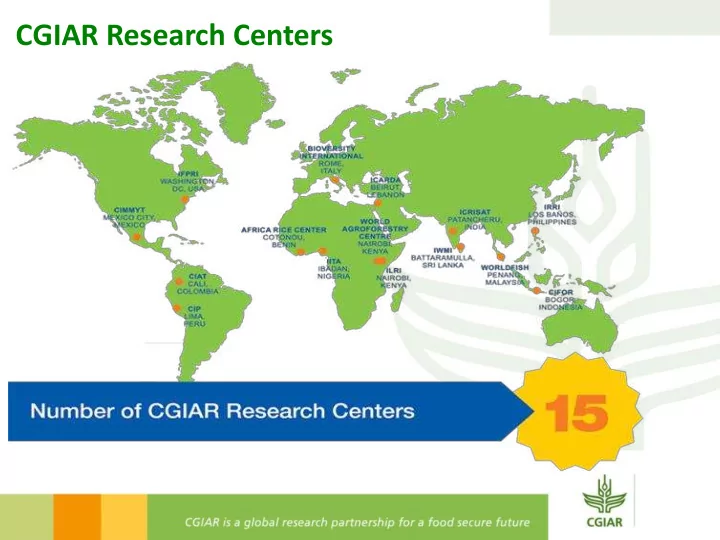
CGIAR Research Centers 17 Sustainable Development Goals with - - PowerPoint PPT Presentation
CGIAR Research Centers 17 Sustainable Development Goals with emphasis on sustainable and equitable food systems SRF Agri-Food Systems Germplasm banks Pre Breeding Breeding Sustainable Intensification and Systems Value Chain and Markets
Global wheat impact study 2014
increase due to global wheat improvement 1994 - 2014
CGIAR wheat improvement, US$ 2.1 - 5.7 billion, annually
breeding: US$ 30 million Current investments: accelerate climate change adaptation (2C = 0.6% p.a. lost); nutritional value; resistance to pandemic diseases Wheat provides 18% of all calories and 20% of all protein in the human diet
2011 First reports in Kenya, > 95% of all varieties affected 2014 MLN in 7 countries; 23% of Kenya’s maize production lost 2014 First resistant variety released How? Highly effective CGIAR – NARS – Private sector collaboration, rapid donor investments, precision phenotyping Current investments: diverse (not just a few) resistant varieties, scale out
Traits & Genetic Diversity Policies & Partnerships Breeding Speed & Efficacy To Meet The Challenge
Swarna-sub1
Crop
Improvement
& seed Banana Plantain Cassava Potato Sweetpotato Yam Other R&T
per capita per day
Revolving Seed Fund Boundary partners Lead farmers Broader community Built a large network of delivery partners capable of identifying and equipping lead farmers … … who rapidly mobilized others in their community to adopt new varieties, thereby motivating seed companies to produce, promote and distribute improved varieties
Lead farmers are influential and trusted, and can take risk with testing new technologies Boundary partners with aligned goals
Participatory Variety Selection – asking the farm family what they want in a new variety
Swarna-sub1
Crop
Improvement
& seed
Five new varieties including ICGV-SM 03517 now called Wamusanga
Impact of Research Investment in Resilient Production Systems in Marginal Drylands Integrated Livestock/Rangeland/Crops Production System for Marginal Lands through the Dryland Systems & Livestock CRPs
Women in livestock raising, processing, trading – gender transformative approaches Inclusive dairy development: Target: 60 million smallholders in East Africa Increased economic value $260 million per annum Insuring the never-before insured against catastrophic drought in the Horn
Improved food and nutrition security for health Improved natural resource systems and ecosystem services Reduced poverty