CERN BE/ABP How to Establish a Straight Line on the Dynamic Curved - - PowerPoint PPT Presentation

cern be abp how to establish a straight line on the
SMART_READER_LITE
LIVE PREVIEW

CERN BE/ABP How to Establish a Straight Line on the Dynamic Curved - - PowerPoint PPT Presentation

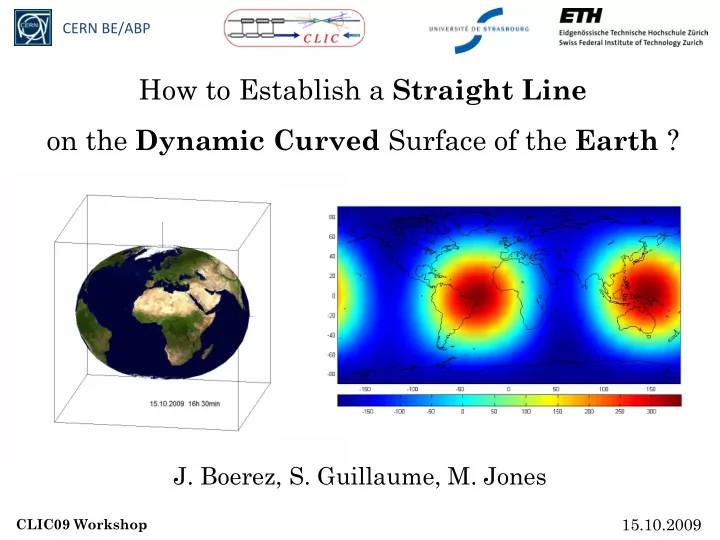
CERN BE/ABP How to Establish a Straight Line on the Dynamic Curved Surface of the Earth ? J. Boerez, S. Guillaume, M. Jones 15.10.2009 CLIC09 Workshop CERN BE/ABP CLIC Pre-alignment tolerence 10 [ m] over a 200 [m] sliding window (3 )


slide-1
SLIDE 1

15.10.2009

How to Establish a Straight Line

  • n the Dynamic Curved

Surface of the Earth ?

  • J. Boerez, S. Guillaume, M. Jones

CLIC09 Workshop

CERN BE/ABP
slide-2
SLIDE 2

15.10.2009

  • J. Boerez, S. Guillaume, M. Jones

CLIC09 Workshop

CERN BE/ABP

Definition of “Straight Line” for CLIC Pre-Alignment?

CLIC Pre-alignment tolerence ± 10 [μm] over a 200 [m] sliding window (3σ)

slide-3
SLIDE 3

15.10.2009

  • J. Boerez, S. Guillaume, M. Jones

CLIC09 Workshop

CERN BE/ABP

Trajectory of Photons in a vacuum Tube on the Earth

Newton’s approximation

Shortest Path between 2 Points in Euclidian Space

Relativistic deflection on the Earth ~ 0.5 μm/200 m NEGLECTED

slide-4
SLIDE 4

15.10.2009

  • J. Boerez, S. Guillaume, M. Jones

CLIC09 Workshop

CERN BE/ABP

Trajectory

  • f the Light

in Standard Atmosphere Refraction Field and Shape

  • f the Earth in

Euclidian Space

6 [mm]

slide-5
SLIDE 5

15.10.2009

  • J. Boerez, S. Guillaume, M. Jones

CLIC09 Workshop

CERN BE/ABP

Three References under study:

  • the static water (HLS)
  • a stretched wire (WPS)
  • a laser beam under vacuum

References

vertical horizontal + vertical horizontal + vertical

PhD Thomas Touzé

slide-6
SLIDE 6

15.10.2009

  • J. Boerez, S. Guillaume, M. Jones

CLIC09 Workshop

CERN BE/ABP

HLS Hydrostatic Leveling System

not a straight line

Z Y X Euclidian Reference System

slide-7
SLIDE 7

Definition of Gravity Potential

15.10.2009

  • J. Boerez, S. Guillaume, M. Jones

CLIC09 Workshop

CERN BE/ABP

Potential W(P) at point P is the Work needed to bring a unit mass from infinity to P

slide-8
SLIDE 8

Definition of Gravity Potential

15.10.2009

  • J. Boerez, S. Guillaume, M. Jones

CLIC09 Workshop

CERN BE/ABP Time dependent Time independent

Picture from the Physikalische Geodäsie Skriptum Universität Bonn

Equipotential Surfaces of the Earth’s Gravity Field at different Levels

surface of static water

slide-9
SLIDE 9

First Part

15.10.2009

  • J. Boerez, S. Guillaume, M. Jones

CLIC09 Workshop

CERN BE/ABP Time dependent Time independent

surface of static water

slide-10
SLIDE 10

15.10.2009

  • J. Boerez, S. Guillaume, M. Jones

CLIC09 Workshop

CERN BE/ABP

Time Independent Geometry of the Gravity Equipotentials (Geoid)

Geoid undulation [m] EGM 96

slide-11
SLIDE 11

15.10.2009

  • J. Boerez, S. Guillaume, M. Jones

CLIC09 Workshop

CERN BE/ABP

Time Independent Geometry of the Gravity Equipotentials (Geoid)

density, approx. known well known

slide-12
SLIDE 12

15.10.2009

  • J. Boerez, S. Guillaume, M. Jones

CLIC09 Workshop

CERN BE/ABP

Effect of the Swiss Lakes on Geoid

500000 550000 600000 650000 700000 750000 800000 100000 150000 200000 250000 300000

swisstopo U. Marti

slide-13
SLIDE 13

15.10.2009

  • J. Boerez, S. Guillaume, M. Jones

CLIC09 Workshop

CERN BE/ABP

Effect of Topography on Geoid

500000 550000 600000 650000 700000 750000 800000 100000 150000 200000 250000 300000

swisstopo U. Marti

slide-14
SLIDE 14

15.10.2009

  • J. Boerez, S. Guillaume, M. Jones

CLIC09 Workshop

CERN BE/ABP

Accuracy of the Best Available Geoids

  • 1-2 [cm] for wavelengths of 10-100 [km]
  • 1-10 [mm] for wavelengths 1-10 [km]

For wavelengths < 1 [km], some questions to be answered :

  • Spectrum for very shorts wavelengths ?
  • Time Variation ?
  • Detection of dangerous anomalies (ampl. > 1-2 μm for λ

< 200 [m])

Measurement process ?

slide-15
SLIDE 15

Gravity Field’s Observables on the Earth

not directly observable gravimeter astro-geodetic instrument gravimeter torsion balance Autocollimator in vacuum coupled with inclinometers (to be developed)

15.10.2009

  • J. Boerez, S. Guillaume, M. Jones

CLIC09 Workshop

CERN BE/ABP

slide-16
SLIDE 16

15.10.2009

  • J. Boerez, S. Guillaume, M. Jones

CLIC09 Workshop

CERN BE/ABP

Astro-Geodetic Measurements Precision : < 0.1 [arcsec] = 0.5 [mm/km] 1 point/10[m] → σN ~ 10μm/200 [m]

  • 1000 [mm] focal length
  • 2184 x 1472 CCD camera
  • 6 very accurate tiltmeters
  • 1 GPS for precise timing
  • 8 motors for automation
slide-17
SLIDE 17

15.10.2009

  • J. Boerez, S. Guillaume, M. Jones

CLIC09 Workshop

CERN BE/ABP

Astro-Geodetic Measurements

130 stars extracted, Field of View 0.75 x 0.50 degree, exposure time = 0.300 [sec] 1 pixel = 1.4 [arcsec]

slide-18
SLIDE 18

15.10.2009

  • J. Boerez, S. Guillaume, M. Jones

CLIC09 Workshop

CERN BE/ABP

Astro-Geodetic Measurements

80 stars identified, 50 stars used

0.5 [arcsec]

slide-19
SLIDE 19

15.10.2009

  • J. Boerez, S. Guillaume, M. Jones

CLIC09 Workshop

CERN BE/ABP

Astro-Geodetic Measurements

0.1 ‘’ 0.1 ‘’

u n i t s [ a r c s e c ]

slide-20
SLIDE 20

15.10.2009

  • J. Boerez, S. Guillaume, M. Jones

CLIC09 Workshop

CERN BE/ABP

Gravimetric Measurements Absolute Relative

slide-21
SLIDE 21

15.10.2009

  • J. Boerez, S. Guillaume, M. Jones

CLIC09 Workshop

CERN BE/ABP

Test Measurements

slide-22
SLIDE 22

15.10.2009

  • J. Boerez, S. Guillaume, M. Jones

CLIC09 Workshop

CERN BE/ABP

Gravimetric Measurements

slide-23
SLIDE 23

15.10.2009

  • J. Boerez, S. Guillaume, M. Jones

CLIC09 Workshop

CERN BE/ABP

Gravimetric Measurements

slide-24
SLIDE 24

Second Part

15.10.2009

  • J. Boerez, S. Guillaume, M. Jones

CLIC09 Workshop

CERN BE/ABP Time dependent Time independent

surface of static water

slide-25
SLIDE 25

15.10.2009

  • J. Boerez, S. Guillaume, M. Jones

CLIC09 Workshop

CERN BE/ABP

Earth Tides

Gravitational Forces Centripetal Force

slide-26
SLIDE 26

15.10.2009

  • J. Boerez, S. Guillaume, M. Jones

CLIC09 Workshop

CERN BE/ABP

Tidal Deformation of the Earth’s Crust

Vertical displacement [mm]

– Cyclical signal – Mainly caused by Moon and Sun – Maximum amplitude : 0.80 [m] ! – Long period, diurnal and semi-diurnal periods.

slide-27
SLIDE 27

The HLS measures :

  • The real height difference
  • The movement of the earth’s crust
  • The tidal variation in gravity potential
  • Others phenomenon…?

→ We want to measure the real height difference, so we must remove all factors that can be anticipated

15.10.2009

  • J. Boerez, S. Guillaume, M. Jones

CLIC09 Workshop

CERN BE/ABP

slide-28
SLIDE 28
  • Cyclical signal measured by a Hydrostatic Leveling System
  • In this example the 2 HLS sensors are separated from 115m

15.10.2009

  • J. Boerez, S. Guillaume, M. Jones

CLIC09 Workshop

CERN BE/ABP 23 days

Height betw een to HLS sensors

slide-29
SLIDE 29
  • 26/05/2009 18/06/2009 :

23 days

  • Sampling

1h

  • Distance between

the 2 sensors : 115.438m

  • The Fast Fourier

Transform shows 1 semi- diurnal tide and 2 diurnal tides 15.10.2009

  • J. Boerez, S. Guillaume, M. Jones

CLIC09 Workshop

CERN BE/ABP Height betw een to HLS sensors

slide-30
SLIDE 30
  • Corrected

by the general model

  • f

ETERNA (reference software to predict tides). This model uses general parameters for tidal waves.

  • Amplitudes reduced

:

  • Diurnal divided by 3.5
  • Semi-diurnal

divided by 2 15.10.2009

  • J. Boerez, S. Guillaume, M. Jones

CLIC09 Workshop

CERN BE/ABP fft of residuals after correction

slide-31
SLIDE 31
  • Corrected

by a local model with ETERNA.

  • This

local model is

  • btained

after an analysis

  • f another sample of data.

It allows to have a better tidal model (specific parameters for tidal waves).

  • Amplitudes reduced

:

  • Diurnal divided

by 6;

  • Semi-diurnal

divided by 3

15.10.2009

  • J. Boerez, S. Guillaume, M. Jones

CLIC09 Workshop

CERN BE/ABP fft of residuals after correction

slide-32
SLIDE 32

15.10.2009

  • J. Boerez, S. Guillaume, M. Jones

CLIC09 Workshop

CERN BE/ABP

How to Establish a Straight Line

  • n the Dynamic Curved Surface of the Earth ?

(for the vertical component with HLS)

Instrumentation :

  • resolution and internal accuracy :

now : 0.1, 1-2 [μm] resp. → ok

  • stability with time (drifts) :

now : < 5 [μm/month] → objective : < 1 [μm/month]

  • absolute calibration :

now : 10 [μm] → objective : 1 [μm]

Reference System (time variable hydro-static shape) :

  • static part (geoid) :
  • improvement and development of appropriate instruments (Zenith Camera, Autocollimator …)
  • measurement and data processing concept to get the geoid

at [μm] accuracy level

  • determination of the spectrum for wavelengths < 1 [km]
  • determination of the impact of the time variable densities (underground water…)
  • time dependent part (earth tides)
  • modelization
  • f cyclical and systematical effects
  • better estimation of tidal parameters with longer time series of data
  • comparison with precise tiltmeters

times series

slide-33
SLIDE 33

15.10.2009

  • J. Boerez, S. Guillaume, M. Jones

CLIC09 Workshop

CERN BE/ABP

Thanks' for your attention

Julien Boerez Sébastien Guillaume Mark Jones

slide-34
SLIDE 34

15.10.2009

  • J. Boerez, S. Guillaume, M. Jones

CLIC09 Workshop

CERN BE/ABP

Gravimetric Measurements

slide-35
SLIDE 35
  • The Global model of ETERNA has almost the same phases and

amplitudes as the raw signal :

  • The cyclical signal measured by the HLS are the earth tides.
  • The residuals still have a cyclical component…
  • After an harmonic analysis of a different sample, specific coefficients (for

phases and amplitudes) for each wave can be used to predict tides

  • The residues are smaller than with global model
  • The residuals still have a cyclical component…

Summary

15.10.2009

  • J. Boerez, S. Guillaume, M. Jones

CLIC09 Workshop

CERN BE/ABP

slide-36
SLIDE 36
  • The harmonic analysis allows us to consider some of the effects of the

environment over the theoretical tidal model :

  • Cavity forces

(uneven forces acting on a tunnel’s wall)

  • geological anomalies

(local changes in the rock density)

  • response of the hydrostatic network

(waves in the HLS water pipe, orientation of water pipe)

  • We know that to obtain a very precise correction for the earth

tides, we must analyze a long period of sample data.

  • We need a long stable sample (several months) of data from the

TT1 or other networks, with little noise and accurate measurements of temperature, humidity and pressure

Conclusion

15.10.2009

  • J. Boerez, S. Guillaume, M. Jones

CLIC09 Workshop

CERN BE/ABP

slide-37
SLIDE 37
  • This data sample needs to be analyzed to see if it is possible to completely

remove the cyclical signal from the measurement data

  • Once this analysis is completed it will be possible to determine

if the HLS is well modeled solely by the earth tides or not

  • If the residual signal after correction is too large to be ignored, another

independent measurement is required to provide a control of the real changes in tilt in the TT1 tunnel

  • Any discrepancy between the two will indicate if other environmental

effects need to be considered in order to completely model an HLS, such as:

  • Underground water table levels
  • Changes in atmospheric pressure

Conclusion

15.10.2009

  • J. Boerez, S. Guillaume, M. Jones

CLIC09 Workshop

CERN BE/ABP

slide-38
SLIDE 38
  • Modification of the TT1 network :
  • To have long period data
  • Install a very accurate inclinometer to compare with HLS results
  • Installation of another HLS network on TZ32 :
  • More stable than TT1 (less parasite noise)
  • Access to TT1 can be denied because of SPL project

Next Steps

15.10.2009

  • J. Boerez, S. Guillaume, M. Jones

CLIC09 Workshop

CERN BE/ABP