SLIDE 1 Slides borrowed from: Latombe’s book and slides, Choset, Kuffner
Cell Decomposition Methods
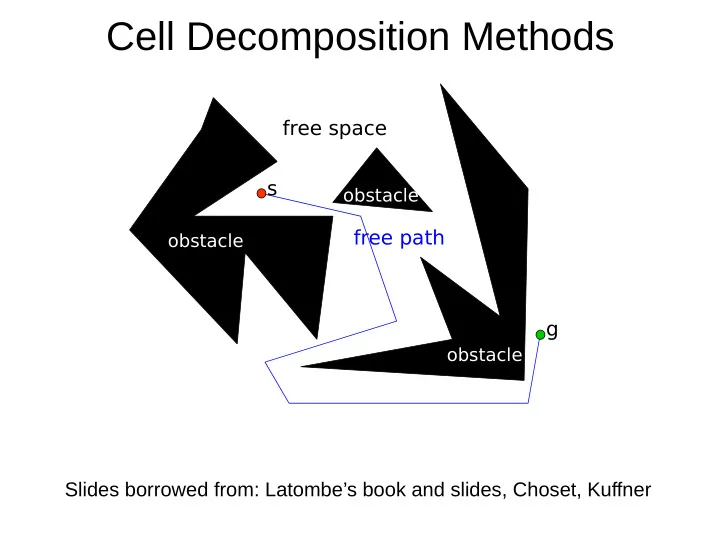
free space s g free path
SLIDE 2 Problem
Given: – a point-robot (robot is a point in space) – a start and goal configuration Find: – path from start to goal that does not result in a collision
free space s g free path
SLIDE 3
Motion planning framework
Continuous representation Discretization Graph searching
(blind, best-fjrst, A*)
SLIDE 4
Approximate Cell Decomposition
SLIDE 5
Approximate Cell Decomposition
SLIDE 6
Approximate Cell Decomposition
SLIDE 7
Approximate Cell Decomposition
SLIDE 8 Approximate Cell Decomposition
- 1. Compute cell decomposition down to
some resolution
- 2. Identify start and goal cells
- 3. Search for sequence of empty/mixed cells
between start and goal cells
- 4. If no sequence, then exit with no path
- 5. If sequence of empty cells, then exit with
solution
- 6. If resolution threshold achieved, then exit
with failure
- 7. Decompose further the mixed cells
- 8. Return to 2
SLIDE 9
Approximate Cell Decomposition
SLIDE 10
Approximate Cell Decomposition
SLIDE 11
Approximate Cell Decomposition
SLIDE 12
Exact Cell Decomposition
SLIDE 13
Exact Cell Decomposition
SLIDE 14
Exact Cell Decomposition
SLIDE 15
Exact Cell Decomposition
SLIDE 16
Exact Cell Decomposition
SLIDE 17 critical events criticality-based decomposition
…
Exact Cell Decomposition
SLIDE 18
Exact Cell Decomposition
SLIDE 19
Exact Cell Decomposition
SLIDE 20
Exact Cell Decomposition
The good: – exact cell decomposition is complete The bad: – it doesn’t scale well to high dimensions