Cell Analogies Using abstraction to show off your creativity and - - PowerPoint PPT Presentation

cell analogies
SMART_READER_LITE
LIVE PREVIEW

Cell Analogies Using abstraction to show off your creativity and - - PowerPoint PPT Presentation

Cell Analogies Using abstraction to show off your creativity and your knowledge of cells Project goal: Use abstraction to represent a cell through the use of an analogy. Possible analogies A real or fictional place - city, amusement park,


slide-1
SLIDE 1

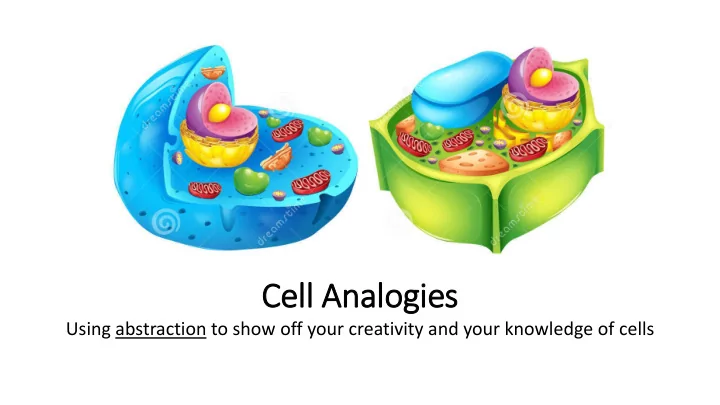
Cell Analogies

Using abstraction to show off your creativity and your knowledge of cells
slide-2
SLIDE 2

Project goal: Use abstraction to represent a cell through the use of an analogy.

slide-3
SLIDE 3
slide-4
SLIDE 4

Possible analogies

 A real or fictional place - city, amusement park, store, restaurant, sports arena, school…  An existing or made up game  An existing or made up story  An app - SnapChat, Instagram, YouTube...

slide-5
SLIDE 5

Step 1: Brainstorm what analogy you want to use, and how each cell part fits into your analogy

  • A. Cell = City
  • B. Cell membrane = City limits
  • C. Cytoplasm = Environment
  • D. Nucleus = Town Hall
  • F. Ribosomes = Factory
  • G. Endoplasmic Reticulum =

Roads and Highways

slide-6
SLIDE 6

Step 2: Visually create your analogy

  • Can be a map/drawing, a board game, an illustrated story, a labeled app

walkthrough, etc.

  • Can be done on an 11x17” piece of paper, in a Google Presentation, or in

Scratch.

  • Make it colorful and creative, and don’t forget to include something to

represent each cell part!

  • You may label cell parts directly, or label them with letters and include a

legend or map key.

slide-7
SLIDE 7
slide-8
SLIDE 8

Step 3: Explain your analogy

  • Justify why you selected each component of your analogy to represent that

part of the cell and what that analogy part and the cell part have in common

  • Identify the type of cell you picked by writing down whether it is a plant or

animal cell

  • For each component, include:
  • the name of the component
  • the name of the cell part it corresponds to
  • why you selected that component to represent the cell part. For

example, the Town Hall represents the nucleus because it controls the town’s activities.

slide-9
SLIDE 9