CEE 697K ENVIRONMENTAL REACTION KINETICS Lecture #2 Rate - - PDF document

cee 697k
SMART_READER_LITE
LIVE PREVIEW

CEE 697K ENVIRONMENTAL REACTION KINETICS Lecture #2 Rate - - PDF document

9/4/2013 Updated: 4 September 2013 CEE 697K Lecture #2 1 Print version CEE 697K ENVIRONMENTAL REACTION KINETICS Lecture #2 Rate Expressions: Bromide + Chlorine case study & lab project Kumar & Margerum paper Introduction David A.


slide-1
SLIDE 1

9/4/2013 1

CEE 697K

ENVIRONMENTAL REACTION KINETICS

Introduction

David A. Reckhow

CEE 697K Lecture #2 1

Updated: 4 September 2013

Print version

Lecture #2

Rate Expressions: Bromide + Chlorine case study & lab project

Kumar & Margerum paper

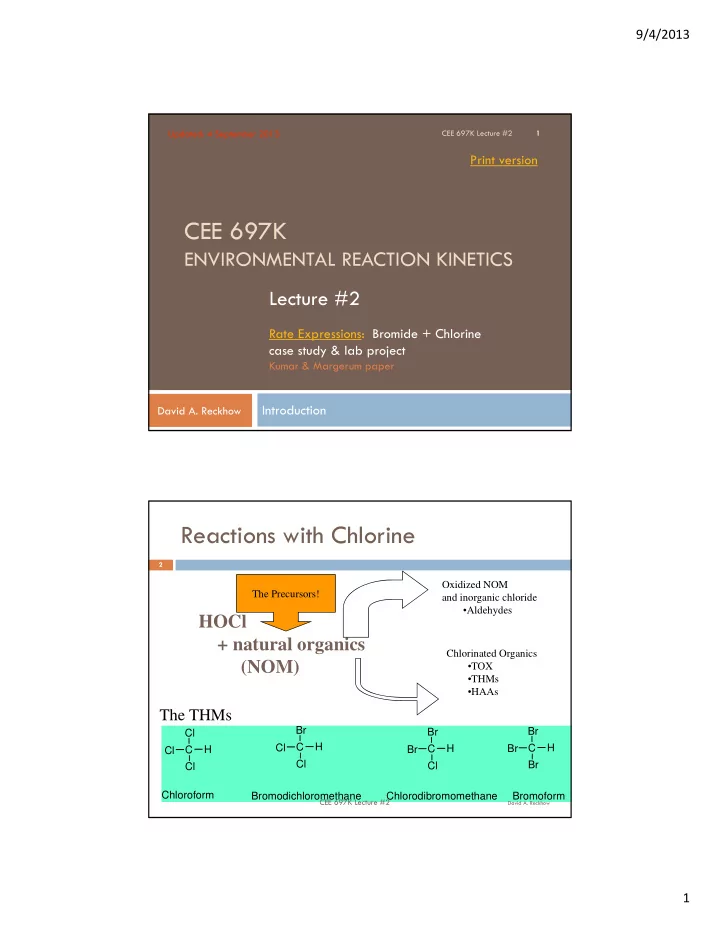
Reactions with Chlorine

HOCl + natural organics (NOM)

Oxidized NOM and inorganic chloride

  • Aldehydes

Chlorinated Organics

  • TOX
  • THMs
  • HAAs

Cl Cl Cl C H Br Cl Cl C H Br Cl Br C H Br Br Br C H Chloroform Bromodichloromethane Chlorodibromomethane Bromoform

The THMs

The Precursors!

David A. Reckhow

CEE 697K Lecture #2

2

slide-2
SLIDE 2

9/4/2013 2

The Haloacetic Acids

Cl Cl Cl C COOH Br Cl Cl C COOH Br Cl Br C COOH Br Br Br C COOH Trichloroacetic Bromodichloroacetic Chlorodibromoacetic Tribromoacetic Acid Acid Acid Acid

(TCAA)

Cl Cl H C COOH Br Cl C COOH Br Br H C COOH Dichloroacetic Bromochloroacetic Dibromoacetic Acid Acid Acid

(DCAA)

H

David A. Reckhow

CEE 697K Lecture #2

3

David A. Reckhow

4

Distribution: Variability within a single system

 Example: New

Haven Service Area

 DS model

CEE 697K Lecture #2

slide-3
SLIDE 3

9/4/2013 3

David A. Reckhow

5

 Sept 11, 1997  22:00  chlorine

New Haven Distribution System

Lake Saltonstall WTP West River WTP Lake Gaillard WTP Millrock Basins Maltby Tank

3,400 pipes 2,500 junctions

3 MG 8.7 MG

2.0 mg/L DOC (Treated) pH 7 1.8 mg/L chlorine dose

CEE 697K Lecture #2

David A. Reckhow

6

 Sept 11, 1997  22:00  TTHM

CEE 697K Lecture #2

slide-4
SLIDE 4

9/4/2013 4

David A. Reckhow

7

 Sept 11, 1997  22:00  HAA6

CEE 697K Lecture #2

Single Cell Gel Electrophoresis Genotoxicity Potency Log Molar Concentration (4 h Exposure)

10-6 10-5 10-4 10-3 10-2

IAA BAA CAA DIAA TBAA DBAA 3,3-Dibromo-4-oxopentanoic Acid 2-Bromobutenedioic Acid 2-Iodo-3-bromopropenoic Acid 2,3-Dibromopropenoic Acid DBNM BDCNM TBNM TCNM BNM BCNM DBCNM DCNM CNM Bromoacetamide Dibromoacetamide Tribromopyrrole MX Bromate EMS +Control Haloacetic Acids Halo Acids Haloacetamides Halonitromethanes Other DBPs

DBP Chemical Class

Not Genotoxic: DCAA, TCAA, BDCAA, Dichloroacetamide, 3,3-Dibromopropenoic Acid, 3-Iodo-3-bromopropenoic Acid, 2,3,3,Tribromopropenoic Acid July 2006 Chloroacetamide Trihloroacetamide Iodoacetamide Haloacetonitriles Bromoacetonitrile Dibromoacetonitrile Bromochloroacetonitrile Chloroacetonitrile 3,3-Bromochloro-4-oxopentanoic Acid Iodoacetonitrile Trichloroacetonitrile Dichloroacetonitrile BIAA CDBAA BCAA

 Work of Michael Plewa  Univ. of Illinois

8

Genotoxicity

David A. Reckhow

CEE 697K Lecture #2

slide-5
SLIDE 5

9/4/2013 5

9

Bromide: THM Formation

Bromide Concentration (mg/L)

0.0 0.4 0.8 1.2 1.6 2.0

Percent of TTHM

20 40 60 80 100 CHCl3 CHBrCl2 CHBr2Cl CHBr3

Data from: Minear & Bird, 1980

96 hours, pH 7.0 5 mg/L Chlorine Dose 1 mg/L Humic Acid

David A. Reckhow

CEE 697K Lecture #2

10

Impact of Bromide on DHAA Formation

Bromide Concentration (mg/L)

1 2 3 4 5

Concentration (g/L as Cl-)

20 40 60 80 100

CHCl2COOH CHClBrCOOH CHBr2COOH pH 7, 25oC, 7 days 25 mg/L chlorine dose 2.9 mg/L TOC

From Pourmoghaddas, 1990

David A. Reckhow

CEE 697K Lecture #2

slide-6
SLIDE 6

9/4/2013 6

11

Formation of Brominated THMs

A C

C H Cl Cl Cl C H Br Cl Cl C H Br Br Cl C H Br Br Br

B D E F

HOCl HOCl HOCl HOCl HOCl HOCl

HOCl Br HOBr Cl

k

    

 

David A. Reckhow

CEE 697K Lecture #2

David A. Reckhow

12

THM Br/(Cl+Br)

0.0 0.2 0.4 0.6 0.8 1.0

THM Mole Fraction (THM4 only)

0.0 0.2 0.4 0.6 0.8 1.0 1.2 CHCl3 CHBrCl2 CHBr2Cl CHBr3 CHCl3 Lab tests CHBrCl2 Lab tests CHBr2Cl Lab tests CHBr3 Lab tests

Full-scale data (small symbols) from Weinberg et al., 2002

(All 12 plants)

Lab data (large symbols) from Hua & Reckhow, 2004 Lines are geometric model

Bromo speciation

CEE 697K Lecture #2

slide-7
SLIDE 7

9/4/2013 7

Case study: chlorine + bromide

David A. Reckhow

CEE 697K Lecture #2

13

 Observed reaction  Nucleophilic attack of bromide on oxygen in

hypochlorous acid

 k2 = 2.95 x10³ M-1s-1 at 25ºC

 Note that HOCl deprotonates at elevated pHs  From Farkas et al., 1949

 Transfer of Cl+ to form intermediate (BrCl)

 From Kumar & Margerum, 1987

 

    Cl HOBr Br HOCl

k2

BrCl O H A Br HOCl HA

k

     

  2

3

 

      Cl Br Br BrCl

fast 2

 

   

3 2

Br Br Br

fast

Background

 Absorbance for

monitoring reaction

 Known equilibria

David A. Reckhow

14

CEE 697K Lecture #2

slide-8
SLIDE 8

9/4/2013 8

Alkaline Experiments

David A. Reckhow

CEE 697K Lecture #2

15

 Pseudo-1st order  Bromide in great excess  Slow reactions  Could be monitored directly by

conventional UV spectrophotometer

 292 nm peak for hypochlorite

(OCl-)

 Followed for 4 half-lives

 Complete from: 1.1 sec – 4 hr

 Plot ln(At-A∞) vs time

 Slope is kobs

Kobs is a linear function of Bromide

David A. Reckhow

CEE 697K Lecture #2

16

slide-9
SLIDE 9

9/4/2013 9

pH dependency

David A. Reckhow

CEE 697K Lecture #2

17

Overall pH dependence

David A. Reckhow

CEE 697K Lecture #2

18

 How to explain pH effect on 2nd order rate constant?  See also, Brezonik, pg 230; figure 4-20

slide-10
SLIDE 10

9/4/2013 10

Buffer Tests

David A. Reckhow

CEE 697K Lecture #2

19

 Low pH  High pH

Buffer Effect

 Proposed dependence on

HA

David A. Reckhow

20

CEE 697K Lecture #2

 

] [ ] [ ] [

  

  Br HA k H k k k

HA H

  • bs

] [ ] [ 1 1 ] [

] [  

    

H K C H C C HA

a T T H K T

a

                 

  

] [ ] [ ] [ ] [ H K buffer k k H k Br k

a T HA H

  • bs

1 2 2

10 ) 15 . 25 . 1 (

 

  s M x kHA

1 2

3 . 1 9 . 8

 

  s M kHA

HPO4

  • 2

HCO3

slide-11
SLIDE 11

9/4/2013 11

 High pH only  More generally

David A. Reckhow

21

CEE 697K Lecture #2

 

] [ ] [ ] [

  

  Br HA k H k k k

HA H

  • bs

 

] [ ] ][ [ ] [ ] [ )] ( [

  

     Br OCl HA k HOCl k OCl k dt I Cl d

HA HOCl

 

] ][ [ ] [ ] [ ] [

   

    Br OCl HA k H k k dt OCl d

HA H

Acidic Experiments

David A. Reckhow

CEE 697K Lecture #2

22

 Pseudo-1st order  Bromide in great excess  Fast reactions  Required high-speed setup  Stopped-flow spectrophotometer  Could monitor 2º product  266 nm peak for tribromide (Br3

  • )

 Followed for 4 half-lives

 Complete from 0.40-0.01 sec

 Plot ln(At-A∞) vs time

 Slope is kobs

slide-12
SLIDE 12

9/4/2013 12

Stopped-flow

David A. Reckhow

CEE 697K Lecture #2

23

 Principle  Commercial instruments  Limitations  Correct for slow mixing speed (km)  For Durrum instrument: km = 1700 s-1

   

m

  • bs k

k

  • bs
  • bs

k k

   1

Kobs is still linear with Br-

David A. Reckhow

CEE 697K Lecture #2

24

 No difference in mechanism?

slide-13
SLIDE 13

9/4/2013 13

Acidic data: impact of acids

David A. Reckhow

CEE 697K Lecture #2

25

 General and specific acid

Overall pH dependence

David A. Reckhow

CEE 697K Lecture #2

26

 Three effective zones  See also, Brezonik, pg 230; figure 4-20 HOCl OCl- H+ + HOCl

slide-14
SLIDE 14

9/4/2013 14

Catalysis: comparison with pKa

David A. Reckhow

CEE 697K Lecture #2

27

 Bronsted catalysis  Indicates that HA engages in greater

donation of proton to OCl- than to HOCl

H3O+ HCO3

  • HPO4
  • 2

CH3COOH CH2ClCOOH H2O

 

 a A HA

K G k 

27 .   75 .  

Mechanisms

David A. Reckhow

CEE 697K Lecture #2

28

 Proposed mechanism  Alternative  Less likely

slide-15
SLIDE 15

9/4/2013 15

Temperature: Arrhenius Equation

David A. Reckhow

CEE 697K Lecture #2

29

 Arrhenius Equation  Where R is the universal gas constant  Transforms to:

/

a

E RT

k Ae 

8.3145

  • J

R M K 

1 ( ) ( )

a T

E Ln k Ln A R T       

Ln(k) 1/T

1 1

a b a

E R T T Tb Ta

k k e

       

Or:

Pizza Kinetics

David A. Reckhow

CEE 697K Lecture #2

30

 Leenson, 1999  What are the kinetics of

pizza spoilage?

 Do they conform to

Arrhenius?

  • J. Chem Ed., 76:4:504-505
slide-16
SLIDE 16

9/4/2013 16

Pizza II

David A. Reckhow

CEE 697K Lecture #2

31

 Arrhenius plot  t~k

Time (min)

20 40 60 80 100

Absorbance at 292 nm (cm-1)

0.00 0.05 0.10 0.15 0.20 0.25 0.30 0.35

Lab Project Example Data #I

David A. Reckhow

CEE 697K Lecture #2

32

 0.1 M NaOH What is the Absinf ?

slide-17
SLIDE 17

9/4/2013 17

Time (min)

20 40 60 80

Ln (A292-A292inf)

  • 6
  • 5
  • 4
  • 3
  • 2
  • 1

b[0] -1.5509712892 b[1] -0.0400283854

Lab Project Example Data #II

David A. Reckhow

CEE 697K Lecture #2

33

 0.1 M NaOH Set Absinf = 0.085

time vs ln(A-Ainf) Plot 1 Regr

Time (min)

20 40 60 80

Absorbance at 292 nm (cm-1)

0.00 0.05 0.10 0.15 0.20 0.25 0.30 0.35

Lab Project Example Data #III

David A. Reckhow

CEE 697K Lecture #2

34

 0.05 M NaOH Set Absinf = ?

slide-18
SLIDE 18

9/4/2013 18

Time (min)

20 40 60 80

Ln (A292-A292inf)

  • 9
  • 8
  • 7
  • 6
  • 5
  • 4
  • 3
  • 2
  • 1

b[0] -1.4076822953 b[1] -0.0862394216

Lab Project Example Data #IV

David A. Reckhow

CEE 697K Lecture #2

35

 0.05 M NaOH Set Absinf = 0.094 Maybe too high ? Downward curvature

time vs ln(A-Ainf) Plot 1 Regr

Time (min)

20 40 60 80

Ln (A292-A292inf)

  • 7
  • 6
  • 5
  • 4
  • 3
  • 2
  • 1

b[0] -1.6667372496 b[1] -0.0679233226

Lab Project Example Data #V

David A. Reckhow

CEE 697K Lecture #2

36

 0.05 M NaOH Set Absinf = 0.092 Looks better, except for final data where relative error is high, Use only earlier data?

slide-19
SLIDE 19

9/4/2013 19

Time (min)

10 20 30

Ln (A292-A292inf)

  • 4.5
  • 4.0
  • 3.5
  • 3.0
  • 2.5
  • 2.0
  • 1.5
  • 1.0

b[0] -1.5462593144 b[1] -0.0744460114

Lab Project Example Data #VI

David A. Reckhow

CEE 697K Lecture #2

37

 0.05 M NaOH Set Absinf = 0.092 Using only earlier data where relative error is low, Better linearity and estimate of kobs?

Related systems

David A. Reckhow

CEE 697K Lecture #2

38

slide-20
SLIDE 20

9/4/2013 20

CEE 697K

ENVIRONMENTAL REACTION KINETICS

Introduction

David A. Reckhow

CEE 697K Lecture #2 39

Updated: 4 September 2013

Print version

Lecture #2b

Introduction: Simple Rate Laws

Brezonik, pp.31-39

David A. Reckhow

CEE 697K Lecture #2

40

Variable Kinetic Order

 Any reaction order, except n=1 n nc

k dt dc  

 

  

1 1 1

1 1 1

 

  

n n

  • n
  • t

c k n c c

  t

k n c c

n n

  • n

1 1 1

1 1

  

 

slide-21
SLIDE 21

9/4/2013 21

David A. Reckhow

CEE 697K Lecture #2

41

Half-lives

 Time required for initial concentration to drop to

half, i.e.., c=0.5co

 For a zero order reaction:  For a first order reaction:

c c kt

2 1

5 . kt c c

 k c t

  • 5

.

2 1 

c c e

  • kt

2 1

5 .

kt

  • e

c c

k k t 693 . ) 2 ln(

2 1

 

Example: Benzyl Chloride

David A. Reckhow

CEE 697K Lecture #2

42

 Use:  Manufacture of benzyl compounds, perfumes,

pharmaceuticals, dyes, resins, floor tiles

 Toxicity  Intensely irritating to skin, eyes, large doses can cause

CNS depression

 Emission  45,000 lb/yr  Fate  Benzyl chloride undergoes slow degradation in water to

benzyl alcohol

slide-22
SLIDE 22

9/4/2013 22

Benzyl chloride II

David A. Reckhow

CEE 697K Lecture #2

43

25ºC

Sources:

  • Schwarzenbach et al., 1993, Env. Organic Chemistry
  • 1972, J. Chem.Soc. Chem. Comm. 425-6
  • 1967, Acta Chem. Scand. 21:397-407
  • 1961, J. Chem. Soc. 1596-1604

] [ ] [ A k dt A d  

 Benzyl chloride to benzyl alcohol  Nucleophilic substitution  SN1 or SN2?

 How to distinguish?

 Salt effects

CH2Cl CH2OH

H2O HCl

Temperature 0.1ºC 25ºC K 0.042x10⁻⁵ s-1 1.38x10⁻⁵s-1 T1/2 19.1 d 0.58 d

Mixed Second Order

David A. Reckhow

CEE 697K Lecture #2

44

 Two different reactants  Initial Concentrations are different; [A]0≠[B]0

 The integrated form is:  Which can be expressed as:

products B A

k

  

2

   dt A d dt d V rate

A

] [ 1 1  

  

x B x A k B A k dt dx    

2 2

] [ ] [ ] ][ [

t k B A A B B A

2

] [ ] [ ] [ ] [ ln ] [ ] [ 1    

2

] [ ] [ log ] [ ] [ 43 . ] [ ] [ log A B t B A k B A    ] [ ] [ log B A

t

] [ ] [ log B A

slide-23
SLIDE 23

9/4/2013 23

Mixed Second Order

David A. Reckhow

CEE 697K Lecture #2

45

 Initial Concentrations are the same; [A]0=[B]0

 The integrated form is:  Which can be integrated:

products B A

k

  

2

  

x A x A k A A k dt dx    

2 2

] [ ] [ ] ][ [

2

] [ 1 2 ] [ 1 A t k A   ] [ 1 A

t

] [ 1 A

x B x A B A      ] [ ] [ ] [ ] [

 

 dt k A A d

A 2 2

] [ ] [  t k A A

2

2 ] [ 1 ] [ 1  

David A. Reckhow

CEE 697K Lecture #2

46

Pseudo first order

 For most reactions, n=1 for each of two different

reactants, thus a second-order overall reaction

1 1 2 B Ac

c k dt dc  

1 1 5

min 10 9 . 3

  

 Lmg x k

 Many of these will have one reactant in great excess (e.g., B)

 These become “pseudo-1st

  • rder in the limiting reactant,

as the reactant in excess really doesn’t change in concentration

B

c

A

c

products B A

k

  

2

slide-24
SLIDE 24

9/4/2013 24

10 20 30 40 50 60 70 80 90 20 40 60 80 Time (min) Concentration

David A. Reckhow

CEE 697K Lecture #2

47

Pseudo-1st order (cont.)

 Since C2 changes little

from its initial 820 mg/L, it is more interesting to focus

  • n CA

 CA exhibits simple 1st

  • rder decay, called

pseudo-1st order

 The pseudo-1st order rate

constant is just the “observed rate” or kobs

1 1 2 B Ac

c k dt dc  

t k Ao A

  • bs

e c c

1 5 2

min 032 . ) 820 ( 10 9 . 3

 

   x c k k

B

  • bs

Example: O3 & Naphthalene

David A. Reckhow

CEE 697K Lecture #2

48

 How long will it take for ozone (4.8

mg/L dose) to reduce the concentration of naphthalene by 99%?

 Used in moth balls and as a chemical

intermediate

 2nd order reaction; k2 = 3000 M-1s-1

 Table 1 in Hoigne & Bader, 1983 [Wat.

  • Res. 17:2:173]

 Industrial WW with 0.1mM naphthalene

 Both reactants are at same (0.1mM)

concentration

 Therefore, this reduces to a simple 2nd

  • rder reaction

t k A A

2

] [ 1 ] [ 1   t 3000 10 1 10 1

4 6

 

 

min 5 . 5 sec 330 000 , 990 3000    t t

slide-25
SLIDE 25

9/4/2013 25

O3 & Naphthalene (cont.)

David A. Reckhow

CEE 697K Lecture #2

49

 Contaminated river water (0.001 mM)  Now ozone is in great molar excess, so this is a pseudo-1st

  • rder reaction

t B k

e A A

2

] [

] [ ] [

 

 

sec 4 . 15 3 . 605 . 4 10 3000 10 10 ln ] [ ] [ ] [ ln

4 6 8 2

             

  

t t t t B k A A

Molecularity of three: 3rd order kinetics

David A. Reckhow

CEE 697K Lecture #2

50

 Quite improbably, but sometimes happens  Three different reactants  Complicated integrated form exists  Two different reactants  Integrated form:

products C B A

k

   

3

   

x C x B x A k C B A k dt dx     

3 3

] [ ] [ ] [ ] ][ ][ [

products B A

k

  

3

2

   

x B x A k B A k dt dx    

2 3 2 3

] [ 2 ] [ ] [ ] [

    

t k A B B A A B A A A B A A

3 2

] [ ] [ 2 ] [ ] [ ] [ ] [ ln ] [ ] [ ] [ ] [ 2 ] [ ] [     

slide-26
SLIDE 26

9/4/2013 26

3rd Order (cont.)

David A. Reckhow

CEE 697K Lecture #2

51

 Only one reactant or Initial Concentrations are the same

 The integrated form is:  Which can be integrated:

products A

k

  3 3

   

x A x A x A k A A A k dt dx     

3 3

] [ ] [ ] [ ] ][ ][ [

2 3 2

] [ 1 6 ] [ 1 A t k A  

2

] [ 1 A

t

2

] [ 1 A

 

 dt k A A d

A 3 3

] [ ] [  t k t k A A

A 3 3 2 2

6 2 ] [ 1 ] [ 1     

3rd Order (cont.)

David A. Reckhow

CEE 697K Lecture #2

52

 Pseudo-2nd order reactions  When one of the reactants has a fixed concentration

 E.g., present in excess or buffered, or acts catalytically

 Like a regular 2nd order reaction with two reactants but

  • bserved constant is fundamental rate constant times

concentration of the 3rd reactant.

 The integrated form:

t C k B A A B B A ] [ ] [ ] [ ] [ ] [ ln ] [ ] [ 1

3

 

  • bs

k

slide-27
SLIDE 27

9/4/2013 27

Example: chlorate formation

David A. Reckhow

CEE 697K Lecture #2

53

 Formation of chlorate in concentrated hypochlorite

solutions

 Concern: chlorate is toxic  MCLG=0.2 mg/L  Stoichiometry  Is this 3rd order? Be skeptical!  Observed kinetics  So, why is it 2nd order?

  

  Cl ClO OCl 2 3

3

 

2 3 ]

[

 

 OCl k dt ClO d

  • bs

Chlorate example (cont.)

David A. Reckhow

CEE 697K Lecture #2

54

 Answer: this is a reaction pathway composed of two

elementary reactions

 Step #1  Step #2  In multi-step reactions such as these, we say that  the overall rate is determined by the slowest step

 Called the “rate-limiting step” or RLS

 Rate law is written based on the RLS  Subsequent steps are ignored  Prior steps are incorporated as they determine the

concentrations of the RLS reactants

  

    Cl ClO OCl

slow 2

2

   

     Cl ClO ClO OCl

fast 3 2

Homework #2 is based on this reaction

H

slide-28
SLIDE 28

9/4/2013 28

David A. Reckhow

CEE 697K Lecture #2

55

Reversible reaction kinetics

For a general reversible reaction:

k qQ + pP bB + aA k

r f

And the rate law must consider both forward and reverse reactions:

where, kf = forward rate constant, [units depend on a and b] kb or kr = backward rate constant, [units depend on a and b] CP = concentration of product species P, [moles/liter] CQ = concentration of product species Q, [moles/liter] p = stoichiometric coefficient of species P q = stoichiometric coefficient of species Q

q Q p P r b B a A f

C C k C C k rate  

David A. Reckhow

CEE 697K Lecture #2

56 Reversible 1st order reactions

Stumm & Morgan

  • Fig. 2.10
  • Pg. 69

] [ ] [

2 1

B k A k dt dB  

eq

K k k A B B k A k dt dB     

2 1 2 1

] [ ] [ ] [ ] [

 Kinetic law  Eventually the reaction

slows and,

 Reactant concentrations

approach the equilibrium values

slide-29
SLIDE 29

9/4/2013 29

Reversible 1st order (cont.)

David A. Reckhow

CEE 697K Lecture #2

57

 Solution to non-equilibrium reaction period  See Brezonik, pg 37-38 for details  Where k* = kf + kr  And:  Where:

 

t k f r

e k k A k A

*

*

] [ 1 ] [

 

k P A k

r f

t k equ equ

e A A A A

*

] [ ] [ ] [ ] [

  

 

equ equ equ r f

A P K k k ] [ ] [  

Linearized version

David A. Reckhow

CEE 697K Lecture #2

58

 To next lecture