CEE 697K ENVIRONMENTAL REACTION KINETICS Lecture #10 Special - - PDF document

cee 697k
SMART_READER_LITE
LIVE PREVIEW

CEE 697K ENVIRONMENTAL REACTION KINETICS Lecture #10 Special - - PDF document

10/17/2013 Updated: 17 October 2013 CEE697K Lecture #10 1 Print version CEE 697K ENVIRONMENTAL REACTION KINETICS Lecture #10 Special Topics: DCP in Water Primary Literature (e.g., Guthrie & Cossar, 1986) Introduction David A. Reckhow


slide-1
SLIDE 1

10/17/2013 1

CEE 697K

ENVIRONMENTAL REACTION KINETICS

Introduction

David A. Reckhow

CEE697K Lecture #10 1

Updated: 17 October 2013

Print version

Lecture #10

Special Topics: DCP in Water

Primary Literature (e.g., Guthrie & Cossar, 1986)

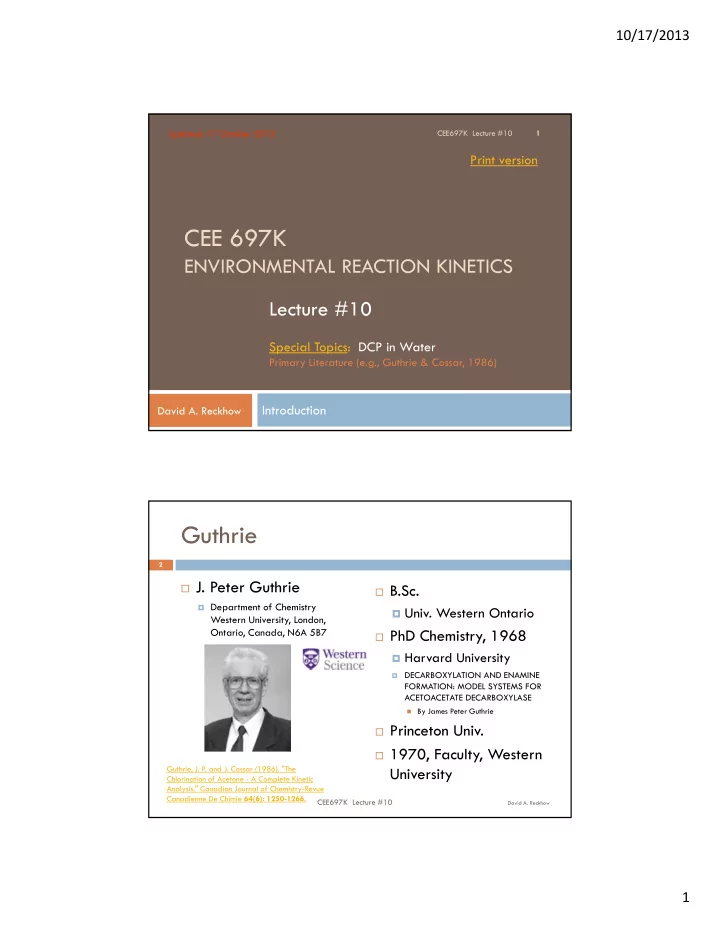
Guthrie

 J. Peter Guthrie

 Department of Chemistry

Western University, London, Ontario, Canada, N6A 5B7

 B.Sc.  Univ. Western Ontario  PhD Chemistry, 1968  Harvard University

 DECARBOXYLATION AND ENAMINE

FORMATION: MODEL SYSTEMS FOR ACETOACETATE DECARBOXYLASE

 By James Peter Guthrie

 Princeton Univ.  1970, Faculty, Western

University

David A. Reckhow

2

CEE697K Lecture #10 Guthrie, J. P. and J. Cossar (1986). "The Chlorination of Acetone - A Complete Kinetic Analysis." Canadian Journal of Chemistry-Revue Canadienne De Chimie 64(6): 1250-1266.

slide-2
SLIDE 2

10/17/2013 2

Mechanisms: Haloform Reaction

David A. Reckhow

CEE690K Lecture #09

3

 Chlorine + acetone  Morris & Baum, 1978  Brezonik, 1994

Pg 240-241

Haloform reaction: initial step

David A. Reckhow

CEE690K Lecture #09

4

 Three potential pathways to enolate  Reaction with water (KO), hydroxide (KOH), and proton (KH)  kf=KO+KOH[OH-]+KH[H+]  For acetone, the OH pathway dominates above pH 5.5 What is kr?

] [ ] ][ [ HA A H k k K

r f a  

 

slide-3
SLIDE 3

10/17/2013 3

Guthrie & Cossar Pathway

David A. Reckhow

CEE697K Lecture #10

5

 Scheme 1

David A. Reckhow

CEE697K Lecture #10

6

 a

Hydrolysis of 1,1-DCP

The product

The many forms of 1,1-DCP

slide-4
SLIDE 4

10/17/2013 4

DCP equilibria I

David A. Reckhow

CEE697K Lecture #10

7

 Bell K’s

pH

2 4 6 8 10 12 14

Alpha

0.0 0.2 0.4 0.6 0.8 1.0 1.2 H+ alpha E alpha Q alpha L alpha 5

DCP equilibria II

David A. Reckhow

CEE697K Lecture #10

8

 Bell K’s

pH

2 4 6 8 10 12 14

Alpha

1e-8 1e-7 1e-6 1e-5 1e-4 1e-3 1e-2 1e-1 1e+0 1e+1 H+ alpha E alpha Q alpha L alpha 5

slide-5
SLIDE 5

10/17/2013 5

DCP equilibria III

David A. Reckhow

CEE697K Lecture #10

9

 Guthrie K’s

pH

2 4 6 8 10 12 14

Alpha

0.0 0.2 0.4 0.6 0.8 1.0 1.2 H+ alpha E alpha Q alpha L alpha 5

DCP equilibria IV

David A. Reckhow

CEE697K Lecture #10

10

 Guthrie K’s

pH

2 4 6 8 10 12 14

Alpha

1e-8 1e-7 1e-6 1e-5 1e-4 1e-3 1e-2 1e-1 1e+0 1e+1 H+ alpha E alpha Q alpha L alpha 5

slide-6
SLIDE 6

10/17/2013 6

Loss of intermediates in lab water

David A. Reckhow

CEE690K Lecture #09

11

 21C, ultrapure

water

 (Nikolaou et al.,

2001)

David A. Reckhow

CEE697K Lecture #10

12

 chlorine

slide-7
SLIDE 7

10/17/2013 7

David A. Reckhow

CEE697K Lecture #10

13

 a

Model

David A. Reckhow

CEE697K Lecture #10

14

 Guthrie model for 1,1-DCP degradation

pH

4 5 6 7 8 9 10 11 12 13 14

Half-Life (hrs)

0.0001 0.001 0.01 0.1 1 10 100 1000 Chlorine Hydrolysis

slide-8
SLIDE 8

10/17/2013 8

LFER Analysis

David A. Reckhow

CEE697K Lecture #10

15

 Baiyang Chen analysis  pH 7-7.5  20-25C  Predicted hydrolysis

rate constant for 1,1- DCP is 10-1.66 hr-1

 Half-life of 31.7 hr

 6.1 x 10⁻⁶ sec-1  (Chen, 2011).  Data point estimated from

Nikolaou et al., 2001

Chen, B. Y. "Hydrolytic Stabilities of Halogenated Disinfection Byproducts: Review and Rate Constant Quantitative Structure- Property Relationship Analysis." Environmental Engineering Science 28(6): 385-394.

Comparison with Chen 2001

David A. Reckhow

CEE697K Lecture #10

16

 Guthrie model for 1,1-DCP degradation

pH

4 5 6 7 8 9 10 11 12 13 14

Half-Life (hrs)

0.0001 0.001 0.01 0.1 1 10 100 1000 Chlorine Hydrolysis

Chen, 2011

slide-9
SLIDE 9

10/17/2013 9

Loss in water heaters

David A. Reckhow

CEE690K Lecture #09

17

 Liu et al.,

2013

 In review

Reaction Time (hr) 20 40 60 80 100 120 CP (g/L) 0.0 0.1 0.2 0.3 0.4 0.5 0.6 No heating 6 hrs incubation+heating 24 hrs incubation+heating 48 hrs incubation+heating 72 hrs incubation+heating 96 hrs incubation+heating Reaction Time (hr) 20 40 60 80 100 120 TCP (g/L) 0.0 2.0 4.0 6.0 8.0 No heating 6 hrs incubation+heating 24 hrs incubation+heating 48 hrs incubation+heating 72 hrs incubation+heating 96 hrs incubation+heating Reaction Time (hr) 20 40 60 80 100 120 DCAN (g/L) 0.0 0.5 1.0 1.5 2.0 2.5 No heating 6 hrs incubation+heating 24 hrs incubation+heating 48 hrs incubation+heating 72 hrs incubation+heating 96 hrs incubation+heating Reaction Time (hr) 20 40 60 80 100 120 1,1-DCP (g/L)

0.0 0.5 1.0 1.5 2.0 2.5 3.0

No heating 6 hrs incubation+heating 24 hrs incubation+heating 48 hrs incubation+heating 72 hrs incubation+heating 96 hrs incubation+heating

a b c d

Profile of 1,1-DCP in Water Systems

David A. Reckhow

CEE697K Lecture #10

18  1,1-Dichloropropanone concentrations compared to the corresponding

TTHM concentration for all samples

Chloroform (g/L)

20 40 60 80 100 120 140

1,1-dichloropropanone (g/L)

0.0 0.5 1.0 1.5 2.0 2.5 3.0 3.5 4.0 6.0 8.0 San Francisco Jan(Cl2/NH4Cl) Charleston(ClO2/ NH4Cl) San Francisco Apr (Cl2/NH4Cl) Ann Arbor(O3/NH4Cl) East Bay( Cl2/NH4Cl) Cincinnati(Cl2) Minneapolis (NH4Cl/NH4Cl) Monroe(O3/Cl2) Wyoming( Cl2/Cl2) Pinellas County(Cl2/Cl2) Pinellas County(Cl2/NH4Cl) Knoxville(ClO2/Cl2)

slide-10
SLIDE 10

10/17/2013 10

David A. Reckhow

CEE697K Lecture #10

19  1,1-Dichloropropanone concentrations compared to the corresponding

TTHM concentration for all samples: focus on free chlorine plants

Chloroform (g/L)

20 40 60 80 100 120

1,1-dichloropropanone (g/L)

0.0 0.2 0.4 0.6 0.8 1.0 San Francisco Jan(Cl2/NH4Cl) Charleston(ClO2/ NH4Cl) San Francisco Apr (Cl2/NH4Cl) Ann Arbor(O3/NH4Cl) East Bay( Cl2/NH4Cl) Cincinnati(Cl2) Minneapolis (NH4Cl/NH4Cl) Monroe(O3/Cl2) Wyoming( Cl2/Cl2) Pinellas County(Cl2/Cl2) Pinellas County(Cl2/NH4Cl) Knoxville(ClO2/Cl2) Monroe Cincinnati Wyoming Pinellas County

Profile of TCP in water systems

David A. Reckhow

CEE690K Lecture #09

20  1,1,1-Trichloropropanone concentrations compared to the corresponding

TTHM concentration for all samples

Chloroform (g/L)

20 40 60 80 100 120 140

1,1,1- trichloropropanone (g/L)

1 2 3 4 5 San Francisco Jan(Cl2/NH4Cl) Charleston(ClO2/ NH4Cl) San Francisco Apr (Cl2/NH4Cl) Ann Arbor(O3/NH4Cl) East Bay( Cl2/NH4Cl) Cincinnati(Cl2) Minneapolis (NH4Cl/NH4Cl) Monroe(O3/Cl2) Wyoming( Cl2/Cl2) Pinellas County(Cl2/Cl2) Pinellas County(Cl2/NH4Cl) Knoxville(ClO2/Cl2) Monroe Pinellas Co. Knoxville

slide-11
SLIDE 11

10/17/2013 11

Lab 2

David A. Reckhow

CEE697K Lecture #10

21

 15 Oct 2013 experiment

Reaction Time (sec)

100 200 300

Absorbance at 292 nm

0.0 0.1 0.2 0.3 Time (s) vs Abs

absinf = 0.012

Lab 2

David A. Reckhow

CEE697K Lecture #10

22

 1st order plot

Reaction Time (sec)

100 200 300

Ln (Abs-Abs

  • 6
  • 5
  • 4
  • 3
  • 2
  • 1

Time (s) vs ln abs-absinf Plot 1 Regr b[1] -0.0128851211

absinf = 0.012

K = 46 hr-1

slide-12
SLIDE 12

10/17/2013 12

Lab 2

David A. Reckhow

CEE697K Lecture #10

23

 2nd order plot

Reaction Time (sec)

100 200 300

1/(Abs-Abs

50 100 150 200 250 300 Time (s) vs 1/(abs-absinf) Plot 1 Regr David A. Reckhow

CEE697K Lecture #10

24

 Guthrie model

pH

4 5 6 7 8 9 10 11 12 13 14

Half-Life (hrs)

0.0001 0.001 0.01 0.1 1 10 100 1000 Chlorine Hydrolysis

slide-13
SLIDE 13

10/17/2013 13

David A. Reckhow

CEE697K Lecture #10

25

 To next lecture