
SLIDE 1
Catalyzing Innovations in the Curriculum
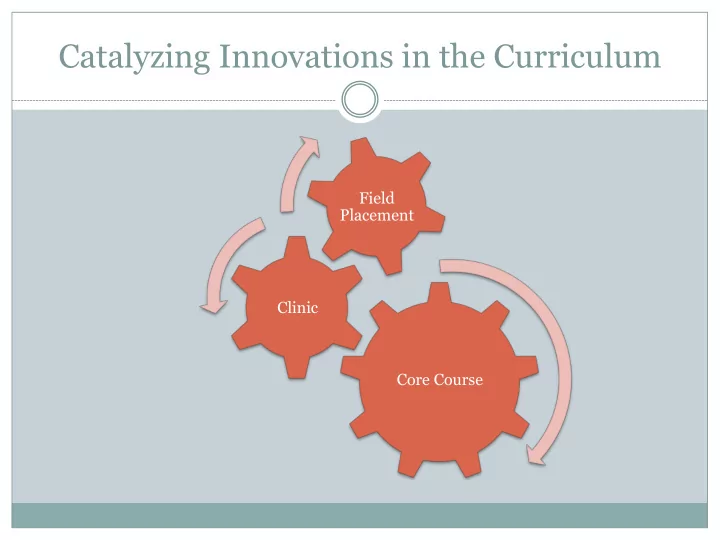
Core Course Clinic Field Placement
Catalyzing Innovations in the Curriculum Field Placement Clinic - - PowerPoint PPT Presentation
Catalyzing Innovations in the Curriculum Field Placement Clinic Core Course An A exam: An A exam would make a supervising attorney (client) (the intended audience) feel confident about relying on your work with little or no
Core Course Clinic Field Placement
An ‘A’ exam would make a supervising attorney (client) (the intended audience)
feel confident about relying on your work with little or no corrections or
counter arguments and legal obstacles that the case would likely encounter. The reader would understand “what” the law is, “how” it applies to her case, and (where appropriate) “why” the law is what it is or why it is as uncertain as it is.
An ‘A’ exam will: (a) be easy to read due to strong large-scale organization, clarity, and focus; (b) have missed no major causes of action or misstated any major rules of law; (c) have further analyzed the minor or more subtle legal issues in the fact pattern; (d) connect fact and law seamlessly to reason to legal conclusions; (e) be based on a close, accurate, and thorough reading of the facts; (f) ground legal advice in a sophisticated understanding of how a case proceeds
through the legal process
A ‘B’ exam would make a favorable impression on the intended audience. It would communicate that you know the law and legal analysis well. A supervising attorney would enjoy watching your growth and would feel confident that, with guidance, you will be a very good
refine the precise terminology, or to tighten the analytical structure. The intended audience would generally understand the law, the conclusions, and the legal advice with strong clarity.
A ‘B’ exam will:
(a) be similar to, but lack the thoroughness, power, or polish of an ‘A’ paper;
(b) have generally hit “the big issues” and stated the law accurately, but missed some of the minor nuances and complexities;
(c) be generally well-organized, but may require the reader to reread certain sentences or paragraphs before fully grasping the author’s point or may use excessive space to make minor points;
(d) state defensible legal conclusions, but further clarity may be necessary to understand the reasoning in all its contours;
(e) explain the “what” and “how” of the law, but may leave the client with further follow-up questions regarding why the result is as you suggest it is or why the other side might prevail
¡ Analysis to achieve client outcomes ¡ Lawyering within a legal process ¡ Legal output that clients need and value
¡ Serial dumping of issues ¡ Bland memorization (cramming) of legal rules ¡ Bifurcating goals of day-to-day classroom experience from
Lawyering skills Critical thinking; Articulating a “voice” Social, political, economic, historic context Rationales and critiques Substantive legal rules
Fun Bar exam
“What are the facts of the case?” “Who is the client?” “What is she seeking?”
“What is the source and strength of authority?” “Does the authority advance client goals?”
R E A L C L I E N T S I M U L A T I O N T H R E A D
All work that you complete today will be done in groups and will be submitted for “other participation” points. The groups should be no more than three – four persons. These “other assignments” cumulatively are worth 10% of your overall course grade. I intend for everyone to contribute to the dialogue and shift the drafting roles around. List at the top of your document the names of all group members contributing.
STEP 1 – NEEDS ASSESSMENT. For the purposes of this exercise only, assume
that the $1.5MM inheritance that Lucy received is in a trust that can only be used for the care and well-being of Lucy’s daughters. Assume further that Lucy will seek maintenance from Brad. Brad will not seek any maintenance from Lucy. Analyze the relevant code provisions to determine each party’s respective arguments under the “needs assessment” provision of the maintenance statute 403.200(1) only. Write a persuasive argument using the facts.
STEP 2 – AWARD AMOUNT. Assuming Lucy meets the “needs assessment”
under 403.200(1), use the factors in 403.200(2) to make the most persuasive argument possible for your client regarding (a) how much maintenance should be awarded; and (b) what type of maintenance to be awarded (permanent, durational, rehabilitative). Don’t worry so much about attaching a dollar figure to your request, but explain why you are asking for a particular range and type of award.
All work that you complete today will be done in groups and will be submitted for “other participation” points. The groups should be no more than three – four persons. These “other assignments” cumulatively are worth 10% of your overall course grade. I intend for everyone to contribute to the dialogue and shift the drafting roles around. List at the top of your document the names of all group members contributing.
STEP 1 – CALCULATE INCOME. Calculate each spouse’s percentage share of the gross monthly income. For the purposes of this exercise, assume that Brad is no longer receiving rental income because he is now living in the condominium. Brad will stipulate that he will receive $125,000 a year in future annual bonuses. Assume further that Lucy’s $1.5MM inheritance is structured as a trust to be paid out for the care and well being of Lucy’s daughters at $3,000 a month.
STEP 2 – PRESUMPTIVE AWARD. Use the child support guidelines to calculate the presumptive award and use strong client counseling language to explain not just how much will be awarded, but the strong public policy reasons and federal mandates that dictate this
STEP 3 – DISCRETIONARY ADD-ONS. Consider whether there are any arguments for deviations from the presumptive award. If so, make the argument in the context of client counseling.
By the completion of this course, you should be able to:
Critique and analyze current legal frameworks regulating the family using a
legal lens grounded in social, economic, and policy considerations and considering the implications of legal frameworks across cultures, communities, and diverse family structures;
Construct persuasive client narratives to achieve specific client goals within
an objective legal framework;
Advise clients regarding possible grounds for divorce, defenses to divorce,
and divorce pleading requirements;
Represent clients in the distribution of property by conducting an equitable
distribution analysis;
Calculate presumptive child support awards and raise arguments for
deviations;
Read and interpret statutory provisions regulating the family unit; Analyze the constitutional issues that arise from laws regulating the family