Social Studies Colloquia Agenda March 2, 2017 Welcome and DESE - - PowerPoint PPT Presentation

social studies colloquia agenda march 2 2017
SMART_READER_LITE
LIVE PREVIEW

Social Studies Colloquia Agenda March 2, 2017 Welcome and DESE - - PowerPoint PPT Presentation

Social Studies Colloquia Agenda March 2, 2017 Welcome and DESE Updates Periodization: What is it and why does it matter? Thinking Like a Social Scientist: Dr. Kevin Fernlund, University of Missouri-St. Louis Teaching a New


slide-1
SLIDE 1

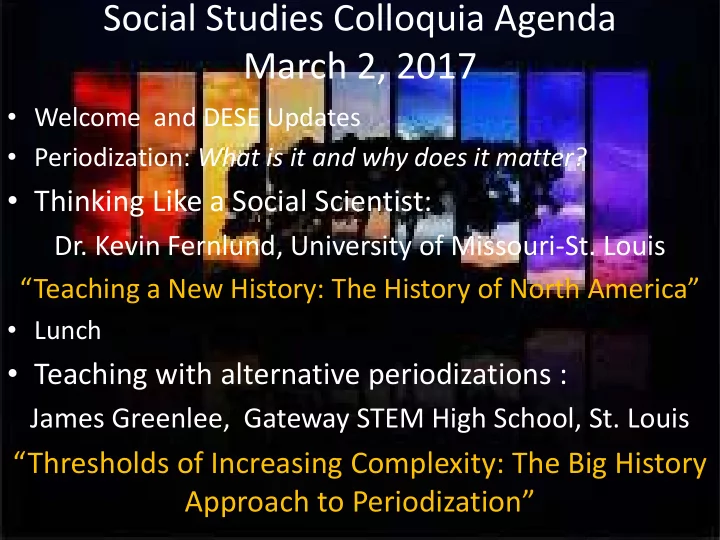
Social Studies Colloquia Agenda March 2, 2017

  • Welcome and DESE Updates
  • Periodization: What is it and why does it matter?
  • Thinking Like a Social Scientist:
  • Dr. Kevin Fernlund, University of Missouri-St. Louis

“Teaching a New History: The History of North America”

  • Lunch
  • Teaching with alternative periodizations :

James Greenlee, Gateway STEM High School, St. Louis

“Thresholds of Increasing Complexity: The Big History Approach to Periodization”

slide-2
SLIDE 2

DESE Updates

  • Personal Finance Workgroup progressing
  • Fine Arts workgroup created
  • Assessment work continues

DESE Updates

slide-3
SLIDE 3

Assessment Work

slide-4
SLIDE 4

Assessment Work

slide-5
SLIDE 5
  • All content areas
  • K-5, 6-12
  • Includes Arts Integration
  • June 12-16
  • Jeff City
  • Sessions repeat
  • Registration almost open
slide-6
SLIDE 6

Does anyone really know what time it is? Does anybody really care?

Colloquia March 2, 2017

slide-7
SLIDE 7

What is periodization?

Process of investigation, analysis, categorization and evaluation of the past to create descriptive abstractions which facilitate understanding of history..

slide-8
SLIDE 8

How does someone demonstrate mastery

  • f the concept of periodization as a social

science thinking skill?

The student can:

  • Explain how historical events/processes can be
  • rganized into periods.
  • Evaluate how/why an event or date should/should

not be considered a turning point.

  • Analyze different and/or competing models of

periodization.

slide-9
SLIDE 9

Periodization Concepts

  • Calendar
  • Prominent individuals
  • Historical/Political

events

  • Cultural movements
  • Illusory/mythological
  • Geological
  • Cosmological
  • Others……?
slide-10
SLIDE 10
slide-11
SLIDE 11
slide-12
SLIDE 12

Chinese Dynasties Song

Shang Zhou Qin Han Shang Zhou Qin Han Sui Tang Song Sui Tang Song

Yuan Ming Qing Republic Yuan Ming Qing Republic Mao and Deng Xi Jinping Mao and Deng Xi Jinping

slide-13
SLIDE 13

Why is periodization a significant historical thinking skill?

slide-14
SLIDE 14

Periodization Anchor Assignment

  • What makes this an

anchor activity?

  • Why was this our first

class assignment?

  • What would you, as the

teacher, learn from reading your students’ work?

  • How could you alter this

assessment to suit your specific needs?

slide-15
SLIDE 15

Other periodization anchors and applications

Periodization Socratic Seminar

  • To what degree was Funes a

“perpetual prisoner?”

  • In what ways are remembering

and forgetting equally important to memory?

  • To the narrator, what does it

mean to think? To you?

  • HW: What connections exist

between the ideas in this short story and the concept of periodization in historical thinking?

Periodization Argumentation Brief

  • What elements of

periodization as a historical thinking skill does this assignment evaluate?

  • How might you change,

alter/adjust this assignment to fit your students’ needs?

slide-16
SLIDE 16

Big History: An innovative approach to Periodization

  • https://school.bighistoryproject.com/bhplive
  • https://www.youtube.com/watch?v=yqc9zX04DXs

David Christian, Ted Talk

slide-17
SLIDE 17

Brief break: When you return..

  • Dr. Kevin Fernlund, Professor of History,

University of Missouri---St. Louis

slide-18
SLIDE 18

Lunch

  • Be quick today, we are starting promptly at

1:15. Marie Antoinette’s Kid

slide-19
SLIDE 19

Periodization: Classroom Application

James Greenlee, Gateway STEM High School, St. Louis, Missouri

“Thresholds of Increasing Complexity: The Big History Approach to Periodization”

slide-20
SLIDE 20

Closing Reminders