CASE STUDY ON CHILDREN WIT ITH DYSLEXIA OBJEC OBJECTIVES OF TH - - PowerPoint PPT Presentation

case study on children wit ith dyslexia
SMART_READER_LITE
LIVE PREVIEW

CASE STUDY ON CHILDREN WIT ITH DYSLEXIA OBJEC OBJECTIVES OF TH - - PowerPoint PPT Presentation

Presenter: Eva Wong EFFECT OF NEUROFEEDBACK: CASE STUDY ON CHILDREN WIT ITH DYSLEXIA OBJEC OBJECTIVES OF TH TIVES OF THE P E PAPER APER Seeks to present the effectiveness of Neurofeedback as strategy to improve children with Dyslexia in


slide-1
SLIDE 1

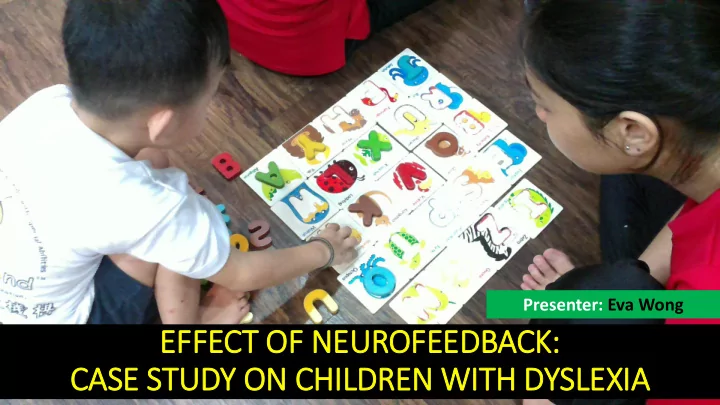
EFFECT OF NEUROFEEDBACK: CASE STUDY ON CHILDREN WIT ITH DYSLEXIA

Presenter: Eva Wong
slide-2
SLIDE 2

OBJEC OBJECTIVES OF TH TIVES OF THE P E PAPER APER Seeks to present the effectiveness of Neurofeedback as strategy to improve children with Dyslexia in word recognition

slide-3
SLIDE 3

WHY?

  • PREVALENCE RATE OF ASD
  • IMPLICATIONS OF THE

CONDITION: PSYCHOLOGY SOCIAL BEHAVIOUR

  • CONDITION IN MALAYSIA

7% Standard 2 Malays students (Gomez, 2000)

slide-4
SLIDE 4

METHODOLOGY Embedded experimental design QUAL + quan

Creswell, 2003

slide-5
SLIDE 5

Research Design

  • n= 10, DDT (Dysphoneidesia)
  • Age (mean): 8.4
  • Sampling: Purposive
  • Design: Pre-post
  • Group: Intervention (A-E),

Control (F-J)

  • Duration: 30 sessions

qual

Dyslexia Determination Test Post-positivism

Quan

Burt Reading Test positivism

slide-6
SLIDE 6

WHAT?

  • Intervention group

Educational Therapy Neurofeedback

  • Intervention group

Educational Therapy

Educational Therapy

Phonetic Task Writing Task

slide-7
SLIDE 7

IN INTERVENTION GROUP

Block

Duration Instruction

1

0 - 5 minutes Toy play

2

5 - 25 minutes Phonic Task

3

25 - 55 minutes Games + Neurofeedback

4

55 – 75 minutes Writing tasks

Neurofeedback Protocol T6 Delta F7 – C3 Alpha Marinus, et al (2009)

slide-8
SLIDE 8

CONTROL GROUP

Block

Duration Instruction

1

0 - 5 minutes Toy play

2

5 - 25 minutes Phonic Task

3

25 - 55 minutes Games

4

55 – 75 minutes Writing tasks

slide-9
SLIDE 9

FIN INDINGS: In Intervention Group

  • Quantitative Data
  • Pre: Avg 3.67
  • Post: Avg 4.08
  • 11.36% (Improvement)

Subjects Chro. Age Burt Pre Post A

7;4

3;9 4;3 B

7;7

4;1 4;5 C

7;6

3;3 3;9 D

7;3

3;8 4;2 E

7;8

3;7 4;2

1 2 3 4 5 6 7 8 9 A B C D E

Reading Age Pre and Post Intervention (Intervention Group)

Pre Post

slide-10
SLIDE 10

FIN INDINGS: Control Group

  • Quantitative Data
  • Pre: Avg 3.58
  • Post: Avg 3.83
  • 7.00% (Improvement)

Subjects Burt Burt Before After F 3;1 3;3 G 3;6 3;9 H 4;1 4;4 I 3;3 3;3 J 4;0 4;7

1 2 3 4 5 6 7 8 9 10 F G H I J

Reading Age Pre and Post Intervention (Control Group)

Pre Post

slide-11
SLIDE 11

Fin indings: : Qualitative Data (In (Intervention Group) Dysle lexia Determination Test

Subjects Pre – Intervention Post - Intervention

Basal Level Ceiling Level Basal Level Ceiling Level

A

Pre-Primer Pre-Primer Primer Primer

B

Pre-Primer Pre-Primer Pre-Primer Primer

C

  • Pre-Primer

Pre-Primer

D

  • Pre-Primer

Pre-Primer

E

Pre-Primer Pre-Primer Primer Grade 1

slide-12
SLIDE 12

Fin indings: : Qualitative Data (C (Control Group) Dysle lexia Determination Test

Subjects Pre – Intervention Post - Intervention

Basal Level Ceiling Level Basal Level Ceiling Level

A

  • B

Primer Primer

C

Pre-Primer Pre-Primer

D

Pre-Primer Grade 1

E

Pre-Primer Pre-Primer

slide-13
SLIDE 13

DIS ISCUSSION

  • Result (intervention and control group)
  • Quantitative and Qualitative
  • Literature (Vanessa, 2014; Edelson, 2014)
slide-14
SLIDE 14

Limitation

  • Limited number of subjects
  • Short intervention duration
  • Long term effect?
slide-15
SLIDE 15

THANK YOU