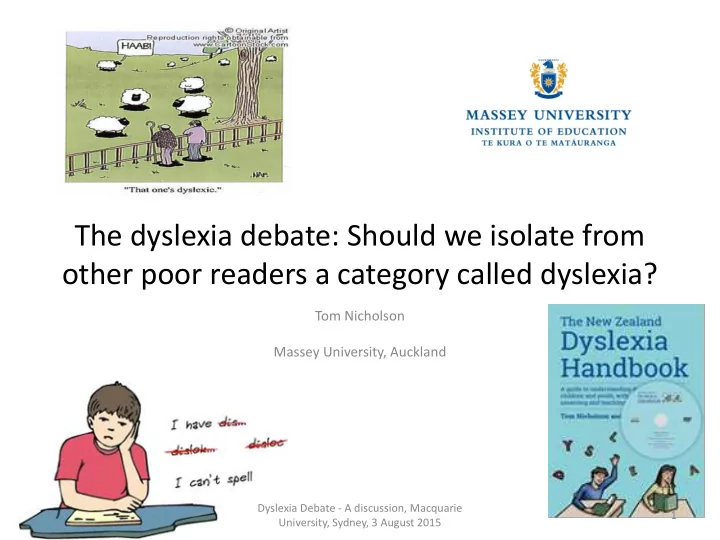
The dyslexia debate: Should we isolate from
- ther poor readers a category called dyslexia?
Tom Nicholson Massey University, Auckland
1 Dyslexia Debate - A discussion, Macquarie University, Sydney, 3 August 2015
The dyslexia debate: Should we isolate from other poor readers a - - PowerPoint PPT Presentation
The dyslexia debate: Should we isolate from other poor readers a category called dyslexia? Tom Nicholson Massey University, Auckland Dyslexia Debate - A discussion, Macquarie 1 University, Sydney, 3 August 2015 Contact details Tom Nicholson,
Tom Nicholson Massey University, Auckland
1 Dyslexia Debate - A discussion, Macquarie University, Sydney, 3 August 2015
Tom Nicholson, Professor, Education, Massey University, Auckland Phone: +64 9 443 9685 – mobile 021 1085 923 t.nicholson@massey.ac.nz Publications that might be of interest: New Zealand Dyslexia Handbook, by Tom Nicholson and Sue Dymock (2015, NZCER Press) http://www.youtube.com/watch?v=GwRgwh_fuoU Phonics Handbook by Tom Nicholson, published in 2005 by Wiley (UK) http://au.wiley.com/WileyCDA/WileyTitle/productCd-1861564384.html
Dyslexia Debate - A discussion, Macquarie University, Sydney, 3 August 2015 2
Dyslexia Debate - A discussion, Macquarie University, Sydney, 3 August 2015 3
Dyslexia Debate - A discussion, Macquarie University, Sydney, 3 August 2015 4
Dyslexia Debate - A discussion, Macquarie University, Sydney, 3 August 2015 5
Dyslexia Debate - A discussion, Macquarie University, Sydney, 3 August 2015 6
& Greaney, 2010), is that dyslexia:
7 Dyslexia Debate - A discussion, Macquarie University, Sydney, 3 August 2015
Arguments against dyslexia:
instruction to dyslexic pupils as for ordinary reading difficulties
New Zealand just 17 pupils in decile one schools received special assessment conditions (SACs) for external NCEA exams in 2014. Just under 1300 pupils in decile 10 schools received help. Arguments for
dyslexia – it is a special category
because we make it hard for poor parents to get help, by insisting on expensive psychologist reports
8 Dyslexia Debate - A discussion, Macquarie University, Sydney, 3 August 2015
the best predictor of reading difficulties
auditory or kinaesthetic learners but no evidence to show this
and this seems to draw them into remedial reading
training
studies have found no effect
9 Dyslexia Debate - A discussion, Macquarie University, Sydney, 3 August 2015
10 Dyslexia Debate - A discussion, Macquarie University, Sydney, 3 August 2015
11 Dyslexia Debate - A discussion, Macquarie University, Sydney, 3 August 2015
12 Dyslexia Debate - A discussion, Macquarie University, Sydney, 3 August 2015
13 Dyslexia Debate - A discussion, Macquarie University, Sydney, 3 August 2015
14 Dyslexia Debate - A discussion, Macquarie University, Sydney, 3 August 2015
15 Dyslexia Debate - A discussion, Macquarie University, Sydney, 3 August 2015
16 Dyslexia Debate - A discussion, Macquarie University, Sydney, 3 August 2015
17 Dyslexia Debate - A discussion, Macquarie University, Sydney, 3 August 2015
18 Dyslexia Debate - A discussion, Macquarie University, Sydney, 3 August 2015
19 Dyslexia Debate - A discussion, Macquarie University, Sydney, 3 August 2015
20 Dyslexia Debate - A discussion, Macquarie University, Sydney, 3 August 2015
21 Dyslexia Debate - A discussion, Macquarie University, Sydney, 3 August 2015
Measures Start of Year 1 Start of Year 2 End of year 2 Age 10y 1m 11 y 2 m 11 y 10 m Alien Words 20 32 37 Reading Accuracy 7 y 5 m 8 y 11 m 13+ Reading Comprehension 7 y 11 m 10 y 4 m 13+ Receptive Vocabulary 15 y 9 m Adult level Spelling 7 y 3 m 7 y 3 m 8 y 2 m
22 Dyslexia Debate - A discussion, Macquarie University, Sydney, 3 August 2015
age); children read passages from Neale Analysis of Reading Ability; their miscues were classified
meaningful errors than the non-dyslexic poor reader because they are able to use their language skills to make better guesses from story context about words they do not know
them if they relied on this rather than trying to learn how to decode – which might explain why they make good progress when they learn decoding skill. The Thomson study looked at this question.
23 Dyslexia Debate - A discussion, Macquarie University, Sydney, 3 August 2015
Dyslexic Group Good reader group Age 10.5 10.10 Reading age 8.2 11.8 Spelling age 7.7 11.10 IQ (non verbal) 11.7 11.8
24 Dyslexia Debate - A discussion, Macquarie University, Sydney, 3 August 2015
Reading Ages (Neale Test) Dyslexic Group Good reader group Reading comprehension 10.1 12.4 Reading Accuracy 8.1 11.3 Reading speed 7.4 12.6
25 Dyslexia Debate - A discussion, Macquarie University, Sydney, 3 August 2015
1. Dyslexic group’s reading comprehension level was at their age level in the Thomson study – even though their oral reading and speed was much lower than their chronological age. To have normal reading comprehension for their age is in itself is different to other poor readers. 2. Results: In terms of surface structure, dyslexic group made more graphic and phonemic miscues than did the good reader group – but made similar syntactic and semantic miscues. 3. The Thomson results indicated that the difference between the good readers and dyslexic readers was in reading accuracy, not in ability to use context clues. But we are doing more research on this - to compare dyslexic readers with younger normally developing readers of the same reading age and with younger non-dyslexic poor readers. If their miscues turn out to be different, then dyslexia may be a different category of poor reader.
26 Dyslexia Debate - A discussion, Macquarie University, Sydney, 3 August 2015
Types of miscue – surface structure Dyslexic M Good reader group M Significance Graphic proximity 3.0 5.3 * Phonemic proximity 2.3 4.6 * Syntactic proximity 7.2 7.3 ns Semantic proximity 1.6 1.9 ns
27 Dyslexia Debate - A discussion, Macquarie University, Sydney, 3 August 2015
28 Dyslexia Debate - A discussion, Macquarie University, Sydney, 3 August 2015
Younger students: Nicholson, T., & Dymock, S. (2015). NZ Dyslexia Handbook. Wellington: NZCER Press. Dymock, S., & Nicholson, T. (2012) Teaching reading comprehension. Wellington: NZCER Press Nicholson, T., & Dymock, S. (2010). Teaching reading vocabulary. Wellington: NZCER Press Nicholson, T. (2005). At the cutting edge: The importance of phonemic awareness in learning to read and spell. Wellington: NZCER Press Nicholson, T. (2005). Phonics handbook. Chichester, UK: Wiley Teenagers and adults: Dymock, S., & Nicholson, T. (2013). Dyslexia decoded. Auckland: Dunmore.
Dyslexia Debate - A discussion, Macquarie University, Sydney, 3 August 2015 29
30