CASCADIA SUBDUCTION ZONE Taylor Peacock EPSC 330 Setting: ~1000 - - PDF document

cascadia subduction zone
SMART_READER_LITE
LIVE PREVIEW

CASCADIA SUBDUCTION ZONE Taylor Peacock EPSC 330 Setting: ~1000 - - PDF document

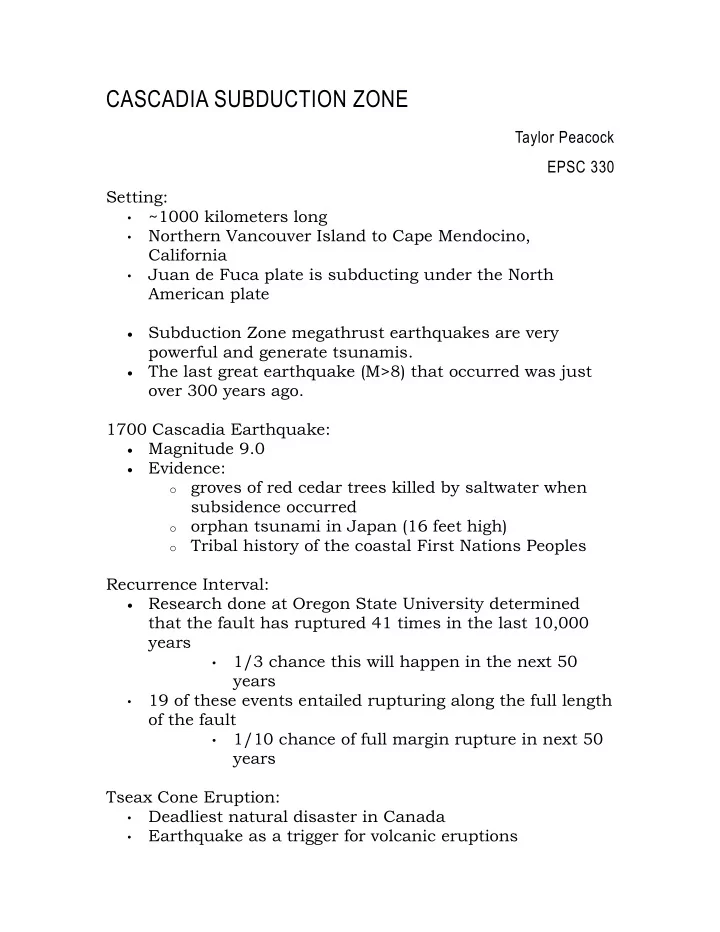
CASCADIA SUBDUCTION ZONE Taylor Peacock EPSC 330 Setting: ~1000 kilometers long Northern Vancouver Island to Cape Mendocino, California Juan de Fuca plate is subducting under the North American plate Subduction Zone


slide-1
SLIDE 1

CASCADIA SUBDUCTION ZONE

Taylor Peacock EPSC 330 Setting:

  • ~1000 kilometers long
  • Northern Vancouver Island to Cape Mendocino,

California

  • Juan de Fuca plate is subducting under the North

American plate

Subduction Zone megathrust earthquakes are very powerful and generate tsunamis.

The last great earthquake (M>8) that occurred was just

  • ver 300 years ago.

1700 Cascadia Earthquake:

Magnitude 9.0

Evidence:

  • groves of red cedar trees killed by saltwater when

subsidence occurred

  • rphan tsunami in Japan (16 feet high)
  • Tribal history of the coastal First Nations Peoples

Recurrence Interval:

Research done at Oregon State University determined that the fault has ruptured 41 times in the last 10,000 years

  • 1/3 chance this will happen in the next 50

years

  • 19 of these events entailed rupturing along the full length
  • f the fault
  • 1/10 chance of full margin rupture in next 50

years Tseax Cone Eruption:

  • Deadliest natural disaster in Canada
  • Earthquake as a trigger for volcanic eruptions
slide-2
SLIDE 2
  • Last eruption was between 1668 and 1714
  • Carbon dating of wood from trees and based on

historical and magnetic dating

  • Cascadia ruptured 450 km south of Tseax
  • First Nations told stories of shaking before any fire and

smoke

  • Could the next rupture of of the CSZ trigger a volcanic

eruption in this region? During the event:

  • Initial waves=compressional
  • May be detected by sensors 30-90s prior to

beginning of shaking

  • Audible to dogs/other animals
  • Provide warning and to trigger safety procedures
  • 3-5 minutes of shaking
  • M 8.0-8.6 if southern portion ruptures and 8.7+ if the

entire length ruptures

  • Several feet of vertical motion and up to 100 feet of

westward motion

  • The wave is estimated to be 20-100 feet tall

depending on where it reaches the coast Impact and Aftermath:

71,000 people in the inundation zone must evacuate between earthquake and tsunami, which is 10-30 minutes.

  • Earthquake and ensuing tsunami is expected to leave

>12,000 people dead and >26,000 injured (FEMA model: early February event)

  • Results:
  • Fallen bridges will trap people on the coast and

prevent rescue workers from being able to reach them

  • Liquefaction: solid ground behaves as a liquid and

causes instability

  • Highways and roads will be damaged, power will go
  • ut, fires will start
  • ~30,000 landslides will occur in Seattle alone
slide-3
SLIDE 3
  • They anticipate having to provide food and water for 2.5

million people, and shelter for 1 million. According to OSSPAC:

  • Improvements in seismic codes since 1994: ~75% of

structures are likely to fail

  • Evacuation procedures + routes
  • Illegal to build hospitals, schools, firehouses, police

stations in the inundation zone

  • The inundation zone will be ~uninhabitable for years
  • Time estimates for restoration on the coast:
  • 3-6 months for electricity
  • 1-3 years for drinking water and sewage systems
  • Time estimates for restoration west of Interstate 5:
  • 1-3 months for electricity
  • 1-12 months for drinking water and sewer services
  • 6-12 months for major highways
  • 18 months for healthcare facilities
  • Collapse of the economy in the PNW