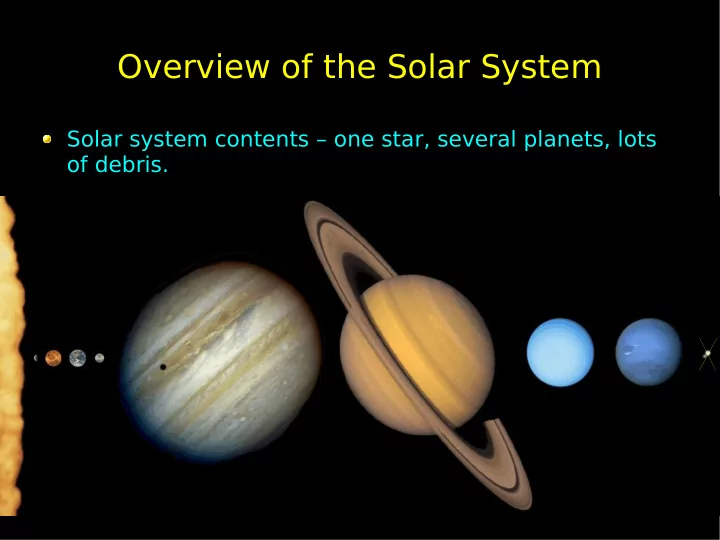
SLIDE 1 Overview of the Solar System
Solar system contents – one star, several planets, lots
SLIDE 2 Most of it is the Sun!
99.8% of the mass of the Solar System resides in the Sun.
–
A hot ball of mostly hydrogen and helium held together by gravity.
–
In bulk composition it resembles an unbiased scoop of galactic material.
SLIDE 3 Most of it is the Sun!
99.8% of the mass of the Solar System resides in the Sun.
–
A hot ball of mostly hydrogen and helium gas held together by gravity.
–
In bulk composition it resembles an unbiased scoop of galactic material. 3/4 Hydrogen 1/4 Helium 1% other elements
SLIDE 4
Eight Major Planets
Maybe one or two more depending on semantics and future discoveries.
SLIDE 5 Four Jovian Worlds
Jupiter, Saturn, Uranus and Neptune
– “Gasballs” constituting 99.9% of the planetary mass
SLIDE 6 Four Jovian Worlds
Jupiter, Saturn, Uranus and Neptune
– Hydrogen and helium, under high pressure, become dense
liquids – more appropriately these are spinning liquid droplets.
SLIDE 7 Four Terrestrial Worlds
Mercury, Venus, Earth, and Mars
– Small rocky/metallic worlds hugging
the Sun with thin or non-existent atmospheres.
SLIDE 8 Jovian vs. Terrestrial Characteristics
Terrestrial: Mercury, Venus, Earth, and Mars
– Small relatively speaking – Solid rocky cratered surfaces
with significant iron cores
– Three satellites between them
all
SLIDE 9 Jovian vs. Terrestrial Characteristics
Jovian: Jupiter, Saturn, Uranus, Neptune – The “Gas Giants”
– about 10 times bigger than the terrestrial worlds – Gaseous with no solid surface, resembling the Sun in composition
(mainly Hydrogen and Helium) .
– Clouds of Methane, Water, Ammonia, and other molecules provide an
apparent “surface”
– More than one hundred satellites – most made mainly of water/ice.
SLIDE 10
Jovian vs. Terrestrial Characteristics
Jovian: Interiors of compressed liquified gas
SLIDE 11
Jovian vs. Terrestrial Characteristics
Jovian: Cloudtop “surfaces”
SLIDE 12
Jovian vs. Terrestrial Characteristics
Jovian: Many satellites
SLIDE 13
Jovian vs. Terrestrial Characteristics
Jovian: Icy satellites
SLIDE 14
Jovian vs. Terrestrial Characteristics
Jovian: Satellites as big as planets, some with atmospheres.
SLIDE 15
Minor Constituents: Asteroids, Comets, and Dust
Asteroids: Millions of small rocky objects mostly between the orbits of Mars and Jupiter
SLIDE 16
Minor Constituents: Asteroids, Comets, and Dust
Asteroids: Millions of small rocky objects mostly between the orbits of Mars and Jupiter
http://www.daviddarling.info/encyclopedia/A/asteroid.html
SLIDE 17
Minor Constituents: Asteroids, Comets, and Dust
Asteroids: Millions of small rocky objects mostly between the orbits of Mars and Jupiter
SLIDE 18 An Outer Icy Asteroid Belt
Another group of asteroid-sized bodies orbit beyond Neptune in the “Kuiper Belt”
– Pluto is one of the largest of these.
SLIDE 19 A Cloud of Cometary Nuclei
Trillions of small iceballs, most only a kilometer in size,
- rbit as far out as ½ way to the nearest star.
– only a small fraction make it into the inner solar system to be
heated by the Sun to become a comet.
SLIDE 20 A Cloud of Cometary Nuclei
Trillions of small iceballs, most only a kilometer in size,
- rbit as far out as ½ way to the nearest star.
– only a small fraction make it into the inner solar system to be
heated by the Sun to become a comet.
SLIDE 21
Interplanetary Dust
The grinding of asteroids and evaporation of comets populates the inner solar system with fine dust.
http://www.astrophoto.com/images.htm
SLIDE 22
Interplanetary Dust
The grinding of asteroids and evaporation of comets populates the inner solar system with fine dust.
SLIDE 23
Interplanetary Dust
The grinding of asteroids and evaporation of comets populates the inner solar system with fine dust.
SLIDE 24
Regular Features of the Solar System
All of the planets orbit the Sun in the same plane All planetary orbits are nearly circular All planets orbit the Sun in the same “direction” Most planets rotate in the same sense as the orbit.
See orbits
SLIDE 25 Regular Features of the Solar System
The Jovian and Terrestrial planets are well sorted in terms of distance from the Sun.
– rocky worlds close – gaseous/icy worlds far away
SLIDE 26
Regular Features of the Solar System
All of the planets orbit the Sun in the same plane All planetary orbits are nearly circular All planets orbit the Sun in the same “direction” Most planets rotate in the same sense as the orbit.
See orbits
SLIDE 27
Regular Features of the Solar System
The Giant Planet satellite systems resemble the Solar System
SLIDE 28 Regular Features of the Solar System
Exposed solid surfaces are heavily cratered throughout the Solar System.
– The process was messy and produced lots of leftovers.
SLIDE 29 Regular Features of the Solar System
Exposed solid surfaces are heavily cratered throughout the Solar System.
– The process was messy and produced lots of leftovers.
SLIDE 30 Building a Solar System through “Accretion”
These regular features are “fossilized” memory of the conditions that gave rise to the Solar System.
– In sum, they suggest the planets grew within a rotating
flattened disk and, today, their orbits reflect the structure of that disk.