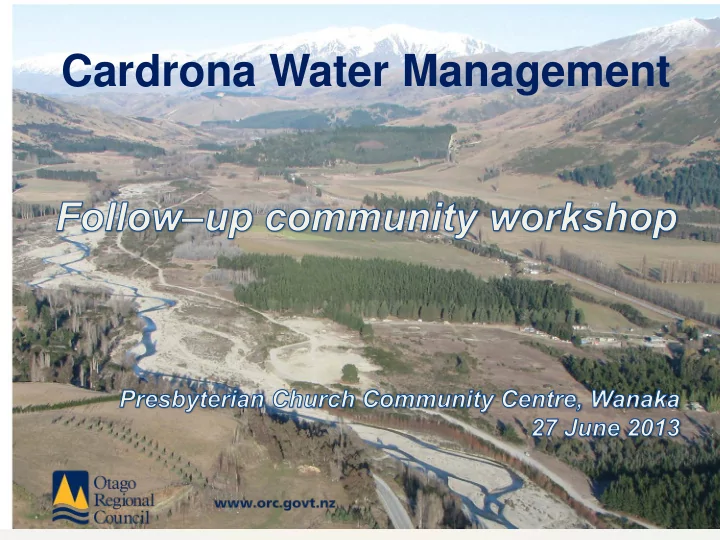
Cardrona Water Management Today Introduction Overview of surface - - PowerPoint PPT Presentation

cardrona water management
SMART_READER_LITE
LIVE PREVIEW

Cardrona Water Management Today Introduction Overview of surface - - PowerPoint PPT Presentation

Cardrona Water Management Today Introduction Overview of surface water management options Social and economic impacts Feedback session1: Minimum flow and allocation Overview of groundwater management options Feedback


slide-1
SLIDE 1

Cardrona Water Management

slide-2
SLIDE 2

Today

  • Introduction
  • Overview of surface water management options
  • Social and economic impacts
  • Feedback session1: Minimum flow and

allocation

  • Overview of groundwater management options
  • Feedback session 2: Maximum allocation

volume

  • Summary of key messages
  • Where to from here...
slide-3
SLIDE 3

Option A - “Year round flow continuity”

700 l/s @ Clutha confluence

  • Approx.1,000 l/s at The Larches
  • Optimum flow for adult and juvenile rainbow trout,

and year round habitat for juvenile trout in the lower reaches of the Cardrona

  • Run of the river irrigation difficult in average or dry

year

slide-4
SLIDE 4
  • Flow continuity May -Jan (incl. peak tourist season)
  • Optimum flow for rainbow trout adult, juvenile &
  • spawning. Allows adult trout to return to the Clutha
  • Moderate irrigation restriction in January, but allows

irrigation during driest part of the year

  • Distributes water resources between “upper” and

“lower” water takes

Option B - “Peak holiday season flow”

May – Jan: 700 l/s @ Clutha confluence

Feb – April: 400l/s @ The Larches

slide-5
SLIDE 5
  • Flow continuity from May to Dec.
  • Optimum flow for rainbow trout adult, juvenile &
  • spawning. Allows adult trout to return to Clutha in

Nov/Dec

  • Status quo for current irrigation practice - little

restriction

  • Distributes water resources between “upper” and

“lower” water takes

Option C - “Extended low flow”

May – Dec: 700 l/s @ Clutha Confluence

Jan – April: 400 l/s @ The Larches

slide-6
SLIDE 6

Primary allocation limit

  • The default allocation “target” is 500 l/s
  • The current estimated actual take is 1,160 l/s
  • Suggested allocation limit: between 500 and

1,000 l/s:

  • Will allow current water users to operate
  • Maintains or increases surety of supply
  • Encourages efficient water use
slide-7
SLIDE 7

Economic and social impacts

slide-8
SLIDE 8

Minimum flow & aquifer restriction level Reduced surety of supply

  • Does not affect all users

(e.g. Dom. supply, stock water)

  • Dependant on:
  • Frequency
  • Duration
  • Timing
  • Short & long term effects
  • Mitigating measures:
  • Rationing, rostering
  • Infrastructure
slide-9
SLIDE 9

Allocation limit& Max. Allocation volume Limited water availability

  • Impacts vary

(e.g. Existing vs. new takes)

  • Direct & flow-on effects
  • Mitigating measures:
  • Change land

management

  • Infrastructure -

access to alternative sources

slide-10
SLIDE 10

Feedback Session 1

Options for minimum flow primary allocation

How do these options affect you?

slide-11
SLIDE 11

Groundwater Management Options

GW Option 1: Blanket Maximum Allocation Volume

  • Set MAV to 5 million cubic m per annum

(Mm3/a) across the whole Wanaka Aquifer

GW Option 2: Higher MAV & partial Water Take Restriction Zone

  • Set MAV to 8 Mm3/a for whole aquifer
  • Set restrictions on the amount of water

table drop in the eastern area of the aquifer

slide-12
SLIDE 12

Water Take Restriction Zone Options

Groundwater consents can be restricted if monitored bore water levels decline to critical depths.

(Domestic & municipal bores unaffected)

Option 1 Option 2

WANAKA WANAKA 5 Mm3/y 5 + 3 Mm3/y

slide-13
SLIDE 13

Feedback Session 2

Options for maximum allocation volume

How do these options affect you?

slide-14
SLIDE 14

Where to from here....

slide-15
SLIDE 15

How to provide further feedback

Provide any further feedback by 22 July Workshop materials, feedback forms on the website www.orc.govt.nz 0800 474082 Email: policy@orc.govt.nz

slide-16
SLIDE 16

Otago Regional Council 70 Stafford Street Private Bag 1954 Dunedin

Phone: 03 474-0827 Free: 0800 474 082 Fax: 03 477-9837

slide-17
SLIDE 17

Supplementary allocation

  • Current supplementary minimum flow is 2,860 l/s

(mean flow) at the Clutha confluence

  • We suggest the following supplementary allocation

regime

Supplementary minimum flow @ Clutha confluence (l/s) Allocation block size (l/s) 1,500 500 2,000 500 2,500 500 3,000 500