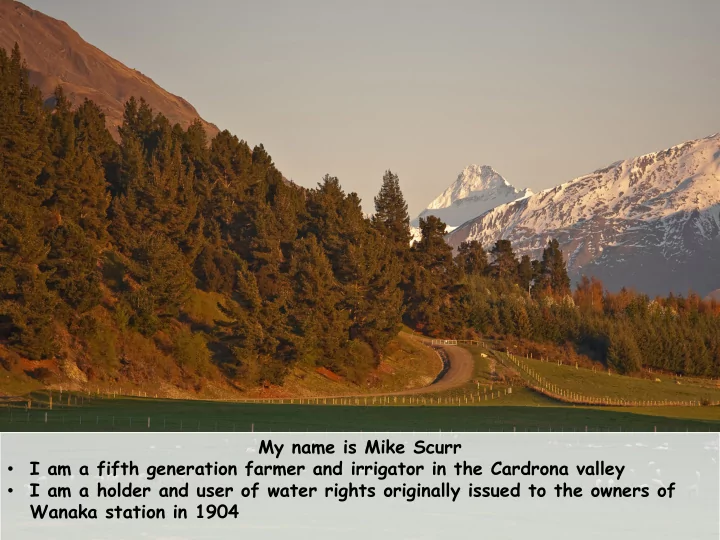
SLIDE 1 My name is Mike Scurr
- I am a fifth generation farmer and irrigator in the Cardrona valley
- I am a holder and user of water rights originally issued to the owners of
Wanaka station in 1904
SLIDE 2
I believe that the ecology of the Cardrona catchment has been enhanced under the stewardship of those who have farmed the land and managed the river system in the last 100 years
SLIDE 3
There are 10 farms within the Cardrona valley as well as many smaller lifestyle properties across the Wanaka flats that were once part of these farm holdings.
Farming in the Cardrona
SLIDE 4
- 28,000 hectares are still used for pastoral farming today
- This area carries approximately 50,000 stock units of sheep, beef and deer.
- The farmed area generates a gross revenue over $5m per year
Farming in the Cardrona
SLIDE 5
- The farms also support 24 families directly though employment,
accommodation and succession planning.
- Some farms are supporting 3-4 generations of family on the property
SLIDE 6
Farming in the Cardrona Valley is financially, socially and environmentally sustainable. We have 100 years of history to back that up.
SLIDE 7
- The average farm size in the Cardrona is 2800 ha
- The average carrying capacity is 5000 su
- Within each farm there is an average of 200 ha of land that is arable.
- Half of the arable area is under irrigation.
Typical farm
SLIDE 8
- The Cardrona valley has one of the shortest growing seasons in New Zealand
- We lose access to over half our farm area during the winter
- All farms in the Cardrona are limited by the area of wintering country they
have and the amount of hay/ silage and crop they can produce for the winter.
SLIDE 9 June July Aug Sept Oct Nov Dec Jan Feb Mar Apr May
Typical Cardrona dry matter growth and demand curve
Dry matter production Feed demand
SLIDE 10
SLIDE 11
Each farm needs to make the equivalent of 1200 round bales of hay/silage.
SLIDE 12
30ha crops to feed during the winter.
SLIDE 13
How do we do it?
Farming in the Cardrona is no different in principle to anywhere else in New Zealand. We just have a few more extremities to deal with.
SLIDE 14
To balance our properties ability to produce year round ; 1. we need the scope our farm size gives us in the summer 2. The ability to maximise dry matter production on the small area of arable land we have for the winter..
How do we do it?
SLIDE 15
We are simply trying to retain soil moisture at a level that optimises dry matter production. Irrigation extents our growing season on the areas irrigated. Longer season = more hay and better crops.
Why is irrigation so important?
SLIDE 16
- Restricting or stopping irrigation during the summer effectively turns the tap
- ff for grass growth until the cooler autumn rains
- Without irrigation we would need to buy in supplements for the winter.
- The cost difference between growing verses buying is $150,000 per farm
SLIDE 17 Key Points
- Our farming systems are equilibrium of all the physical, environmental and
financial forces that have evolved over the last hundred years.
- Irrigation water has been the life blood of farms since the beginning.
- Future sustainability of the Cardrona farming community is reliant on
irrigation
- The natural drying of the Cardrona already limits expansion of some farm
production
- Timing of available water is as critical as the volume of water.
- In a dry year water is critical from the beginning of December
- The demand for irrigation water through increased efficiency wont diminish.
- The area of irrigated land will just increase.