Carbon Dioxide Utilization off-setting the costs of CCS and - - PowerPoint PPT Presentation

carbon dioxide
SMART_READER_LITE
LIVE PREVIEW

Carbon Dioxide Utilization off-setting the costs of CCS and - - PowerPoint PPT Presentation

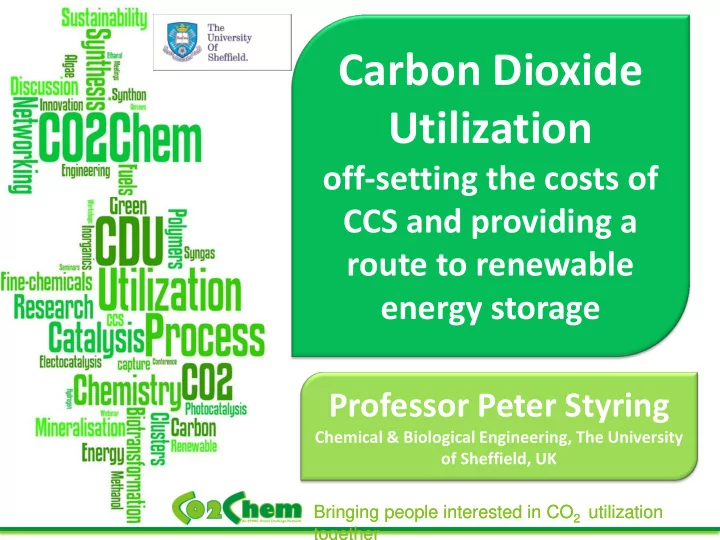
Carbon Dioxide Utilization off-setting the costs of CCS and providing a route to renewable energy storage Professor Peter Styring Chemical & Biological Engineering, The University of Sheffield, UK Bringing people interested in CO 2


slide-1
SLIDE 1

Bringing people interested in CO2 utilization together Bringing people interested in CO2 utilization together

Carbon Dioxide Utilization

  • ff-setting the costs of

CCS and providing a route to renewable energy storage Professor Peter Styring

Chemical & Biological Engineering, The University

  • f Sheffield, UK
slide-2
SLIDE 2

Bringing people interested in CO2 utilization together

slide-3
SLIDE 3

The CO2Chem Network

  • Network has 580 individual members (June 2013)
  • 80% from the UK, 20% from rest of the world
  • 225 different organisations are represented

76 Academic = 34% 103 Industry = 46% 46 Other = 20%

  • Website at www.co2chem.com, Twitter @CO2Chem
  • Website has members database, links to research papers, presentations

from events and latest news

  • Networking at a CO2Chem event in 2011 led to an FP7 proposal that was

funded to €2.0 million. The partners had never met before that event.

  • Regions of Knowledge SCOT consortium (BEL, FRA, NED, UK) now in

negotiations phase with EC for € 2.6 million.

Bringing people interested in CO2 utilization together

slide-4
SLIDE 4

A Coordinated, Comprehensive approach to Carbon Capture and Utilisation

  • Consortium of four UK universities: Sheffield, UCL,

Queens Belfast, Manchester

  • 7.5 M€
  • 9 Post-doctoral positions and Project Manager
  • Four year programme of research
  • Whole System approach:

– Life Cycle Analysis – Carbon Capture Reagents, ionic liquids & polymers – Flue Gas & AD Off-gas conversion – Fuels from CO2 – Molecular Modelling

Bringing people interested in CO2 utilization together

slide-5
SLIDE 5

Key Research Priorities

Hydrocarbons Bringing people interested in CO2 utilization together

slide-6
SLIDE 6

CO2Che m Network

Systems Approaches to CDU Integration Carbon Capture for CDU Electrochemical Transformations Chemical Transformations Fuels Bio Transformations Mineral Carbonation Public Perception of CDU

Bringing people interested in CO2 utilization together

slide-7
SLIDE 7

Carbon Capture and Utilisation in the green economy

Using CO2 to manufacture fuel, chemicals and materials

Authors Peter Styring (The University of Sheffield), Daan Jansen (ECN) Co-authors Heleen de Coninck (ECN), Hans Reith (ECN), Katy Armstrong (The University

  • f Sheffield)
slide-8
SLIDE 8

CDU in CO2Chem

Bringing people interested in CO2 utilization together

slide-9
SLIDE 9

Electrochemical Reduction Micro-algae Thermochemical Photoatalytic Plasma Market Value Time Development Growth Maturity Decline

Modified from Frost & Sullivan

Perspectives for Enabling Technologies

Catalysis

slide-10
SLIDE 10

Bringing people interested in CO2 utilization together

slide-11
SLIDE 11

http://www.olicognography.org/graph/energydensity.jpg Bringing people interested in CO2 utilization together

slide-12
SLIDE 12

Alternative Energy Sources

  • Solar

Intermittent, geographical

  • Wind

Intermittent

  • Tidal

Predictable

  • Hydro

Geographical

  • Nuclear

Political, constant output

  • Geothermal

Geographical

The commonality between all these renewable sectors is the production of electricity, or simply a supply of electrons. Bio- and crop-based renewables are not included above but examples include maize, sugar beet and algae

Bringing people interested in CO2 utilization together

slide-13
SLIDE 13

20% efficiency 70% efficiency Plant Efficiency Plants, typical 0.1% 0.2–2% Typical crop plants 1–2% Sugarcane 7–8% peak

Modern photovoltaic efficiency now over 20% Conversion from solar to chemical energy 10- 15% which is better than nature!

slide-14
SLIDE 14

maximal achievable extraction of wind power by a wind turbine is 59% of the total theoretical wind power Main problem is intermittency and synchronisation to peak power

  • demand. Electricity is wasted at times of low demand.

Overall 41% efficiency for wind to chemical conversion

slide-15
SLIDE 15

How can CDU help in renewable intermittent energy storage?

  • Buffering intermittent power generation.
  • Converting electrical to chemical energy which is

easier to store.

  • Can convert to liquid or gas. Liquids tend to have

higher energy densities.

  • Offers alternatives to distributed power, including

remote, local conversion.

  • Easier storage and transport solutions.
  • Value-added product from a renewable resource.

Bringing people interested in CO2 utilization together

slide-16
SLIDE 16

Figures of Merit

Bringing people interested in CO2 utilization together

  • T. E. Müller, W. Leitner et al.,

ChemSusChem 2011, 4, 1216 – 1240

Net Capture Capacity Capture Lifetime Market Value Market Capacity

Ideal Product

slide-17
SLIDE 17
  • K. Armstrong, B. Robinson, P. Styring & C. Jones

To be published at ICCDU XII, Washington, June 2013

1 2 3 4 5 6 7 8 9 10 Net CO2 Capture Storage Lifetime Market Value Market Capacity Sustainable Feedstocks Sustainable Catalysts Energy Efficiency Synthetic Liquid Fuel aspirin CCS

Public Perception

Bringing people interested in CO2 utilization together

slide-18
SLIDE 18

Conclusions

Bringing people interested in CO2 utilization together

  • CDU is an essential part of the CC portfolio that includes CCS,

EOR and EGR.

  • Designed capture agents are essential to reduce costs and

emissions while increasing activity and selectivity.

  • Integration of capture agents with catalysts offer an opportunity

to intensify processes.

  • Integration of with renewable intermittent energy sources offers

energy storage and security as well as the possibility for remote local fuel production.

  • Air capture will become increasingly important so needs to be

addressed now.

  • A chance to address the Sustainability and Security of fuel &

chemical supplies by using renewable non-fossil feedstocks.

slide-19
SLIDE 19

Free Membership at www.co2chem.com