Canterbury Earthquake Disaster - Phases of Response and Recovery - - PDF document

canterbury earthquake disaster
SMART_READER_LITE
LIVE PREVIEW

Canterbury Earthquake Disaster - Phases of Response and Recovery - - PDF document

Canterbury Earthquake Sequence science plan Kelvin Berryman Director, Natural Hazards Research Platform GNS Science NSF-RAPID Workshop, Washington DC, 9-10 Feb 2012 Natural Hazards Research Platform


slide-1
SLIDE 1
  • GNS Science

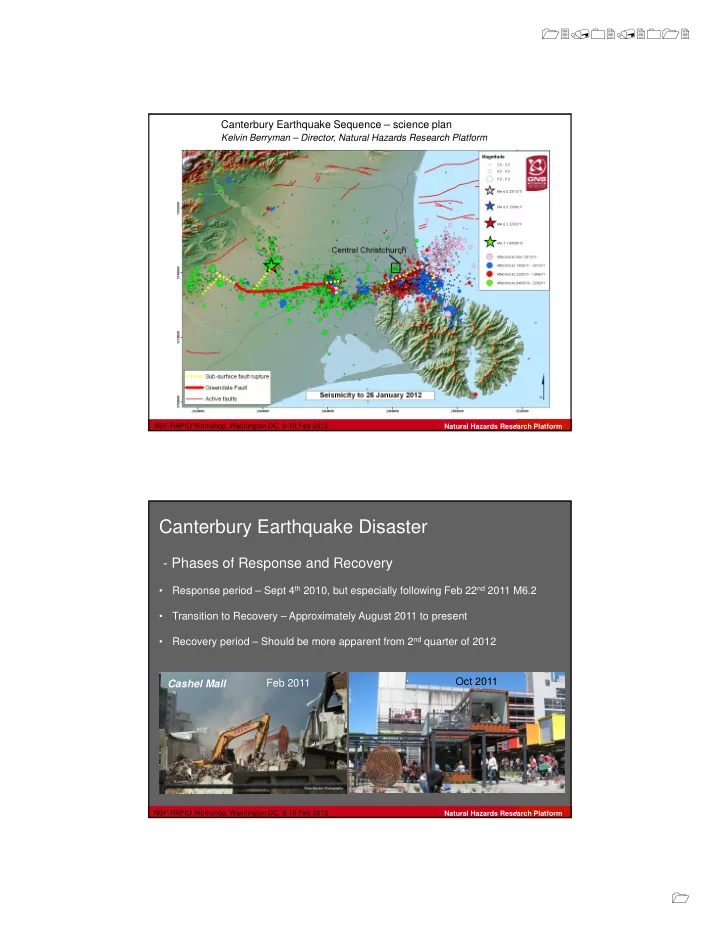
Canterbury Earthquake Sequence – science plan

Kelvin Berryman – Director, Natural Hazards Research Platform

Natural Hazards Research Platform NSF-RAPID Workshop, Washington DC, 9-10 Feb 2012 GNS Science Natural Hazards Research Platform

Canterbury Earthquake Disaster

  • Phases of Response and Recovery
  • Response period – Sept 4th 2010, but especially following Feb 22nd 2011 M6.2
  • Transition to Recovery – Approximately August 2011 to present
  • Recovery period – Should be more apparent from 2nd quarter of 2012

NSF-RAPID Workshop, Washington DC, 9-10 Feb 2012

Cashel Mall Feb 2011 Oct 2011

slide-2
SLIDE 2
  • GNS Science

Natural Hazards Research Platform NSF-RAPID Workshop, Washington DC, 9-10 Feb 2012

Research and Response

  • Immediate
  • Rapid damage assessment
  • Working closely with Ministry of

Civil Defence & Emergency Management

  • Forecasting further earthquake activity
  • Social well-being, relief centres, evacuation?
  • Geological/geophysical context of

rare/surprising events

  • International collaboration and needs

assessment

  • Diversion of research effort as

appropriate (c. NZD 3-4M pa) and retrospective additional NZD 1M

GNS Science Natural Hazards Research Platform NSF-RAPID Workshop, Washington DC, 9-10 Feb 2012

Research during the Transition to Recovery

  • Earthquake likelihood and revision to building code
  • Rockfall & slope stability assessment in Port Hill suburbs
  • Liquefaction & Infrastructure
  • Foundation damage in the CBD
  • Performance to engineered structures
  • Impacts on business, tourism, education
  • Psycho-social impacts, migration, economic

impacts, health

  • Diversion of research effort as appropriate

(c. NZD 3-4M pa) and additional NZD 2M immediately available

  • Extensive international collaboration (US & Japan

especially, including NSF RAPID)

  • Development of a Canterbury Earthquakes

Research Strategy (NHRP)

slide-3
SLIDE 3
  • GNS Science

Research and Recovery

  • A partnership between researchers, government

agencies (CERA in particular) and international collaborators

  • Integration of lessons learned in engineering,

seismology, risk, social well-being and economics

  • Research strategy in place
  • New research funding to “learn lessons in Canterbury and apply them to

New Zealand” – 4 years @ NZD 3M pa

  • The recommendations of the Royal Commission are expected to provide

impetus to applying lessons for national benefit

Natural Hazards Research Platform NSF-RAPID Workshop, Washington DC, 9-10 Feb 2012 GNS Science

On-going challenges

  • Providing accurate advice on likelihood further

earthquakes - a rapidly evolving, time- varying, situation

  • Developing suitable adjustments to building code

provisions in a time-varying hazard situation

  • Providing confident advice to allow insurers and
  • ther agencies to make the correct decisions on

where, when, and how to begin the rebuild of Christchurch

  • Finding the societally acceptable balance between current risk aversion

and appropriate building standards for the nominal 50 year design life of reconstruction – acceptable risk and tolerable impacts

  • Developing an accurate assessment of socio-economic impact of the

earthquake sequence and evaluate vulnerabilities with respect to city reconstruction

Natural Hazards Research Platform NSF-RAPID Workshop, Washington DC, 9-10 Feb 2012

slide-4
SLIDE 4
  • GNS Science

Uptake of Research knowledge – what & how??

Natural Hazards Research Platform

  • Science liaison in Emergency Operation Centres – both NCMC & Christchurch
  • Frequent and persistent discussion with stakeholders

NSF-RAPID Workshop, Washington DC, 9-10 Feb 2012

Research Participants Research Users (stakeholders)

Natural Hazards Research Platform CERA (coordination) (coordination) GNS Science/GeoNet Recovery Minister NIWA Dept & Ministries of: Social Development University of Canterbury Tourism, Education, Health, Building & University of Auckland Housing, The Treasury, SCIRT Resilient Organisations ECAN, CCC & other TA’s Massey University Insurers & Re-insurers Joint Centre for Disaster Research Technical Societies – Earthquake Victoria University Engineering, Geotechnical, Structural Lincoln University Engineering, Concrete Opus International Consultant engineers NSF grantees Other International