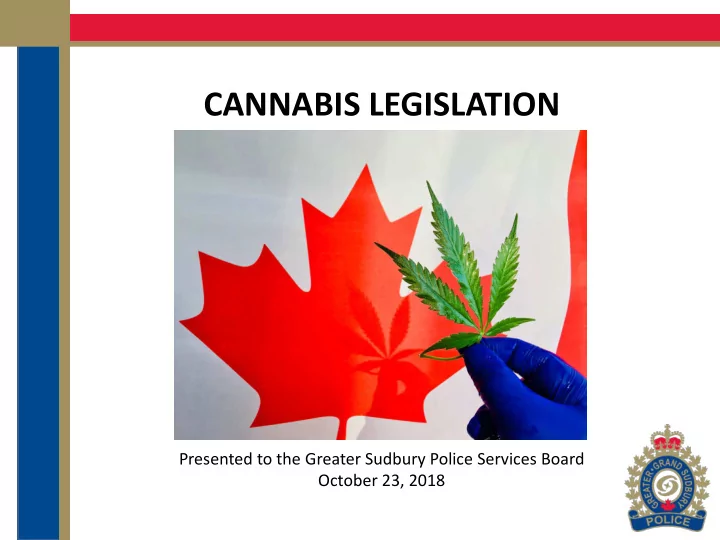
CANNABIS LEGISLATION Presented to the Greater Sudbury Police - - PowerPoint PPT Presentation

cannabis legislation
SMART_READER_LITE
LIVE PREVIEW

CANNABIS LEGISLATION Presented to the Greater Sudbury Police - - PowerPoint PPT Presentation

CANNABIS LEGISLATION Presented to the Greater Sudbury Police Services Board October 23, 2018 Agenda Overview of Legislation Federal Legislation Cannabis Act Provincial Legislation Cannabis Control Act Internal Training


slide-1
SLIDE 1

CANNABIS LEGISLATION

Presented to the Greater Sudbury Police Services Board October 23, 2018

slide-2
SLIDE 2

Agenda

  • Overview of Legislation
  • Federal Legislation – Cannabis Act
  • Provincial Legislation – Cannabis Control Act
  • Internal Training
  • Fit for Duty Procedure
  • Public Education and Awareness
  • Impaired Driving
  • Cannabis Related Complaints
  • Cost Impacts
slide-3
SLIDE 3
slide-4
SLIDE 4

Federal Legislation – Cannabis Act

  • Purpose – to legalize and regulate the possession,

production, sale and distribution of recreational cannabis.

  • The Act removed cannabis

related offences from the Controlled Drugs and Substances Act (CDSA)

  • 13 Federal Charges
  • Cannabis Act
  • 33 Federal Charges
slide-5
SLIDE 5

Federal Legislation – Cannabis Act

POSSESSION: SECTION 8

  • Anyone 18+ can possess up to 30 grams of dried

cannabis or equivalent

  • Any “young person” (12-17) can possess between

0-5 grams of dried cannabis or equivalent

slide-6
SLIDE 6

Federal Legislation – Cannabis Act

DISTRIBUTION (Share): SECTION 9

  • Anyone 18+ can share up to 30 grams of dried cannabis or

equivalent with another adult (18+)

  • No one 18+ can share cannabis with a young person or
  • rganization
  • No one 18+ can share cannabis that they know was not

purchased from a licensed producer/authorized retailer

  • Any young person (12-17) can share up to 5 grams of dried

cannabis

  • No one can possess cannabis for the purpose of

distributing contrary to Section 9(1)

slide-7
SLIDE 7

Federal Legislation – Cannabis Act

SELLING: SECTION 10

  • No one can sell cannabis to anyone or to an
  • rganization
  • No one can possess cannabis for the purpose of

selling it to anyone or to an organization

slide-8
SLIDE 8

Federal Legislation – Cannabis Act

PRODUCTION: SECTION 12

  • Anyone 18+ can grow and

harvest up to 4 cannabis plants in dwelling/on property

  • Only 4 cannabis plants can be

grown and harvested in one dwelling at any given time even if two or more individuals, 18+, are living in the same dwelling

  • No young person can grow or harvest any cannabis plant
  • No one may obtain cannabis by manufacturing, synthesis,
  • r altering the chemical or physical properties, or to

alter by use of an organic solvent

slide-9
SLIDE 9

Provincial Legislation – Cannabis Control Act

  • You must be 19 and older to buy, use, possess, and grow

recreational cannabis

  • The Ontario Cannabis Store website is the only legal
  • ption for purchasing recreational cannabis. It follows

strict rules set by the federal government

  • You are able to have a maximum of 30 grams (about one
  • unce) of dried cannabis in public at any time
  • You are able to grow up to four plants per residence (not

per person)

  • Zero tolerance for young, novice and commercial drivers
slide-10
SLIDE 10

Provincial Legislation – Cannabis Control Act

Where you can smoke and vape cannabis:

  • Private residences – this does not include residences that

are also workplaces

  • Many outdoor public places (e.g. sidewalks, parks)

*Additional restrictions on smoking and vaping may exist in municipal bylaws, lease agreements, and the policies of employers and property owners.

slide-11
SLIDE 11

Provincial Legislation – Cannabis Control Act

Where you CANNOT smoke and vape cannabis:

  • indoor common areas in condos, apartment buildings and

university/college residence

  • enclosed public places and enclosed work places
  • Schools and places where children gather (playgrounds/daycare)
  • Off grounds and 20+ meters away
  • Hospitals, hospices, care homes and other facilities
  • Off grounds and 9+ meters away
  • Vehicles and boats
  • You (passengers included) cannot consume cannabis (smoking,

vaping, eating) in a vehicle or boat that is being driven or is at risk

  • f being put into motion
  • Other outdoor areas
  • Patios, recreational facilities, sheltered outdoor areas
slide-12
SLIDE 12

Internal Training

  • Canadian Police Knowledge Network (CPKN)

Federal training module

  • Canadian Association of Chiefs of Police (CACP)
  • Royal Canadian Mounted Police (RCMP)
  • Waiting on Provincial training through the Ontario

Police College (OPC)

  • Full-day in-service training; Federal and Provincial

Acts

  • Additional line-up presentations
  • Development of quick reference guide
slide-13
SLIDE 13

Internal Training – Quick Reference Guide

slide-14
SLIDE 14

Fit for Duty Procedure

  • “Fit for Duty” means that a member is mentally,

emotionally, and physically able to safely and competently perform assigned duties, without any limitations attributable, but not limited to, illness, injury, mental stress, or the use and/or after effects of intoxicating substances.

  • Members are responsible to report for work fit for duty

and remain fit for duty for the entire time they are conducting Police Service business.

  • Supervisors have a duty to assess members under their

supervision to determine if they are fit for duty.

slide-15
SLIDE 15

Public Education and Awareness

slide-16
SLIDE 16

Impaired Driving

  • Remains a significant concern
  • Standard Field Sobriety Test (SFST) trained officers
  • Currently 35 SFSTs
  • Goal – all frontline members trained
  • Drug Recognition Experts (DRE)
  • Currently three DREs
  • Two more by end of March 2019
  • Only training program available in United States
  • All Police Service across Canada vying for spots
  • DRAGER5000
  • Considerations
  • Reduce Impaired Driving Everywhere (RIDE) Grant

funding under review

slide-17
SLIDE 17

Cannabis Related Complaints

  • Complaints related to Smoke-Free Ontario Act
  • Call Public Health Sudbury & Districts 705-522-9200

extension 235

  • Odour complaints
  • Call City of Greater Sudbury By-law Department at

*311

  • Individuals using cannabis in a car/on a boat
  • Call Police at 705-675-9171
  • Impaired Driver
  • Call 911
  • You can find a list of the Federal and Provincial offences on
  • ur website, www.gsps.ca
slide-18
SLIDE 18

Cost Impacts/Increases

  • Cost impact on operations and deployment of

resources due to shift in enforcement/education demands

  • Estimated 2% budget
  • New costs
  • Training – addition to already demanding

training

  • Equipment
  • Staffing – OT/Specialty pay premiums
slide-19
SLIDE 19

Cost Impacts

Service Wide – Legislative In-service Training $132,000 Standard Field Sobriety Testing (SFST) Service-wide $420,000 Drug Recognition Expert (DRE) *Per candidate cost $11,000 SFST and DRE Premiums *$800 qualified candidate $168,000 Roadside Screening Equipment and Supplies $270,000 Overtime u/k Enforcement of Thefts, Suicides, Break and Enters, Robberies, Mischief u/k Impaired Driving/Motor Vehicle Collision Investigations/RIDE u/k Neighbour Disputes/Illicit Marketing/ u/k Youth Education and Prevention u/k Blood Drawing Process/Property Management & Preservation u/k

slide-20
SLIDE 20

Cost Impacts

  • Training
  • Bill C-45, Bill C-46, Provincial Regulations
  • One eight-hour training day
  • Standard Field Sobriety Testing (SFST)
  • Goal to train all officers – 32 hour course
  • Drug Recognition Expert (DRE)
  • 120 hour course – two weeks in Canada/one week in

Florida

  • Premium pay associated with specialized designation

$800/year

  • Increase in RIDE Spot Checks
slide-21
SLIDE 21

Closing Thoughts

slide-22
SLIDE 22

Questions