Ca Cattle Gr e Grazing t to M o Manage Na e Native Pr e - - PowerPoint PPT Presentation

ca cattle gr e grazing t to m o manage na e native pr e
SMART_READER_LITE
LIVE PREVIEW

Ca Cattle Gr e Grazing t to M o Manage Na e Native Pr e - - PowerPoint PPT Presentation

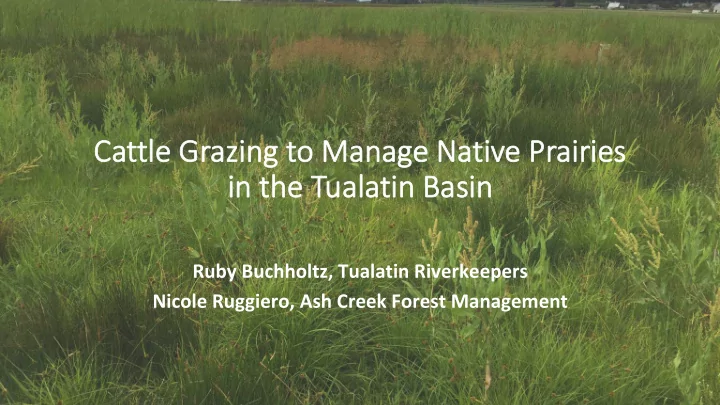
Ca Cattle Gr e Grazing t to M o Manage Na e Native Pr e Prairies es in the T in the Tuala ualatin B tin Basin asin Ruby Buchholtz, Tualatin Riverkeepers Nicole Ruggiero, Ash Creek Forest Management Ecological Context- Native Prairies


slide-1
SLIDE 1

Ca Cattle Gr e Grazing t to M

  • Manage Na

e Native Pr e Prairies es in the T in the Tuala ualatin B tin Basin asin

Ruby Buchholtz, Tualatin Riverkeepers Nicole Ruggiero, Ash Creek Forest Management

slide-2
SLIDE 2

Ecological Context- Native Prairies

  • Prairies are now a rare habitat
  • Early successional habitat and are maintained

through disturbance (fire)

  • Hotter, drier summers
  • Without disturbance:
  • Woody encroachment
  • Invasive species
  • Over-dominance by grass (decrease in diversity)
slide-3
SLIDE 3

Geographic context

  • Washington Co.

rapidly growing: rural-urban interface

  • Loss of ag land
  • Native prairie

conservation sites:

  • Hutchinson WRP
  • Tualatin River NWR
  • Metro sites
  • CWS sites
  • Private mitigation
slide-4
SLIDE 4

The Solution

  • Climate adapted
  • Low cost
  • Multiple benefits
  • Ecological
  • Social
  • Economic
slide-5
SLIDE 5

Evidence of ecological benefits

  • Increased plant vigor

and density

  • Sustainable, diverse

plant communities

  • Reduction in invasive

species

slide-6
SLIDE 6

Objective

To improve plant diversity by using cattle grazing as a disturbance.

Methods

  • 2 cattle operators
  • Sites, agreements,

logistics

  • Different timing and

stocking

  • Monitoring

Attribute Butler 2016-2017 Hutchinson 2017 Dominant soil McBee silty clay loam/ Wapato silty clay loam/ Chehalis silty clay loam McBee silty clay loam Dominant grasses Tufted hairgrass/ California oatgrass Red fescue (non- native) Acres grazed 20 58 Grazing plan layout 1 pasture. Continuous grazing 8 pastures. Cows had access to one large pasture continuously with new pastures rotated weekly. Stocking rate 1.67 acres/cow 2.23 acres/pair Timing Late May- June (5 weeks) September (2 weeks) June-July (8 weeks) November (2 weeks) Herd composition 12, 2-year olds 26 cow/calf pairs

slide-7
SLIDE 7

Percent cover Height

slide-8
SLIDE 8

Results

slide-9
SLIDE 9

Site Year % Native Grass % Non- native Grass % Native Forbs % Non- native Forbs % Bare Ground % Thatch/ Litter Butler 2016 Butler 2017 Hutchinson 2017

Change in Percent Cover During the Grazing Period

slide-10
SLIDE 10

Hundreds of pounds of seed planted

Over 35 species of flowers, rushes, and sedges added to grazed prairies Species such as: Common camas Slender cinquefoil Meadow checkermallow Western buttercup Blue-eyed grass Willow dock Western yarrow Slender rush Oregon sunshine

slide-11
SLIDE 11

Site Year % Native Grass % Non- native Grass % Native Forbs % Non- native Forbs % Bare Ground % Thatch/ Litter Butler

May 2016 81% 0% 13% 0% 3% 2%

Butler

May 2017 63% 0% 18% 5% 16% 2%

Change

Change in Percent Cover Between 2 Years (before grazing)

slide-12
SLIDE 12

Lessons Learned

Timing- earlier Stocking rate- higher Planning

  • Time
  • Inclusion
slide-13
SLIDE 13