
SLIDE 1
C h i c a g o C o n v e n t i o n 7 D e c e m b e r 1 9 4 4 - - PowerPoint PPT Presentation
THE CONCEPT OF 1940s C h i c a g o C o n v e n t i o n 7 D e c e m b e r 1 9 4 4 Article 44 of the Convention on International Civil Aviation defines the privileges and restrictions of all ICAO Member States and provides for the
defines the privileges and restrictions of all ICAO Member States and provides for the adoption of International Standards and Recommended Practices (SARPs) regulating international air transport.
complete and exclusive sovereignty over the airspace above its territory.
C h i c a g o C o n v e n t i o n 7 D e c e m b e r 1 9 4 4
Poland 6 April 1945 India 1 March 1947 THE CONCEPT OF 1940s
designated as either military or civil airspace but should be considered as one continuum and national asset.
nature.
I C A O C I R 3 3 0
THE CONCEPT OF THE NEW MILENNIUM
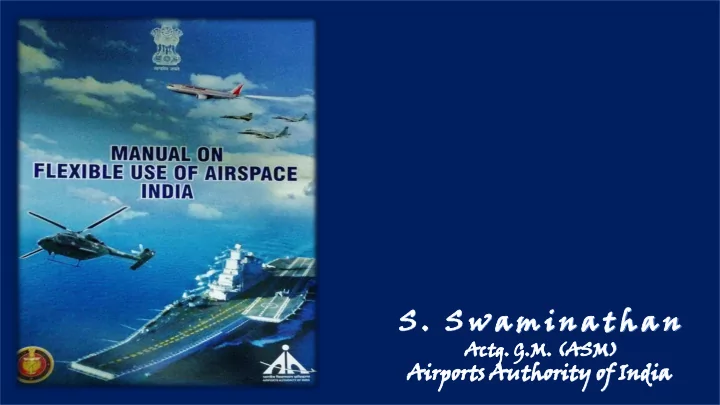
FUA IMPLEMENTATION AND ITS LINKAGE TO ATFM IN INDIA
AIRSPACE MNAGEMENT AIR TRAFFIC SERVICES AIR TRAFFIC FLOW MANAGEMENT
P E R I O D D E TAI L S Jan, 2007 DGCA - India, submits a report on Flexible Use of Airspace in India 2008/2009 Representatives of Civil-Military authority, including AAI and DGCA delegation visits USA, NATS and Eurocontrol to study FUA implementation Sep, 2012 MoCA proposed the implementation of FUA, constitution of a NHLAPB, authorizing the NHLAPB to set up appropriate committees to take suitable decisions to implement FUA in India Mar, 2013 Government of India approved the implementation of FUA and the constitution of NHLAPB. May, 2013 Draft Roadmap for the implementation of FUA in India prepared Oct, 2013 NHLAPB Constituted Dec, 2013 National Airspace Management Advisory Committee constituted.
Preamble-objective ii) The FUA Manual has taken into consideration the recommendations
the International Civil Aviation Organization in this regard, ICAO Cir 330, the Global Air Navigation Plan (Doc 9750, especially GPI – 1 which promotes the optimal, balanced and equitable use of airspace by civil and military
through both strategic coordination and dynamic interaction, thus allowing the implementation of optimal flight paths, reducing operating costs of airspace users while protecting the environment. Preamble-objective ii) The FUA Manual has taken into consideration the recommendations of the International Civil Aviation Organization in this regard, ICAO Cir 330, the Global Air Navigation Plan (Doc 9750, especially GPI – 1 which promotes the optimal, balanced and equitable use of airspace by civil and military users. FUA shall be facilitated through both strategic coordination and dynamic interaction, thus allowing the implementation of
freedom for military aviation reducing operating costs of airspace users while protecting the environment within the guidelines
requirements. IAF i) the inclusion of complete operational freedom for military aviation is antithetical to FUA. FUA is applied in available airspace which can be commonly and equitably used. Military flights do have operational freedom within PRAs. The phrase “reducing operating costs of airspace users” applies to both civil and military users. May be dropped ii) May consider including “within the guidelines… security requirements. iii) Alternately May consider including “ while protecting the environment, within the guidelines… security requirements and providing for military operational requirements.”
National background- ii) The main gap identified in the current system is the lack of a policy and procedures for the flexible use of airspace, which hampers airspace design and management by not allowing the application of an optimal airspace structure and the use of
limitations that have been identified include the existence
airspace, primarily for military purposes, and the consequent constraints in airspace planning, which prevents direct flights between airports of origin - destination and/or city pairs. National background- ii) The main gap identified in the current system is the lack of a policy and procedures for the flexible use of airspace, which hampers airspace design and management by not allowing the application of an optimal airspace structure and the use of
that have been identified include the existence of permanently reserved airspace, primarily for military purposes, and the consequent constraints in airspace planning, which prevents direct flights between airports of origin - destination and/or city pairs. The endeavour would be to permit civil flights through such areas, when not being utilized by the military. NAVY IAF has deleted this point Whereas, Navy has asked for an addition of a sentence, IAF has deleted this paragraph. The para contains factual details on constraints in the existing system and therefore, the Indian Navy suggestion may be agreed to and the IAF’s deletion (may be inadvertent) of the paragraph may be disregarded ii) SHOULD BE i). AND REPHRASE National background-(iii) National background-(iii) IAF This may be included as a separate point at the end of point iii) “…..The civil military… in this
Rationale- ii) In the context of the ATM Operational Concept, airspace management (ASM) is the process whereby options for the use of airspace are selected and applied to meet user needs. The
more efficient use of airspace, taking into account actual needs and, whenever possible, to avoid permanent segregation
Rationale- ii) In the context of the ATM Operational Concept, airspace management (ASM) is the process whereby options for the use of airspace are selected and applied to meet user needs. The objective of ASM is to achieve a more efficient use
needs and, whenever possible, to avoid permanent segregation of airspace. IAF AND NAVY The key phrase is “whenever possible” …. This is the rai·son d'ê·tre of FUA. This point should not be excluded WHENEVER POSSIBLE TO BE DELETED ACTUAL NEEDS OF ALL USERSTO BE INCLUDED Rationale-(iv) a) all available airspace should be managed in a flexible manner; d) the use of airspace should be coordinated and monitored to meet the different requirements of Rationale-(iv) a) all available airspace may be managed in a flexible manner with the concurrence
military authorities; However military is to be given priority in usage of any airspace. d) the use of non-military airspace should be coordinated and monitored IAF The key phrase is “all available airspace”….. Furthermore, the military authorities are fully represented in all bodies which are vested with the responsibility of FUA implementation. This may not be included
Definitions Not available ADC,ADIA,AFMLU AND ADIZ IAF May be included Definitions Flexible Use of Airspace (FUA) Concept of airspace management based on the principle that airspace should not be designated as exclusively military or civilian, but as a continuous space that meets the requirements of all users to the extent possible FUA-Concept of airspace management based on the principle that airspace should not be designated as exclusively military or civilian, but as a continuous space that meets the requirements of all users to the extent possible. Note:However, given the prevailing security situation in Indian subcontinent, national security imperatives and consequently, military requirements would take precedence also be taken into consideration Navy i) The definition of FUA is an international definition and may not be changed. ii) FUA should be effectively implemented, without compromising national security imperatives, which are adequately captured and addressed throughout this Manual May be dropped ADD AS A NOTE Preamble-objective ii) The FUA Manual has taken into consideration the recommendations
the International Civil Aviation Preamble-objective ii) The FUA Manual has taken into consideration the recommendations
Organization in this regard, ICAO Navy i) the GPI- 1 is a Global Plan Initiative as stated by ICAO in the Global Air Navigation Plan (Doc 9750) and therefore may not be changed. Furthermore, equitable has a connotation “fair and impartial” and not equal.
AIR FORCE NAVY ARMY DEFENCE RESEARCH SPACE RESEARCH POLICE RPAs…..
VOAR VOTX
VOMM