Bull Run Filtration Project EPA passes a new Portland develops Low - - PDF document

bull run filtration project
SMART_READER_LITE
LIVE PREVIEW

Bull Run Filtration Project EPA passes a new Portland develops Low - - PDF document

12/12/2018 Why are we here today? Portland City Council Bull Run Filtration Project Authorize the Water Bureaus recommended December 12, 2018 alternatives for filtration capacity, location and technology. Michael Stuhr , P .E.


slide-1
SLIDE 1

12/12/2018 v3 1

Portland City Council Bull Run Filtration Project

December 12, 2018 Michael Stuhr , P .E. Administrator Gabriel Solmer , Deputy Administrator Teresa Elliott, P .E. Chief Engineer David Peters, P .E. Principal Engineer

2

Why are we here today?

 Authorize the Water Bureau’s recommended alternatives for filtration capacity, location and technology.

Bull Run Filtration Project

3

Why do we need filtration?

4

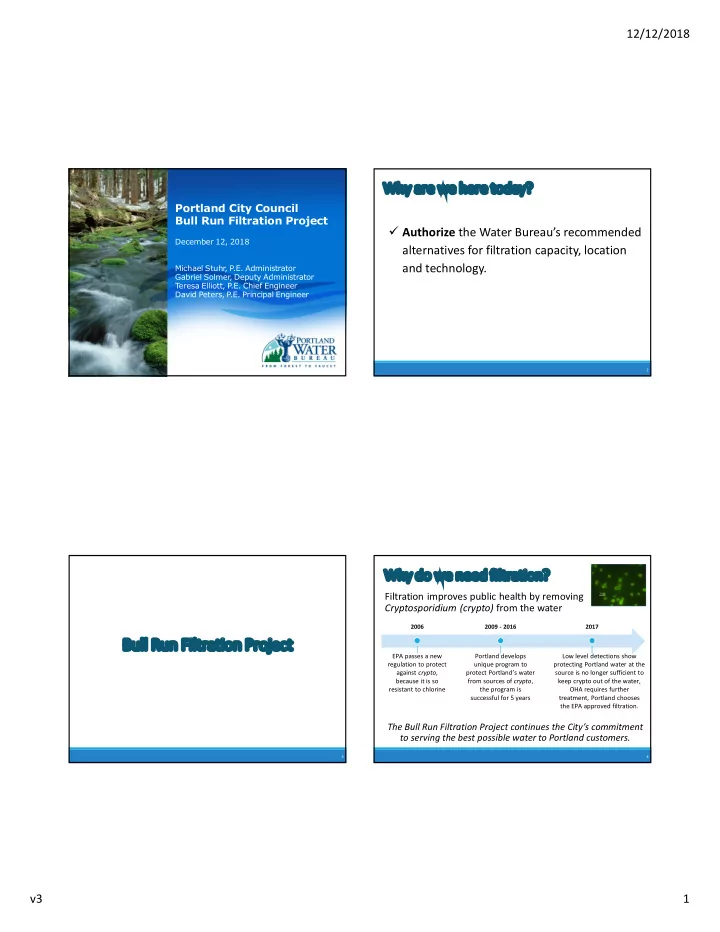
Filtration improves public health by removing Cryptosporidium (crypto) from the water

The Bull Run Filtration Project continues the City’s commitment to serving the best possible water to Portland customers.

2006 EPA passes a new regulation to protect against crypto, because it is so resistant to chlorine 2009 - 2016 Portland develops unique program to protect Portland’s water from sources of crypto, the program is successful for 5 years 2017 Low level detections show protecting Portland water at the source is no longer sufficient to keep crypto out of the water, OHA requires further treatment, Portland chooses the EPA approved filtration.

slide-2
SLIDE 2

12/12/2018 v3 2

Filtration also provides other benefits

 Makes Portland’s water safer by removing microorganisms  Makes Bull Run supply more reliable  Allows Bull Run to be used sooner after an emergency, such as a fire  May reduce the amount of chlorine needed for disinfection  Prepares us to respond to future regulations

6

Community Conversations

Prioritizing public outreach and communication to guide this work  Online survey  Digital/social media outreach  Stakeholder interviews  November 8th Community Forum  Ongoing outreach with potential project neighbors

7

Initial decisions focus on four foundational elements

Procurement Method

City Council decision 8-29-18

Filtration Plant Location Filtration Plant Capacity Filtration Plant Technology

During a typical year During a hot, dry year The most Portland's pipelines can deliver

Analysis: Filtration Plant Capacity

115 MGD 145 - 160 MGD

Recommended capacity

How much water are we going to need?

200 MGD

slide-3
SLIDE 3

12/12/2018 v3 3

9

Proposed Filtration Plant Capacity

Recommended capacity alternative: 145 to 160 MGD  Continues Bull Run as Portland’s main water supply, meeting demands on most days in most years  Manages costs by matching filtration plant size to expected water use  Allows for future expansion if needed

Analysis: Filtration Plant Location

Lusted Hill Lusted Hill Carpenter Lane Carpenter Lane Roslyn Lake Roslyn Lake Headworks Headworks Larsen’s Ranch Larsen’s Ranch Powell Butte Powell Butte

Where should the filtration plant be located?

Bull Run Watershed

11

Recommended Filtration Plant Location

Site HGL Proximity to Conduits Tax Lot Size Slopes and Geologic Hazards Schedule

Carpenter Lane

Pass Pass Pass Pass Pass

Headworks

Fail Pass Fail Fail Pass

Larson’s Ranch

Fail Pass Pass Pass Pass

Lusted Hill

Pass Pass Pass (with site expansion) Pass Pass

Powell Butte

Pass Pass Pass Pass Fail

Roslyn Lake

Fail Pass Pass Pass Pass 12

Proposed Filtration Plant Location

 Site is at the right elevation and location, so that less pumping is needed  Property is already owned by Portland Water Bureau so avoids the cost of purchasing a new property  Zoning allows a filtration facility  Site is large enough to provide a buffer between the facility and its neighbors

Recommended site: Carpenter Lane

Carpenter Lane is a 95-acre property purchased by Portland for a future treatment facility

slide-4
SLIDE 4

12/12/2018 v3 4

Slow Sand

Analysis: Filtration Technology

Granular Media Factors:

  • Water quality
  • Hydraulics
  • Regulatory

requirements

  • Comparative

costs

  • Other utility

comparisons

Membrane

14

Analysis: Filtration Technology

Membranes

X High energy use X High capital and operating costs

Slow Sand

X Significant size X Comparative poor water quality

Granular Media

Best operating capabilities Good water quality Most flexibility

Recommended technology is a granular media filtration system.

15

Proposed Filtration Technology

 Proven technology that produces excellent water quality  Lowest cost technology that can meet desired water quality  Very flexible – it can be adapted to different water conditions and new water quality requirements  Fits on the filtration plant site with room to grow in the future Recommended filtration technology: granular media filtration

Bull Run Filtration will be in

  • peration by 2027

16 ICCT project to reduce lead completed April 2022

slide-5
SLIDE 5

12/12/2018 v3 5

Next Steps For City Council

17

 Authorize a design contract, summer 2019  Authorize a professional services contract with Construction Manager/ General Contractor (CM/GC), end of 2019

Questions?

18 19

What’s important to customers for the Bull Run Filtration Project?

Most important:

 Water quality  Cost benefit (getting good value from investments)

Portland started the project by reaching out to customers

20

slide-6
SLIDE 6

12/12/2018 v3 6

Analysis: Filtration Plant Location

Lusted Hill Lusted Hill Carpenter Lane Carpenter Lane Roslyn Lake Roslyn Lake Headworks Headworks Larsen’s Ranch Larsen’s Ranch Powell Butte Powell Butte

Met all evaluation criteria Sites that were eliminated based on:

  • Incompatible hydraulics
  • Incompatible zoning
  • Poor land conditions
  • Land ownership concerns

Met all evaluation criteria Sites that were eliminated based on:

  • Incompatible hydraulics
  • Incompatible zoning
  • Poor land conditions
  • Land ownership concerns

Site Evaluation Results

Bull Run Watershed

Analysis: Filtration Technology

Granular Media Filtration – How does it work?

Granular media filtration is used at almost all of the large filtration plans in North America