
SLIDE 1
FOR FURNACE OIL & THERMIC FLUID
OIL FILTRATION SYSTEM
Efficlean
TM
SSBU/PD/08-09/004 dt on 27.02.2009
Efficlean OIL FILTRATION SYSTEM FOR FURNACE OIL & THERMIC FLUID - - PowerPoint PPT Presentation
TM Efficlean OIL FILTRATION SYSTEM FOR FURNACE OIL & THERMIC FLUID SSBU/PD/08-09/004 dt on 27.02.2009 A typical furnace oil filtration system Conventional method of filtration of FO for boilers in done in stages: Stage One: Oil
FOR FURNACE OIL & THERMIC FLUID
OIL FILTRATION SYSTEM
TM
SSBU/PD/08-09/004 dt on 27.02.2009
A typical furnace oil filtration system
Conventional method of filtration of FO for boilers in done in stages: Stage One: Oil decanted to main storage tank. Coarse strainer of 10 mesh size (2000 microns) used. Stage 2: Between Service tank and day tank Strainer of 40 mesh size (420 microns) used Stage 3: Between day tank and oil pre heater Strainer of 80 mesh size (177 microns) used Stage 4: Between Oil pre heater and burner Strainer of 120 mesh size (125 microns) used Hence particles of size below 125 microns enter the burner and this cause wear and tear of the nozzles.
Problems With Heavy Fuel Oil Combustion Systems
Maximum particle size going in the system for combustion would be 125 microns, which would be the maximum a 120 mesh filter can screen. The particles below 125 micron are the main cause of wear of nozzles in burners, thus causing decrease in combustion efficiency. Analysis shows that the sediments have 90% of the impurities in the range of 0.25 to 100 micron level, which is way below the capacity of normal mesh filtration system. Routine maintenance is required for cleaning. Huge man hours spent on this activity Wastage of dirty oil from strainers every time the filter is cleaned. This is a direct loss of expensive furnace oil. Use of diesel is required for cleaning the filter elements. Nozzle failures due to improper oil quality. Frequent pump failures as a result of high wear and tear.
Effect on nozzle performance
Nozzle failures occur due to high wear and tear Nozzle angle getting altered Nozzle plugged or choked due to impurities Oil starvation due to choking leading to incomplete combustion resulting in CO emissions Burnt end of nozzle due to overheating High maintenance and downtime due to nozzle replacement
Net effect of conventional filtration
Reduction in efficiency due to high wear and tear in systems Loss of costly FO drained due to frequent cleaning of filters Loss of costly diesel used for cleaning of the filter elements Reduction in availability of boiler due to frequent failures in FO transfer system and burner Huge man hours spent on frequent cleaning and maintenance
Efficlean - Intelligent way of furnace oil & Thermal oil filtration
What is Efficlean?
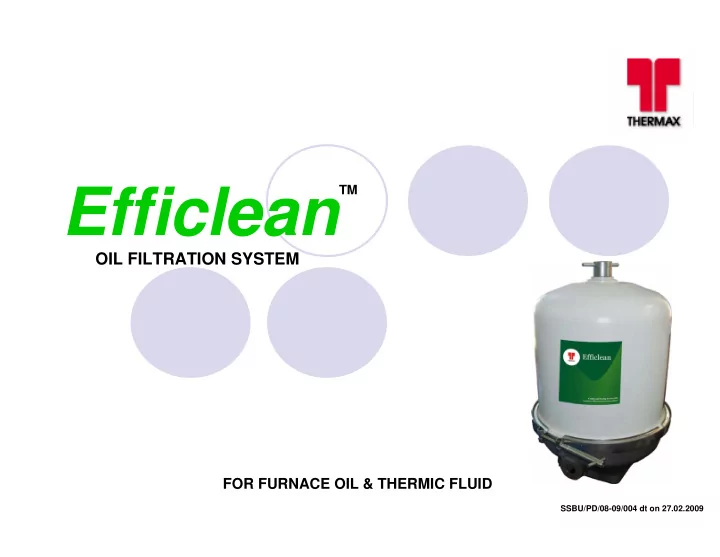
Efficlean is a filter cleaning fluid at micron levels even to the extent of 0.25 microns This works on the principle of centrifugal action where oil will be circulated thro the system and cleaned oil back to the tank This is a bypass filter with a separate pump with inlet pressure requirement of 2.5 to 7.0 bar. This pressure energy is converted to rotational energy in Efficlean, which causes particles to accumulate layer by layer in the rotor walls of Efficlean The outlet of the cleaned oil from Efficlean will go to the tank directly by gravity
Working Principle
This filter works in Centrifugal principle It is an offline filter The design uses the pressure energy of 6 bar of fluid to rotate the unit at speeds of 4000-6000 rpm This centrifugal force separates solid from liquid and solid impurities stick to wall of centrifuge, and liquid falls by gravity to sump/tank. This solid muck is cleaned by stopping the centrifuge, cleaning particles to as low as 0.25 microns from the medium.
Efficlean System – Typical Schematic Diagram
Scope of Supply - Efficlean System
Thermax offers a complete solution for your filtration requirement. This system will comprise of
A fully flexible offering can be made on case to case basis depending
infrastructure available at Customers premises etc.
Advantages of Efficlean filtration system
Higher equipment/machine availability Less cleaning frequency of filter elements Less diesel consumption for cleaning of filter elements Overall reduction in maintenance cost Removing the sediments from the rotor is easy By pass filter, does not interfere with the system. Improvement in Furnace oil handling THERMAL OIL Prevent insoluble from choking the system
replacement cost of thermal oil
Technical Specification – Efficlean filters Model : Efficlean 6.0
Rotor dirt Holding Capacity: 6 Ltrs Rotor oil holding capacity : 6.5 Ltrs Flow: Up to 4200 Ltrs/hr Rotor RPM: Approx 4000 – 6000 rpm Cleaning frequency : 1 KL oil / 1 hour circulation
Model : Efficlean 2.0
Rotor dirt Holding Capacity: 2 Ltrs Rotor oil holding capacity : 2.3 Ltrs Flow: Below 400 Ltrs/hr Rotor RPM: Approx 4000 – 6000 rpm Cleaning frequency : 1 KL oil / 4 hours of circulation
Efficlean at work
The rotor showing the dirt/sediments deposited in the side wall after few hours of oil circulation, which can be cleaned before it is refitted back
Sediments removed from Rotor
Thermax helps in eliminating the possibility of using disposable paper elements, which is hazardous
Reference Letter