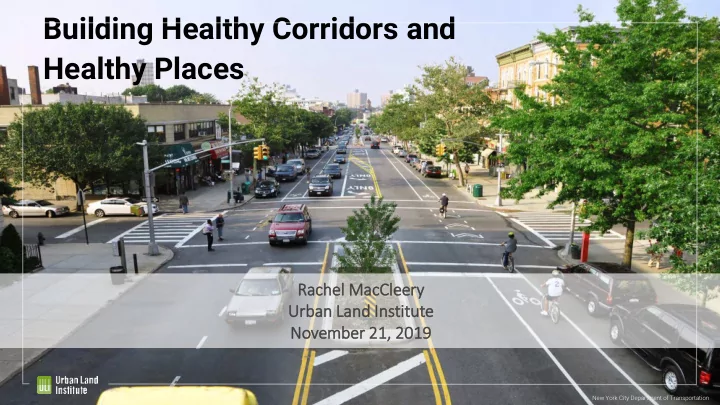
SLIDE 1 Ra Rachel l MacCleery ry Urb rban Lan Land In Institute No November 21 21, , 20 2019 19
Building Healthy Corridors and Healthy Places
New York City Department of Transportation
SLIDE 2 LEVERAGING THE POWER OF ULI’S GLOBAL NETWORKS TO SHAPE PROJECTS AND PLACES IN WAYS THAT IMPROVE THE HEALTH OF PEOPLE AND CO COMMUNITIE IES
SLIDE 3 BUILDING HEALTHY PLACES INITIATIVE
Engages, , in info forms, , and in inspir ires ULI members to promote health, wellness, and social equity in their professional practice and in their communities.
Development practice Cities and regions ULI members and member networks
SLIDE 4
ULI CENTER FOR SUSTAINABILITY AND ECONOMIC PERFORMANCE
Dedicated to creating healthy, re resilient, , an and hig igh- performance communities around the world. Through the work of its Greenprint, Building Healthy Places, and Urban Resilience programs, the Center provides leadership and support to real estate and land use professionals to invest in energy efficient, healthy, resilient, and sustainable buildings and communities.
SLIDE 5
SLIDE 6
PLACE SHAPES HEALTH
Health is not just what happens in the doctor’s office. Instead, health is significantly shaped by factors that include housing, transportation, education, and job opportunities—the social determinants of health. Low income people often have the least access to the ingredients of a healthy life.
SLIDE 7
Vista Avenue, Boise, Idaho
SLIDE 8
Vista Avenue, Boise, Idaho Federal Boulevard, Denver, Colorado
SLIDE 9
Charlotte Avenue, Nashville, TN
SLIDE 10 UNHEALTHY CORRIDORS ARE EVERYWHERE
Automobile-centric commercial corridors exist in nearly every community, characterized by:
- wide road with multiple lanes
- high-speed traffic
- nonexistent or limited transit service
- buildings set back from the street
- bstructive utility poles and wires
- lack of trees and vegetation
- few healthy food options
- poor quality sidewalks
- few connections with adjacent
neighborhoods
SLIDE 11 Most corridors in this country are unhealthy.
Source: Blind Spots: How Unhealthy Corridors Harm Communities and How to Fix Them
SLIDE 12 Arterials account for 4% 4% of roads but 28% of all road deaths 15% of people killed in traffic crashes on all roads nationally were on foot, but people on foot account for 32% of traffic deaths along arte rterials Older people and Latinos are particularly likely to be killed along unhealthy corridors
Source: Blind Spots: How Unhealthy Corridors Harm Communities and How to Fix Them
SLIDE 13
Pri rinciples for Creating Healthy Corridors
SLIDE 14 PUT PEOPLE FIR IRST
Make existing residents and businesses the priority Preserve and add affordable housing Provide training and support to current and aspiring business owners Offer small loans and grants to help improve storefronts Authentically engage community members
Loc Local l bus busin iness ss improvements on n Co Colle lege Av Avenue, Fa Fayettevil ille le, , AR AR
SLIDE 15 H Street NE in Washington, DC Strategies
- Enhanced development plans and
transportation infrastructure
- All new streetscape – sidewalks, lighting,
signage, etc.
- Arts and culture focus
- Hundreds of dollars in private investment –
mixed use, retail, housing
- Streetcar came online in 2017
- Growing housing affordability challenges
SLIDE 16 H Street NE in Washington, DC Before and After
2018 2008
SLIDE 17 FIX IX LAND USE PATTERNS
Adopt mixed-use zoning
Revise parking
Penalize owners for leaving land vacant Adopt land-value taxes Leverage BRT for “horizontal mixed use”
Co Colu lumbia ia Pi Pike ke, , Vi Virg rgin inia ia
SLIDE 18 Columbia Pike, Arlington, VA Str trategies
Enha hanced d cor corrid ridor r thr hrough Form
ased Cod Codes
- Commitment to affordable housing
- Faster than normal approvals and reduced opposition
to new projects
- Walkable, high quality design
- Tax Increment Financing (TIF) devoted to transit
improvements and affordable housing.
- Over 1 million sqft of new commercial space, 3000
units of new housing
- Now the busiest bus transit corridor in Virginia
Before After
SLIDE 19 Columbia Pike, Virginia Before and After
2009 2018
SLIDE 20 MAKE TR TRANSPORTATION CONNECTIONS
Adopt Complete Streets policies – with bus, transit, sidewalks, bike lanes Focus on safety Change policies and practices that prioritize cars Connect with adjacent neighborhoods Take local control of streets
Jack Byerly
Grey’s Ferry, Philadelphia
SLIDE 21 Aurora Avenue in Shoreline, Washington Strategies
Better co corrid idor through infr infrastructure inve investment.
- $140 million in improvements included: sidewalks, bike trail,
medians, lighting, undergrounded utilities
- A new bus rapid transit (BRT) service – King County RapidRide
with Business Access Transit (BAT) lanes
- Accidents reduced by 60%, bus ridership increased
- Multiple new businesses and
development – horizontal mixed use
- New city hall and high school,
700 units of new housing, 1000 more in permitting or under construction
SLIDE 22
Aurora Avenue in Shoreline, Washington Before and Aft fter
SLIDE 23 LE LEVERAGE PARTNERSHIPS AND ANCHOR IN INSTITUTIONS
Take advantage of nearby employees Make connections Work together on investments and programming Consider a BID or CID
Sh Shore reli line, , Washin ington
SLIDE 24 Euclid Avenue in Cleveland, Ohio Strategies
- Enhanced corridor through BRT and upgrades
- 9.2 mile corridor linking major health care
institutions
- $200 million transit investment includes BRT, new
sidewalks, bike lanes, lighting, public art and street trees
- $6.3 billion in new development, 13,000 new jobs,
4,000 new residential units
- Travel times reduced from 40 to 28 minutes.
Ridership up 70%
SLIDE 25
Euclid Avenue in Cleveland, Ohio Before and After
SLIDE 26 CELEBRATE WIT ITH ARTS AND CULTURE AND EVENTS
Bailey Lytle
Build community with culture and programs Implement placemaking and placekeeping Celebrate successes and milestones
Sho hort No North Ar Arts s Dist stric ict, Co Colu lumbus Oh Ohio io
SLIDE 27
Van Nuys Boulevard Pacoima, Los Angeles
2016 ULI Los Angeles Health Zone Tactical urbanism Arts incubator
SLIDE 28 LE LEAD WITH HEALTH
Vi Vist sta Av Avenue, , Boise se, , Idaho
Consider doing a Health Impact Assessment Emphasize outcomes for people and planet
SLIDE 29
Dic ick Jackson, MD
“We now know that developers can be more effective in achieving public health than the doctors in white coats.”
SLIDE 30 ULI Healthy Corridors Resources
www.uli.org/healthycorridors
30
Using the lens of health to reimagine the future of urban and suburban arterials.
2019 2019 2016
SLIDE 31
rac achel.maccle leery@uli li.org heal alth@uli. li.org uli.o li.org/healt lth
Thank you!