Ngoc Linh Xe Sap Biodiversity Conservation Corridors Corridors - - PowerPoint PPT Presentation

ngoc linh xe sap biodiversity conservation corridors
SMART_READER_LITE
LIVE PREVIEW

Ngoc Linh Xe Sap Biodiversity Conservation Corridors Corridors - - PowerPoint PPT Presentation

Ngoc Linh Xe Sap Biodiversity Conservation ACHIEVEMENTS OF PROJECT Ngoc Linh Xe Sap Biodiversity Conservation Corridors Corridors Implemented from 2006 to 2010 (BCI phase I) Hunh Tin Dng WWF Vietnam Conservation


slide-1
SLIDE 1

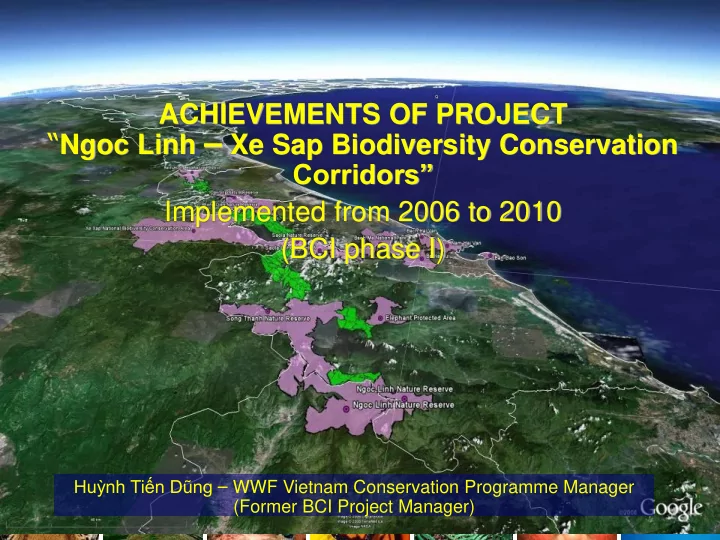
Ngoc Linh – Xe Sap Biodiversity Conservation Corridors ACHIEVEMENTS OF PROJECT “Ngoc Linh – Xe Sap Biodiversity Conservation Corridors” Implemented from 2006 to 2010 (BCI phase I)

Huỳnh Tiến Dũng – WWF Vietnam Conservation Programme Manager (Former BCI Project Manager)

slide-2
SLIDE 2

Biodiversity Conservation Corridors

Corridors 3D map

Quang Tri Hue Da Nang Hoi An (UNESCO site) Quang Nam

slide-3
SLIDE 3

PROJECT CONTEXT

  • Greater Mekong Sub-Region

(GMS) countries including: Cambodia, China (Yunnan and Guangxi), Laos, Myanmar, Thailand and Vietnam would like to improve regional economic cooperation.

  • Economic Corridors connecting

GMS countries were suggested since 2011 to promote regional cooperation in transport, energy, telecommunications and trade in the sub-region.

slide-4
SLIDE 4

Core Environmnetal Programme adopted at Second GMS Summit organized in China in 2005

  • Core Environmental Programme (CEP): initiated at a meeting of GMS Working

Group on Environment in Sept 2004 in Hanoi, Vietnam.

  • CEP adopted by GMS countries at Second GMS Summit organized in China 2005.
  • CEP with 5 components(including BCI) approved by Vietnam Government in Sept

2006

slide-5
SLIDE 5

Core Environmental Programe (CEP) and its components

  • Component 1. Environmental Assessments of Economic Corridors and

Sector Strategies

  • Component 2. Biodiversity Conservation Corridors Initiative (BCI)
  • Component 3. Environmental Performance Assessment and Sustainable

Development Planning

  • Component 4. Capacity Building for Sustainable Environmental

Management

  • Component 5. Program Development, Delivery, and Sustainable

Financing CEP coordinated by the Environment Operations Center (EOC), ADB

slide-6
SLIDE 6

Economic Corridors and BCI pilot sites

slide-7
SLIDE 7

Project Implementation

  • BCI is regional project including Cambodia, China, Laos, Thailand and

Vietnam.

  • Regional level: coordinated and technical assistance by EOC/ADB
  • National level: coordinated by MONRE.
  • Provincial level: coordinated and implemented by Provincial Implemention

Unit (PPIU).

  • WWF Vietnam: technical assistance and financial management in

Vietnam. Project has 05 components:

1. Poverty alleviation through sustainable use of natural resources and development of livelihoods 2. Harmonized land management and government regimes 3. Restoring Ecosystem Connectivity 4. Capacity Building 5. Sustainable financing of the biodiversity corridor interventions.

slide-8
SLIDE 8

BCI phase implementation time and budget

Time:

  • BCI phase started in Vietnam in Nov 2006 and completed

Oct 2010. Budget:

  • The planned budget: 5 million USD
  • Actual budget received: 1,8 million USD
slide-9
SLIDE 9

BCI project sites in Vietnam

Quang Tri province

  • 2 districts

(21communes) Quang Nam province

  • 7 districts (50

communes)

slide-10
SLIDE 10

Achievements from BCI Phase I Implementation

slide-11
SLIDE 11
  • A. Policy outcome
  • Biodiversity Law 2008
  • Draft Gov Decree on Biodiversity Corridor
  • Draft Gov Decree on Benefit Sharing Mechanism Benefit Sharing

Mechanisms for People Adversely Affected by Hydropower Projects in Viet Namot testing (piloted in Avuong Dam, Quang Nam)

  • At least 7 hydropower plant proposals and 01 mining activity were

stopped in the project area (corridors) by the end of the project (much more now).

  • 02 Saola protected areas established in Quang Nam and Thua Thien

Hue.

  • 01 elephant protected area established in Que Son (Quang Nam)
  • CDF Operation Regulation developed and applied.
slide-12
SLIDE 12

Capacity building:

  • Training need assessment conducted and various training

provided: 80 training courses conducted and about 1300 people benefited.

  • Training subjects: Forest site mapping and planting, biodiversity

survey, conservation education training, land use planning and land allocation, GIS, community facilitation skills, nursery management, camera trapping, nature crime investigation, law enforcement, market assessment and value chain, species survey techniques, CDF training, livelihood models, exchange visits and study tours to

  • ther countries, etc.
  • Awareness raising: A variety of awareness raising activities on

biodiversity conservation undertaken such as education campaigns, environmental education network, school contests, posters, leaflets, etc.

  • B. Capacity and sustainable financing
slide-13
SLIDE 13
  • Study the potential of “Harnessing Carbon Finance for the

Biodiversity Corridors of the Central Annamites”.

  • Pilot testing of Benefit Sharing Mechanism for A Vuong Hydropower

plant in Quang Nam (Draft Gov Decree made).

  • 20 CDF operated.
  • Central Annamites became WWF priority landscapes in 2011. More

investment from WWF and a number of follow up projects granted (for example: CARBI)

  • More investment from government (for example: BCC phase II).
  • B. Sustainable financing
slide-14
SLIDE 14
  • 20 CDF established and operated.
  • Community protected area
  • 43 village patrol groups established
  • 11 community nursery established.
  • 36 villages signed common agreements for non-hunting areas.
  • 572 ha forested planted and managed by households (livelihood forest

planting).

  • Establishment of mechanisms for legal harvesting by communities.
  • Protected area boundary demarcation by communities.
  • C. Community mobilization
slide-15
SLIDE 15
  • A lot of local people benefited from the project (improved

access to finance, market linkages, alternative livelihoods

  • ptions, improved social infrastructure, etc.).
  • Generation of employment opportunities through

conservation works (village nursery, check dams, village patrolling, forest plantation, PA boundary demarcation, etc.)

  • D. Poverty reduction and reduced

dependency on ecosystem services

slide-16
SLIDE 16
  • Participatory land-use planning piloted for 3 communes in Quang Tri.
  • Forest land tenure certificates for more than 500 households involved

in forest planting.

  • District and commune forest protection and management plans
  • E. Land use planning

and improved land use rights

slide-17
SLIDE 17
  • The 6 corridors identified with the total area of 130.000 ha in 3

provinces.

  • 60% of critical areas for connecting fragmented PA identified and

restoration undertaken.

  • Forest restoration, enrichment and natural generation by communities:

(653 ha planted).

  • Law enforcement activities: snare and trap removal (5898 traps and

snares), violators’ camps destroying (147), bush fence clearance (33.000 m), confiscation of 100 m3 of timber, handling and care of confiscated wildlife, release of captured wild animals.

  • Satellite images in the year 2006, 2007 and 2008 show that habitat

status quo in corridor is maintained and forest cover is increased.

  • Research and study: land cover mapping; database design,

biodiversity surveys, biological assessment and monitoring – camera trapping, flagship species, amphibian and plant surveys, etc.

  • Saola re-discovered recently after 15 years.
  • F. Reduction of ecosystem fragmentation and

improved ecosystem services

slide-18
SLIDE 18

Critical issues from BCI phase I to be followed up

  • Lack of legal ground for the corridors establishment.
  • Follow up the Commune Development Funds established

under BCI phase I