
SLIDE 1
11/30/2018 1
Building Bridges of Understanding with Religion and Culture through Intercultural Resiliency
JOANNE GINTER, M.A.
Brief Therapy Conference
Treating Anxiety, Depression and Trauma
Burlingame, CA, Dec. 2018
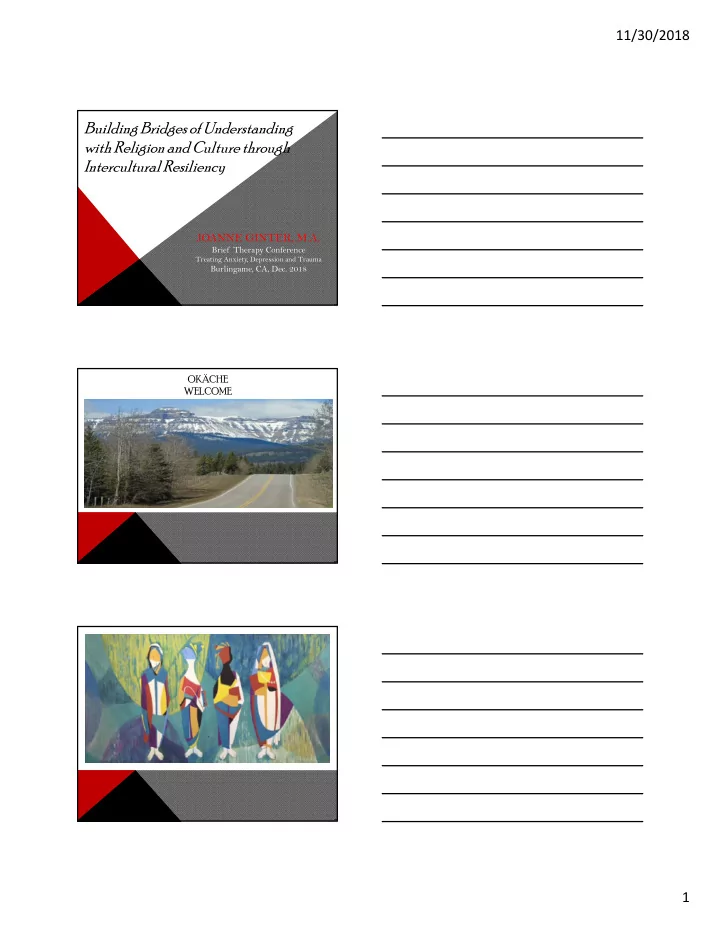
OKÄCHE WELCOME
Building Bridges of Understanding with Religion and Culture through - - PDF document
11/30/2018 Building Bridges of Understanding with Religion and Culture through Intercultural Resiliency JOANNE GINTER, M.A. Brief Therapy Conference Treating Anxiety, Depression and Trauma Burlingame, CA, Dec. 2018 OKCHE WELCOME 1
Brief Therapy Conference
Treating Anxiety, Depression and Trauma
Burlingame, CA, Dec. 2018
OKÄCHE WELCOME
People are the creators of stories that give life events connectedness and meaning. Life stories are woven with successes, challenges and failures; including familial, cultural and religious rituals. Therapists are asked to understand stories outside their worldviews resulting in a need for more inclusive and diversified dialogues promoting intercultural resiliency and pluralism.
What are the significant challenges that present for therapists working
clients have with therapists outside their worldview? How do we understand the role that religion has for a therapist in developing a pluralist lens? How is understanding between differences built through intercultural resiliency?
….the looking glass through which one views the world. ...a set of assumptions, values, beliefs about how human beings and the world in which we live function that directly affect our responses to the world around us.
(Collins and Arthur)
the individual sense of self or story is comprised of the sum of stories from all relationships. Therefore the meaning given to stories is created by both the individual and the community, including culture and the many facets that comprise culture “it is our capacity for personal relationships that make us human; we act as agents in our own life plays within a matrix of relationships”
(Jones)
Includes all psychologies/therapies providing mental health Follows a timeline of psychological theories regarding religion from the early 1900’s to the current integration of spirituality and non-traditional healing methods (Reiki, mindfulness)
R E J E C T I O N I S T
Based in Freudian, behavioral and existential theories, defines religious beliefs as immature reactions to life events; no place in therapy. Religion is a psychological defense Therapist encourages more ego-
life
E X C L U S I V I S T
Referred to as the “spiritual reality perspective”. Based on fundamental belief in a religious or spiritual dimension. For therapy to be effective, therapists must have a religious or spiritual worldview and assume on primary path to wholeness.
C O N S T R U C T I V I S T
Does not assume the existence of an absolute reality; Acknowledges that individuals construct their own personal meanings and realities from their experiences, belief systems, values, fears, and other aspects
P L U R A L I S T
Model of cross-cultural therapy Recognizes each person entering the session (both the client and therapist) comes with their own specific personal and cultural values, ethnic and social characteristics and stories Belief in absolute/spiritual reality
Both the client and the therapist openly acknowledge that each enter the therapeutic relationship with his/her own story, including values, beliefs and experiences; allows for all available meaning making processes, including aspects of the therapist’s story to facilitate more creative problem solving Acceptance of diversity in stories and multiple meanings Supports the therapist that does not hold a universal belief in the sacred
( Aldulaz Sachedina)
Encourages sensitivity to broader acceptance of institutionalized religions worldwide Accepts that religion as it exists in any culture directly
Supports the development of Resiliency which offers a language and process to build bridges between differences
Spiritual Platform “values and philosophical
reflected the spirituality of the clinician”
(Aponte)
Cultural Self
“a fluid entity that reveals who we are at the core” and “who we are becoming culturally in this globalized……age”
(Abi-Hashem)
Cultural Schemata
“the clusters of beliefs and assumptions formed….through social conditioning and experience that act as a kind of cultural filter….including how both counsellor and client behavior is defined and interpreted.” (Collins and Arthur)
Following the questions on the worksheet, take time after the workshop to fill in your spiritual platform
(Walsh, 1999c, p. 37)
take initiative, be creative and humorous and hold a sense of morality
transformed them into life skills that would enable them to continue in positive directions in their adult lives
for personal growth amidst an elaborate system of myths, symbols and ideals that promote active self-righting rather than victimization.
Resiliency develops within an empathic milieu of relationships from which we can experience ourselves as part of something greater than our individual egos, receive empathic understanding for our thoughts and feelings, and receive support for our ideas and goals. These things are necessary for the development and maintenance of joy, creativity, and resiliency in our lives
Creating resiliency within a web of interrelated relationships The therapeutic relationship therefore becomes more collaborative and empowering of the system’s (family) potential so that successful interventions depend on accessing resources within the system
SELF
Soul or spirit
RELATIONSHIP
Mentor, counsellor or caregiver
COMMUNITY OF CARE
Nurture
P S Y C H O L O GY
R E L I GI O N
A process of self-creation within significant resilient relationships and systems Re-visioning and creating new meaning to life stories Sense of self created from multiplicity of personal and relational stories Within the process of self-creation, each person is either the narrator or reader
(William Randall)
Recognition of the person in relationship to those individuals who support individual's development and community that provides nurturance and care Based on a relational interaction between the person and therapist recognizing the uniqueness of the person The relational dance between the client and therapist
The energy that holds pluralism in place Promotes sharing life stories to create new meanings to life changing events Synonymous with Culture-infused counselling (the conscious and purposeful infusion of cultural awareness and sensitivity into all aspect of the counselling process)
Learn and practice respectful questioning Know and practice an inner framework to understand your client(s) Seek to know Accept the resurgence of different and new cultures Believe that resiliency can be the bridge Be present as a member in the active recreation of client(s)’ stories
“When our clients lose hope, our faith in their potential can restore their
rise to meet their challenges with confidence and competence. Valuing human connection, we help our clients to seek reconciliation to heal wounded relationships and encourage them to forge more meaningful personal and spiritual bonds”
(Walsh,)
ÏSNIYÉS THANK YOU REFERENCES
Abi-Hashem, Naji (2011). On Cultural Resiliency. The Austrialian Community Psychologist, 23 (2). Aponte, Harry J. (1999). The Stresses of Poverty and the Comfort of Spirituality. In F. Walsh (Ed.), Spiritual Resources in Family Therapy (pp. 76-89). NY: Guilford. Arthur, Nancy and Collins, Sandra (2010) Introduction to Culture Infused Counseling. In N. Arthur and S. Collins (Ed.) Culture Infused Counselling, (pp. 3-25). Calgary, AB: Counselling Concepts. Collins, Sandra and Arthur, Nancy (2010). Self-Awareness and Awareness of Client Cultural Identities. In N. Arthur and S. Collins (Ed.) Culture Infused Counselling, (pp. 67-102). Calgary, AB: Counselling Concepts. Belzen, Jacob A. (2001). The future is in the return: back to cultural psychology of religion. In D. Jonte-Pace and
REFERENCES
Jones, James W. (2002).Terror and Transformation. NY: Taylor and Francis. (Brunner-Routledge). O’Connell Higgins, Gina (1994). Resilient Adults, Overcoming a Cruel Past. San Francisco: Jossey-Bass Publishers. Pargament, Kenneth I. (1997). The Psychology of Religion and Coping. NY: Guilford Press. Sachedina, Abdulaziz (2001). The Islamic Roots of Democratic Pluralism. NY: Oxford University Press. Walsh, Froma (1998). Strengthening Family Resilience. NY: Guilford. Walsh, Froma (1999b). Religion and Spirituality: Wellsprings for Healing and Resilience. In F. Walsh (Ed.), Spiritual Resources in Family Therapy (pp. 3-27). NY: Guilford.
IMAGES USED
In order of appearance in presentation Ginter, J . (2018). Stoney Nakoda Nation, Alberta. In Unity There is Strength. [online image]. Retrieved May 10, 2018 from https://odi.osu.edu/hale-black- cultural-center/art.html?iid=153 Newton, A. (2008). Harmony [online image]. Retrieved May 10, 2018 from https://fineartamerica.com/featured/harmony-alima-newton.html Newton, A. (2017). The Prayer [online image]. Retrieved May 10, 2018 from https://fineartamerica.com/featured/the-prayer-alima-newton.html Pargament [online image]. Retrieved May 10, 2018 from http://www.peakperformanceconsult.com/Health- Wellness.aspx Wilhelm [online image]. Retrieved May 10, 2018 from https://www.biography.com/people/georg-wilhelm- friedrich-hegel-9333532 Adler [online image]. Retrieved May 10, 2018 from http://www.notablebiographies.com/A-An/Adler- Alfred.html
IMAGES USED
In order of appearance in presentation Freud [online image]. Retrieved May 10, 2018 from https://www.sigmundfreud.net/facts.jsp James [online image]. Retrieved May 10, 2018 from https://www.britannica.com/biography/William-James Jung [online image]. Retrieved May 10, 2018 from https://www.imdb.com/name/nm2123939/ Allport [online image]. Retrieved May 10, 2018 from http://www.lifeandpsychology.com/2014/10/gordon- allport-and-sigmund-freud.html Erikson [online image]. Retrieved May 10, 2018 from https://infograph.venngage.com/p/239810/erik- erikson-and-adolf-hitler Seemel, G. (2009). Jeannette. [online image]. Retrieved May 10, 2018 from http://www.gwennseemel.com/index.php/blog/comments/direct/ Seemel, G. (2010). Lola [online image]. Retrieved May 10, 2018 from http://www.gwennseemel.com/index.php/blog/comments/mediocre_to_sell/
IMAGES USED
In order of appearance in presentation Intercultural Dialogue [online image]. Retrieved May 10, 2018 from https://canadianarchives.ca/project/intercultural-dialogue/ Split Personality [online image]. Retrieved May 10, 2018 from http://www.thehaguepsychologist.nl/split- personality-multiple-personality-disorder/ Ethnic and Cultural Art [online image]. Retrieved May 10, 2018 from https://fineartamerica.com/contests/ethnic-and-cultural-art-exposed.html Simpson, K. (2009). The Beauty of Diversity [online image]. Retrieved May 10, 2018 from https://www.imagekind.com/the-beauty-of-diversity_art?IMID=d94af94f-a013-4fc9-8849- 63fdca5df7b3 Ginter, J . (2018). Lake at Nakoda Lodge, Alberta.