
SLIDE 1
Truss Bridges
- f Kentucky
1899
1893
ACEC Partnering Conference 2012
Amanda Abner Rebecca Turner
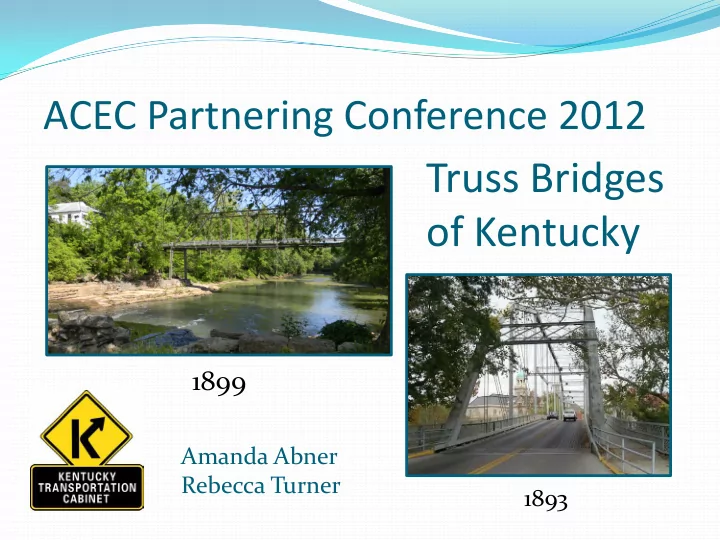
Truss Bridges of Kentucky 1899 Amanda Abner Rebecca Turner 1893 - - PowerPoint PPT Presentation
ACEC Partnering Conference 2012 Truss Bridges of Kentucky 1899 Amanda Abner Rebecca Turner 1893 Truss Bridges of Kentucky Truss Bridges of Kentucky Vincennes Bridge Company Champion Bridge Company Empire Bridge Company Truss Bridges of
1899
1893
Amanda Abner Rebecca Turner
Vincennes Bridge Company Champion Bridge Company Empire Bridge Company
Henry Lawrence Bridge 1934 Kennedy Bridge, 1964
Some types are very rare
Whipple-Murphy- 3 Parker Pony- 1 Bedstead- 2 Baltimore Through- 3 Baltimore Deck- 1 Bowstring- 2 Pennsylvania Petit- 3 Pratt Deck- 2
Circa 1890s Whipple Truss, Breathitt County
Garrett Bridge Floyd County
The most important historic truss bridges in each District were identified based on:
(e.g., stone abutments, decorative features)
(e.g., railroad, WPA)
Ted Grossardt Len O’Connell
Kentucky Transportation Center
Identify major repairs/work needed to maintain bridge
for 20 years
Generate rough estimate of cost to preserve Obtain estimate of amount of effort to preserve the
bridge on a scale of 1 (very little or no effort) to 10 ( most difficult)
Opinion regarding preservation or replacement Identification of functional issues related to the
preservation effort (e.g., problems with approach, traffic issues)
Attribute Explanation Bridge Identification Number A bridge with a B is state maintained; One with a C is county Maintained Sufficiency Rating From the NBI, ranging from 0.0 (closed) to 100 (condition new) Year Built Year said to be built; but may be year rehabilitated and not always accurate
Attribute Explanation Work Effort to Preserve Ranges from very little or no effort (1) to most difficult (10) Replace or Preserve Engineer’s opinion on bridge’s preservation Potential Historic Qualities Lists some of the qualities that render the bridge of historic interest Preserve but bridge presents significant functional issues (summary table only) The bridge engineer said it could be preserved but mentioned significant
preservation, such as traffic flow issues
Cost to Preserve This is a very rough estimate of the cost
ID S.R. Year Built Work Effort Replace or Preserve Cost to Preserve Historic Qualities
071C23 25.0 1925 3.5 Preserve $600,000 with painting, $80,000 without Stone abutments, pin connections 085C05 25.0 1911 2.5 Preserve $100,000 Camelback, Pin Connections 114C07 16.5 1911 5.5 Preserve $500,000 to $800,000 Pratt Half-hip Pony, Pin Connections, Stone abutments 085C07 24.7 1921 9 Replace Vincennes Bridge Co.
Sufficiency Rating Category Number of Bridges Opinion Preserve Opinion Replace Preserve w/ Functional Issues 0.0-9.99 6 2 2 2 10-19.99 14 3 5 6 20-29.99 16 9 3 4 30—39.99 7 2 2 3 40-49.99 16 16 50-59.99 7 6 1 60-69.99 2 2 70-79.99 4 3 1 80-89.99 90-100 Totals 72 (100%) 43 (59.7%) 13 (18.1%) 16 (22.2%)
Many of the truss bridges can be
maintained/preserved
Maintenance needs (esp. painting) are underfunded,
aggravating deterioration rates
A spot painting program and/or the use of marine
grease may be needed
More frequent joint repair/replacement to lengthen
life of bridge
Functional Issues – Width, Approaches, Existing and
Future Traffic Mix, Heavy Agricultural or Industrial use – some bridges simply don’t meet the functional needs of the routes they serve.
County Maintained Bridges – County has little
incentive to maintain. State will fix or replace if it gets too bad.
Understanding Federal Funding.
Federal Funding can be used to rehabilitate these
bridges – even if they show up on the Highway Plan as “replace”.
A bridge is eligible for rehabilitation if it has a
sufficiency rating below 80. It is not required to reach a post-rehabilitation SR of 80 to qualify for federal funding.
The bridge must not have been federally funded for
construction or restoration within the last ten years.
The bridge must be rehabilitated “to maintain or
upgrade its structural capacity to the present and anticipated future capacity needed for route traffic.”
The State Agency makes this determination. Kentucky: County Roads = 18 Tons
State Routes = 22 Tons AAA Highway = 31 Tons
If these targets cannot be met, the bridge may still
remain in the system with a posted weight limit.
Tom Matthews & Phil Logsdon
Pennsylvania Petit Steel Truss
Constructed in 1921 205’ long, 18-20’ wide Sufficiency Rating = 38.7
Existing Bridge Remove Horizontal Deficiencies
3-Ton Weight Limit Overall Condition - Paint Vertical Member Repairs Gusset Plate Repairs End Post Plate Replacement
Replacement Estimate = $1.8M (ROW + Utilities + Construction) Paint and Repair Engineer’s Estimate = $913K Four Bids = $465K - $696K Low Bid = $465K
Plans Developed In-House Let - September 28, 2011 $465K - Spartan
Contractors
Closed - October 17-21 Completed - December 5,
2011
Construction: End Post Plate Repair…..Note new plate installed after painting
Containment Down finished product…..Note masonry coating on deck curb.
20+ year repair 15-Ton weight limit 5-Day Closure 2-months with 1-lane 75% Savings
Very few historic truss bridges remain We need to get better at estimating rehabilitation costs Rehabilitation should be considered – even for bridges
identified for “replacement” in the highway plan
“Right Sizing” a project may save overall project costs,
including environmental costs
District Bridge Engineers are interested in preserving
and maintaining historic truss bridges
Consider investing more in preventive maintenance