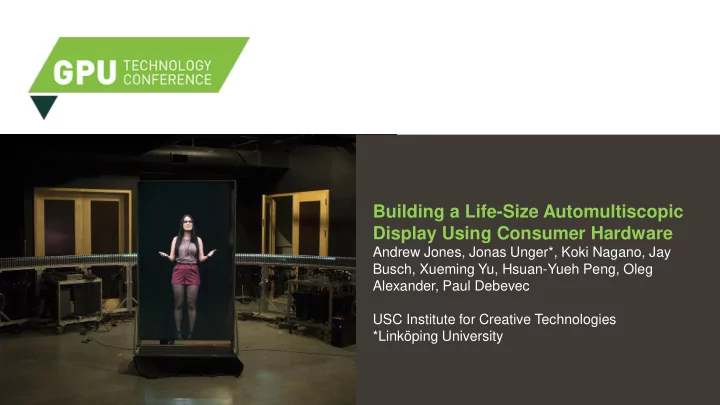
SLIDE 1 Building a Life-Size Automultiscopic Display Using Consumer Hardware
Andrew Jones, Jonas Unger*, Koki Nagano, Jay Busch, Xueming Yu, Hsuan-Yueh Peng, Oleg Alexander, Paul Debevec USC Institute for Creative Technologies *Linköping University
SLIDE 2
Stereoscopic Automutiscopic
SLIDE 3
Automutiscopic
How do we capture, render, display automultiscopic content?
SLIDE 4 Projectors Anisotropic screen Audience
SLIDE 5
1st prototype Focus on face 2nd prototype Full-size bodies
SLIDE 6
3D Geometry custom vertex shader Image-based Light Fields custom pixel shader
SLIDE 7
Bandwidth
1920 x 1080 x 60 fps x 360⁰ x 24 bit = 134GB / sec Large number of output streams Data transfer to GPU
SLIDE 8 Our Approach
- Distribute rendering across multiple GPUs
and computers
- Scalable, additional projectors increases
field of view
SLIDE 9
Kara video
SLIDE 10 Takanori Okoshi, Three-Dimensional Imaging Techniques, Academic Press 1976
- Fig. 5.5(b), “projection-type three-dimensional display”, p. 131
projectors screen
Screen materials:
- Horizontal lenticular
- Light shaping diffusers
- Brushed metal
- Privacy filters
SLIDE 11 Anisotropic Projector Arrays
[Agocs et al. 2007]
Holographika
[Kawatika et al. 2012] [Yoshida et al. 2011]
SLIDE 12 Projector Array
– 480 x 320 Resolution – Mini HDMI input
- 1.66° Angular Resolution
- 110° Field of View
SLIDE 13
- 40 lines per inch Lenticular screen from Microlens Inc.
- 1° horizontal x 60° vertical diffuser from Luminit Co.
Anisotropic Screen
SLIDE 14 Graphics Cards
AMD Radeon 7870 graphics cards, 4 x 6 Mini DisplayPort outputs = total 24 outputs DisplayFusion (nView, Ultramon)
SLIDE 15 Video Splitters
24 Matrox TripleHeadToGo video splitters
– 1 DisplayPort input, 3 DisplayPort outputs each
SLIDE 16 DisplayPort 1.2
- Multi-Stream Transport (MST)
- Appear as separate displays
- Each display can have different
resolution/refresh rate etc
- Each graphics card still has upper bound
for total number of streams
SLIDE 17
SLIDE 18 Multiple-center of projection
Every pixel rendered from different viewpoint
SLIDE 19
SLIDE 20
corresponding viewer
screen from view point
projectors screen current viewer vertex possible viewers
Vertex projection
SLIDE 21 current viewer current projector screen vertex possible viewers S
Vertex projection
SLIDE 22 Runing in Activision pipeline
demo
SLIDE 23
Gaussians
default height and distance
- Falloff distance ≈ width
- f shoulders
Multiple viewers
SLIDE 24
projectors
Anisotropic Projector Arrays
Jones et al. “Interpolating Vertical Parallax for an Autostereoscopic 3D Projector Array”. SPIE Stereoscopic Displays and Applications 2014
SLIDE 25
Projectors
SLIDE 26
SLIDE 27 Vivitek Qumi projectors
- 1280 x 800 pixels
- LED light source
- 300 Lumens
- Low power, small
size
SLIDE 28
The Anisotropic Screen
1° horizontal x 60° vertical diffuser from Luminit Co
SLIDE 29
The Anisotropic Screen
Light from each projector is scattered as a vertical stripe
SLIDE 30
The Anisotropic Screen
Light from each projector is scattered as a vertical stripe
SLIDE 31 The Anisotropic Screen
Each view is composed
stripes
SLIDE 32 The Anisotropic Screen
Each view is composed
stripes
SLIDE 33 Light Stage 6 8 meter geodesic dome LED illumination
30 cameras
SLIDE 34
Capture
SLIDE 35
SLIDE 36
Video showing input clips
SLIDE 37
Light Field Sampling
0.625 degrees between projectors
SLIDE 38
Light Field Sampling
1.75 degrees between eyes at 2 meters
SLIDE 39
Light Field Sampling
6 degrees between cameras
SLIDE 40 View Interpolation
Camera 1 Camera 2 Virtual View Proxy geometry Actual geometry
SLIDE 41 View Interpolation
Camera 1 Camera 2 Virtual View Proxy geometry Actual geometry
SLIDE 42
SLIDE 43 Geometry Reconstruction
reconstruction
- Relatively slow
- AGIsoft - 40 minutes per
frame with 30 cameras
Image-Based Visual Hulls Matusik et al., SIGGRAPH ‘00 Free-viewpoint Video of Humans Carranza et al., SIGGRAPH ‘03
SLIDE 44
SLIDE 45 Einarsson et al. “Relighting Human Locomotion with Flowed Reflectance Fields”, EGSR 2006
SLIDE 46
- M. Werlberger, T. Pock, and H. Bischof: Motion Estimation with Non-Local Total
Variation Regularization, IEEE Conference on Computer Vision and Pattern Recognition (CVPR), San Francisco, CA, USA, June 2010.
SLIDE 47 View Interpolation
Camera 1 Camera 2 Virtual View Proxy geometry Actual geometry
SLIDE 48 View Interpolation
Camera 1 Camera 2 Virtual View Proxy geometry Actual geometry
SLIDE 49
SLIDE 51
SLIDE 52
SLIDE 53
The Interview
SLIDE 54
SLIDE 55 Video Decoding
- 11 source videos, 20 optical flow videos
per GPU
- CPU decoding FFMPEG (multi-core)
- GPU MPEG video decoding (NVCUVID)
SLIDE 56 Distributed rendering
Windows 7 Default: commands sent to most single GPU and blitted across Current solution: New instance of application per GPU Next step: OS/Vendor specfic extensions to assign resources to GPUs (ie WGL_NV_gpu_affinity)
Shalini Venkataraman, “Programming Multi-GPUs for Scalable Rendering” GTC 2012
SLIDE 57 Ongoing Work
language processing / artificial intelligence
- Extend up to 30+ hours of
interview
Arstein et al. “Time-Offset Interaction with a Holocaust Survivor”, Proceedings of International Conference On Intelligent User Interfaces (IUI), 2014
SLIDE 58
SLIDE 59 Conclusions
- Simple techniques for rendering geometry
and light fields for automultiscopic displays
- Limited by GPU bandwidth
- Need new tools to exploit redundancy, and
distribute resources across views
SLIDE 60
Questions
Thanks to CNN, Morgan Spurlock, Inside Man Productions, Shoah Foundation, Pinchas Gutter, Julia Campbell, Bill Swartout, Randall Hill, Randolph Hall, U.S. Air Force DURIP, and U.S. Army RDECOM
http://gl.ict.usc.edu/
SLIDE 61