SLIDE 1
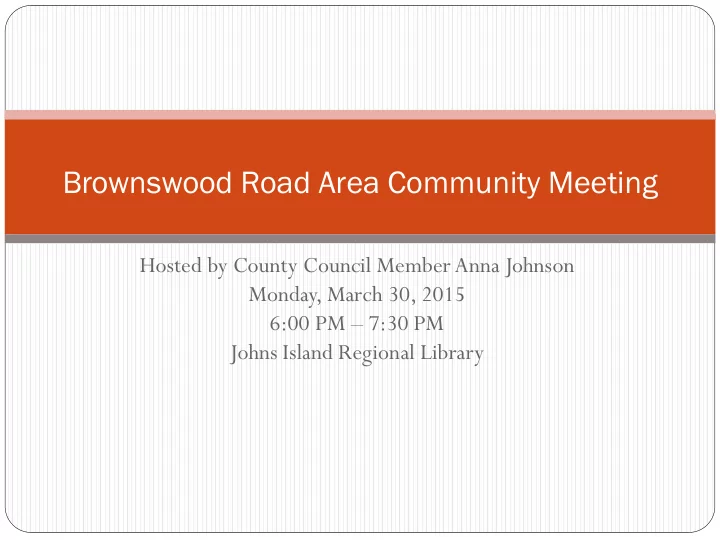
Hosted by County Council Member Anna Johnson Monday, March 30, 2015 6:00 PM – 7:30 PM Johns Island Regional Library
Brownswood Road Area Community Meeting
SLIDE 2 Agenda
Welcome and Introductions Meeting Purpose Background/History
Comprehensive Plan/Urban Growth Boundary Public facilities (well/septic, public water/sewer, etc.)
Questionnaire Next Steps Public Questions and Comments Adjourn
SLIDE 3 Meeting Purpose
As part of the recent adoption of the Charleston County
Comprehensive Plan Five-Year Review, County Council directed staff to work with the Brownswood Road Area Community to:
Gather input on the location of the Urban Growth Boundary (UGB) Investigate amendments to the Zoning and Land Development
Regulations Ordinance to allow properties located in the fringe area
- f the UGB more flexibility to develop at the higher end of the
currently established density range for the Rural Residential Future Land Use designation
SLIDE 4
SLIDE 5 Zoning Map March 25, 2015 Rural Area Density: 1 house/3 acres to 1 house per acre
SLIDE 6
Meeting Purpose (cont’d)
Gather input from the community regarding if/how growth
and development should occur:
Should growth and development occur in this area? If so, where? What type (single family, office, etc.)? How much? At what pace?
Information gathered will be presented to the Charleston
County Council and Planning Commission for consideration and direction
SLIDE 7
What is a Comprehensive Plan?
An expression of a community’s vision for its future It’s LAW! Serves as a guide for public policy decisions Authority granted by Article 3 of the SC Code of Laws, Title
6, Chapter 29, as amended
Describes the process, elements, and requirements for
comprehensive plans
SLIDE 8 History of Comprehensive Planning in Charleston Co.
April 20, 1999: County adopted its first Comprehensive Plan after a
two year long public planning process
Consolidated previously adopted area plans into one planning document
(61 Corridor, James Island, Johns Island, Edisto Island, Wadmalaw Island)
Established residential density guidelines by future land use
designations (future land use designations were implemented in the 2001 Unified Development Ordinance through new zoning districts)
Established the Suburban/Rural Area Edge (now known as
the Urban Growth Boundary or UGB) as a tool to delineate the Rural Area from the Urban/Suburban Area
SLIDE 9
SLIDE 10 April 20, 1999 Rural Area Density: 1 house/3 acres to 1 house per acre
SLIDE 11
History of Planning in Charleston Co.
(cont’d) November 18, 2003: County Council adopted the Five-Year
Review of the Plan, which included moving the Suburban/Rural Area Edge from its location on Brownswood Road to follow Fickling Hill/Patton Avenue and changing its location in the Plow Ground Road Area
Application to rezone 309 acres to the Planned Development
Zoning District (PD) was submitted (Brickman Farms)
Application to rezone approximately 54 acres to the S-3 Zoning
District was submitted
SLIDE 12 Future Land Use Map April 20, 1999 Rural Area Density: 1 house/3 acres to 1 house per acre
SLIDE 13 Future Land Use Map November 18, 2003 South of Fickling Hill Rd/ Patton Av to Brownswood Rd: Rural Area North of Fickling Hill Rd/ Patton Av: Urban/ Suburban Area Applications to rezone properties for the Brickman Farms Planned Development and a property on the north side of Old Pond Rd were
- submitted. Both were located in the
Urban/Suburban Area.
SLIDE 14
History of Planning in Charleston Co.
(cont’d) December 16, 2003: An application to move the Suburban/Rural
Area Edge back to its original location following Brownswood Road was submitted by a resident. This request was disapproved by County Council on April 20, 2004
May 3, 2004: A second application to move the Suburban/Rural
Area Edge back to its original location following Brownswood Road was submitted by a resident. This request was approved by County Council on October 5, 2004
SLIDE 15 History of Planning in Charleston Co.
(cont’d) November/December 2004: Brickman Farms PD and S-3
rezoning applications were approved by Council
Brickman Farms PD allowed 509 single family homes, 1.93 dwelling
units per acre, and 128 acres of open space
Note: In 2009, Council approved the request of the owner of Brickman
Farms to amend the PD to reduce the total number of dwelling units to 270 and increase the open space to 154 acres
SLIDE 16 Future Land Use Map November 18, 2003 South of Fickling Hill Rd/ Patton Av to Brownswood Rd: Rural Area North of Fickling Hill Rd/ Patton Av: Urban/ Suburban Area Applications to rezone properties for the Brickman Farms Planned Development and a property on the north side of Old Pond Rd were
- submitted. Both were located in the
Urban/Suburban Area.
SLIDE 17 Future Land Use Map October 5, 2004 Rural Area Density: 1 house/3 acres to 1 house per acre Applications to rezone properties for the Brickman Farms Planned Development and a property on the north side of Old Pond Rd were approved by Council in November/December 2004.
SLIDE 18
History of Planning in Charleston Co.
(cont’d)
November 18, 2008: County Council adopted the Ten-Year
Update of the Comprehensive Plan following a 14 month public planning process. No changes were made to the location of the Suburban/Rural Area Edge at that time; however, it was renamed the Urban Growth Boundary (UGB)
SLIDE 19 Future Land Use Map November 18, 2008/ January 6, 2015 Rural Area Density: 1 house/3 acres to 1 house per acre
SLIDE 20
History of Planning in Charleston Co.
(cont’d)
November 2012 – October 2014: The Charleston County
Planning Commission conducted the Five-Year Review of the Comprehensive Plan. One of the main focuses of the review was to refine the location of the Urban Growth Boundary (UGB) for consistency with the UGBs adopted by the City of Charleston and Town of Mount Pleasant, parcel boundaries, and geographic features
The owners of two properties located just north of Brownswood
Road asked the Planning Commission and Council to consider moving the UGB to follow the wetland/waterway system to the north of Brownswood Road
SLIDE 21
SLIDE 22
Alternative UGB Location Consideration (2013 - 2015 Five-Year Review)
If the UGB was changed, it would result in moving approximately 183
properties totaling 525 acres (147 unincorporated properties and 486 unincorporated acres) from the Rural Area to the Urban/Suburban Area
The current density of one dwelling unit per three acres allows
approximately 160 dwelling units in the unincorporated County; an Urban/Suburban Area density (four or more dwelling units per acre) could allow approximately 1,950 or more dwelling units in this area
The Planning Commission recommended keeping the UGB in its
current location following Brownswood Road and Council agreed
SLIDE 23 History of Planning in Charleston Co.
(cont’d)
January 6, 2015:
County Council adopted the Five-Year Review of the
Comprehensive Plan, which included keeping the UGB in its current location following Brownswood Road.
Council also directed staff to hold community meetings with the
residents along Brownswood Road to:
Gather input on the location of the UGB Investigate amendments to the Zoning and Land Development Regulations
Ordinance to allow properties located in the fringe area of the UGB more flexibility to develop at the higher end of the currently established density range for the Rural Residential Future Land Use designation
SLIDE 24 Future Land Use Map January 6, 2015 Rural Area Density: 1 house/3 acres to 1 house per acre
SLIDE 25
Zoning
The Rural Residential Future Land Use Designation is
implemented by the Rural Residential 3 Zoning District (RR-3)
Majority of the area between Brownswood Road and Main Road is
zoned RR-3
Maximum density: 1 dwelling unit per 3 acres Minimum lot area: 30,000 SF
SLIDE 26 Zoning Map March 25, 2015 Rural Area Density: 1 house/3 acres to 1 house per acre
SLIDE 27 Zoning Options (1 house per acre)
Processing an application to rezone to the Planned Development Zoning District
Write your own zoning (text and site plan) Adoption process (Planning Commission recommendation, Public Hearing, Council
approval)
Can be expensive; no guarantee of approval
Conservation Subdivision
Staff level approval process 1 house per 2 acres when 30% - 49.9% of site is conserved 1 house per acre when 50% + of site is conserved Flexibility to vary lot sizes and design a unique development Potential waterfront lot increases in proportion to increased waterfront setbacks
Other potential future options:
Allow up to 1 house per acre when public water and/or sewer are available Allow smaller minimum lot sizes and minimum setbacks when public water and/or
sewer are available
Additional ideas?
SLIDE 28
Public Facilities
The County does not have control over the provision of public
water and sewer service
The entities that do provide these services have their own
policies in effect which determine where these services can be provided
Public water: St. John’s Water Company Majority of this area utilizes septic tanks
SLIDE 29
Public Sewer Information
Charleston Water System – Kin Hill, P .E., CEO Berkeley-Charleston-Dorchester Council of Governments – Ron Mitchum, Executive Director
SLIDE 30
Questionnaire
Fill out the questionnaire and turn it in before leaving tonight or submitting it by mail or email no later than April 6
SLIDE 31
Next Steps
Staff will compile the results of the questionnaire,
present the information to Charleston County Council and Planning Commission for consideration and direction
Questionnaire results will be posted on the County’s website
May result in amendments to the Charleston County
Comprehensive Plan and/or Zoning and Land Development Regulations Ordinance
Additional community meetings
SLIDE 32
Public Questions and Comments
SLIDE 33
Thank you for attending tonight’s meeting! Contact information:
Council Member Anna Johnson: ajohnson@charlestoncounty.org (795-3970) Dan Pennick, AICP , Director: dpennick@charlestoncounty.org (202-7226) Joel Evans, AICP: jevans@charlestoncounty.org (202-7202) Andrea Pietras, AICP: apietras@charlestoncounty.org (202-7219)