Bringing Long-Tail Microscopy & Characterisation Data into the - - PowerPoint PPT Presentation

bringing long tail microscopy characterisation data into
SMART_READER_LITE
LIVE PREVIEW

Bringing Long-Tail Microscopy & Characterisation Data into the - - PowerPoint PPT Presentation

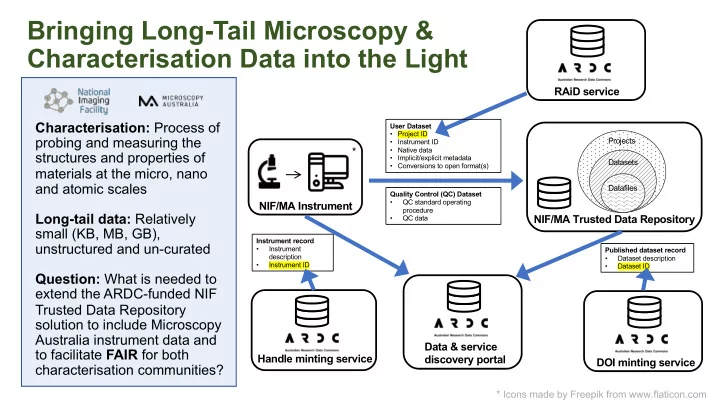
Bringing Long-Tail Microscopy & Characterisation Data into the Light RAiD service Characterisation: Process of User Dataset Project ID probing and measuring the Projects Instrument ID * Native data structures and properties


slide-1
SLIDE 1

NIF/MA Trusted Data Repository

Projects Datasets Datafiles

* NIF/MA Instrument

User Dataset

  • Project ID
  • Instrument ID
  • Native data
  • Implicit/explicit metadata
  • Conversions to open format(s)

Handle minting service

Quality Control (QC) Dataset

  • QC standard operating

procedure

  • QC data

Instrument record

  • Instrument

description

  • Instrument ID

Data & service discovery portal DOI minting service RAiD service

Published dataset record

  • Dataset description
  • Dataset ID

Bringing Long-Tail Microscopy & Characterisation Data into the Light

Characterisation: Process of probing and measuring the structures and properties of materials at the micro, nano and atomic scales Long-tail data: Relatively small (KB, MB, GB), unstructured and un-curated Question: What is needed to extend the ARDC-funded NIF Trusted Data Repository solution to include Microscopy Australia instrument data and to facilitate FAIR for both characterisation communities?

* Icons made by Freepik from www.flaticon.com

slide-2
SLIDE 2

Key issues

Flexible data model

Projects Datasets Datafiles

Catalogue metadata schemas and vocabularies

  • DCC list of Metadata Standards, RDA Metadata

Directory, FAIRsharing.org Standards…

  • USID, OME-XML, (EPS) Equipment Data Standard,

Directory Interchange Format, AODN Instrument vocabulary, Core Scientific Metadata Model (CSMD), …

Catalogue file types, metadata extraction tools and file conversion tools

  • 60+ instruments recorded to date
  • Visits to CMCA + ACMM in November

Data packaging standard

  • BagIt
  • DataCrate
  • RO-Crate

(Research Object Crate)

Standardised protocol for collecting quality data

  • V1.0 derived from

NIF Trusted Data Repository Project

Matrix of candidate repository platforms

  • MyTardis, Dspace,

CKAN, XNAT, 4Ceed/Clowder, IMS, OMERO, LORIS, …

Community-agreed licenses for data publishing

Findable:

  • PIDs and rich metadata for

projects (RAiD), datasets (DOI) and instruments (handle)

  • Data & Service Discovery

portal (RDA) Accessible:

  • Deposit of quality data into a

trusted data repository service (TruDat@UWA) Interoperable

  • Data packaging specification

for interoperability (Data Crate, RO-Crate) Reusable

  • Licenses for data publishing
  • Open data formats
slide-3
SLIDE 3
  • Most crucial information must be captured at the

project creation and data collection stages

  • Lack of open standards

Ø 100s to 1000s of hours wasted in finding and sharing data, converting between formats, seeking missing parameters and fixing missing values

  • Need to support a variety of data repository

platforms

  • Agree upon a common data packaging standard to

facilitate interoperability

Ø Metadata schemas and vocabularies Ø Tools for metadata extraction and data transformation

  • Cloud-based service for metadata extraction and file

conversion to open formats

  • PID services needed: RAiD (Project), DOI (Dataset),

ORCiD (User), Handle (Instrument)

Lessons learnt and findings to date

slide-4
SLIDE 4
  • 1. Microscopy Australia Data & Informatics Committee 2. National Imaging Facility Informatics Fellow

Project Team:

  • Andrew Mehnert1,2 (CMCA, UWA – Project Lead)
  • Roger Wepf1 (Director, CMM, UQ; Head, MA D&I Committee)
  • Aswin Narayanan2 (CAI, UQ)
  • Lisa Yen (Chief Operating Officer, MA, USyd)
  • Ryan Sullivan (eResearch Consultant, USyd)
  • Matt Foley1 (ACMM, USyd)
  • Abby Asomani (Library Information Specialist, UWA)
  • Mingfang Wu (ARDC)
  • Alexander Joos (CMCA, UWA)
  • Instrument managers and technique group leaders at

ACMM, CMM, CAI and CMCA

Acknowledgements