Breeding for nutritional traits in tomato using naturally occurring - - PowerPoint PPT Presentation

breeding for nutritional traits in tomato using naturally
SMART_READER_LITE
LIVE PREVIEW

Breeding for nutritional traits in tomato using naturally occurring - - PowerPoint PPT Presentation

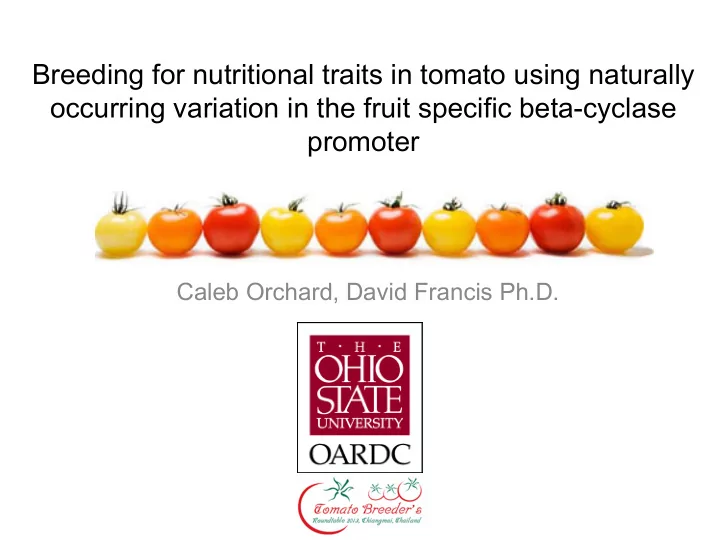
Breeding for nutritional traits in tomato using naturally occurring variation in the fruit specific beta-cyclase promoter Caleb Orchard, David Francis Ph.D. Kopec et al. 2012 Carotenoids in Tomato B Ronen et al. 2010 Does variation in the

slide-1
SLIDE 1

Breeding for nutritional traits in tomato using naturally

  • ccurring variation in the fruit specific beta-cyclase

promoter

Caleb Orchard, David Francis Ph.D.

slide-2
SLIDE 2
slide-3
SLIDE 3

Kopec et al. 2012

slide-4
SLIDE 4

Carotenoids in Tomato

slide-5
SLIDE 5

B

Ronen et al. 2010

slide-6
SLIDE 6

Does variation in the promoter of the B gene lead to different levels of beta-carotene in tomato fruit?

slide-7
SLIDE 7

Sources of variation

Juane Flammee – S. lycopersicum LA716 – S. pennellii 97L97 – S. cheesmanii

John R. Stommel. HortScience April 2001 vol. 36 no. 2 387-388

Does variation in the promoter of the B gene lead to different levels of beta-carotene in tomato fruit?

slide-8
SLIDE 8

Promoter Variation

slide-9
SLIDE 9

Promoter Variation

slide-10
SLIDE 10

Promoter Variation

2010 Dalal et al., BMC Plant Biology 2010, 10:61

slide-11
SLIDE 11

Population Development

Recurrent Parent

  • OH8245

Donor Parents

  • LA3501 (M-82)
  • LA3502 (M-82)
  • Juane Flammee

Recurrent Donor

  • Y. Eshed and D. Zamir. Genetics. 1995 November; 141(3): 1147–1162.

BC1 BC2 BC3

slide-12
SLIDE 12

SolCA lCAP SNP A Array rray

Sim S-C, Van Deynze A, Stoffel K, Douches DS, et al. (2012) High-Density SNP Genotyping of Tomato (Solanum lycopersicum L.) Reveals Patterns

  • f Genetic Variation Due to Breeding. PLoS ONE 7(9): e45520. doi:10.1371/journal.pone.0045520

http://www.plosone.org/article/info:doi/10.1371/journal.pone.0045520

slide-13
SLIDE 13

Marker Selection

slide-14
SLIDE 14

Marker Selection

slide-15
SLIDE 15

Marker Selection

slide-16
SLIDE 16

Marker Selection

slide-17
SLIDE 17

MAS

slide-18
SLIDE 18
slide-19
SLIDE 19

Distribution of Progeny vs. % Recurrent Genome in BC1

% Recurrent Parent Genome # of Progeny

Average RP Genome 75.50% Population 1 74.45% Population 2 76.00% Population 3 Selections: 84.9 – 89.6% (a generation ahead)

slide-20
SLIDE 20

Future work

/ BC2

slide-21
SLIDE 21

Conclusions

Multiple versions of fruit-specific beta-cyclase promoter Marker resources allow us to distinguish genetic backgrounds (M82 vs. OH8245, JF vs. OH8245) BGS facilitates selection of individuals one generation “ahead” each cycle

slide-22
SLIDE 22

Plant Genetic Resources for Human Health and Nutrition Research

slide-23
SLIDE 23
slide-24
SLIDE 24

Acknowledgements

  • Ohio State

– David Francis – Steven Schwartz – Sung-Chur Sim – Heather Merk – Nancy Huarachi – Troy Aldrich – Cassi Sewell – Rachel Kopec – Jessica Cooperstone

  • UC-Davis

– Allen Van Deynze – Kevin Stoffel – Alex Kozic

  • Michigan State

– David Douches – Robin Buell – John Hamilton – Dan Zarka – Kelly Zarka

  • Cornell

– Walter De Jong – Lucas Mueller

  • USDA-Beltsville

– John Stommel

slide-25
SLIDE 25

Thank you