SLIDE 1
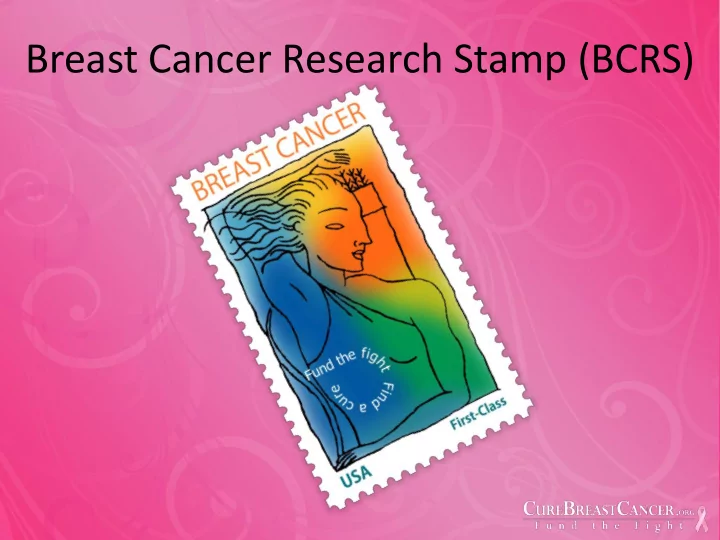
Breast Cancer Research Stamp (BCRS)
SLIDE 2 FACTS
- Introduced in the United States in 1997 after
two years of Congressional lobbying efforts.
- First ever fund-raising stamp issued in the
United States
- Sales to date exceed 950 million stamps
SLIDE 3 FACTS
- Research revenue to date exceed $79 million
- Sixteen other countries have issued the stamp
worldwide with many others in various stages
SLIDE 4 FACTS
- The image of the BCRS is available (free of
charge) to any country wishing to join the project.
All countries issuing the BCRS keep all the monies raised in the that country. In third world countries, where no research infrastructure exists, we encourage funds to be allocated for education, outreach and treatment.
SLIDE 5 Important Note
A primary concern is always about the selection of a ‘single cause’ or ‘single disease’ being “targeted”. While we are fighting breast cancer, in actuality we were fighting all
- diseases. The rational for this lies in the fact
that cancer research dollars from the stamp spent over the years have actually made advances in the field of Genomics and Nanotechnology.
SLIDE 6 Important Note
These two fields of research represent the key to the future diagnosis and treatment of all diseases (coronary artery disease, diabetes, hypertension, cancer, etc.) Genomics for precise genetic characterization of an individual’s disease process and nanotechnology for treatment (i.e. drug delivery systems, robotic repair at the cellular level, imaging technologies, etc.)
SLIDE 7
The bottom line is that the BRCS fights diseases on all fronts. Therefore, should someone ask for a “diabetes stamp”, we can truthfully say that we are devoting funds to that disease as well.
SLIDE 8
The Global Journey
Despite some wishful reports, breast cancer, worldwide, is on the rise. In the United States alone, the National Cancer Institute (NCI) predictions for the numerical increase in invasive breast cancers as the baby boom generation ages is expected to reach 480,000/year by 2017.
SLIDE 9
The Global Journey
While similar statistics are not available internationally, there is every reason to believe that such dramatic increases will be global.
SLIDE 10
The “Global Journey” is the name adopted for the introduction of Breast Cancer Research Stamp (BCRS) in all nations. The mission is predicated on the highly successful BCRS program initiated in the United States, by Congressional direction in 1998.
SLIDE 11
Since its inception, the BCRS has raised nearly $80 million through the sales of 950 million stamps.
SLIDE 12
In 1996 as I was preparing a lecture on the history of breast cancer a thought occurred – wouldn’t it be great to have a stamp addressing breast cancer – moments later – another thought…
The BCRS Story
SLIDE 13
… wouldn’t it be even better to have a postage stamp, priced slightly higher than a first-class stamp, with the extra monies raised directed to breast cancer research.
The BCRS Story
SLIDE 14 It made good sense, particularly in light of the fact that the cost of research has consistently
- increased. In the early 1990’s nearly 70% of
all research proposals received funding; by the early 2000’s less than 25% of all proposals were funded.
The BCRS Story
SLIDE 15
What if somewhere in that 75% of non-funded proposals would be the key – the one piece of information so crucial to a breakthrough – hidden in a non-funded proposal?
The BCRS Story
SLIDE 16
A quick analysis of the United States Postal Service (USPS) in 1996 revealed that 180 billion pieces of mail were handled, 1/3 of which were first class items utilizing a 32 cent stamp.
The BCRS Story
SLIDE 17
If half of those stamps were sold at 33 cents, $300 million would be generated annually, nearly equaling the entire National Cancer Institute’s budget for breast cancer research.
The BCRS Story
SLIDE 18
I contacted the Postmaster General about the idea and received a swift and terse reply – NO; this could not happen, as the USPS is not a fund raising organization. Furthermore, many other worthy causes would approach the USPS with similar requests – essentially opening a “Pandora’s Box.”
The BCRS Story
SLIDE 19
I quickly realized that it would take an Act of Congress to convince the USPS that this would be a worthwhile undertaking. I wrote to the 48 female Representatives and 11 female Senators in Congress.
The BCRS Story
SLIDE 20
Receiving not one reply, I purchased an airline ticket to Washington D.C. My mission: Find out why no one had responded to my inquiry
The BCRS Story
SLIDE 21 Interestingly, as I began to walk the halls of Congress, each and every legislative assistant for health care issues of the females addressed had a copy of my letter. Apparently my personal appearance made a difference; I was not just some “quack” with an outlandish
The BCRS Story
SLIDE 22
I did not want money – I did not want Congressional Districts lines to be redrawn to ensure a candidates victory – all I wanted was a fund-raising stamp to underwrite research for breast cancer.
The BCRS Story
SLIDE 23
Unbeknownst to myself, I became a lobbyist – and an effective one at that. Sadly, I admit I made several trips to my local library to read 8th grade civics books to learn how Congress works – how a Bill becomes Law.
The BCRS Story
SLIDE 24
It had often occurred to me that if someone of my fortunate position did not understand the laws of the land, how can one expect those less fortunate than myself to know anything of how the government works; how can they make an intelligent choice on issues of any importance?
The BCRS Story
SLIDE 25
In early 1996, after several trips to Washington, the first House Bill HR3401, was introduced by Representative Vic Fazio, the Senate version of the Bill S726 was introduced by Senator Dianne Feinstein.
The BCRS Story
SLIDE 26
1996 was an election year so Congress adjourned in early summer. All Bills introduced in that session, but not discussed on the “floor” were null. Our Bills were amongst the discarded, potential legislations.
The BCRS Story
SLIDE 27
The downtime between the summer of 1996 and the installation of a new regime in January, 1997 offered time to prepare a “strategic plan.” A plan was devised to return to Washington in 1997 and begin again.
The BCRS Story
SLIDE 28
Some 250,000 signatures were gathered and mailed to Congress, as a grassroots support efforts; numerous, prestigious organizations, including: The American College of Surgeons The National Cancer Registrars Association The American Medical Association were recruited to write letters of endorsement.
The BCRS Story
SLIDE 29 A series of new Bills were quickly introduced, again by Fazio and Feinstein, and later by Susan
- Molinari. On July 27th at 10 p.m. the gavel in
the House of Representatives was struck. I was sitting high in the viewing area of the House when the vote was tallied.
The BCRS Story
SLIDE 30
The Bill passed 422-3
The BCRS Story
SLIDE 31
The following day, Senator Feinstein introduced an identical Bill on the Senate floor where it passed unanimously. President Clinton signed the Bill into Law (PL 105-41) the following week.
The BCRS Story
SLIDE 32 Now we had a law and all we needed was a
- stamp. The USPS undertook the task of stamp
design engaging Whitney Sherman and Ethel Kessler.
The BCRS Story
SLIDE 33
The Stamp was unveiled in July 1998 at the Revlon Run/Walk for Breast/Ovarian Cancer in Los Angeles, California to a crowd of 60,000. And what a glorious event it was.
The BCRS Story
SLIDE 34
Since its unveiling, over 950,000,000 stamps have been sold, raising nearly $80 million for breast cancer research – it has become one of the highest selling stamps in history.
The BCRS Story
SLIDE 35
Nationally, it is one of the most popular stamps ever issued it definitely is the most powerful. Why? Because no other stamp, to my knowledge, can claim to have saved lives.
The BCRS Story
SLIDE 36 An anecdotal story involves a woman who had been in the audience of one of my previous
- lectures. She was inspired to by two sheets of
stamps, which she gave to her best friend. This friend had two daughters, aged 34 and 36, who each went to get a mammogram, spurred
The BCRS Story
SLIDE 37
The 34 year old turned out to have breast cancer – found by mammography – a lesion which would probably not have been detected for an additional 5-10 years by palpations. This stamp had literally saved her life.
The BCRS Story
SLIDE 38 Where do we stand now? Currently every two years we have to re- introduce the law to continue the BCRS. The Law is “Sun-Setted,” meaning, that the stamp is
- nly mandated for 2 years at a time.
The BCRS Story
SLIDE 39
Four extensions have made the stamp available through December 2012. Of course, we will return again for a further extension – hopefully a final Bill, which would grant the stamp a lifetime of invulnerability.
The BCRS Story
SLIDE 40
In addition, we have now begun the “Global Journey” introducing the stamp to the international community. No less than 77 countries have already expressed a major interest in pursuing such an endeavor.
The BCRS Story
SLIDE 41
We are allying our efforts with powerful, international personalities and corporations. Our goal is to fund the cure of breast cancer.
The BCRS Story
SLIDE 42
In October 2005, Hungary released the first- ever-international version of the BCRS. Belize released its version of the BCRS in October 2006.
The BCRS Story
SLIDE 43
Since then Austria, Croatia, El Salvador, France, Grenada, Italy, Kenya, Kosovo, Jordan, Macedonia, Micronesia, Serbia and The Gambia have also issued Breast Cancer Research Stamps.
The BCRS Story
SLIDE 44
Issued Stamps
SLIDE 45 1. Obtain/develop contacts in the following Ministries/offices
a. Ministry of Health b. Ministry of Finance c. Ministry of Communication/Transportation d. Postal Service of Your Country
2. Once the above have been obtained, simply have the Postal Service send a letter to Layne D. Owned, Stamp Services, USPS to
- btain the artwork (free of charge) for your country. (letter is
available by contacting Cure Breast Cancer, Inc or online at www.curebreastcancer.org
Steps Needed to Obtain The Breast Cancer Research Stamp For Your Country
SLIDE 46 3. Decide on the price you wish to charge and which institutions/organizations you wish to receive the extra monies. These can be research, education, outreach or treatment
4. REMEMBER: All the monies raised in your country stay in your country!!! Thank you
Steps Needed to Obtain The Breast Cancer Research Stamp For Your Country
SLIDE 47