Breast Health, Screening and Breast Cancer Prevention Presenter - - PowerPoint PPT Presentation

breast health screening and breast cancer prevention
SMART_READER_LITE
LIVE PREVIEW

Breast Health, Screening and Breast Cancer Prevention Presenter - - PowerPoint PPT Presentation

Breast Health, Screening and Breast Cancer Prevention Presenter name: Center for Community Outreach and Engagement Columbia University Herbert Irving Comprehensive Cancer Center What well be talking about today Breast cancer facts


slide-1
SLIDE 1

Presenter name: Center for Community Outreach and Engagement Columbia University Herbert Irving Comprehensive Cancer Center
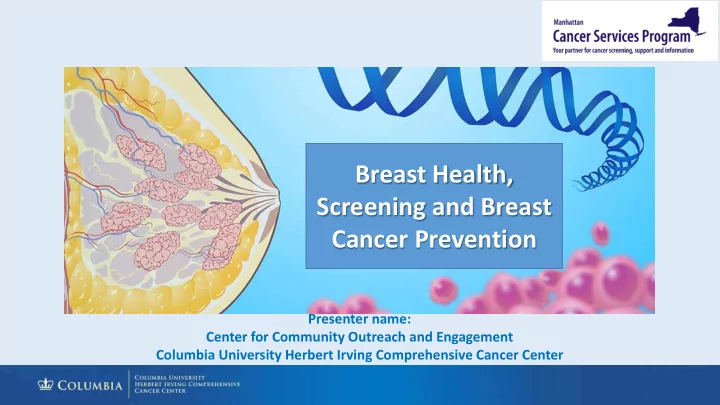
Breast Health, Screening and Breast Cancer Prevention

slide-2
SLIDE 2

What we’ll be talking about today…

  • Breast cancer facts
  • What is cancer? What causes it?
  • Breast anatomy – what’s inside of a breast?
  • What is breast cancer?
  • What is breast cancer risk?
  • How to reduce breast cancer risk
  • What is breast cancer screening?
  • Breast cancer screening guidelines based on risk
  • Additional information
slide-3
SLIDE 3

Important things to know about breast cancer

  • Breast cancer is the most common cancer in women in New York State (after skin cancer) and the

second most common cause of cancer death

  • Age differences: Over 75% of women who are diagnosed with breast cancer are age 50 or older.

Younger women (6%) get more aggressive types of breast cancer

  • Ethnic differences: Although Caucasian women have a slightly higher rate of breast cancer than

African American, African American women get it at younger ages than Caucasian women. Hispanic women have a lower rate but tend to get diagnosed with more advanced cancers

  • More women are surviving breast cancer in recent years due to 1) early detection, 2) finding breast

cancer before it spreads and 3) because of improvements in treatment

slide-4
SLIDE 4

What is cancer?

  • Cancer cells are damaged cells that can multiply without stopping, creating tumors that

can spread into other parts of the body.

slide-5
SLIDE 5

What causes cancer?

  • It is thought that a combination of harmful exposures in the environment, gene mutations

and lifestyle that can lead to cancer

  • There are hundreds of types of cancers and the causes of many of those cancers are still

unknown

slide-6
SLIDE 6

What is inside of a breast?

The female breast is made up mainly of: Lobules–the milk-producing glands Ducts–tiny tubes that carry the milk from the lobules to the nipple Stroma–fatty tissue and connective tissue surrounding the ducts and lobules, blood vessels, and lymphatic vessels

slide-7
SLIDE 7

Breast cancer most often begins with cell changes in the breast milk ducts and may grow and spread from there.

What is breast cancer?

Normal milk duct Non invasive cancer: Cancer cells stay inside the duct Invasive cancer: Cancer cells spread out

  • f the duct to other

parts of the breast

slide-8
SLIDE 8

Recognizing the signs and symptoms of breast cancer

  • The most common symptom is a lump
  • r mass in the breast
  • One breast suddenly larger or misshapen

as compared to the other (new breast asymmetry)

  • Bloody nipple discharge
  • Nipple inversion
  • Crusting around nipple
  • Redness, heat or swelling of the breast
  • Orange peel skin
slide-9
SLIDE 9

Something that can make you more likely to develop a condition, like breast cancer is called a risk factor.

slide-10
SLIDE 10

What risk factors can make someone more likely to develop breast cancer?

Older age

Obesity &

  • besity after

menopause

Inherited gene mutation Lack of exercise Birth after 30 Drinking Alcohol Unhealthy diet Breast density

Breast cancer in self/family

slide-11
SLIDE 11

Who is at high risk for breast cancer?

Women known to be at high risk for breast cancer have; 1) genetic mutations 2) previous breast cancer 3) family history of breast cancer

slide-12
SLIDE 12
  • Learn your family history of breast

cancer and share with doctors

  • Get regular screening- mammograms

There is no sure way to prevent breast cancer but there are lifestyle changes all women can make to reduce their breast cancer risk

slide-13
SLIDE 13

What is breast cancer screening?

  • Breast cancer screening with a mammogram looks for

changes in the breast over time

  • If the screening test identifies a problem, more testing may

be needed

  • A mammogram may find cancer before someone can feel a

lump or have any signs or symptoms of the disease

slide-14
SLIDE 14

American Cancer Society recommendations for breast cancer screening for average risk

Age 40-44 years Discuss with doctor on when to begin screening Age 45 to 54 years Have a mammogram every year 55 years and

  • lder

Have a mammogram every other year

slide-15
SLIDE 15

Mammogram

  • A 2D digital mammogram is a low

dose x-ray of the breast

  • The breast is pressed between 2

plates to flatten and spread the tissue for better visualization of the structures

  • This produces an image most often

seen on a computer screen

slide-16
SLIDE 16

How to prepare for a mammogram

  • Do not use deodorants or body powders on the day of the

mammogram

  • Wear two piece clothing
  • Make a mammogram appointment the week after your

menstrual period

slide-17
SLIDE 17

Regular screening with mammogram is important because…

  • It can find breast cancer early, before it has had time to spread

which means:

  • the cancer is easier to treat
  • it reduces the risk of dying from breast cancer
slide-18
SLIDE 18

What is mammographic breast density?

  • Mammographic breast density is a measure used to describe the amount of glandular and

connective tissue in the breast as compared with fat

  • High breast density finds a greater amount of glandular and connective tissue compared to

fat.

  • Low breast density finds a greater amount of fat compared to breast and connective tissue.
  • Breast density does NOT describe how a breast feels to touch
  • Higher breast density is linked to an increased breast cancer risk
slide-19
SLIDE 19

What does mammographic breast density look like?

slide-20
SLIDE 20

Recommendations for women at high risk for breast cancer

Women at high risk for breast cancer include those with a family or personal history, genetic mutation for the breast cancer genes BRCA 1 and BRCA2. They should speak with their doctor about:

  • Screening with mammography before age 40
  • Getting additional breast imaging with breast ultrasound or MRI
  • Genetic counseling and testing
  • Referral to high risk clinic to talk further with doctors
slide-21
SLIDE 21

Breast ultrasound

  • A breast ultrasound is used to see whether

a breast lump is filled with fluid (a cyst) or if it is a solid mass

  • An ultrasound is used in women with

mammographic breast density

slide-22
SLIDE 22

Breast MRI (Magnetic Resonance Imaging)

  • An MRI uses magnets and radio waves to image organs of the body. A breast MRI is

most commonly used once breast cancer is diagnosed to determine spread of disease. The benefits and risks of screening high risk women with breast MRI is still being studied.

slide-23
SLIDE 23

Genetic counseling and family history

  • Women who have close family members diagnosed with breast

cancer, and who have themselves been diagnosed with breast cancer can benefit from consultation with a genetic counselor

  • The counselor will chart who in the family has been diagnosed with

breast cancer and determine the level of risk for the women developing breast cancer. Women at high risk will be recommended for genetic testing

23

slide-24
SLIDE 24

Genetic testing

  • Genetic testing, done by providing a small blood sample
  • The genes in the blood sample are tested for known genetic mutations

such as BRCA 1 and BRCA2

  • Women with either of these BRCA mutations receive more counselling

and consultation to decide if risk lowering breast surgery is appropriate

  • These women can also be enrolled into high risk clinics and be monitored

more frequently

24

slide-25
SLIDE 25

Free cancer screening for uninsured New Yorkers

Manhattan Cancer Services Program New York Presbyterian, Columbia University Medical Center

212.851.4516

slide-26
SLIDE 26

To call for genetic counseling/testing

Columbia Doctors Genetic Counseling

212-305-6731

slide-27
SLIDE 27

THANK YOU What are your questions?